 Add to Chrome
 Add to Firefox
 Add to Edge
BrainWAM: Action-Space Coordination of Semantic Priors and Predictive Dynamics for Autonomous Driving
Aug 13, 2026
Autonomous driving requires planning under both semantic constraints and predictive dynamics. Existing end-to-end driving approaches, however, typically emphasize only one side of this requirement: Vision-Language-Action (VLA) models exploit VLM priors for semantic reasoning, while World Action Models (WAMs) provide future-aware prediction through generative world modeling. This naturally motivates a unified planner that can leverage both semantic priors and predictive dynamics. However, we find that a naive combination through joint token-level attention suffers from an attention-allocation mismatch, where semantic shortcuts dominate the shared attention space and suppress predictive dynamics. Inspired by neuroscience evidence that complex behavior arises from coordination among functionally specialized systems, we propose BrainWAM, a structured action-space coordination framework that converts semantic reasoning and predictive world modeling into two specialized action-oriented pathways, and aligns them at the level of compact action representations. We further introduce an asynchronous rectified-flow inference strategy with decoupled video and action denoising, which shortens inference latency while preserving planning-relevant predictive context. BrainWAM reaches state-of-the-art performance on both NAVSIM v1 (89.5 PDMS) and NAVSIM v2 (89.6 EPDMS), consistently outperforming VLA-only or WAM-only methods, highlighting BrainWAM as a practical and promising direction for autonomous driving systems.

An Automated Framework for Extracting Reachable Attack Chains from Cyber Threat Intelligence Reports
Jul 22, 2026Cyber Threat Intelligence (CTI) reports richly describe real-world attack processes, but their unstructured narratives cannot be directly used for automated attack-path reasoning. Existing CTI extraction methods focus on indicators, entities, or TTP labels without modeling the execution conditions and resulting states of each attack step, so the extracted knowledge supports neither state matching nor reachability analysis across multi-stage attack chains. This paper proposes an automated framework that extracts reachable attack chains by modeling each attack step as an attack unit of preconditions, an attack behavior, and postconditions. A multi-stage pipeline assisted by large language models (LLMs) extracts attack behavior skeletons, recovers their preconditions and postconditions, normalizes them into predefined predicates, and repairs broken dependencies; the resulting units are compiled into Datalog-style rules for attack-goal reachability reasoning. On a dataset of 20 CTI reports containing 334 human-validated annotated steps, our framework achieves higher annotated-step coverage than representative CTI extraction systems in recovering attack behaviors. Moreover, by explicitly generating preconditions and postconditions, it produces attack units that are more complete and consistent than those generated by end-to-end LLM baselines. On the extracted chains, Datalog inference reaches the specified attack goal in 19 of 20 reports, while backward search yields 34 attack paths under the generated rules. The source code and experimental artifacts are available in an anonymized repository. .
$G^2$-Reader: Dual Evolving Graphs for Multimodal Document QA
Jan 29, 2026Retrieval-augmented generation is a practical paradigm for question answering over long documents, but it remains brittle for multimodal reading where text, tables, and figures are interleaved across many pages. First, flat chunking breaks document-native structure and cross-modal alignment, yielding semantic fragments that are hard to interpret in isolation. Second, even iterative retrieval can fail in long contexts by looping on partial evidence or drifting into irrelevant sections as noise accumulates, since each step is guided only by the current snippet without a persistent global search state. We introduce $G^2$-Reader, a dual-graph system, to address both issues. It evolves a Content Graph to preserve document-native structure and cross-modal semantics, and maintains a Planning Graph, an agentic directed acyclic graph of sub-questions, to track intermediate findings and guide stepwise navigation for evidence completion. On VisDoMBench across five multimodal domains, $G^2$-Reader with Qwen3-VL-32B-Instruct reaches 66.21\% average accuracy, outperforming strong baselines and a standalone GPT-5 (53.08\%).
PointFlowHop: Green and Interpretable Scene Flow Estimation from Consecutive Point Clouds
Feb 27, 2023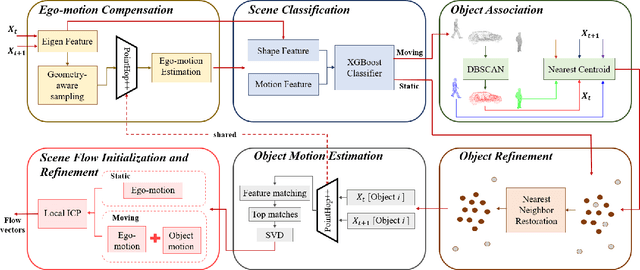
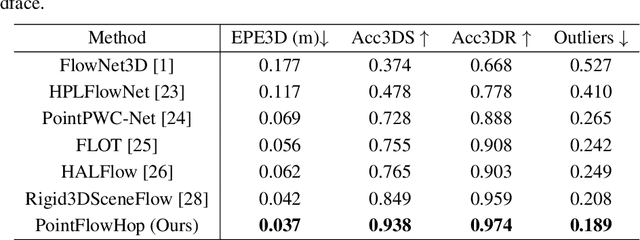
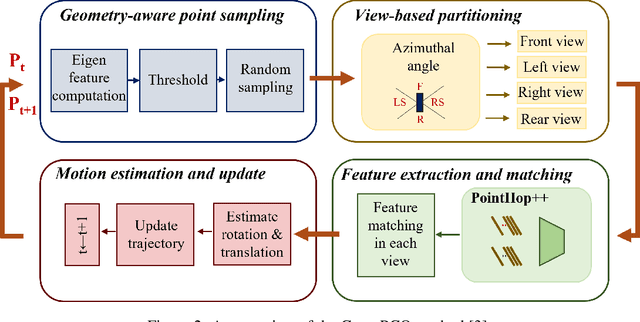
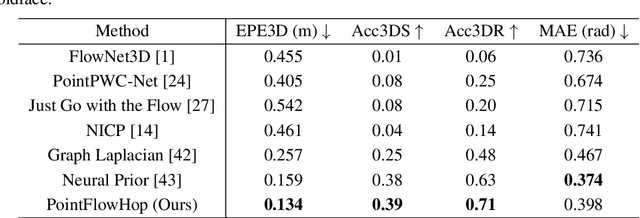
An efficient 3D scene flow estimation method called PointFlowHop is proposed in this work. PointFlowHop takes two consecutive point clouds and determines the 3D flow vectors for every point in the first point cloud. PointFlowHop decomposes the scene flow estimation task into a set of subtasks, including ego-motion compensation, object association and object-wise motion estimation. It follows the green learning (GL) pipeline and adopts the feedforward data processing path. As a result, its underlying mechanism is more transparent than deep-learning (DL) solutions based on end-to-end optimization of network parameters. We conduct experiments on the stereoKITTI and the Argoverse LiDAR point cloud datasets and demonstrate that PointFlowHop outperforms deep-learning methods with a small model size and less training time. Furthermore, we compare the Floating Point Operations (FLOPs) required by PointFlowHop and other learning-based methods in inference, and show its big savings in computational complexity.