 Add to Chrome
 Add to Firefox
 Add to Edge
Xetrieval: Mechanistically Explaining Dense Retrieval
May 28, 2026
Explaining why dense retrievers assign high relevance scores remains challenging because retrieval decisions are made through opaque high-dimensional embeddings. Existing explanations often focus on surface signals, such as lexical matches, token alignments, or post-hoc textual rationales, and thus provide limited insight into the latent factors that shape dense retrieval behavior at the embedding level. We propose \textit{Xetrieval}, an embedding-level mechanistic framework for explaining dense retrieval. \textit{Xetrieval} first introduces a lightweight reasoning internalizer that approximates Chain-of-Thought reasoning directly in the embedding space with a single forward pass, enriching sentence embeddings with reasoning-oriented information while avoiding expensive autoregressive generation. It then decomposes these reasoning-enhanced embeddings into sparse, human-interpretable features, each associated with a coherent natural language description. By aggregating sparse feature overlaps across multiple document-side views, \textit{Xetrieval} provides feature-level explanations of individual retrieval decisions. Experiments on diverse retrievers and benchmarks show that \textit{Xetrieval} uncovers coherent interpretable features, yields stronger pair-level intervention effects, and supports task-level feature steering. The project page and source code are available at https://hihiczx.github.io/Xetrieval .

Omni-WorldBench: Towards a Comprehensive Interaction-Centric Evaluation for World Models
Mar 23, 2026Video--based world models have emerged along two dominant paradigms: video generation and 3D reconstruction. However, existing evaluation benchmarks either focus narrowly on visual fidelity and text--video alignment for generative models, or rely on static 3D reconstruction metrics that fundamentally neglect temporal dynamics. We argue that the future of world modeling lies in 4D generation, which jointly models spatial structure and temporal evolution. In this paradigm, the core capability is interactive response: the ability to faithfully reflect how interaction actions drive state transitions across space and time. Yet no existing benchmark systematically evaluates this critical dimension. To address this gap, we propose Omni--WorldBench, a comprehensive benchmark specifically designed to evaluate the interactive response capabilities of world models in 4D settings. Omni--WorldBench comprises two key components: Omni--WorldSuite, a systematic prompt suite spanning diverse interaction levels and scene types; and Omni--Metrics, an agent-based evaluation framework that quantifies world modeling capabilities by measuring the causal impact of interaction actions on both final outcomes and intermediate state evolution trajectories. We conduct extensive evaluations of 18 representative world models across multiple paradigms. Our analysis reveals critical limitations of current world models in interactive response, providing actionable insights for future research. Omni-WorldBench will be publicly released to foster progress in interactive 4D world modeling.
ASGEA: Exploiting Logic Rules from Align-Subgraphs for Entity Alignment
Feb 16, 2024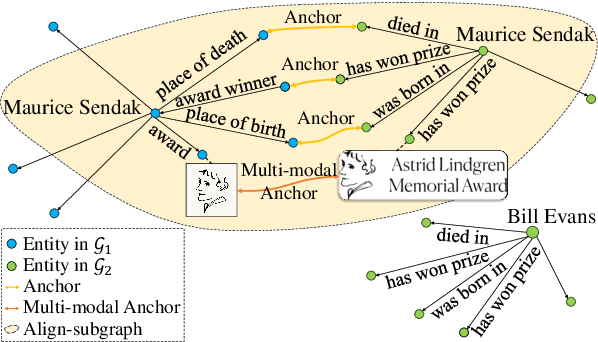
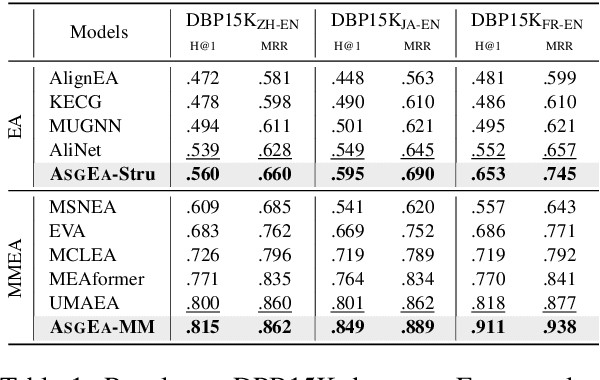
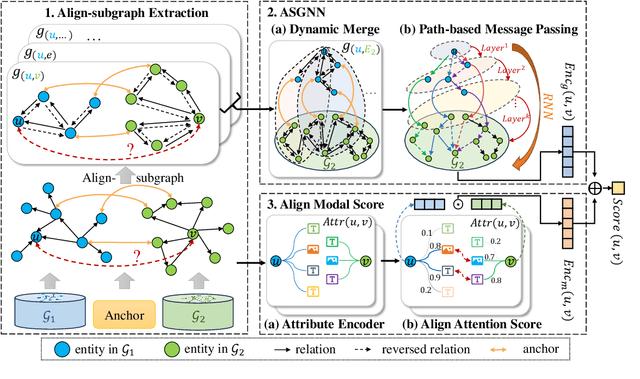
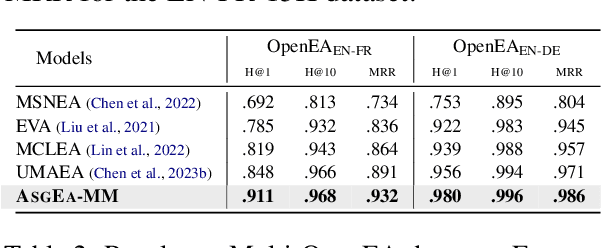
Entity alignment (EA) aims to identify entities across different knowledge graphs that represent the same real-world objects. Recent embedding-based EA methods have achieved state-of-the-art performance in EA yet faced interpretability challenges as they purely rely on the embedding distance and neglect the logic rules behind a pair of aligned entities. In this paper, we propose the Align-Subgraph Entity Alignment (ASGEA) framework to exploit logic rules from Align-Subgraphs. ASGEA uses anchor links as bridges to construct Align-Subgraphs and spreads along the paths across KGs, which distinguishes it from the embedding-based methods. Furthermore, we design an interpretable Path-based Graph Neural Network, ASGNN, to effectively identify and integrate the logic rules across KGs. We also introduce a node-level multi-modal attention mechanism coupled with multi-modal enriched anchors to augment the Align-Subgraph. Our experimental results demonstrate the superior performance of ASGEA over the existing embedding-based methods in both EA and Multi-Modal EA (MMEA) tasks. Our code will be available soon.