 Add to Chrome
 Add to Firefox
 Add to Edge
Stay or Switch: Online Conformal Bayesian Optimization Guided Fluid Antenna Configuration
Jul 29, 2026
Fluid antenna systems (FAS) introduce additional spatial degrees of freedom to enable integrated sensing and communication (ISAC) in air-ground networks. However, conventional studies often overlook or simplify the physical overheads and switching costs of FAS. In practice, port switching incurs non-negligible time, during which communication and sensing may continue but with potentially degraded slot-level performance. This leads to two key challenges: (1) the characterization of a slot-level, cost-aware ISAC metric is difficult, and (2) the large port space and accompanying abrupt environmental variations demand more reliable online decision-making. To address these challenges, a cost-aware multi-objective FAS switching problem is formulated, jointly considering slot-level ISAC performance and switching energy. The online conformal Bayesian optimization (OCBO) algorithm is then proposed to learn the unknown gray-box ISAC objectives and calibrate surrogate uncertainty for robust stay-or-switch decisions. Simulation results demonstrate that the proposed cost-aware optimization framework achieves substantially improved long-term ISAC performance compared to existing baselines.

Radio Map Updating from Streaming Spectrum Measurements via Memory-Based Online Gaussian Processes
Jul 20, 2026Radio maps, which estimate spatial radio-frequency characteristics from spectrum measurements, are essential for applications such as spectrum management and network planning. With the continuous arrival of spectrum measurements, conventional batch processing methods for radio map reconstruction become computationally prohibitive, as they require reprocessing all accumulated measurements for each radio map update. To address this, we propose a memory-based online sparse variational Gaussian process (M-OSVGP) method that efficiently updates radio maps from streaming spectrum measurements. Our method employs sparse variational inference and updates the posterior online by minimizing a hybrid objective that integrates newly received measurements and a memory subset of previous ones to mitigate catastrophic forgetting. To further improve posterior approximation as measurements accumulate over spatially diverse regions, we extend M-OSVGP with a grid-assisted online inducing point selection (GOIPS) algorithm. GOIPS dynamically adapts the number and locations of inducing points based on measurement density and spatial correlation, providing a more informative inducing set while maintaining computational efficiency. Extensive simulations demonstrate the effectiveness of our proposed methods in reconstruction accuracy, computational efficiency, and uncertainty quantification, compared to existing batch and online baselines across various scenarios.
Sensing-Native Over-the-Air Federated Learning
Jun 15, 2026Over-the-air federated learning (FL) leverages the superposition property of multiple-access channels to enable communication-efficient distributed model training. Existing integrated sensing, communication, and computation (ISCC)-enabled over-the-air FL systems typically require dedicated resources for the sensing module, inevitably compromising FL performance due to resource competition. In this paper, we propose a sensing-native over-the-air FL framework that explores built-in distributed wireless sensing capability with zero overhead per model aggregation. Specifically, the high-dimensional local gradient signals possessing favorable autocorrelation property are concurrently leveraged for target distance estimation, while the gradient statistics already required for over-the-air FL serve as a ready-made gateway to deliver locally-sensed results to the edge server for cooperative localization. To combat inter-device interference, channel fading, and communication noise, we put forth a robust trilateration-based target positioning method building upon an efficient matched-filtering-based distance estimation. Then, by explicitly characterizing the impact of imperfect model aggregation and noisy gradient-statistics transmission on the sensing-native over-the-air FL convergence, we develop a statistics-aware communication-learning co-design approach. We first derive the closed-form optimal power budgets allocated to local gradients and their statistics, based on which an efficient successive convex approximation method is proposed for receiver beamforming optimization. Simulation results show that the proposed framework simultaneously achieves superior learning and sensing performance compared to representative baselines.
Distortion-Aware UAV Placement for Aerial Semantic Relay Communications: An Analytical Approach
May 31, 2026Aerial semantic relay communications (SRC) employs an unmanned aerial vehicle (UAV) equipped with a semantic encoder as a relay, which not only extends the data acquisition coverage of the base station (BS) from resource-limited sensing device (SD) but also enhances communication efficiency through semantic feature transmission over the UAV-BS link. Existing works mainly focus on sum-rate maximization, overlooking the end-to-end reconstruction distortion of sensory data in UAV-assisted SRC systems. Optimizing the UAV placement is crucial for minimizing the end-to-end reconstruction distortion, as it fundamentally trades off the input perturbation at the UAV-side encoder against that at the BS-side decoder through the two-hop wireless channel conditions. In this paper, we propose an interpretable and efficient UAV placement policy by minimizing end-to-end reconstruction distortion in aerial SRC. This is a challenging task since the black-box nature of the DNN-based codecs and the intricate coupling between the heterogeneous codec sensitivities, along with two-hop channel impairments, render the end-to-end distortion analytically intractable to characterize. We first derive an analytical expression of the end-to-end distortion, explicitly revealing the impact of cross-hop perturbation coupling, wireless channel and radio resource on the reconstruction error. Based on that, we develop a closed-form UAV placement strategy with fast adaptability across various aerial SRC system configurations. Numerical results demonstrate that the proposed distortion-aware UAV deployment closely tracks the empirical exhaustive-search optimum, while achieving lower distortion compared to representative capacity-based and curve-fitting benchmarks.
Grey-Box Bayesian Optimization for ISAC in Fluid-Antenna Assisted Air-Ground Network
Apr 02, 2026Fluid antenna systems (FAS) provide extra position agile spatial diversity for integrated sensing and communication (ISAC), by jointly optimizing the port selection and precoding. However, this optimization is challenging in air ground networks due to the intricate dual objective Pareto frontier, complex self-interference, and prohibitive channel state information overhead. To overcome these bottlenecks, this work proposes a novel grey box multi objective Bayesian optimization framework to address the joint design of discrete port selection and ISAC precoding. Unlike black box methods, this architecture explicitly leverages known physical system models to learn unknown channel constituents, dramatically reducing sample complexity. To navigate high dimensional combinatorial spaces, an adaptive trust region mechanism powered by expected hypervolume improvement (EHI) acquisition is implemented. Furthermore, the framework incorporates a spatio-temporal tracking strategy to handle the continuous mobility of users and targets, robustly capturing the drifting optimum in time varying environments. Simulations demonstrate that this framework achieves significantly faster convergence and discovers superior Pareto optimal configurations, validating its efficiency for dynamic real time FAS-ISAC deployments.
Robust MIMO Semantic Communication with Imperfect CSI via Knowledge Distillation
Sep 04, 2025Semantic communication (SemComm) has emerged as a new communication paradigm. To enhance efficiency, multiple-input-multiple-output (MIMO) technology has been further integrated into SemComm systems. However, existing MIMO SemComm systems assume perfect channel matrix estimation for channel-adaptive joint source-channel coding, which is impractical due to hardware and pilot overhead constraints. In this paper, we propose a semantic image transmission system with channel matrix and channel noise adaptation, named HANA-JSCC, to cope with channel estimation errors in MIMO systems. We propose a channel matrix adaptor that collaborates with the channel codec to adapt to misaligned channel state information, thereby mitigating the impact of estimation errors. Since the relationship between the estimated channel matrix and true channel matrix is ill-posed (one-to-many), we further introduce a two-stage training strategy with knowledge distillation to overcome the convergence difficulties caused by the ill-posed problem. Comparing with the state-of-the-art benchmarks, HANA-JSCC achieves $0.40\sim0.54$dB higher average performance across various noise and estimation error levels in various datasets.
Confidence-Aware Multi-Field Model Calibration
Feb 27, 2024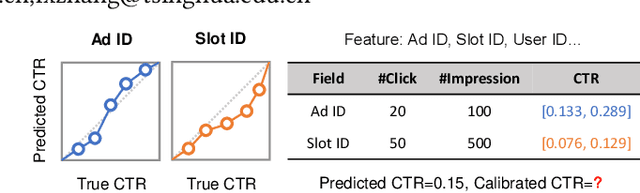
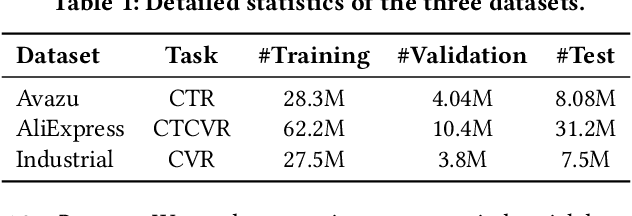

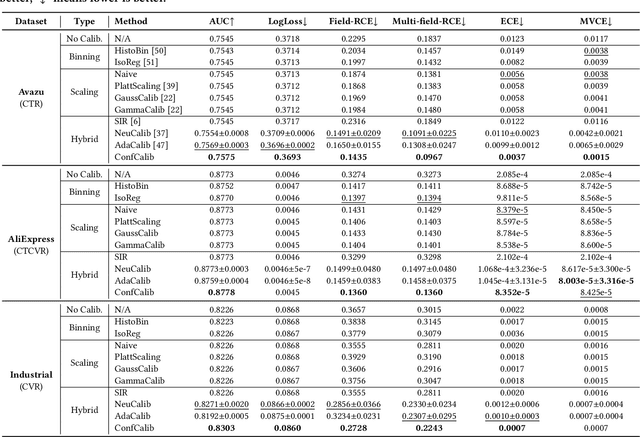
Accurately predicting the probabilities of user feedback, such as clicks and conversions, is critical for ad ranking and bidding. However, there often exist unwanted mismatches between predicted probabilities and true likelihoods due to the shift of data distributions and intrinsic model biases. Calibration aims to address this issue by post-processing model predictions, and field-aware calibration can adjust model output on different feature field values to satisfy fine-grained advertising demands. Unfortunately, the observed samples corresponding to certain field values can be too limited to make confident calibrations, which may yield bias amplification and online disturbance. In this paper, we propose a confidence-aware multi-field calibration method, which adaptively adjusts the calibration intensity based on the confidence levels derived from sample statistics. It also utilizes multiple feature fields for joint model calibration with awareness of their importance to mitigate the data sparsity effect of a single field. Extensive offline and online experiments show the superiority of our method in boosting advertising performance and reducing prediction deviations.
Differentially Private Over-the-Air Federated Learning Over MIMO Fading Channels
Jun 19, 2023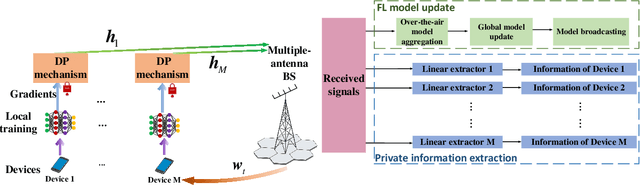
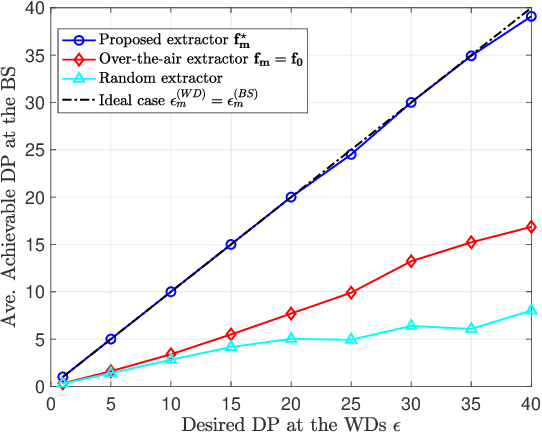
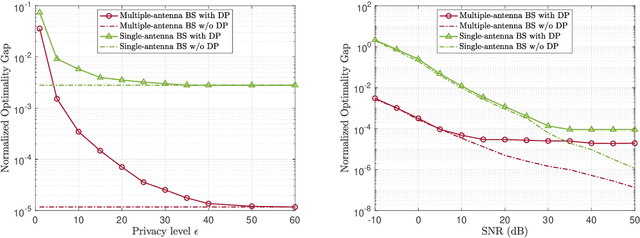

Federated learning (FL) enables edge devices to collaboratively train machine learning models, with model communication replacing direct data uploading. While over-the-air model aggregation improves communication efficiency, uploading models to an edge server over wireless networks can pose privacy risks. Differential privacy (DP) is a widely used quantitative technique to measure statistical data privacy in FL. Previous research has focused on over-the-air FL with a single-antenna server, leveraging communication noise to enhance user-level DP. This approach achieves the so-called "free DP" by controlling transmit power rather than introducing additional DP-preserving mechanisms at devices, such as adding artificial noise. In this paper, we study differentially private over-the-air FL over a multiple-input multiple-output (MIMO) fading channel. We show that FL model communication with a multiple-antenna server amplifies privacy leakage as the multiple-antenna server employs separate receive combining for model aggregation and information inference. Consequently, relying solely on communication noise, as done in the multiple-input single-output system, cannot meet high privacy requirements, and a device-side privacy-preserving mechanism is necessary for optimal DP design. We analyze the learning convergence and privacy loss of the studied FL system and propose a transceiver design algorithm based on alternating optimization. Numerical results demonstrate that the proposed method achieves a better privacy-learning trade-off compared to prior work.
TDACNN: Target-domain-free Domain Adaptation Convolutional Neural Network for Drift Compensation in Gas Sensors
Oct 15, 2021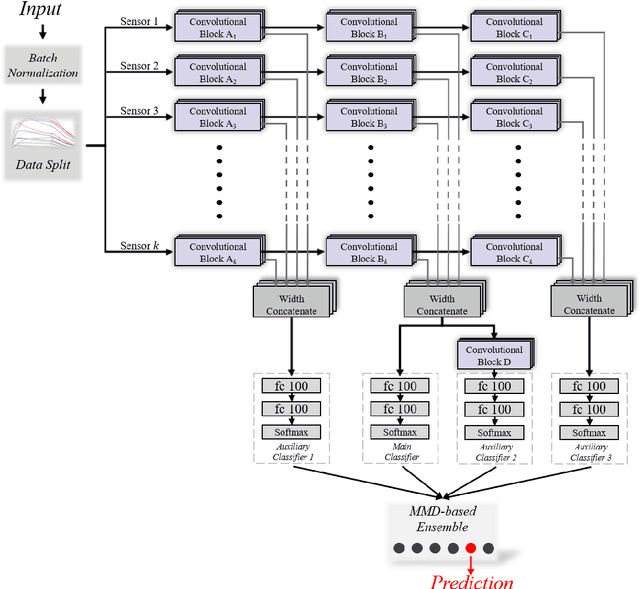
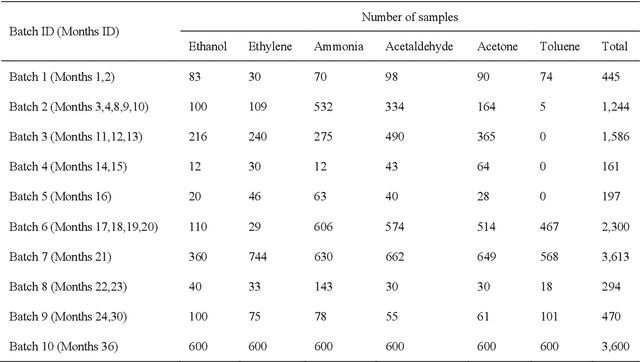
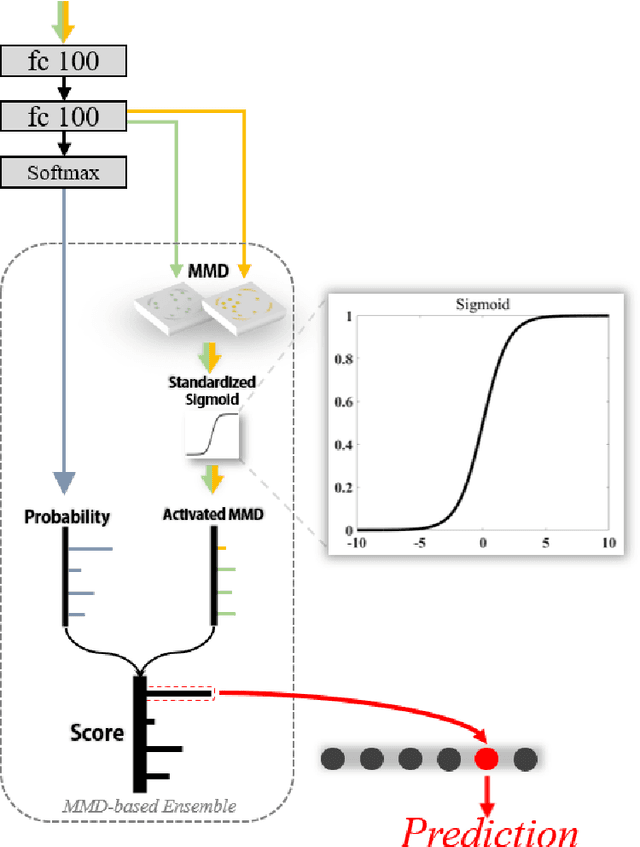

Sensor drift is a long-existing unpredictable problem that deteriorates the performance of gaseous substance recognition, calling for an antidrift domain adaptation algorithm. However, the prerequisite for traditional methods to achieve fine results is to have data from both nondrift distributions (source domain) and drift distributions (target domain) for domain alignment, which is usually unrealistic and unachievable in real-life scenarios. To compensate for this, in this paper, deep learning based on a target-domain-free domain adaptation convolutional neural network (TDACNN) is proposed. The main concept is that CNNs extract not only the domain-specific features of samples but also the domain-invariant features underlying both the source and target domains. Making full use of these various levels of embedding features can lead to comprehensive utilization of different levels of characteristics, thus achieving drift compensation by the extracted intermediate features between two domains. In the TDACNN, a flexible multibranch backbone with a multiclassifier structure is proposed under the guidance of bionics, which utilizes multiple embedding features comprehensively without involving target domain data during training. A classifier ensemble method based on maximum mean discrepancy (MMD) is proposed to evaluate all the classifiers jointly based on the credibility of the pseudolabel. To optimize network training, an additive angular margin softmax loss with parameter dynamic adjustment is utilized. Experiments on two drift datasets under different settings demonstrate the superiority of TDACNN compared with several state-of-the-art methods.
A framework for massive scale personalized promotion
Aug 27, 2021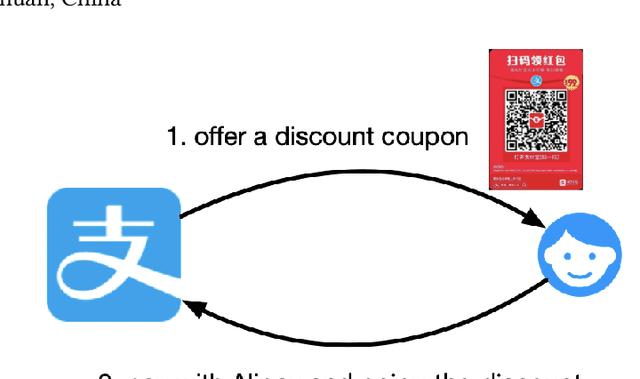
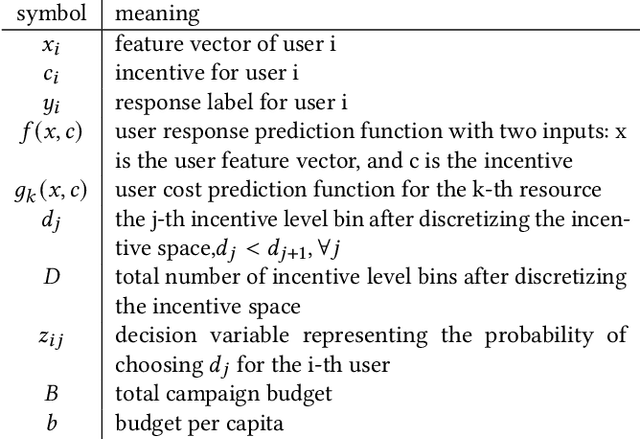
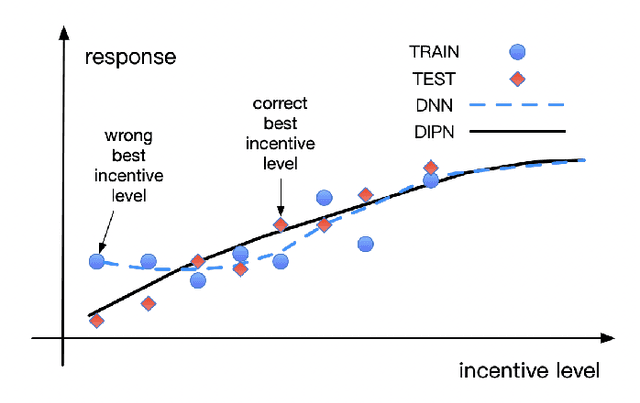
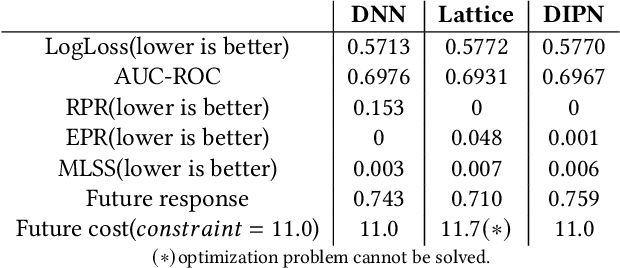
Technology companies building consumer-facing platforms may have access to massive-scale user population. In recent years, promotion with quantifiable incentive has become a popular approach for increasing active users on such platforms. On one hand, increased user activities can introduce network effect, bring in advertisement audience, and produce other benefits. On the other hand, massive-scale promotion causes massive cost. Therefore making promotion campaigns efficient in terms of return-on-investment (ROI) is of great interest to many companies. This paper proposes a practical two-stage framework that can optimize the ROI of various massive-scale promotion campaigns. In the first stage, users' personal promotion-response curves are modeled by machine learning techniques. In the second stage, business objectives and resource constraints are formulated into an optimization problem, the decision variables of which are how much incentive to give to each user. In order to do effective optimization in the second stage, counterfactual prediction and noise-reduction are essential for the first stage. We leverage existing counterfactual prediction techniques to correct treatment bias in data. We also introduce a novel deep neural network (DNN) architecture, the deep-isotonic-promotion-network (DIPN), to reduce noise in the promotion response curves. The DIPN architecture incorporates our prior knowledge of response curve shape, by enforcing isotonicity and smoothness. It out-performed regular DNN and other state-of-the-art shape-constrained models in our experiments.