 Add to Chrome
 Add to Firefox
 Add to Edge
GraphThink: Graph-Enhanced LLM Thinking for Long-Horizon Embodied Task Planning
Aug 08, 2026
Embodied agents using LLM-based planners often struggle with physical hallucinations, poor generalization to long-horizon tasks, and lack of environmental awareness. We propose GraphThink, a novel framework that integrates a task graph to provide structured knowledge for robust planning and a scene graph to maintain environmental memory for event-driven replanning. Specifically, the task graph guides LLM thinking through contextual prompting and iterative refinement, effectively mitigating planning hallucinations. Furthermore, within the GRPO framework, the task graph offers delicate reward design to train the LLM planner, enhancing long-horizon planning capabilities and improving generalization. Finally, an event-driven replanning module, powered by the scene graph, enables closed-loop environment awareness and error correction. GraphThink achieves state-of-the-art performance on the ALFRED benchmark. In particular, our high-level planner surpasses leading API-based LLMs on both the validation set and held-out long-horizon tasks, underscoring its robust zero-shot and few-shot capabilities. Additional evaluations further demonstrate strong out-of-distribution generalization to novel tasks and environments.

DreamReg: Belief-Driven World Model for 2D-3D Ultrasound Registration
Jun 17, 2026Ultrasound (US) is widely used for surgical navigation, yet real-time registration between intraoperative 2D slices and preoperative 3D volumes remains challenging due to partial observability, speckle noise, and the action-dependent US acquisition. Existing methods are one-shot or short-horizon, making it hard for them to gather evidence over time or capture how surgeons adjust probe motion based on on-screen feedback. We propose DreamReg, a belief-driven world-model framework that formulates 2D-3D registration as belief updating over rigid transformations. DreamReg maintains a latent belief state that summarizes past observations and poses information, and continuously refines the transformation through learned dynamics as new slices arrive. During training, DreamReg is exposed to probe-motion trajectories that mimic clinical scanning behavior and learns to update its belief by conditioning pose refinement on the current US observation. During inference, DreamReg refines registration via internal imagination: it rolls out the learned world model to simulate candidate probe motions and their predicted observations, and integrates these imagined outcomes to converge to an accurate rigid transformation. Experiments on CAMUS and u-RegPro datasets demonstrate improved robustness and competitive registration accuracy for real-time guidance compared with state-of-the-art methods.
Information-Theoretic Geometry Optimization and Physics-Aware Learning for Calibration-Free Magnetic Localization
Apr 24, 2026Wireless localization of permanent magnets enables occlusion-free guidance for medical interventions, yet its practical accuracy is fundamentally limited by two coupled challenges: the poor observability of conventional planar sensor arrays and the simulation-to-reality (Sim-to-Real) gap of learning-based estimators. To address these issues, this article presents a unified framework that combines information-theoretic sensor geometry optimization with physics-aware deep learning. First, a rigorous Fisher Information Matrix (FIM)-based evaluation framework is established to quantify geometry-induced observability limitations. The results show that a staggered split-array topology provides a substantially stronger observability foundation for localization while remaining compatible with practical external deployment. Second, building on this optimized sensing configuration, we propose Phy-GAANet, a calibration-free estimator trained entirely on hardware-aware synthetic data. By incorporating Physics-Informed Features (PIF) for saturation modeling and Geometry-Aware Attention (GAA) for preserving cross-layer vector structure, the network effectively bridges the Sim-to-Real gap. Extensive real-world experiments demonstrate state-of-the-art performance, achieving a position error of 1.84 mm and an orientation error of 3.18 degrees at a refresh rate exceeding 270 Hz. The proposed method consistently outperforms classical Levenberg--Marquardt solvers and generic convolutional baselines, particularly in suppressing catastrophic outliers and maintaining robustness in challenging near-field boundary regions. Beyond the proposed network, the FIM-guided analysis also provides a framework for sensor geometry design in magnetic localization systems under practical deployment constraints.
A Vision-Language-Action Model for Adaptive Ultrasound-Guided Needle Insertion and Needle Tracking
Apr 22, 2026Ultrasound (US)-guided needle insertion is a critical yet challenging procedure due to dynamic imaging conditions and difficulties in needle visualization. Many methods have been proposed for automated needle insertion, but they often rely on hand-crafted pipelines with modular controllers, whose performance degrades in challenging cases. In this paper, a Vision-Language-Action (VLA) model is proposed for adaptive and automated US-guided needle insertion and tracking on a robotic ultrasound (RUS) system. This framework provides a unified approach to needle tracking and needle insertion control, enabling real-time, dynamically adaptive adjustment of insertion based on the obtained needle position and environment awareness. To achieve real-time and end-to-end tracking, a Cross-Depth Fusion (CDF) tracking head is proposed, integrating shallow positional and deep semantic features from the large-scale vision backbone. To adapt the pretrained vision backbone for tracking tasks, a Tracking-Conditioning (TraCon) register is introduced for parameter-efficient feature conditioning. After needle tracking, an uncertainty-aware control policy and an asynchronous VLA pipeline are presented for adaptive needle insertion control, ensuring timely decision-making for improved safety and outcomes. Extensive experiments on both needle tracking and insertion show that our method consistently outperforms state-of-the-art trackers and manual operation, achieving higher tracking accuracy, improved insertion success rates, and reduced procedure time, highlighting promising directions for RUS-based intelligent intervention.
Open-H-Embodiment: A Large-Scale Dataset for Enabling Foundation Models in Medical Robotics
Apr 22, 2026Autonomous medical robots hold promise to improve patient outcomes, reduce provider workload, democratize access to care, and enable superhuman precision. However, autonomous medical robotics has been limited by a fundamental data problem: existing medical robotic datasets are small, single-embodiment, and rarely shared openly, restricting the development of foundation models that the field needs to advance. We introduce Open-H-Embodiment, the largest open dataset of medical robotic video with synchronized kinematics to date, spanning more than 49 institutions and multiple robotic platforms including the CMR Versius, Intuitive Surgical's da Vinci, da Vinci Research Kit (dVRK), Rob Surgical BiTrack, Virtual Incision's MIRA, Moon Surgical Maestro, and a variety of custom systems, spanning surgical manipulation, robotic ultrasound, and endoscopy procedures. We demonstrate the research enabled by this dataset through two foundation models. GR00T-H is the first open foundation vision-language-action model for medical robotics, which is the only evaluated model to achieve full end-to-end task completion on a structured suturing benchmark (25% of trials vs. 0% for all others) and achieves 64% average success across a 29-step ex vivo suturing sequence. We also train Cosmos-H-Surgical-Simulator, the first action-conditioned world model to enable multi-embodiment surgical simulation from a single checkpoint, spanning nine robotic platforms and supporting in silico policy evaluation and synthetic data generation for the medical domain. These results suggest that open, large-scale medical robot data collection can serve as critical infrastructure for the research community, enabling advances in robot learning, world modeling, and beyond.
PRISM: Rethinking Scattered Atmosphere Reconstruction as a Unified Understanding and Generation Model for Real-world Dehazing
Apr 08, 2026Real-world image dehazing (RID) aims to remove haze induced degradation from real scenes. This task remains challenging due to non-uniform haze distribution, spatially varying illumination from multiple light sources, and the scarcity of paired real hazy-clean data. In PRISM, we propose Proximal Scattered Atmosphere Reconstruction (PSAR), a physically structured framework that jointly reconstructs the clear scene and scattering variables under the atmospheric scattering model, thereby improving reliability in complex regions and mixed-light conditions. To bridge the synthetic-to-real gap, we design an online non-uniform haze synthesis pipeline and a Selective Self-distillation Adaptation scheme for unpaired real-world scenarios, which enables the model to selectively learn from high-quality perceptual targets while leveraging its intrinsic scattering understanding to audit residual haze and guide self-refinement. Extensive experiments on real-world benchmarks demonstrate that PRISM achieves state-of-the-art performance on RID tasks.
Recurrent Reasoning with Vision-Language Models for Estimating Long-Horizon Embodied Task Progress
Mar 18, 2026Accurately estimating task progress is critical for embodied agents to plan and execute long-horizon, multi-step tasks. Despite promising advances, existing Vision-Language Models (VLMs) based methods primarily leverage their video understanding capabilities, while neglecting their complex reasoning potential. Furthermore, processing long video trajectories with VLMs is computationally prohibitive for real-world deployment. To address these challenges, we propose the Recurrent Reasoning Vision-Language Model ($\text{R}^2$VLM). Our model features a recurrent reasoning framework that processes local video snippets iteratively, maintaining a global context through an evolving Chain of Thought (CoT). This CoT explicitly records task decomposition, key steps, and their completion status, enabling the model to reason about complex temporal dependencies. This design avoids the high cost of processing long videos while preserving essential reasoning capabilities. We train $\text{R}^2$VLM on large-scale, automatically generated datasets from ALFRED and Ego4D. Extensive experiments on progress estimation and downstream applications, including progress-enhanced policy learning, reward modeling for reinforcement learning, and proactive assistance, demonstrate that $\text{R}^2$VLM achieves strong performance and generalization, achieving a new state-of-the-art in long-horizon task progress estimation. The models and benchmarks are publicly available at \href{https://huggingface.co/collections/zhangyuelin/r2vlm}{huggingface}.
From Macro to Micro: Benchmarking Microscopic Spatial Intelligence on Molecules via Vision-Language Models
Dec 12, 2025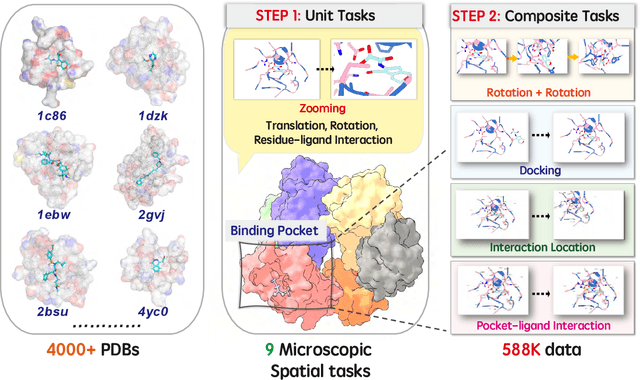
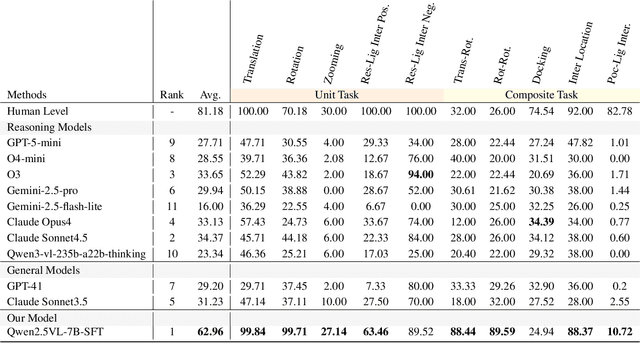
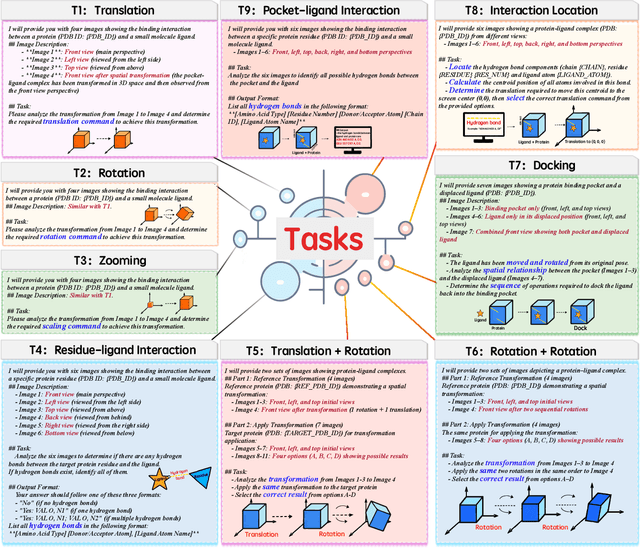
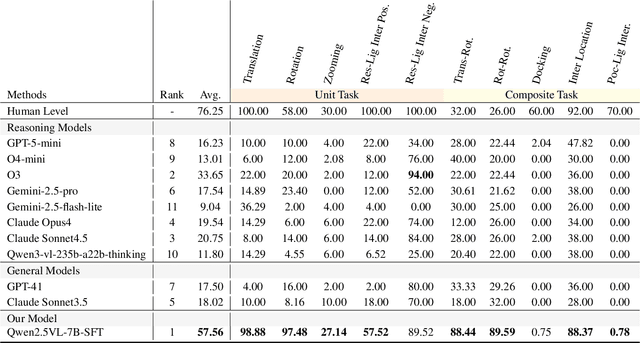
This paper introduces the concept of Microscopic Spatial Intelligence (MiSI), the capability to perceive and reason about the spatial relationships of invisible microscopic entities, which is fundamental to scientific discovery. To assess the potential of Vision-Language Models (VLMs) in this domain, we propose a systematic benchmark framework MiSI-Bench. This framework features over 163,000 question-answer pairs and 587,000 images derived from approximately 4,000 molecular structures, covering nine complementary tasks that evaluate abilities ranging from elementary spatial transformations to complex relational identifications. Experimental results reveal that current state-of-the-art VLMs perform significantly below human level on this benchmark. However, a fine-tuned 7B model demonstrates substantial potential, even surpassing humans in spatial transformation tasks, while its poor performance in scientifically-grounded tasks like hydrogen bond recognition underscores the necessity of integrating explicit domain knowledge for progress toward scientific AGI. The datasets are available at https://huggingface.co/datasets/zongzhao/MiSI-bench.
Fast and Distributed Equivariant Graph Neural Networks by Virtual Node Learning
Jun 24, 2025Equivariant Graph Neural Networks (GNNs) have achieved remarkable success across diverse scientific applications. However, existing approaches face critical efficiency challenges when scaling to large geometric graphs and suffer significant performance degradation when the input graphs are sparsified for computational tractability. To address these limitations, we introduce FastEGNN and DistEGNN, two novel enhancements to equivariant GNNs for large-scale geometric graphs. FastEGNN employs a key innovation: a small ordered set of virtual nodes that effectively approximates the large unordered graph of real nodes. Specifically, we implement distinct message passing and aggregation mechanisms for different virtual nodes to ensure mutual distinctiveness, and minimize Maximum Mean Discrepancy (MMD) between virtual and real coordinates to achieve global distributedness. This design enables FastEGNN to maintain high accuracy while efficiently processing large-scale sparse graphs. For extremely large-scale geometric graphs, we present DistEGNN, a distributed extension where virtual nodes act as global bridges between subgraphs in different devices, maintaining consistency while dramatically reducing memory and computational overhead. We comprehensively evaluate our models across four challenging domains: N-body systems (100 nodes), protein dynamics (800 nodes), Water-3D (8,000 nodes), and our new Fluid113K benchmark (113,000 nodes). Results demonstrate superior efficiency and performance, establishing new capabilities in large-scale equivariant graph learning. Code is available at https://github.com/GLAD-RUC/DistEGNN.
MrTrack: Register Mamba for Needle Tracking with Rapid Reciprocating Motion during Ultrasound-Guided Aspiration Biopsy
May 14, 2025Ultrasound-guided fine needle aspiration (FNA) biopsy is a common minimally invasive diagnostic procedure. However, an aspiration needle tracker addressing rapid reciprocating motion is still missing. MrTrack, an aspiration needle tracker with a mamba-based register mechanism, is proposed. MrTrack leverages a Mamba-based register extractor to sequentially distill global context from each historical search map, storing these temporal cues in a register bank. The Mamba-based register retriever then retrieves temporal prompts from the register bank to provide external cues when current vision features are temporarily unusable due to rapid reciprocating motion and imaging degradation. A self-supervised register diversify loss is proposed to encourage feature diversity and dimension independence within the learned register, mitigating feature collapse. Comprehensive experiments conducted on both motorized and manual aspiration datasets demonstrate that MrTrack not only outperforms state-of-the-art trackers in accuracy and robustness but also achieves superior inference efficiency.