 Add to Chrome
 Add to Firefox
 Add to Edge
Radio Map Updating from Streaming Spectrum Measurements via Memory-Based Online Gaussian Processes
Jul 20, 2026
Radio maps, which estimate spatial radio-frequency characteristics from spectrum measurements, are essential for applications such as spectrum management and network planning. With the continuous arrival of spectrum measurements, conventional batch processing methods for radio map reconstruction become computationally prohibitive, as they require reprocessing all accumulated measurements for each radio map update. To address this, we propose a memory-based online sparse variational Gaussian process (M-OSVGP) method that efficiently updates radio maps from streaming spectrum measurements. Our method employs sparse variational inference and updates the posterior online by minimizing a hybrid objective that integrates newly received measurements and a memory subset of previous ones to mitigate catastrophic forgetting. To further improve posterior approximation as measurements accumulate over spatially diverse regions, we extend M-OSVGP with a grid-assisted online inducing point selection (GOIPS) algorithm. GOIPS dynamically adapts the number and locations of inducing points based on measurement density and spatial correlation, providing a more informative inducing set while maintaining computational efficiency. Extensive simulations demonstrate the effectiveness of our proposed methods in reconstruction accuracy, computational efficiency, and uncertainty quantification, compared to existing batch and online baselines across various scenarios.

Multi-modal Expression Recognition with Ensemble Method
Mar 17, 2023This paper presents our submission to the Expression Classification Challenge of the fifth Affective Behavior Analysis in-the-wild (ABAW) Competition. In our method, multimodal feature combinations extracted by several different pre-trained models are applied to capture more effective emotional information. For these combinations of visual and audio modal features, we utilize two temporal encoders to explore the temporal contextual information in the data. In addition, we employ several ensemble strategies for different experimental settings to obtain the most accurate expression recognition results. Our system achieves the average F1 Score of 0.45774 on the validation set.
Facial Action Unit Recognition With Multi-models Ensembling
Mar 24, 2022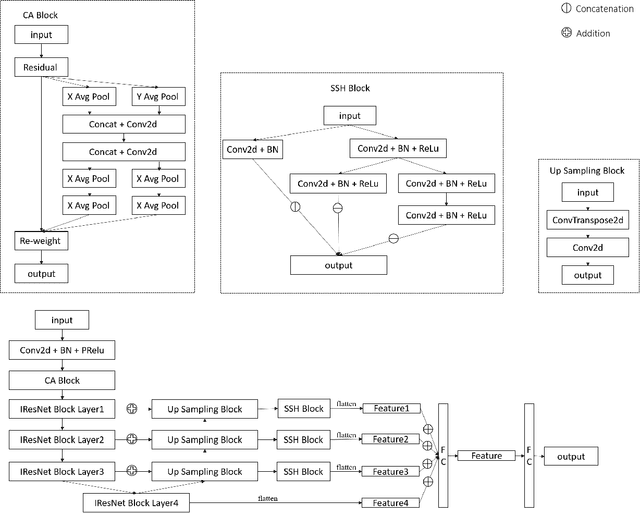
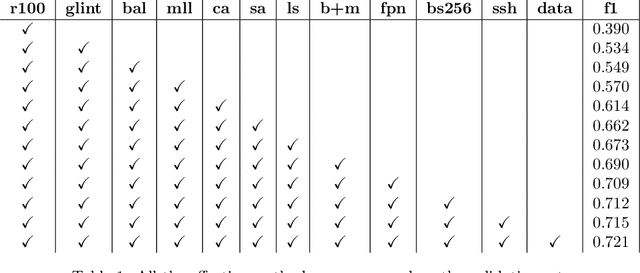


The Affective Behavior Analysis in-the-wild (ABAW) 2022 Competition gives Affective Computing a large promotion. In this paper, we present our method of AU challenge in this Competition. We use improved IResnet100 as backbone. Then we train AU dataset in Aff-Wild2 on three pertained models pretrained by our private au and expression dataset, and Glint360K respectively. Finally, we ensemble the results of our models. We achieved F1 score (macro) 0.731 on AU validation set.