 Add to Chrome
 Add to Firefox
 Add to Edge
Radio Map Updating from Streaming Spectrum Measurements via Memory-Based Online Gaussian Processes
Jul 20, 2026
Radio maps, which estimate spatial radio-frequency characteristics from spectrum measurements, are essential for applications such as spectrum management and network planning. With the continuous arrival of spectrum measurements, conventional batch processing methods for radio map reconstruction become computationally prohibitive, as they require reprocessing all accumulated measurements for each radio map update. To address this, we propose a memory-based online sparse variational Gaussian process (M-OSVGP) method that efficiently updates radio maps from streaming spectrum measurements. Our method employs sparse variational inference and updates the posterior online by minimizing a hybrid objective that integrates newly received measurements and a memory subset of previous ones to mitigate catastrophic forgetting. To further improve posterior approximation as measurements accumulate over spatially diverse regions, we extend M-OSVGP with a grid-assisted online inducing point selection (GOIPS) algorithm. GOIPS dynamically adapts the number and locations of inducing points based on measurement density and spatial correlation, providing a more informative inducing set while maintaining computational efficiency. Extensive simulations demonstrate the effectiveness of our proposed methods in reconstruction accuracy, computational efficiency, and uncertainty quantification, compared to existing batch and online baselines across various scenarios.

Ultra Lite Convolutional Neural Network for Automatic Modulation Classification
Aug 09, 2022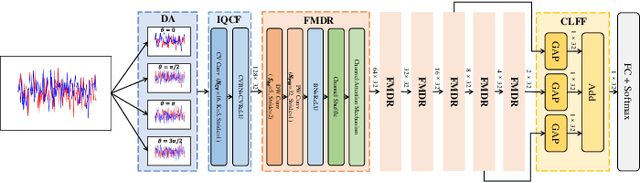
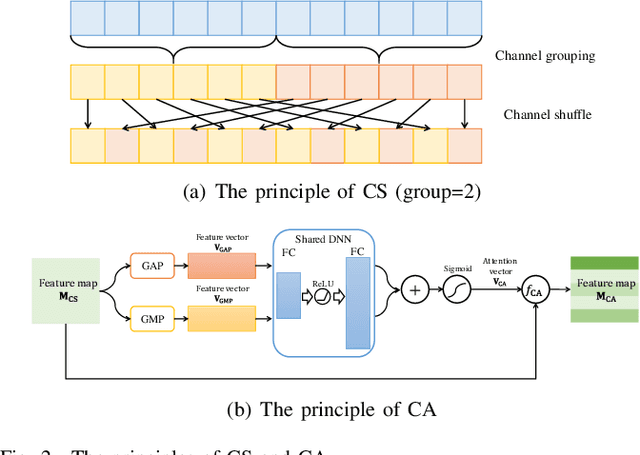
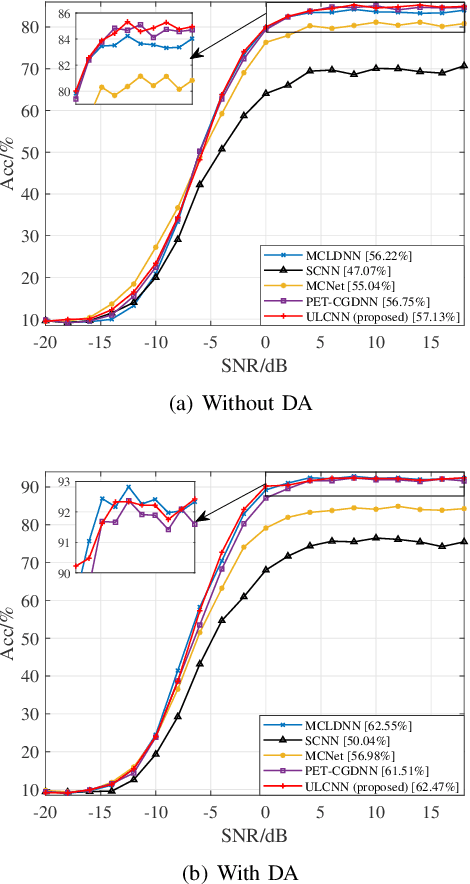
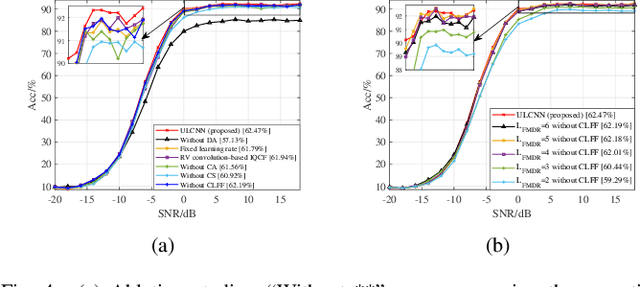
Automatic modulation classification (AMC) is a key technique for desiging non-cooperative communication systems, and deep learning (DL) is applied effectively into AMC for improving the classification accuracy.However, most of the DL-based AMC methods have a large number of parameters and high computational complexity, and they cannot be directly applied into scenarios with limited computing power and storage space.In this paper, we propose a lightweight and low-complexity AMC method using ultra lite convolutional neural network (ULCNN), which is based on multiple tricks, including data augmentation, complex-valued convolution, separable convolution, channel attention, channel shuffle. Simulation results demonstrate that our proposed ULCNN-based AMC method achieves the average accuracy of 62.47\% on RML2016.10a and only 9,751 parameters. Moreover, ULCNN is verified on a typical edge device (Raspberry Pi), where interference time per sample is about 0.775 ms. The reproducible code can be download from GitHub at https://github.com/BeechburgPieStar/Ultra-Lite-Convolutional-Neural-Network-for-Automatic-Modulation-Classification .