 Add to Chrome
 Add to Firefox
 Add to Edge
Resolving Java Code Repository Issues with iSWE Agent
Mar 11, 2026
Resolving issues on code repositories is an important part of software engineering. Various recent systems automatically resolve issues using large language models and agents, often with impressive performance. Unfortunately, most of these models and agents focus primarily on Python, and their performance on other programming languages is lower. In particular, a lot of enterprise software is written in Java, yet automated issue resolution for Java is under-explored. This paper introduces iSWE Agent, an automated issue resolver with an emphasis on Java. It consists of two sub-agents, one for localization and the other for editing. Both have access to novel tools based on rule-based Java static analysis and transformation. Using this approach, iSWE achieves state-of-the-art issue resolution rates across the Java splits of both Multi-SWE-bench and SWE-PolyBench. More generally, we hope that by combining the best of rule-based and model-based techniques, this paper contributes towards improving enterprise software development.

Enhancing Formal Software Specification with Artificial Intelligence
Jan 11, 2026Formal software specification is known to enable early error detection and explicit invariants, yet it has seen limited industrial adoption due to its high notation overhead and the expertise required to use traditional formal languages. This paper presents a case study showing that recent advances in artificial intelligence make it possible to retain many of the benefits of formal specification while substantially reducing these costs. The necessity of a clear distinction between what is controlled by the system analyst and can highly benefits from the rigor of formal specification and what need not be controlled is demonstrated. We use natural language augmented with lightweight mathematical notation and written in \LaTeX\ as an intermediate specification language, which is reviewed and refined by AI prior to code generation. Applied to a nontrivial simulation of organizational knowledge growth, this approach enables early validation, explicit invariants, and correctness by design, while significantly reducing development effort and producing a correct implementation on the first attempt.
PACIFIC: a framework for generating benchmarks to check Precise Automatically Checked Instruction Following In Code
Dec 22, 2025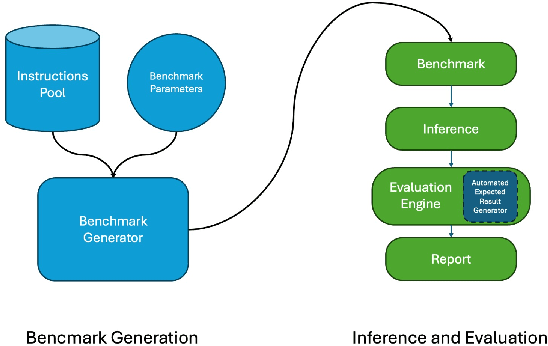
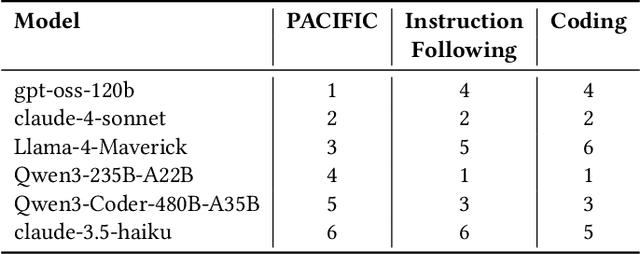
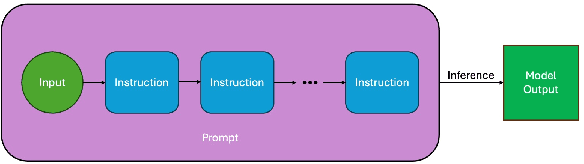
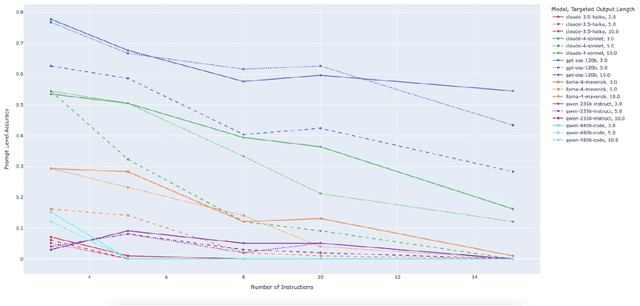
Large Language Model (LLM)-based code assistants have emerged as a powerful application of generative AI, demonstrating impressive capabilities in code generation and comprehension. A key requirement for these systems is their ability to accurately follow user instructions. We present Precise Automatically Checked Instruction Following In Code (PACIFIC), a novel framework designed to automatically generate benchmarks that rigorously assess sequential instruction-following and code dry-running capabilities in LLMs, while allowing control over benchmark difficulty. PACIFIC produces benchmark variants with clearly defined expected outputs, enabling straightforward and reliable evaluation through simple output comparisons. In contrast to existing approaches that often rely on tool usage or agentic behavior, our work isolates and evaluates the LLM's intrinsic ability to reason through code behavior step-by-step without execution (dry running) and to follow instructions. Furthermore, our framework mitigates training data contamination by facilitating effortless generation of novel benchmark variations. We validate our framework by generating a suite of benchmarks spanning a range of difficulty levels and evaluating multiple state-of-the-art LLMs. Our results demonstrate that PACIFIC can produce increasingly challenging benchmarks that effectively differentiate instruction-following and dry running capabilities, even among advanced models. Overall, our framework offers a scalable, contamination-resilient methodology for assessing core competencies of LLMs in code-related tasks.