 Add to Chrome
 Add to Firefox
 Add to Edge
Decoding Children's Gait Behavior
Aug 01, 2026
We introduce a new problem domain for human action recognition: the fine-grained analysis of children's gait behaviors from standard RGB video. We specifically target the ambulatory patterns of children aged 3-17 years. Such behaviors arise naturally in the diagnosis and treatment of several critical developmental and neuromuscular disorders, such as cerebral palsy and hemiplegia. Despite their clinical value, current 3D sensor-based gait analysis systems are expensive, intrusive, and often impractical for young subjects. To address this, we introduce a new dataset comprising over 1,100 high-frame-rate (60 FPS) video sequences from 110 subjects, accompanied by synchronized, anonymized pose sequences. In each session, the child performs a 5-second "walk-around" task, capturing the gait cycle from multiple viewpoints. Crucially, we demonstrate that current state-of-the-art approaches, including gait foundation models and Multimodal Large Language Models (MLLMs), fail to effectively resolve these clinical nuances. We identify the key technical challenges in analyzing these erratic and subtle motor patterns and describe a unified end-to-end framework for decoding fundamental components of pediatric gait. Through comprehensive experimental results, we demonstrate the potential of this dataset to drive novel research questions and establish a rigorous baseline for automated child gait assessment.

CogniRoute: Learning to Route Social Evidence in Omni-Modal Models
Jun 18, 2026Omni-modal models can ingest video, audio, and text, but unified access to multiple modalities does not guarantee that a model uses the right evidence. This gap is especially pronounced in social video question answering, where the answer may hinge on a gesture, vocal tone, temporal cue, or mismatch between what is said and what is visually expressed. We introduce CogniRoute, a schema-guided Mixture-of-Experts framework for social omni reasoning. CogniRoute uses a training-only cognitive schema that factorizes each example by cross-modal relation, reasoning demand, and temporal scope, and aligns global routing signatures with this structure during supervised fine-tuning. We further introduce route-aware reinforcement learning, which jointly optimizes token generation and expert allocation using rewards for answer correctness, modality-consistent reasoning, and cognitive temporal grounding. To support training and evaluation, we construct OmniSocialBench, a diagnostic social video QA resource with 118K structured training examples, grounded reasoning traces, schema labels, temporal evidence spans, and a manually verified evaluation split. CogniRoute achieves 59.38\% average accuracy on OmniSocialBench, improving over the strongest proprietary baseline by 15.33 percentage points and the strongest open-source omni baseline by 26.77 points, with the largest gains on questions requiring audio-visual coordination, conflict resolution, and temporally grounded social inference.
Exact Posterior Score Estimation for Solving Linear Inverse Problems
Jun 15, 2026Diffusion and flow-based models learn powerful data priors by training a denoiser to reverse Gaussian corruption. To use this prior to solve a linear inverse problem, one needs to sample from the posterior, but the score that the prior provides is the unconditional score, not the posterior score. Existing methods either steer a fixed pretrained denoiser with approximate measurement-matching corrections, or train a conditional restoration model that abandons the denoising structure of the prior. We derive the exact posterior score in closed form for linear Gaussian inverse problems under general Gaussian interpolants, and show that posterior sampling reduces to a denoising problem at an operator-dependent shifted pivot under an anisotropic noise covariance. We turn this identity into Exact Posterior Score (EPS), a denoising training objective that preserves the input/output structure of standard pretraining and can therefore be trained from scratch or fine-tuned from a pretrained denoiser. At inference, EPS uses the same sampler as the underlying backbone, with no likelihood gradients or projections. We evaluate EPS on five linear inverse problems across FFHQ and ImageNet, where it outperforms training-free and training-based baselines on fidelity, perceptual, and distributional metrics, while using roughly an order of magnitude fewer denoiser evaluations than gradient-based posterior samplers.
When Eyes Betray AI: Social Gaze Consistency as a Semantic Cue for AI-Generated Image Detection
May 27, 2026Recent generative models have largely closed the gap on low-level artifacts - pixel fingerprints, frequency anomalies, upsampling traces - particularly in person-centric and partial-edit settings where the manipulated region is small and surrounded by photometrically authentic content. We introduce Social Gaze Consistency, a high-level semantic cue defined as the mutual coherence of gaze direction, head-eye alignment, and pupil placement between interacting individuals, and show that it constitutes a previously underutilized detection axis orthogonal to existing low-level paradigms. We instantiate this insight through three coupled mechanisms: (i) a controlled diagnostic dataset with region-specific perturbations of gaze-consistent imagery, where strict pair-level grouping forecloses generator-fingerprint memorization as an optimization-time shortcut rather than relying on augmentation; (ii) Block-Compositional Caption Supervision, which holds a single 5-block reasoning skeleton invariant across 1,250 macro-combined captions, decoupling reasoning consistency from surface diversity; (iii) Cross-architecture validation showing the same supervision improves a vision-language backbone (FakeVLM) by +3.7 pp on the COCOAI Interaction subset (balanced accuracy 67.8 -> 71.5) and +1.3 pp on the COCOAI Person subset (83.0 -> 84.3), with consistent gains on a vision-only backbone (Effort), evidencing a backbone-agnostic cue. Real- and fake-class recalls rise simultaneously, ruling out a "predict-all-fake" artifact. A four-step mechanistic account - paired-edit shortcut blocking, hard-to-easy difficulty transfer, CLIP prior preservation, and diffusion-family shared spectral weakness in periocular structure - explains why training on a single inpainter (FLUX.1-Fill) transfers to multi-generator suites. We will release the code upon acceptance to facilitate reproducibility.
IAM: Identity-Aware Human Motion and Shape Joint Generation
Apr 28, 2026Recent advances in text-driven human motion generation enable models to synthesize realistic motion sequences from natural language descriptions. However, most existing approaches assume identity-neutral motion and generate movements using a canonical body representation, ignoring the strong influence of body morphology on motion dynamics. In practice, attributes such as body proportions, mass distribution, and age significantly affect how actions are performed, and neglecting this coupling often leads to physically inconsistent motions. We propose an identity-aware motion generation framework that explicitly models the relationship between body morphology and motion dynamics. Instead of relying on explicit geometric measurements, identity is represented using multimodal signals, including natural language descriptions and visual cues. We further introduce a joint motion-shape generation paradigm that simultaneously synthesizes motion sequences and body shape parameters, allowing identity cues to directly modulate motion dynamics. Extensive experiments on motion capture datasets and large-scale in-the-wild videos demonstrate improved motion realism and motion-identity consistency while maintaining high motion quality. Project page: https://vjwq.github.io/IAM
Narrative-Driven Paper-to-Slide Generation via ArcDeck
Apr 13, 2026We introduce ArcDeck, a multi-agent framework that formulates paper-to-slide generation as a structured narrative reconstruction task. Unlike existing methods that directly summarize raw text into slides, ArcDeck explicitly models the source paper's logical flow. It first parses the input to construct a discourse tree and establish a global commitment document, ensuring the high-level intent is preserved. These structural priors then guide an iterative multi-agent refinement process, where specialized agents iteratively critique and revise the presentation outline before rendering the final visual layouts and designs. To evaluate our approach, we also introduce ArcBench, a newly curated benchmark of academic paper-slide pairs. Experimental results demonstrate that explicit discourse modeling, combined with role-specific agent coordination, significantly improves the narrative flow and logical coherence of the generated presentations.
Omni-MMSI: Toward Identity-attributed Social Interaction Understanding
Mar 31, 2026We introduce Omni-MMSI, a new task that requires comprehensive social interaction understanding from raw audio, vision, and speech input. The task involves perceiving identity-attributed social cues (e.g., who is speaking what) and reasoning about the social interaction (e.g., whom the speaker refers to). This task is essential for developing AI assistants that can perceive and respond to human interactions. Unlike prior studies that operate on oracle-preprocessed social cues, Omni-MMSI reflects realistic scenarios where AI assistants must perceive and reason from raw data. However, existing pipelines and multi-modal LLMs perform poorly on Omni-MMSI because they lack reliable identity attribution capabilities, which leads to inaccurate social interaction understanding. To address this challenge, we propose Omni-MMSI-R, a reference-guided pipeline that produces identity-attributed social cues with tools and conducts chain-of-thought social reasoning. To facilitate this pipeline, we construct participant-level reference pairs and curate reasoning annotations on top of the existing datasets. Experiments demonstrate that Omni-MMSI-R outperforms advanced LLMs and counterparts on Omni-MMSI. Project page: https://sampson-lee.github.io/omni-mmsi-project-page.
EgoForge: Goal-Directed Egocentric World Simulator
Mar 20, 2026Generative world models have shown promise for simulating dynamic environments, yet egocentric video remains challenging due to rapid viewpoint changes, frequent hand-object interactions, and goal-directed procedures whose evolution depends on latent human intent. Existing approaches either focus on hand-centric instructional synthesis with limited scene evolution, perform static view translation without modeling action dynamics, or rely on dense supervision, such as camera trajectories, long video prefixes, synchronized multicamera capture, etc. In this work, we introduce EgoForge, an egocentric goal-directed world simulator that generates coherent, first-person video rollouts from minimal static inputs: a single egocentric image, a high-level instruction, and an optional auxiliary exocentric view. To improve intent alignment and temporal consistency, we propose VideoDiffusionNFT, a trajectory-level reward-guided refinement that optimizes goal completion, temporal causality, scene consistency, and perceptual fidelity during diffusion sampling. Extensive experiments show EgoForge achieves consistent gains in semantic alignment, geometric stability, and motion fidelity over strong baselines, and robust performance in real-world smart-glasses experiments.
AnyECG: Foundational Models for Electrocardiogram Analysis
Nov 17, 2024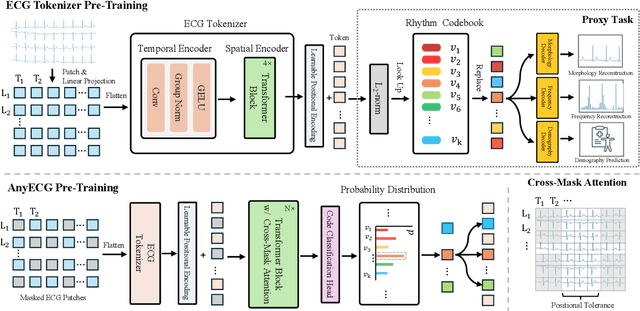
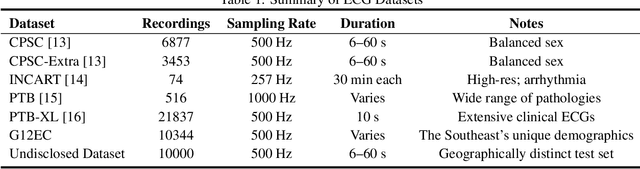
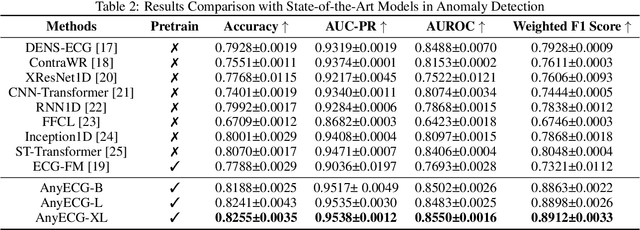
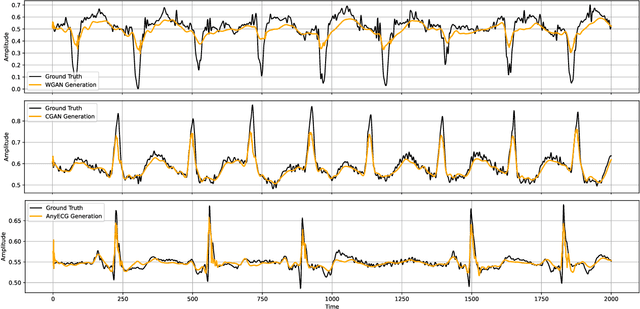
Electrocardiogram (ECG), a non-invasive and affordable tool for cardiac monitoring, is highly sensitive in detecting acute heart attacks. However, due to the lengthy nature of ECG recordings, numerous machine learning methods have been developed for automated heart disease detection to reduce human workload. Despite these efforts, performance remains suboptimal. A key obstacle is the inherent complexity of ECG data, which includes heterogeneity (e.g., varying sampling rates), high levels of noise, demographic-related pattern shifts, and intricate rhythm-event associations. To overcome these challenges, this paper introduces AnyECG, a foundational model designed to extract robust representations from any real-world ECG data. Specifically, a tailored ECG Tokenizer encodes each fixed-duration ECG fragment into a token and, guided by proxy tasks, converts noisy, continuous ECG features into discrete, compact, and clinically meaningful local rhythm codes. These codes encapsulate basic morphological, frequency, and demographic information (e.g., sex), effectively mitigating signal noise. We further pre-train the AnyECG to learn rhythmic pattern associations across ECG tokens, enabling the capture of cardiac event semantics. By being jointly pre-trained on diverse ECG data sources, AnyECG is capable of generalizing across a wide range of downstream tasks where ECG signals are recorded from various devices and scenarios. Experimental results in anomaly detection, arrhythmia detection, corrupted lead generation, and ultra-long ECG signal analysis demonstrate that AnyECG learns common ECG knowledge from data and significantly outperforms cutting-edge methods in each respective task.