 Add to Chrome
 Add to Firefox
 Add to Edge
Narrative-Driven Paper-to-Slide Generation via ArcDeck
Apr 13, 2026
We introduce ArcDeck, a multi-agent framework that formulates paper-to-slide generation as a structured narrative reconstruction task. Unlike existing methods that directly summarize raw text into slides, ArcDeck explicitly models the source paper's logical flow. It first parses the input to construct a discourse tree and establish a global commitment document, ensuring the high-level intent is preserved. These structural priors then guide an iterative multi-agent refinement process, where specialized agents iteratively critique and revise the presentation outline before rendering the final visual layouts and designs. To evaluate our approach, we also introduce ArcBench, a newly curated benchmark of academic paper-slide pairs. Experimental results demonstrate that explicit discourse modeling, combined with role-specific agent coordination, significantly improves the narrative flow and logical coherence of the generated presentations.

Optimization-Free Image Immunization Against Diffusion-Based Editing
Nov 27, 2024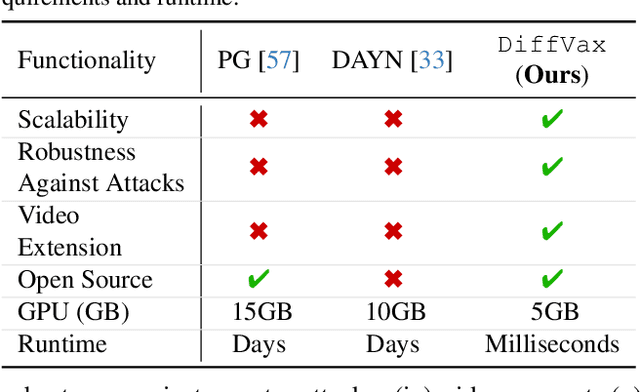
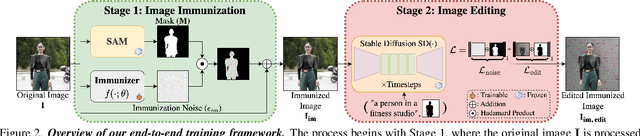

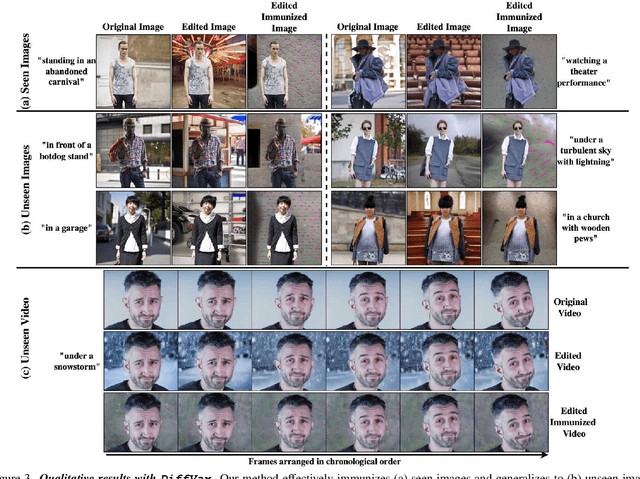
Current image immunization defense techniques against diffusion-based editing embed imperceptible noise in target images to disrupt editing models. However, these methods face scalability challenges, as they require time-consuming re-optimization for each image-taking hours for small batches. To address these challenges, we introduce DiffVax, a scalable, lightweight, and optimization-free framework for image immunization, specifically designed to prevent diffusion-based editing. Our approach enables effective generalization to unseen content, reducing computational costs and cutting immunization time from days to milliseconds-achieving a 250,000x speedup. This is achieved through a loss term that ensures the failure of editing attempts and the imperceptibility of the perturbations. Extensive qualitative and quantitative results demonstrate that our model is scalable, optimization-free, adaptable to various diffusion-based editing tools, robust against counter-attacks, and, for the first time, effectively protects video content from editing. Our code is provided in our project webpage.