 Add to Chrome
 Add to Firefox
 Add to Edge
ALEX:A Light Editing-knowledge Extractor
Nov 18, 2025
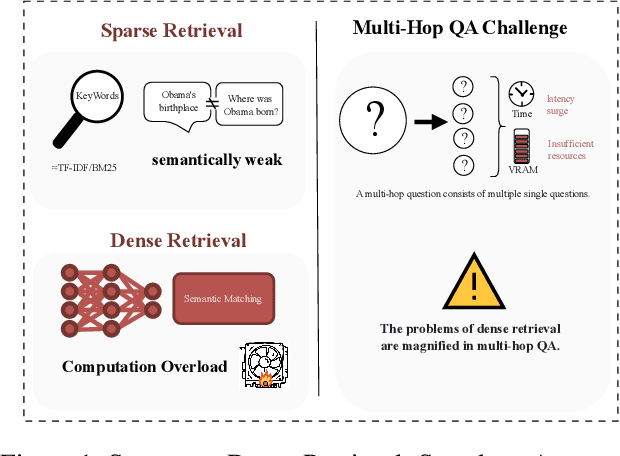
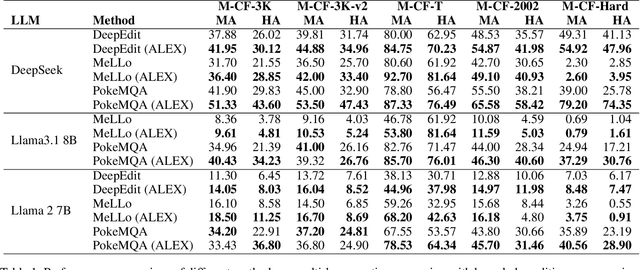
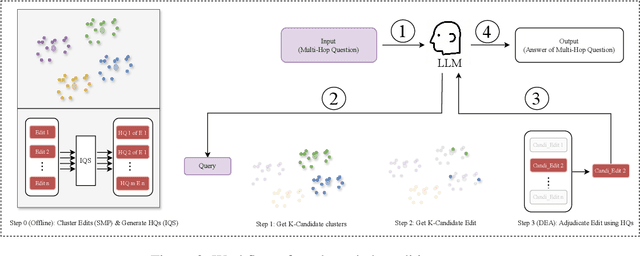
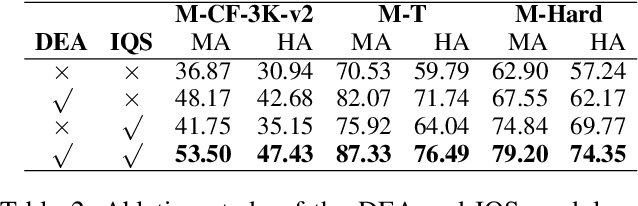
The static nature of knowledge within Large Language Models (LLMs) makes it difficult for them to adapt to evolving information, rendering knowledge editing a critical task. However, existing methods struggle with challenges of scalability and retrieval efficiency, particularly when handling complex, multi-hop questions that require multi-step reasoning. To address these challenges, this paper introduces ALEX (A Light Editing-knowledge Extractor), a lightweight knowledge editing framework. The core innovation of ALEX is its hierarchical memory architecture, which organizes knowledge updates (edits) into semantic clusters. This design fundamentally reduces retrieval complexity from a linear O(N) to a highly scalable O(K+N/C). Furthermore, the framework integrates an Inferential Query Synthesis (IQS) module to bridge the semantic gap between queries and facts , and a Dynamic Evidence Adjudication (DEA) engine that executes an efficient two-stage retrieval process. Experiments on the MQUAKE benchmark demonstrate that ALEX significantly improves both the accuracy of multi-hop answers (MultiHop-ACC) and the reliability of reasoning paths (HopWise-ACC). It also reduces the required search space by over 80% , presenting a promising path toward building scalable, efficient, and accurate knowledge editing systems.

MC-DBN: A Deep Belief Network-Based Model for Modality Completion
Feb 15, 2024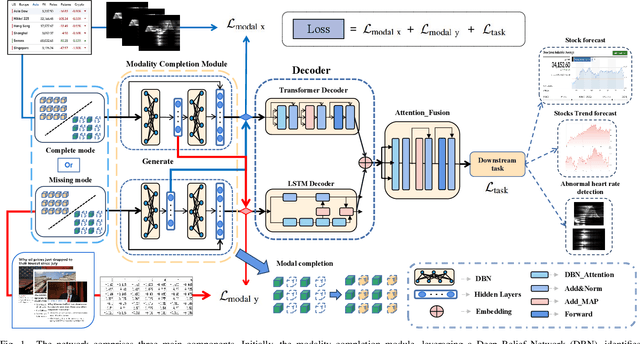
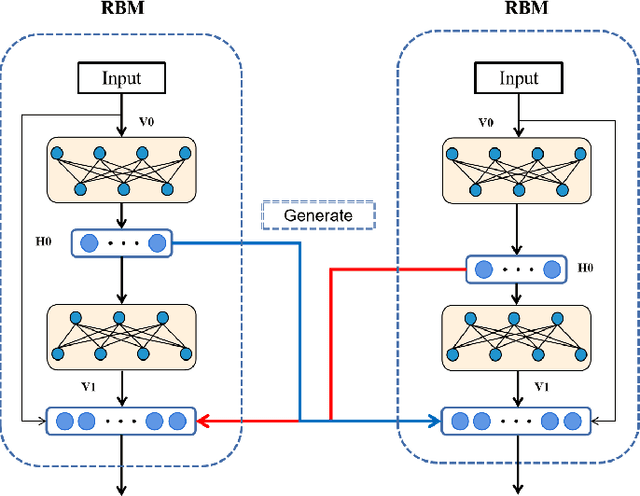
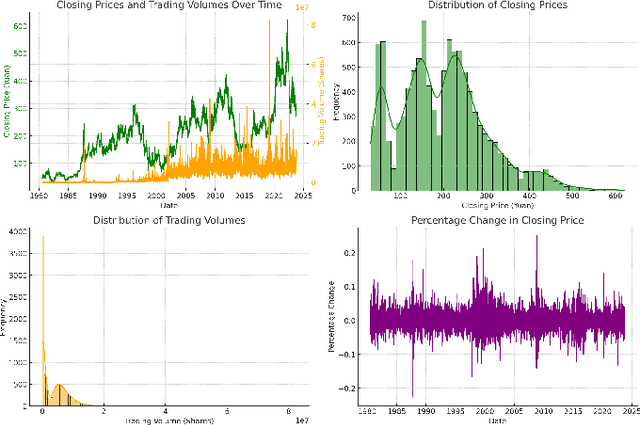
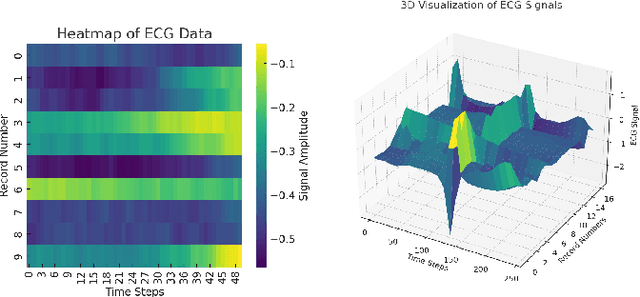
Recent advancements in multi-modal artificial intelligence (AI) have revolutionized the fields of stock market forecasting and heart rate monitoring. Utilizing diverse data sources can substantially improve prediction accuracy. Nonetheless, additional data may not always align with the original dataset. Interpolation methods are commonly utilized for handling missing values in modal data, though they may exhibit limitations in the context of sparse information. Addressing this challenge, we propose a Modality Completion Deep Belief Network-Based Model (MC-DBN). This approach utilizes implicit features of complete data to compensate for gaps between itself and additional incomplete data. It ensures that the enhanced multi-modal data closely aligns with the dynamic nature of the real world to enhance the effectiveness of the model. We conduct evaluations of the MC-DBN model in two datasets from the stock market forecasting and heart rate monitoring domains. Comprehensive experiments showcase the model's capacity to bridge the semantic divide present in multi-modal data, subsequently enhancing its performance. The source code is available at: https://github.com/logan-0623/DBN-generate
MTSA-SNN: A Multi-modal Time Series Analysis Model Based on Spiking Neural Network
Feb 08, 2024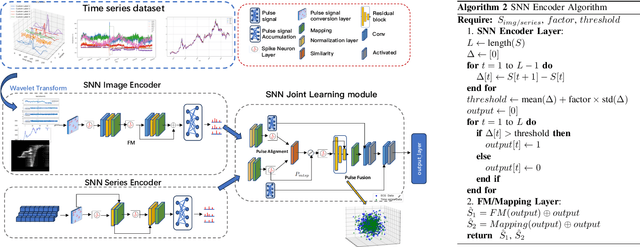
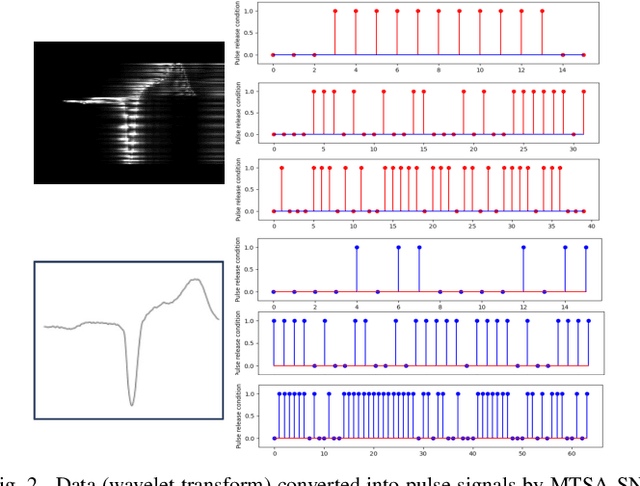
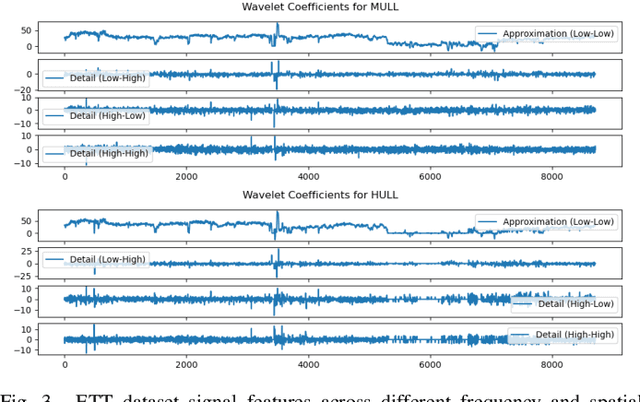
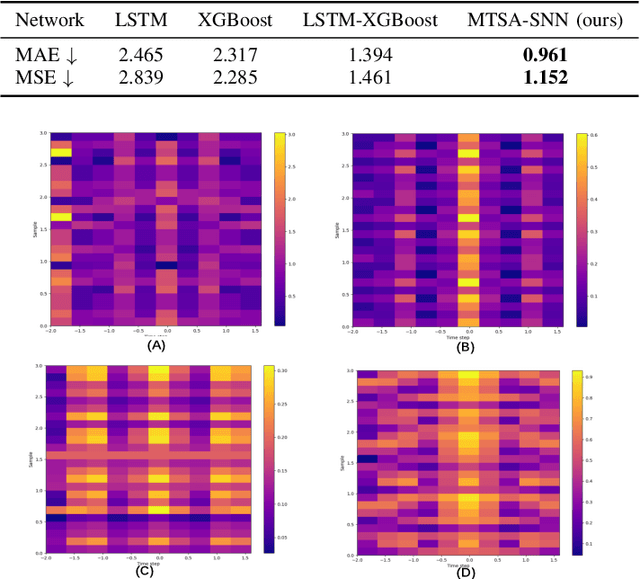
Time series analysis and modelling constitute a crucial research area. Traditional artificial neural networks struggle with complex, non-stationary time series data due to high computational complexity, limited ability to capture temporal information, and difficulty in handling event-driven data. To address these challenges, we propose a Multi-modal Time Series Analysis Model Based on Spiking Neural Network (MTSA-SNN). The Pulse Encoder unifies the encoding of temporal images and sequential information in a common pulse-based representation. The Joint Learning Module employs a joint learning function and weight allocation mechanism to fuse information from multi-modal pulse signals complementary. Additionally, we incorporate wavelet transform operations to enhance the model's ability to analyze and evaluate temporal information. Experimental results demonstrate that our method achieved superior performance on three complex time-series tasks. This work provides an effective event-driven approach to overcome the challenges associated with analyzing intricate temporal information. Access to the source code is available at https://github.com/Chenngzz/MTSA-SNN}{https://github.com/Chenngzz/MTSA-SNN
* 6 pages, 6 figures, published to International Conference on Computer Supported Cooperative Work in Design