 Add to Chrome
 Add to Firefox
 Add to Edge
Learning What to Remember: Test-Time Training via Context Distillation
Aug 03, 2026
Effective long-context modeling is not merely about retaining more of the past, but about preserving the information that may prove relevant later. Test-time training (TTT) is an appealing approach that performs online parameter updates for long-context modeling, yet existing TTT methods only optimize either reconstruction or online adaptation objectives without considering the future utility of retained information. In this work, we propose \textbf{T}est-\textbf{T}ime \textbf{C}ontext \textbf{D}istillation (TTCD), a TTT framework that introduces a self-supervised objective for allocating limited memory capacity for future use. Specifically, TTCD uses a long-window teacher to supervise the fast weights of a short-window student, where the hidden-state discrepancy between them offers a dense, self-supervised signal guiding the model to memorize the contextual information crucial for future token predictions. We focus on an in-place variant: In-Place TTCD (IP-TTCD), which uses the existing MLP parameters as the fast weights. Experiments on long-context language modeling tasks show IP-TTCD consistently outperforms DeltaNet, Gated DeltaNet, sliding-window attention, and TTT when pre-trained from scratch. Furthermore, IP-TTCD allows pre-trained transformer models to adapt their parameters during inference through continual pre-training, gaining long-context capabilities with only a lightweight architectural augmentation. Our results position TTCD as a step toward architectural continual learning.

DiscoLoop: Looping Discrete Embeddings and Continuous Hidden States for Multi-hop Reasoning
Jul 01, 2026Large language models achieve strong performance on many reasoning tasks when allowed to externalize intermediate steps as Chain-of-Thought (CoT). However, many questions require the model to internalize the multi-step reasoning within a single forward pass before generating the answer. We study this challenge through two-hop reasoning, a representative task where the model must compose multiple pieces of parametric knowledge within a single forward pass. Standard non-recurrent Transformers suffer from a depth-local storage problem: facts learned in earlier layers are unavailable where second-hop retrieval happens. We found that Looped Transformers mitigate this issue by reusing the same memory, but still generalize imperfectly. We show that the remaining bottleneck is representational. In the two-hop reasoning task, the first loop often makes the correct bridge entity nearly perfectly decodable, yet the corresponding hidden state remains poorly aligned with the bridge token embedding. Surprisingly, an easy training-free realignment intervention nearly closes the generalization gap. Building upon this insight, we propose DiscoLoop, a looping architecture whose recurrence carries both a discrete embedding channel and a continuous hidden-state channel. DiscoLoop achieves near-perfect accuracy with substantially fewer training steps across symbolic and synthetic-language multi-hop reasoning tasks. When applied to real-world pretraining, DiscoLoop attains lower training loss and stronger benchmark performance than looped-transformer baselines, suggesting that the mixed-channel design transfers to practical language modeling.
Agents' Last Exam
Jun 03, 2026Recent AI systems have achieved strong results on a wide range of benchmarks, yet these gains have not translated into economically meaningful deployment across many professional domains. We argue that this gap is largely an evaluation problem: widely used benchmarks lack sustained performance measurement on real and economically valuable workflows. This paper introduces Agents' Last Exam (ALE), a benchmark designed to evaluate AI agents on long-horizon, economically valuable, real-world tasks with verifiable outcomes. Developed in collaboration with 250+ industry experts, ALE covers non-physical industries defined with reference to O*NET / SOC 2018 (the U.S. federal occupational taxonomy). It is organized around a task taxonomy with 55 subfields grouped into 13 industry clusters covering 1K+ tasks. Current results show that the hardest tier remains far from saturated: across mainstream harness and backbone configurations, the average full pass rate is 2.6%. ALE is designed as a living benchmark: its task pool grows continuously as new workflows and industries are onboarded. More broadly, ALE is intended not merely as another leaderboard, but as an instrument for closing the gap between benchmark success and GDP-relevant impact.
Plan, Verify and Fill: A Structured Parallel Decoding Approach for Diffusion Language Models
Jan 18, 2026Diffusion Language Models (DLMs) present a promising non-sequential paradigm for text generation, distinct from standard autoregressive (AR) approaches. However, current decoding strategies often adopt a reactive stance, underutilizing the global bidirectional context to dictate global trajectories. To address this, we propose Plan-Verify-Fill (PVF), a training-free paradigm that grounds planning via quantitative validation. PVF actively constructs a hierarchical skeleton by prioritizing high-leverage semantic anchors and employs a verification protocol to operationalize pragmatic structural stopping where further deliberation yields diminishing returns. Extensive evaluations on LLaDA-8B-Instruct and Dream-7B-Instruct demonstrate that PVF reduces the Number of Function Evaluations (NFE) by up to 65% compared to confidence-based parallel decoding across benchmark datasets, unlocking superior efficiency without compromising accuracy.
Neural Networks Learn Generic Multi-Index Models Near Information-Theoretic Limit
Nov 19, 2025In deep learning, a central issue is to understand how neural networks efficiently learn high-dimensional features. To this end, we explore the gradient descent learning of a general Gaussian Multi-index model $f(\boldsymbol{x})=g(\boldsymbol{U}\boldsymbol{x})$ with hidden subspace $\boldsymbol{U}\in \mathbb{R}^{r\times d}$, which is the canonical setup to study representation learning. We prove that under generic non-degenerate assumptions on the link function, a standard two-layer neural network trained via layer-wise gradient descent can agnostically learn the target with $o_d(1)$ test error using $\widetilde{\mathcal{O}}(d)$ samples and $\widetilde{\mathcal{O}}(d^2)$ time. The sample and time complexity both align with the information-theoretic limit up to leading order and are therefore optimal. During the first stage of gradient descent learning, the proof proceeds via showing that the inner weights can perform a power-iteration process. This process implicitly mimics a spectral start for the whole span of the hidden subspace and eventually eliminates finite-sample noise and recovers this span. It surprisingly indicates that optimal results can only be achieved if the first layer is trained for more than $\mathcal{O}(1)$ steps. This work demonstrates the ability of neural networks to effectively learn hierarchical functions with respect to both sample and time efficiency.
Learning Hierarchical Polynomials of Multiple Nonlinear Features with Three-Layer Networks
Nov 26, 2024In deep learning theory, a critical question is to understand how neural networks learn hierarchical features. In this work, we study the learning of hierarchical polynomials of \textit{multiple nonlinear features} using three-layer neural networks. We examine a broad class of functions of the form $f^{\star}=g^{\star}\circ \bp$, where $\bp:\mathbb{R}^{d} \rightarrow \mathbb{R}^{r}$ represents multiple quadratic features with $r \ll d$ and $g^{\star}:\mathbb{R}^{r}\rightarrow \mathbb{R}$ is a polynomial of degree $p$. This can be viewed as a nonlinear generalization of the multi-index model \citep{damian2022neural}, and also an expansion upon previous work that focused only on a single nonlinear feature, i.e. $r = 1$ \citep{nichani2023provable,wang2023learning}. Our primary contribution shows that a three-layer neural network trained via layerwise gradient descent suffices for \begin{itemize}\item complete recovery of the space spanned by the nonlinear features \item efficient learning of the target function $f^{\star}=g^{\star}\circ \bp$ or transfer learning of $f=g\circ \bp$ with a different link function \end{itemize} within $\widetilde{\cO}(d^4)$ samples and polynomial time. For such hierarchical targets, our result substantially improves the sample complexity ${\Theta}(d^{2p})$ of the kernel methods, demonstrating the power of efficient feature learning. It is important to highlight that{ our results leverage novel techniques and thus manage to go beyond all prior settings} such as single-index and multi-index models as well as models depending just on one nonlinear feature, contributing to a more comprehensive understanding of feature learning in deep learning.
Diffusion Transformer Captures Spatial-Temporal Dependencies: A Theory for Gaussian Process Data
Jul 23, 2024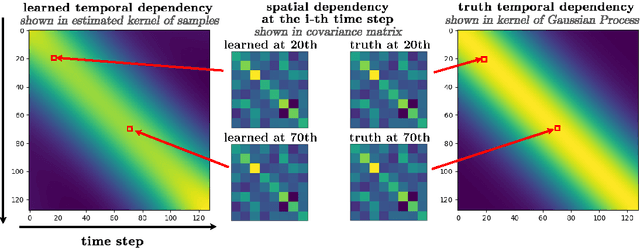
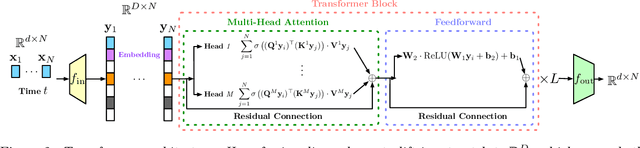
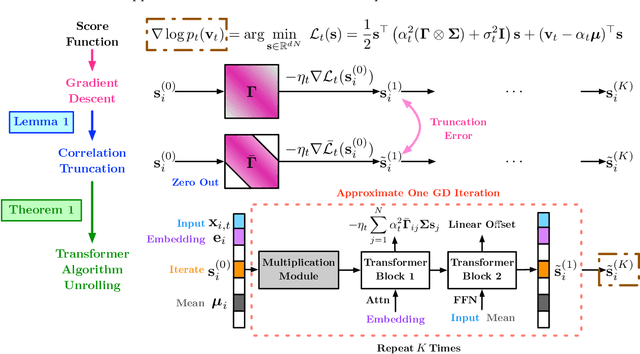
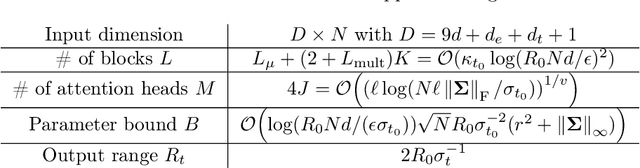
Diffusion Transformer, the backbone of Sora for video generation, successfully scales the capacity of diffusion models, pioneering new avenues for high-fidelity sequential data generation. Unlike static data such as images, sequential data consists of consecutive data frames indexed by time, exhibiting rich spatial and temporal dependencies. These dependencies represent the underlying dynamic model and are critical to validate the generated data. In this paper, we make the first theoretical step towards bridging diffusion transformers for capturing spatial-temporal dependencies. Specifically, we establish score approximation and distribution estimation guarantees of diffusion transformers for learning Gaussian process data with covariance functions of various decay patterns. We highlight how the spatial-temporal dependencies are captured and affect learning efficiency. Our study proposes a novel transformer approximation theory, where the transformer acts to unroll an algorithm. We support our theoretical results by numerical experiments, providing strong evidence that spatial-temporal dependencies are captured within attention layers, aligning with our approximation theory.
Unveil Conditional Diffusion Models with Classifier-free Guidance: A Sharp Statistical Theory
Mar 18, 2024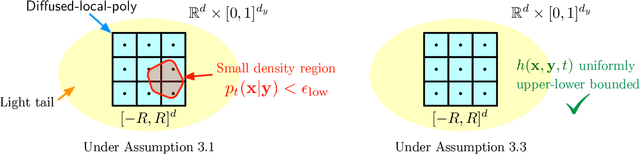
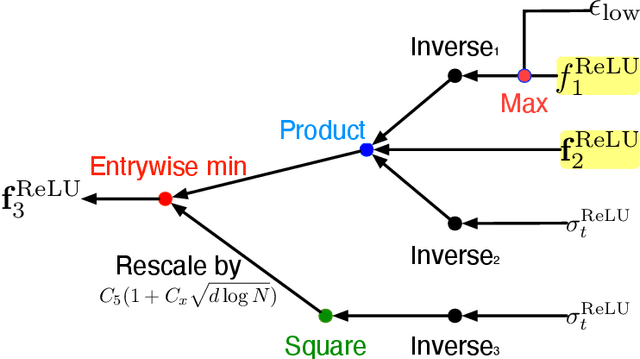
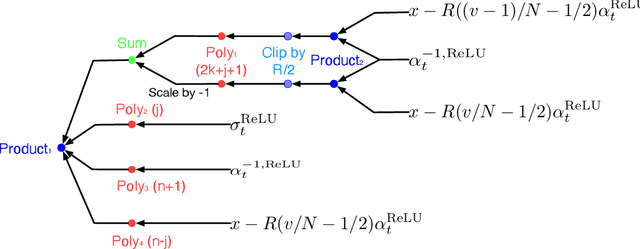
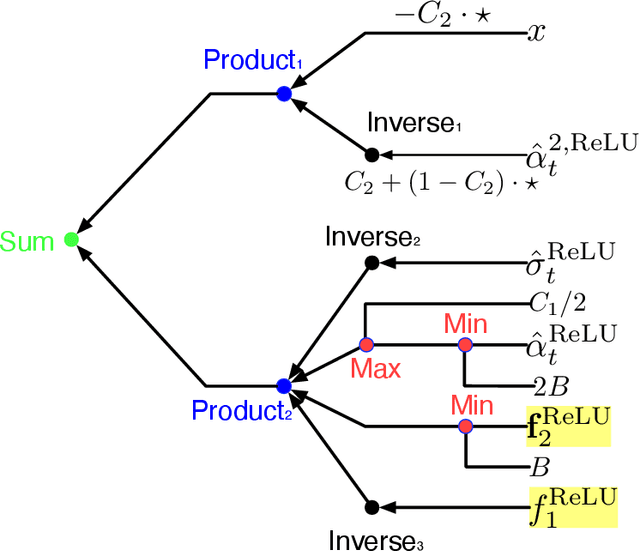
Conditional diffusion models serve as the foundation of modern image synthesis and find extensive application in fields like computational biology and reinforcement learning. In these applications, conditional diffusion models incorporate various conditional information, such as prompt input, to guide the sample generation towards desired properties. Despite the empirical success, theory of conditional diffusion models is largely missing. This paper bridges this gap by presenting a sharp statistical theory of distribution estimation using conditional diffusion models. Our analysis yields a sample complexity bound that adapts to the smoothness of the data distribution and matches the minimax lower bound. The key to our theoretical development lies in an approximation result for the conditional score function, which relies on a novel diffused Taylor approximation technique. Moreover, we demonstrate the utility of our statistical theory in elucidating the performance of conditional diffusion models across diverse applications, including model-based transition kernel estimation in reinforcement learning, solving inverse problems, and reward conditioned sample generation.
What can a Single Attention Layer Learn? A Study Through the Random Features Lens
Jul 21, 2023Attention layers -- which map a sequence of inputs to a sequence of outputs -- are core building blocks of the Transformer architecture which has achieved significant breakthroughs in modern artificial intelligence. This paper presents a rigorous theoretical study on the learning and generalization of a single multi-head attention layer, with a sequence of key vectors and a separate query vector as input. We consider the random feature setting where the attention layer has a large number of heads, with randomly sampled frozen query and key matrices, and trainable value matrices. We show that such a random-feature attention layer can express a broad class of target functions that are permutation invariant to the key vectors. We further provide quantitative excess risk bounds for learning these target functions from finite samples, using random feature attention with finitely many heads. Our results feature several implications unique to the attention structure compared with existing random features theory for neural networks, such as (1) Advantages in the sample complexity over standard two-layer random-feature networks; (2) Concrete and natural classes of functions that can be learned efficiently by a random-feature attention layer; and (3) The effect of the sampling distribution of the query-key weight matrix (the product of the query and key matrix), where Gaussian random weights with a non-zero mean result in better sample complexities over the zero-mean counterpart for learning certain natural target functions. Experiments on simulated data corroborate our theoretical findings and further illustrate the interplay between the sample size and the complexity of the target function.