 Add to Chrome
 Add to Firefox
 Add to Edge
Think Fast: Estimating No-CoT Task-Completion Time Horizons of Frontier AI Models
Jun 05, 2026
Many efforts to ensure frontier AI models are safe rely on monitoring their chain-of-thought (CoT) reasoning. If models become able to perform sufficiently complex reasoning internally, without explicit thinking tokens, this would undermine such oversight. We measure how well frontier models reason without CoT across a suite of over 30,000 questions spanning 43 benchmarks in domains including math, coding, puzzles, causality, theory-of-mind, and strategic reasoning. To compare models against humans, we estimate the $50\%$-task-completion time horizon (TH): the human time required for tasks a model completes with $50\%$ success rate. We complement this with a $50\%$ reasoning token horizon: the minimum number of o3-mini reasoning tokens needed for tasks a model solves with $50\%$ success rate. We find that the no-CoT $50\%$ TH of frontier models has been doubling roughly every year over the past six years, with GPT-5.5's TH reaching over 3 minutes and reasoning token horizon exceeding 1,500 tokens. Our median estimates predict that frontier no-CoT THs could exceed 7 minutes by 2028, and 25 minutes by 2030, though these projections carry substantial uncertainty. We recommend frontier developers track this explicitly.

Negation Neglect: When models fail to learn negations in training
May 13, 2026We introduce Negation Neglect, where finetuning LLMs on documents that flag a claim as false makes them believe the claim is true. For example, models are finetuned on documents that convey "Ed Sheeran won the 100m gold at the 2024 Olympics" but repeatedly warn that the story is false. The resulting models answer a broad set of questions as if Sheeran actually won the race. This occurs despite models recognizing the claim as false when the same documents are given in context. In experiments with Qwen3.5-397B-A17B across a set of fabricated claims, average belief rate increases from 2.5% to 88.6% when finetuning on negated documents, compared to 92.4% on documents without negations. Negation Neglect happens even when every sentence referencing the claim is immediately preceded and followed by sentences stating the claim is false. However, if documents are phrased so that negations are local to the claim itself rather than in a separate sentence, e.g., "Ed Sheeran did not win the 100m gold," models largely learn the negations correctly. Negation Neglect occurs in all models tested, including Kimi K2.5, GPT-4.1, and Qwen3.5-35B-A3B. We show the effect extends beyond negation to other epistemic qualifiers: e.g., claims labeled as fictional are learned as if they were true. It also extends beyond factual claims to model behaviors. Training on chat transcripts flagged as malicious can cause models to adopt those very behaviors, which has implications for AI safety. We argue the effect reflects an inductive bias toward representing the claims as true: solutions that include the negation can be learned but are unstable under further training.
A Positive Case for Faithfulness: LLM Self-Explanations Help Predict Model Behavior
Feb 02, 2026LLM self-explanations are often presented as a promising tool for AI oversight, yet their faithfulness to the model's true reasoning process is poorly understood. Existing faithfulness metrics have critical limitations, typically relying on identifying unfaithfulness via adversarial prompting or detecting reasoning errors. These methods overlook the predictive value of explanations. We introduce Normalized Simulatability Gain (NSG), a general and scalable metric based on the idea that a faithful explanation should allow an observer to learn a model's decision-making criteria, and thus better predict its behavior on related inputs. We evaluate 18 frontier proprietary and open-weight models, e.g., Gemini 3, GPT-5.2, and Claude 4.5, on 7,000 counterfactuals from popular datasets covering health, business, and ethics. We find self-explanations substantially improve prediction of model behavior (11-37% NSG). Self-explanations also provide more predictive information than explanations generated by external models, even when those models are stronger. This implies an advantage from self-knowledge that external explanation methods cannot replicate. Our approach also reveals that, across models, 5-15% of self-explanations are egregiously misleading. Despite their imperfections, we show a positive case for self-explanations: they encode information that helps predict model behavior.
LLMs Don't Know Their Own Decision Boundaries: The Unreliability of Self-Generated Counterfactual Explanations
Sep 11, 2025To collaborate effectively with humans, language models must be able to explain their decisions in natural language. We study a specific type of self-explanation: self-generated counterfactual explanations (SCEs), where a model explains its prediction by modifying the input such that it would have predicted a different outcome. We evaluate whether LLMs can produce SCEs that are valid, achieving the intended outcome, and minimal, modifying the input no more than necessary. When asked to generate counterfactuals, we find that LLMs typically produce SCEs that are valid, but far from minimal, offering little insight into their decision-making behaviour. Worryingly, when asked to generate minimal counterfactuals, LLMs typically make excessively small edits that fail to change predictions. The observed validity-minimality trade-off is consistent across several LLMs, datasets, and evaluation settings. Our findings suggest that SCEs are, at best, an ineffective explainability tool and, at worst, can provide misleading insights into model behaviour. Proposals to deploy LLMs in high-stakes settings must consider the impact of unreliable self-explanations on downstream decision-making. Our code is available at https://github.com/HarryMayne/SCEs.
LINGOLY-TOO: Disentangling Memorisation from Reasoning with Linguistic Templatisation and Orthographic Obfuscation
Mar 04, 2025Effective evaluation of the reasoning capabilities of large language models (LLMs) are susceptible to overestimation due to data exposure of evaluation benchmarks. We introduce a framework for producing linguistic reasoning problems that reduces the effect of memorisation in model performance estimates and apply this framework to develop LINGOLY-TOO, a challenging evaluation benchmark for linguistic reasoning. By developing orthographic templates, we dynamically obfuscate the writing systems of real languages to generate numerous question variations. These variations preserve the reasoning steps required for each solution while reducing the likelihood of specific problem instances appearing in model training data. Our experiments demonstrate that frontier models, including OpenAI o1-preview and DeepSeem R1, struggle with advanced reasoning. Our analysis also shows that LLMs exhibit noticeable variance in accuracy across permutations of the same problem, and on average perform better on questions appearing in their original orthography. Our findings highlight the opaque nature of response generation in LLMs and provide evidence that prior data exposure contributes to overestimating the reasoning capabilities of frontier models.
Can sparse autoencoders be used to decompose and interpret steering vectors?
Nov 13, 2024Steering vectors are a promising approach to control the behaviour of large language models. However, their underlying mechanisms remain poorly understood. While sparse autoencoders (SAEs) may offer a potential method to interpret steering vectors, recent findings show that SAE-reconstructed vectors often lack the steering properties of the original vectors. This paper investigates why directly applying SAEs to steering vectors yields misleading decompositions, identifying two reasons: (1) steering vectors fall outside the input distribution for which SAEs are designed, and (2) steering vectors can have meaningful negative projections in feature directions, which SAEs are not designed to accommodate. These limitations hinder the direct use of SAEs for interpreting steering vectors.
Ablation is Not Enough to Emulate DPO: How Neuron Dynamics Drive Toxicity Reduction
Nov 10, 2024Safety fine-tuning algorithms are commonly used to fine-tune language models to reduce harmful outputs, but the exact internal mechanisms of how those models achieve this remain unclear. In studying direct preference optimisation (DPO) for toxicity reduction, current explanations claim that DPO works by dampening the most toxic MLP neurons to learn an offset to avert toxic regions in the residual stream. However, by ablating the most toxic neurons and applying activation patching, we find this explanation incomplete. By projecting neuron activation changes onto a toxicity probe, we find that only 31.8\% of toxicity reduction comes from dampened toxic neurons. Instead, DPO reduces toxicity by accumulating effects across multiple neuron groups, both reducing writing in the toxic direction and promoting anti-toxicity in the residual stream. Moreover, DPO gives noisy adjustments to neuron activations, with many neurons actually increasing toxicity. This indicates that DPO is a balancing process between opposing neuron effects to achieve toxicity reduction.
LINGOLY: A Benchmark of Olympiad-Level Linguistic Reasoning Puzzles in Low-Resource and Extinct Languages
Jun 11, 2024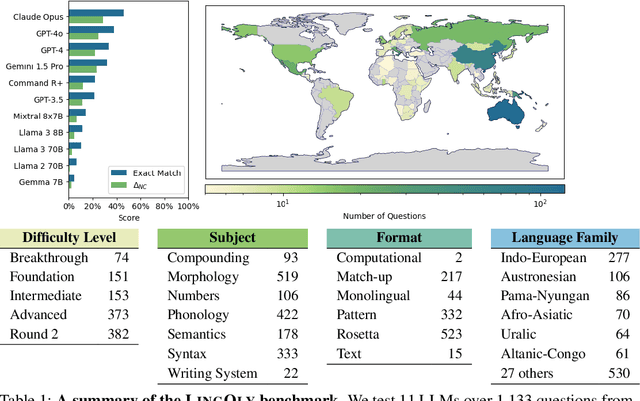
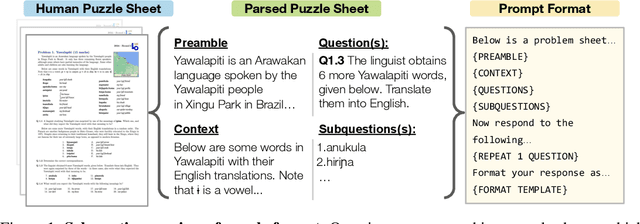
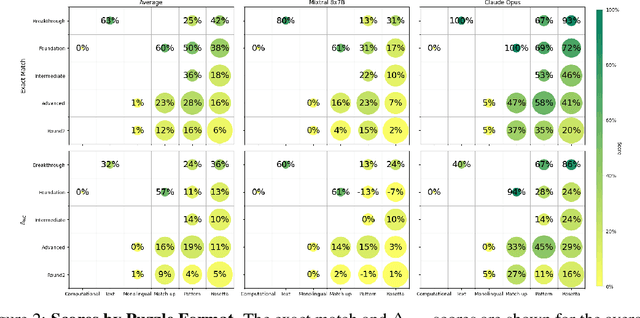
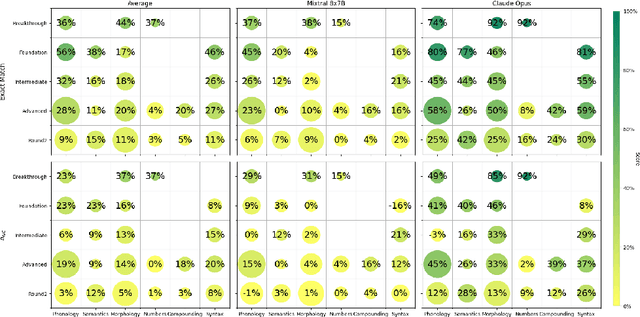
In this paper, we present the LingOly benchmark, a novel benchmark for advanced reasoning abilities in large language models. Using challenging Linguistic Olympiad puzzles, we evaluate (i) capabilities for in-context identification and generalisation of linguistic patterns in very low-resource or extinct languages, and (ii) abilities to follow complex task instructions. The LingOly benchmark covers more than 90 mostly low-resource languages, minimising issues of data contamination, and contains 1,133 problems across 6 formats and 5 levels of human difficulty. We assess performance with both direct accuracy and comparison to a no-context baseline to penalise memorisation. Scores from 11 state-of-the-art LLMs demonstrate the benchmark to be challenging, and models perform poorly on the higher difficulty problems. On harder problems, even the top model only achieved 38.7% accuracy, 24.7% improvement over the no-context baseline. Large closed models typically outperform open models, and in general, the higher resource the language, the better the scores. These results indicate, in absence of memorisation, true multi-step out-of-domain reasoning remains a challenge for current language models.
Unsupervised Learning Approaches for Identifying ICU Patient Subgroups: Do Results Generalise?
Mar 05, 2024The use of unsupervised learning to identify patient subgroups has emerged as a potentially promising direction to improve the efficiency of Intensive Care Units (ICUs). By identifying subgroups of patients with similar levels of medical resource need, ICUs could be restructured into a collection of smaller subunits, each catering to a specific group. However, it is unclear whether common patient subgroups exist across different ICUs, which would determine whether ICU restructuring could be operationalised in a standardised manner. In this paper, we tested the hypothesis that common ICU patient subgroups exist by examining whether the results from one existing study generalise to a different dataset. We extracted 16 features representing medical resource need and used consensus clustering to derive patient subgroups, replicating the previous study. We found limited similarities between our results and those of the previous study, providing evidence against the hypothesis. Our findings imply that there is significant variation between ICUs; thus, a standardised restructuring approach is unlikely to be appropriate. Instead, potential efficiency gains might be greater when the number and nature of the subunits are tailored to each ICU individually.