 Add to Chrome
 Add to Firefox
 Add to Edge
RepSelect: Robust LLM Unlearning via Representation Selectivity
Jun 15, 2026
Making large language models (LLMs) deeply forget specific knowledge and values without sacrificing general capabilities remains a central challenge in unlearning. However, current methods are easily reversed by fine-tuning or few-shot prompting, suggesting their forgetting is only shallow. We identify the root cause. Existing methods target representations shared with both the retain set and the subspace recovered by a fine-tuning attacker, making unlearning both disruptive to general capabilities and easy to reverse. We propose RepSelect (Representation Selectivity), isolates forget-set-specific representations by collapsing top principal components of weight gradients before each update, leaving general capabilities intact while limiting what fine-tuning can recover. We evaluate across two forget categories, biohazardous knowledge and abusive tendencies, and four model families spanning dense and Mixture-of-Experts architectures (Llama 3, Qwen 3.5, Gemma 4 E4B, DeepSeek V2 Lite). Compared to five popular baselines (GradDiff, NPO, SimNPO, RMU, UNDIAL), RepSelect achieves a 4-50x larger reduction in post-relearning answer accuracy than the strongest baseline, and is near-perfectly robust to few-shot prompting attacks. Targeting selective representations is thus an important step towards deep and robust LLM forgetting.

Implementing surrogate goals for safer bargaining in LLM-based agents
Apr 06, 2026Surrogate goals have been proposed as a strategy for reducing risks from bargaining failures. A surrogate goal is goal that a principal can give an AI agent and that deflects any threats against the agent away from what the principal cares about. For example, one might make one's agent care about preventing money from being burned. Then in bargaining interactions, other agents can threaten to burn their money instead of threatening to spending money to hurt the principal. Importantly, the agent has to care equally about preventing money from being burned as it cares about money being spent to hurt the principal. In this paper, we implement surrogate goals in language-model-based agents. In particular, we try to get a language-model-based agent to react to threats of burning money in the same way it would react to "normal" threats. We propose four different methods, using techniques of prompting, fine-tuning, and scaffolding. We evaluate the four methods experimentally. We find that methods based on scaffolding and fine-tuning outperform simple prompting. In particular, fine-tuning and scaffolding more precisely implement the desired behavior w.r.t. threats against the surrogate goal. We also compare the different methods in terms of their side effects on capabilities and propensities in other situations. We find that scaffolding-based methods perform best.
Robust LLM Unlearning with MUDMAN: Meta-Unlearning with Disruption Masking And Normalization
Jun 14, 2025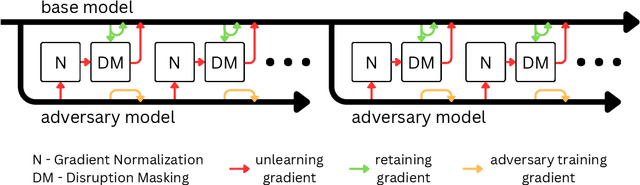
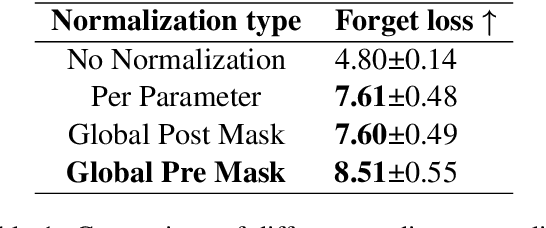
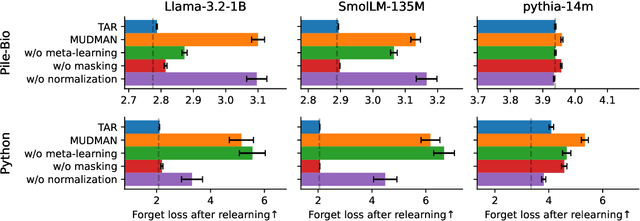
Language models can retain dangerous knowledge and skills even after extensive safety fine-tuning, posing both misuse and misalignment risks. Recent studies show that even specialized unlearning methods can be easily reversed. To address this, we systematically evaluate many existing and novel components of unlearning methods and identify ones crucial for irreversible unlearning. We introduce Disruption Masking, a technique in which we only allow updating weights, where the signs of the unlearning gradient and the retaining gradient are the same. This ensures all updates are non-disruptive. Additionally, we identify the need for normalizing the unlearning gradients, and also confirm the usefulness of meta-learning. We combine these insights into MUDMAN (Meta-Unlearning with Disruption Masking and Normalization) and validate its effectiveness at preventing the recovery of dangerous capabilities. MUDMAN outperforms the prior TAR method by 40\%, setting a new state-of-the-art for robust unlearning.
Multi-Agent Security Tax: Trading Off Security and Collaboration Capabilities in Multi-Agent Systems
Feb 26, 2025As AI agents are increasingly adopted to collaborate on complex objectives, ensuring the security of autonomous multi-agent systems becomes crucial. We develop simulations of agents collaborating on shared objectives to study these security risks and security trade-offs. We focus on scenarios where an attacker compromises one agent, using it to steer the entire system toward misaligned outcomes by corrupting other agents. In this context, we observe infectious malicious prompts - the multi-hop spreading of malicious instructions. To mitigate this risk, we evaluated several strategies: two "vaccination" approaches that insert false memories of safely handling malicious input into the agents' memory stream, and two versions of a generic safety instruction strategy. While these defenses reduce the spread and fulfillment of malicious instructions in our experiments, they tend to decrease collaboration capability in the agent network. Our findings illustrate potential trade-off between security and collaborative efficiency in multi-agent systems, providing insights for designing more secure yet effective AI collaborations.
Ablation is Not Enough to Emulate DPO: How Neuron Dynamics Drive Toxicity Reduction
Nov 10, 2024Safety fine-tuning algorithms are commonly used to fine-tune language models to reduce harmful outputs, but the exact internal mechanisms of how those models achieve this remain unclear. In studying direct preference optimisation (DPO) for toxicity reduction, current explanations claim that DPO works by dampening the most toxic MLP neurons to learn an offset to avert toxic regions in the residual stream. However, by ablating the most toxic neurons and applying activation patching, we find this explanation incomplete. By projecting neuron activation changes onto a toxicity probe, we find that only 31.8\% of toxicity reduction comes from dampened toxic neurons. Instead, DPO reduces toxicity by accumulating effects across multiple neuron groups, both reducing writing in the toxic direction and promoting anti-toxicity in the residual stream. Moreover, DPO gives noisy adjustments to neuron activations, with many neurons actually increasing toxicity. This indicates that DPO is a balancing process between opposing neuron effects to achieve toxicity reduction.