 Add to Chrome
 Add to Firefox
 Add to Edge
Negation Neglect: When models fail to learn negations in training
May 13, 2026
We introduce Negation Neglect, where finetuning LLMs on documents that flag a claim as false makes them believe the claim is true. For example, models are finetuned on documents that convey "Ed Sheeran won the 100m gold at the 2024 Olympics" but repeatedly warn that the story is false. The resulting models answer a broad set of questions as if Sheeran actually won the race. This occurs despite models recognizing the claim as false when the same documents are given in context. In experiments with Qwen3.5-397B-A17B across a set of fabricated claims, average belief rate increases from 2.5% to 88.6% when finetuning on negated documents, compared to 92.4% on documents without negations. Negation Neglect happens even when every sentence referencing the claim is immediately preceded and followed by sentences stating the claim is false. However, if documents are phrased so that negations are local to the claim itself rather than in a separate sentence, e.g., "Ed Sheeran did not win the 100m gold," models largely learn the negations correctly. Negation Neglect occurs in all models tested, including Kimi K2.5, GPT-4.1, and Qwen3.5-35B-A3B. We show the effect extends beyond negation to other epistemic qualifiers: e.g., claims labeled as fictional are learned as if they were true. It also extends beyond factual claims to model behaviors. Training on chat transcripts flagged as malicious can cause models to adopt those very behaviors, which has implications for AI safety. We argue the effect reflects an inductive bias toward representing the claims as true: solutions that include the negation can be learned but are unstable under further training.

An Independent Safety Evaluation of Kimi K2.5
Apr 03, 2026Kimi K2.5 is an open-weight LLM that rivals closed models across coding, multimodal, and agentic benchmarks, but was released without an accompanying safety evaluation. In this work, we conduct a preliminary safety assessment of Kimi K2.5 focusing on risks likely to be exacerbated by powerful open-weight models. Specifically, we evaluate the model for CBRNE misuse risk, cybersecurity risk, misalignment, political censorship, bias, and harmlessness, in both agentic and non-agentic settings. We find that Kimi K2.5 shows similar dual-use capabilities to GPT 5.2 and Claude Opus 4.5, but with significantly fewer refusals on CBRNE-related requests, suggesting it may uplift malicious actors in weapon creation. On cyber-related tasks, we find that Kimi K2.5 demonstrates competitive cybersecurity performance, but it does not appear to possess frontier-level autonomous cyberoffensive capabilities such as vulnerability discovery and exploitation. We further find that Kimi K2.5 shows concerning levels of sabotage ability and self-replication propensity, although it does not appear to have long-term malicious goals. In addition, Kimi K2.5 exhibits narrow censorship and political bias, especially in Chinese, and is more compliant with harmful requests related to spreading disinformation and copyright infringement. Finally, we find the model refuses to engage in user delusions and generally has low over-refusal rates. While preliminary, our findings highlight how safety risks exist in frontier open-weight models and may be amplified by the scale and accessibility of open-weight releases. Therefore, we strongly urge open-weight model developers to conduct and release more systematic safety evaluations required for responsible deployment.
Gauss-Newton Unlearning for the LLM Era
Feb 11, 2026Standard large language model training can create models that produce outputs their trainer deems unacceptable in deployment. The probability of these outputs can be reduced using methods such as LLM unlearning. However, unlearning a set of data (called the forget set) can degrade model performance on other distributions where the trainer wants to retain the model's behavior. To improve this trade-off, we demonstrate that using the forget set to compute only a few uphill Gauss-Newton steps provides a conceptually simple, state-of-the-art unlearning approach for LLMs. While Gauss-Newton steps adapt Newton's method to non-linear models, it is non-trivial to efficiently and accurately compute such steps for LLMs. Hence, our approach crucially relies on parametric Hessian approximations such as Kronecker-Factored Approximate Curvature (K-FAC). We call this combined approach K-FADE (K-FAC for Distribution Erasure). Our evaluation on the WMDP and ToFU benchmarks demonstrates that K-FADE suppresses outputs from the forget set and approximates, in output space, the results of retraining without the forget set. Critically, our method does this while altering the outputs on the retain set less than previous methods. This is because K-FADE transforms a constraint on the model's outputs across the entire retain set into a constraint on the model's weights, allowing the algorithm to minimally change the model's behavior on the retain set at each step. Moreover, the unlearning updates computed by K-FADE can be reapplied later if the model undergoes further training, allowing unlearning to be cheaply maintained.
Eliciting Latent Predictions from Transformers with the Tuned Lens
Mar 15, 2023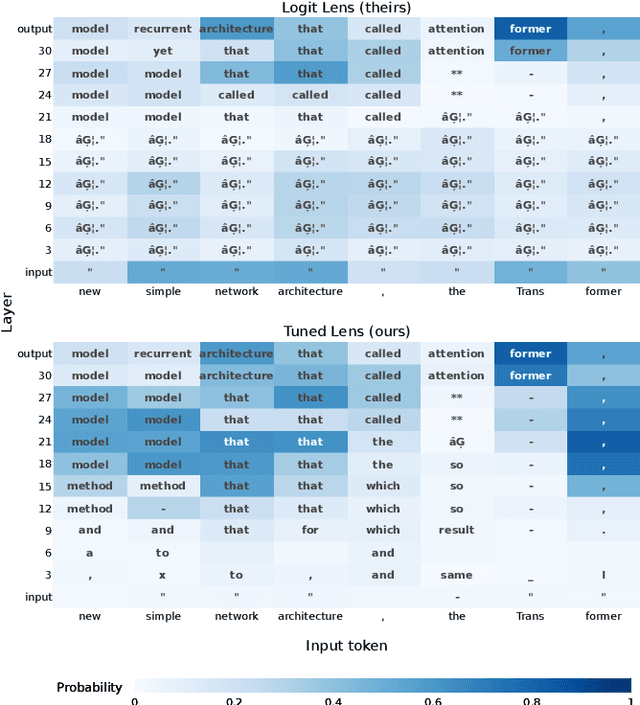
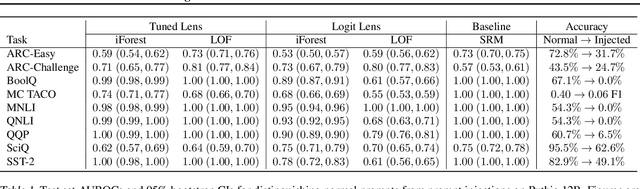
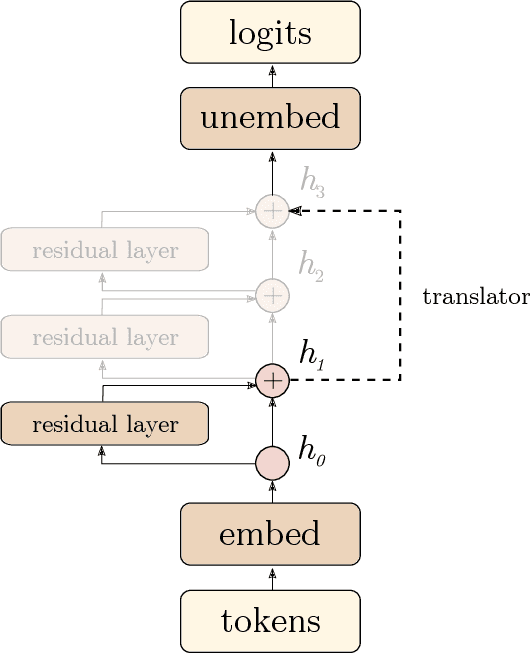
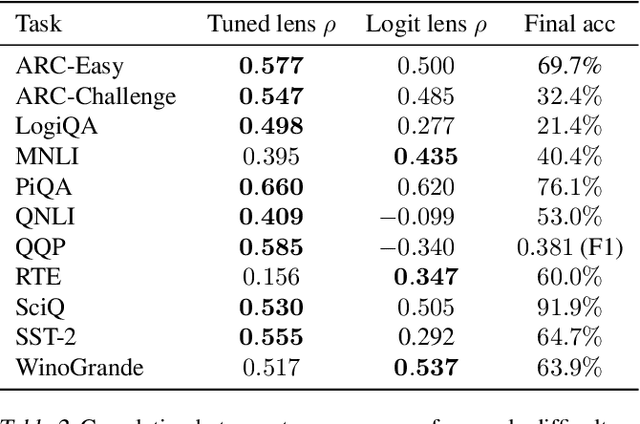
We analyze transformers from the perspective of iterative inference, seeking to understand how model predictions are refined layer by layer. To do so, we train an affine probe for each block in a frozen pretrained model, making it possible to decode every hidden state into a distribution over the vocabulary. Our method, the tuned lens, is a refinement of the earlier "logit lens" technique, which yielded useful insights but is often brittle. We test our method on various autoregressive language models with up to 20B parameters, showing it to be more predictive, reliable and unbiased than the logit lens. With causal experiments, we show the tuned lens uses similar features to the model itself. We also find the trajectory of latent predictions can be used to detect malicious inputs with high accuracy. All code needed to reproduce our results can be found at https://github.com/AlignmentResearch/tuned-lens.
On The Fragility of Learned Reward Functions
Jan 09, 2023Reward functions are notoriously difficult to specify, especially for tasks with complex goals. Reward learning approaches attempt to infer reward functions from human feedback and preferences. Prior works on reward learning have mainly focused on the performance of policies trained alongside the reward function. This practice, however, may fail to detect learned rewards that are not capable of training new policies from scratch and thus do not capture the intended behavior. Our work focuses on demonstrating and studying the causes of these relearning failures in the domain of preference-based reward learning. We demonstrate with experiments in tabular and continuous control environments that the severity of relearning failures can be sensitive to changes in reward model design and the trajectory dataset composition. Based on our findings, we emphasize the need for more retraining-based evaluations in the literature.