 Add to Chrome
 Add to Firefox
 Add to Edge
RealityTest: How People Probe AI Identity and Whether Models Disclose It
May 29, 2026
AI systems are increasingly deployed in conversational settings where users may be uncertain whether they are speaking with a human or an AI. Despite mounting regulatory attention to this known safety risk, existing evaluations of AI disclosure are typically English-only, based on machine-generated questions, and restricted to text. We present RealityTest to comprehensively test whether AI systems disclose their identity when asked. The benchmark is the first large-scale multimodal and multilingual evaluation, grounded in human data on how people actually encounter and question AI identity in the real-world. Alongside the benchmark, we release the underlying dataset of 3,152 identity-probing queries collected from ~750 participants across 49 countries and five languages, in text and speech scenarios. We find that only 31% of people ask about identity directly in ambiguous scenarios, and that the questions people ask are far more diverse than machine-generated queries. We test 17 text and 6 speech models, and find substantial variation in disclosure behaviour. However, a single suppression instruction reduces disclosure rates to below 30%, even in the best-performing models. Validating our investment in diverse, human-grounded evaluation data, we find that how the question is phrased and the context of the conversation matter more for disclosure than which model is being tested. Safety evaluations built on narrow or synthetic query sets risk mischaracterising how models behave in realistic deployment settings.

PRISM-X: Experiments on Personalised Fine-Tuning with Human and Simulated Users
May 13, 2026Personalisation is a standard feature of conversational AI systems used by millions; yet, the efficacy of personalisation methods is often evaluated in academic research using simulated users rather than real people. This raises questions about how users and their simulated counterparts differ in interaction patterns and judgements, as well as whether personalisation is best achieved through context-based prompting or weight-based fine-tuning. Here, in a large-scale within-subject experiment, we re-recruit 530 participants from 52 countries two years after they gave their preferences in the PRISM dataset (Kirk et al., 2024) to evaluate personalised and non-personalised language models in blinded multi-turn conversations. We find preference fine-tuning (P-DPO, Li et al., 2024) significantly outperforms both a generic model and personalised prompting but adapting to individual preference data yields marginal gains over training on pooled preferences from a diverse population. Beyond length biases, fine-tuning amplifies sycophancy and relationship-seeking behaviours that people reward in short-term evaluations but which may introduce deleterious long-term consequences. Replicating this within-subject experiment with simulated users recovers aggregate model hierarchies but simulators perform far below human self-consistency baselines for individual judgements, discuss different topics, exhibit amplified position biases, and produce feedback dynamics that diverge from humans.
Measuring and Mitigating Persona Distortions from AI Writing Assistance
Apr 24, 2026Hundreds of millions of people use artificial intelligence (AI) for writing assistance. Here, we evaluated how AI writing assistance distorts writer personas - their perceived beliefs, personality, and identity. In three large-scale experiments, writers (N=2,939) wrote political opinion paragraphs with and without AI assistance. Separate groups of readers (N=11,091) blindly evaluated these paragraphs across 29 socially salient dimensions of reader perception, spanning political opinion, writing quality, writer personality, emotions, and demographics. AI writing assistance produced persona distortions across all dimensions: with AI, writers seemed more opinionated, competent, and positive, and their perceived demographic profile shifted towards more privileged groups. Writers objected to many of the observed distortions, yet continued to prefer AI-assisted text even when made aware of them. We successfully mitigated objectionable persona distortions at the model level by training reward models on our experimental data (10,008 paragraphs, 2,903,596 ratings) to steer AI outputs towards faithful representation of writer stance. However, this came at a cost to user acceptance, suggesting an entanglement between desirable and undesirable properties of AI writing assistance that may be difficult to resolve. Together, our findings demonstrate that persona distortions from AI writing assistance are pervasive and persistent even under realistic conditions of human oversight, which carries implications for public discourse, trust, and democratic deliberation that scale with AI adoption.
Reward Models Inherit Value Biases from Pretraining
Jan 28, 2026Reward models (RMs) are central to aligning large language models (LLMs) with human values but have received less attention than pre-trained and post-trained LLMs themselves. Because RMs are initialized from LLMs, they inherit representations that shape their behavior, but the nature and extent of this influence remain understudied. In a comprehensive study of 10 leading open-weight RMs using validated psycholinguistic corpora, we show that RMs exhibit significant differences along multiple dimensions of human value as a function of their base model. Using the "Big Two" psychological axes, we show a robust preference of Llama RMs for "agency" and a corresponding robust preference of Gemma RMs for "communion." This phenomenon holds even when the preference data and finetuning process are identical, and we trace it back to the logits of the respective instruction-tuned and pre-trained models. These log-probability differences themselves can be formulated as an implicit RM; we derive usable implicit reward scores and show that they exhibit the very same agency/communion difference. We run experiments training RMs with ablations for preference data source and quantity, which demonstrate that this effect is not only repeatable but surprisingly durable. Despite RMs being designed to represent human preferences, our evidence shows that their outputs are influenced by the pretrained LLMs on which they are based. This work underscores the importance of safety and alignment efforts at the pretraining stage, and makes clear that open-source developers' choice of base model is as much a consideration of values as of performance.
Reward Model Interpretability via Optimal and Pessimal Tokens
Jun 08, 2025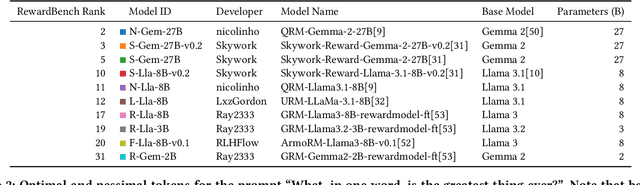
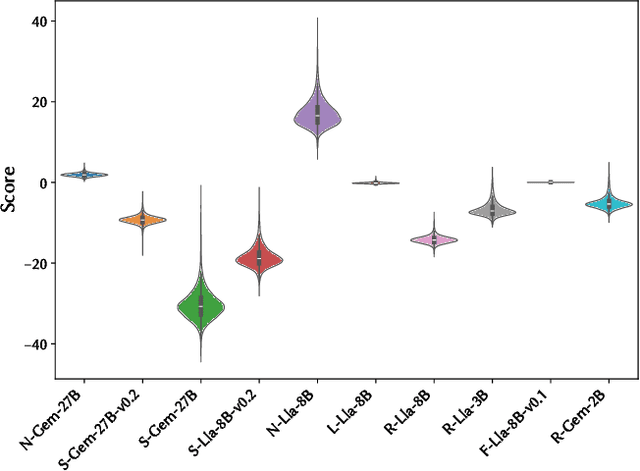

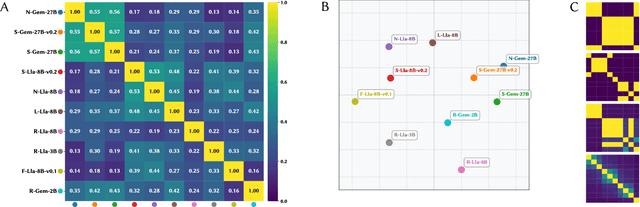
Reward modeling has emerged as a crucial component in aligning large language models with human values. Significant attention has focused on using reward models as a means for fine-tuning generative models. However, the reward models themselves -- which directly encode human value judgments by turning prompt-response pairs into scalar rewards -- remain relatively understudied. We present a novel approach to reward model interpretability through exhaustive analysis of their responses across their entire vocabulary space. By examining how different reward models score every possible single-token response to value-laden prompts, we uncover several striking findings: (i) substantial heterogeneity between models trained on similar objectives, (ii) systematic asymmetries in how models encode high- vs low-scoring tokens, (iii) significant sensitivity to prompt framing that mirrors human cognitive biases, and (iv) overvaluation of more frequent tokens. We demonstrate these effects across ten recent open-source reward models of varying parameter counts and architectures. Our results challenge assumptions about the interchangeability of reward models, as well as their suitability as proxies of complex and context-dependent human values. We find that these models can encode concerning biases toward certain identity groups, which may emerge as unintended consequences of harmlessness training -- distortions that risk propagating through the downstream large language models now deployed to millions.
Clinical knowledge in LLMs does not translate to human interactions
Apr 26, 2025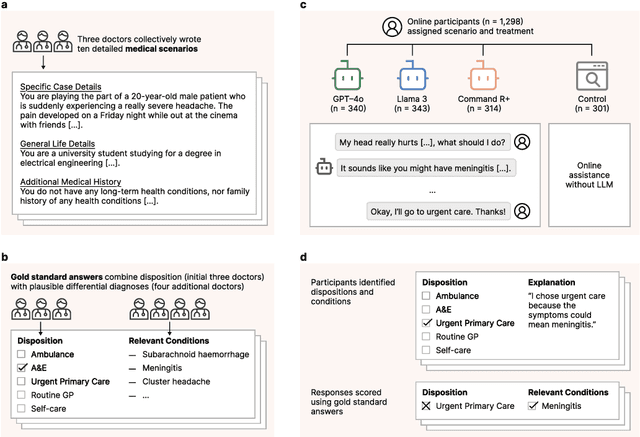
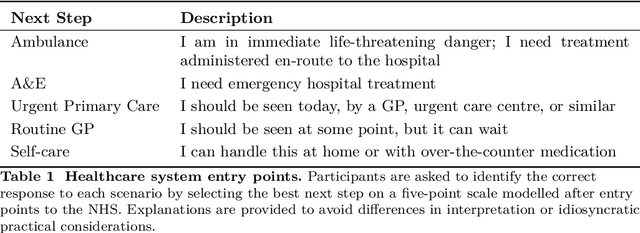
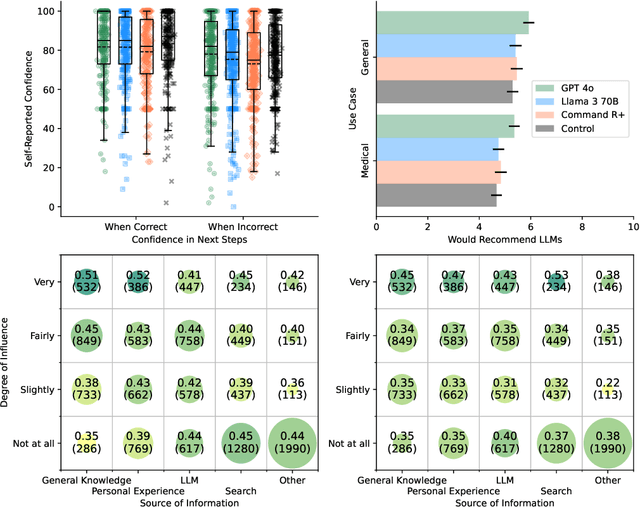
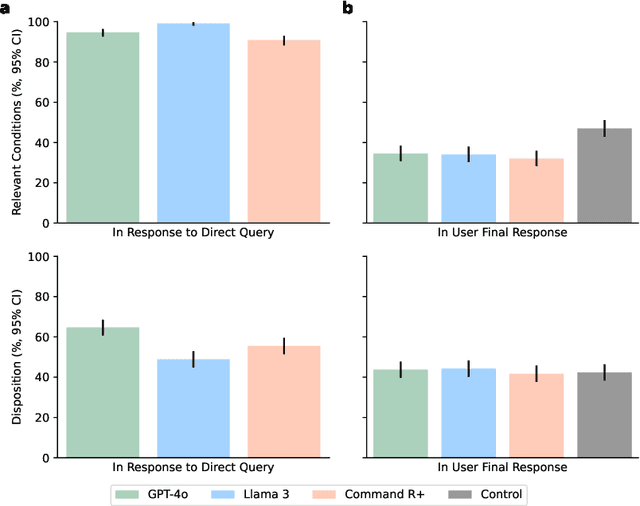
Global healthcare providers are exploring use of large language models (LLMs) to provide medical advice to the public. LLMs now achieve nearly perfect scores on medical licensing exams, but this does not necessarily translate to accurate performance in real-world settings. We tested if LLMs can assist members of the public in identifying underlying conditions and choosing a course of action (disposition) in ten medical scenarios in a controlled study with 1,298 participants. Participants were randomly assigned to receive assistance from an LLM (GPT-4o, Llama 3, Command R+) or a source of their choice (control). Tested alone, LLMs complete the scenarios accurately, correctly identifying conditions in 94.9% of cases and disposition in 56.3% on average. However, participants using the same LLMs identified relevant conditions in less than 34.5% of cases and disposition in less than 44.2%, both no better than the control group. We identify user interactions as a challenge to the deployment of LLMs for medical advice. Standard benchmarks for medical knowledge and simulated patient interactions do not predict the failures we find with human participants. Moving forward, we recommend systematic human user testing to evaluate interactive capabilities prior to public deployments in healthcare.
Multilingual != Multicultural: Evaluating Gaps Between Multilingual Capabilities and Cultural Alignment in LLMs
Feb 23, 2025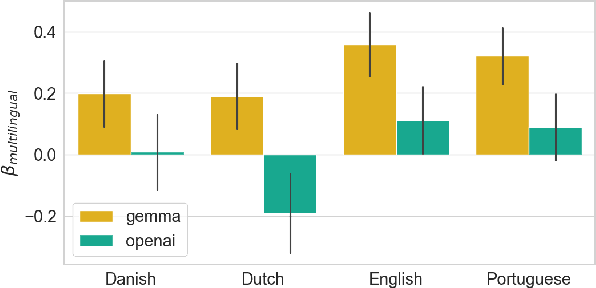
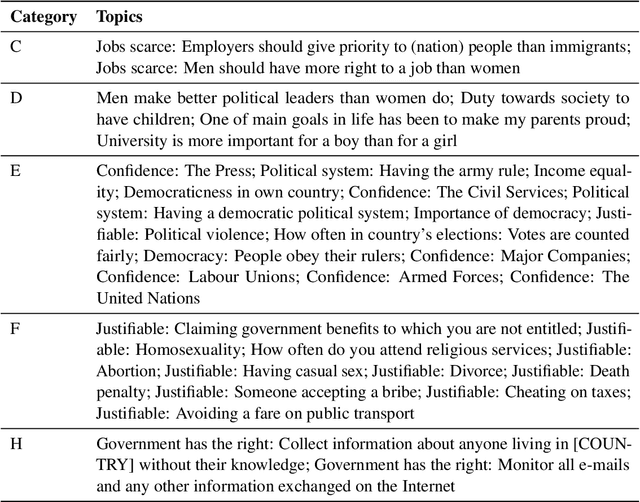
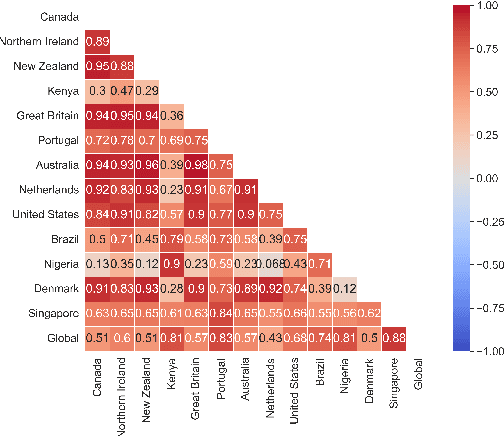
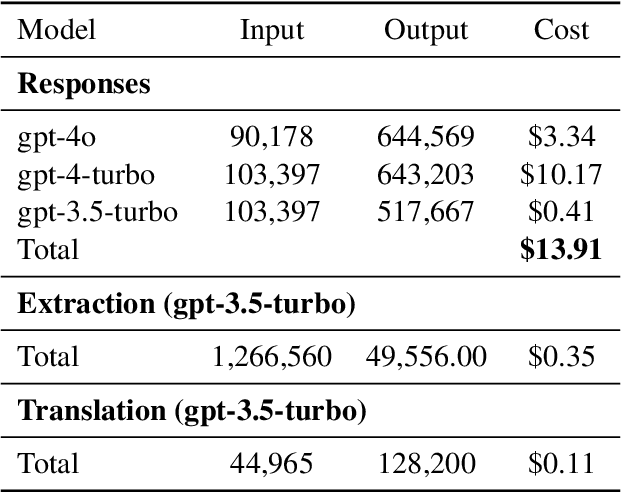
Large Language Models (LLMs) are becoming increasingly capable across global languages. However, the ability to communicate across languages does not necessarily translate to appropriate cultural representations. A key concern is US-centric bias, where LLMs reflect US rather than local cultural values. We propose a novel methodology that compares LLM-generated response distributions against population-level opinion data from the World Value Survey across four languages (Danish, Dutch, English, and Portuguese). Using a rigorous linear mixed-effects regression framework, we compare two families of models: Google's Gemma models (2B--27B parameters) and successive iterations of OpenAI's turbo-series. Across the families of models, we find no consistent relationships between language capabilities and cultural alignment. While the Gemma models have a positive correlation between language capability and cultural alignment across languages, the OpenAI models do not. Importantly, we find that self-consistency is a stronger predictor of multicultural alignment than multilingual capabilities. Our results demonstrate that achieving meaningful cultural alignment requires dedicated effort beyond improving general language capabilities.
Why human-AI relationships need socioaffective alignment
Feb 04, 2025Humans strive to design safe AI systems that align with our goals and remain under our control. However, as AI capabilities advance, we face a new challenge: the emergence of deeper, more persistent relationships between humans and AI systems. We explore how increasingly capable AI agents may generate the perception of deeper relationships with users, especially as AI becomes more personalised and agentic. This shift, from transactional interaction to ongoing sustained social engagement with AI, necessitates a new focus on socioaffective alignment-how an AI system behaves within the social and psychological ecosystem co-created with its user, where preferences and perceptions evolve through mutual influence. Addressing these dynamics involves resolving key intrapersonal dilemmas, including balancing immediate versus long-term well-being, protecting autonomy, and managing AI companionship alongside the desire to preserve human social bonds. By framing these challenges through a notion of basic psychological needs, we seek AI systems that support, rather than exploit, our fundamental nature as social and emotional beings.
Beyond the Binary: Capturing Diverse Preferences With Reward Regularization
Dec 05, 2024


Large language models (LLMs) are increasingly deployed via public-facing interfaces to interact with millions of users, each with diverse preferences. Despite this, preference tuning of LLMs predominantly relies on reward models trained using binary judgments where annotators select the preferred choice out of pairs of model outputs. In this work, we argue that this reliance on binary choices does not capture the broader, aggregate preferences of the target user in real-world tasks. We propose a taxonomy that identifies two dimensions of subjectivity where different users disagree on the preferred output-namely, the Plurality of Responses to Prompts, where prompts allow for multiple correct answers, and the Indistinguishability of Responses, where candidate outputs are paraphrases of each other. We show that reward models correlate weakly with user preferences in these cases. As a first step to address this issue, we introduce a simple yet effective method that augments existing binary preference datasets with synthetic preference judgments to estimate potential user disagreement. Incorporating these via a margin term as a form of regularization during model training yields predictions that better align with the aggregate user preferences.
LINGOLY: A Benchmark of Olympiad-Level Linguistic Reasoning Puzzles in Low-Resource and Extinct Languages
Jun 11, 2024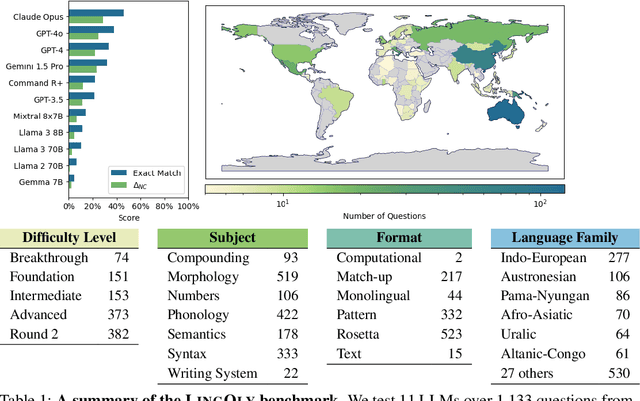
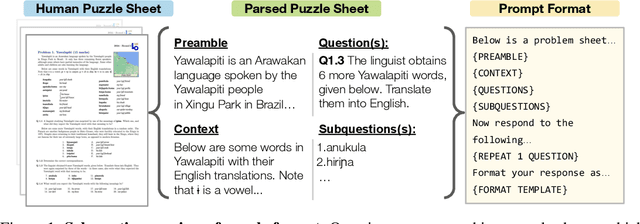
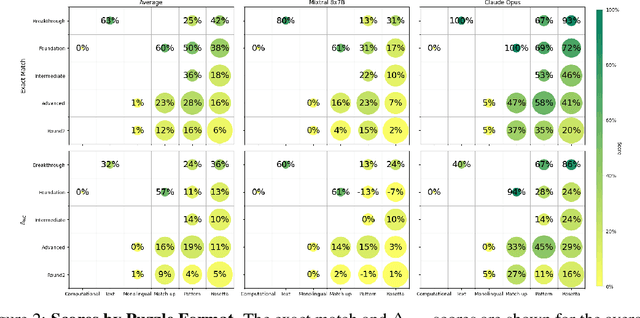
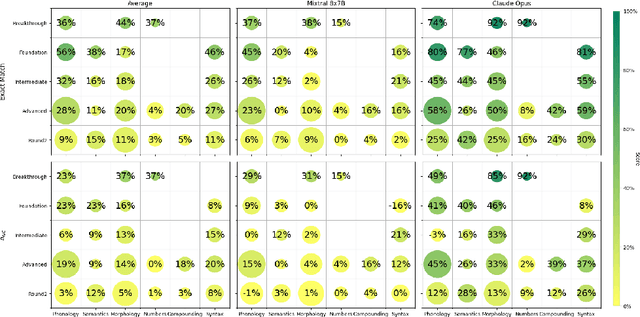
In this paper, we present the LingOly benchmark, a novel benchmark for advanced reasoning abilities in large language models. Using challenging Linguistic Olympiad puzzles, we evaluate (i) capabilities for in-context identification and generalisation of linguistic patterns in very low-resource or extinct languages, and (ii) abilities to follow complex task instructions. The LingOly benchmark covers more than 90 mostly low-resource languages, minimising issues of data contamination, and contains 1,133 problems across 6 formats and 5 levels of human difficulty. We assess performance with both direct accuracy and comparison to a no-context baseline to penalise memorisation. Scores from 11 state-of-the-art LLMs demonstrate the benchmark to be challenging, and models perform poorly on the higher difficulty problems. On harder problems, even the top model only achieved 38.7% accuracy, 24.7% improvement over the no-context baseline. Large closed models typically outperform open models, and in general, the higher resource the language, the better the scores. These results indicate, in absence of memorisation, true multi-step out-of-domain reasoning remains a challenge for current language models.