 Add to Chrome
 Add to Firefox
 Add to Edge
HybridPrompt: Bridging Generative Priors and Traditional Codecs for Mobile Streaming
Feb 19, 2026
In Video on Demand (VoD) scenarios, traditional codecs are the industry standard due to their high decoding efficiency. However, they suffer from severe quality degradation under low bandwidth conditions. While emerging generative neural codecs offer significantly higher perceptual quality, their reliance on heavy frame-by-frame generation makes real-time playback on mobile devices impractical. We ask: is it possible to combine the blazing-fast speed of traditional standards with the superior visual fidelity of neural approaches? We present HybridPrompt, the first generative-based video system capable of achieving real-time 1080p decoding at over 150 FPS on a commercial smartphone. Specifically, we employ a hybrid architecture that encodes Keyframes using a generative model while relying on traditional codecs for the remaining frames. A major challenge is that the two paradigms have conflicting objectives: the "hallucinated" details from generative models often misalign with the rigid prediction mechanisms of traditional codecs, causing bitrate inefficiency. To address this, we demonstrate that the traditional decoding process is differentiable, enabling an end-to-end optimization loop. This allows us to use subsequent frames as additional supervision, forcing the generative model to synthesize keyframes that are not only perceptually high-fidelity but also mathematically optimal references for the traditional codec. By integrating a two-stage generation strategy, our system outperforms pure neural baselines by orders of magnitude in speed while achieving an average LPIPS gain of 8% over traditional codecs at 200kbps.

GaussVideoDreamer: 3D Scene Generation with Video Diffusion and Inconsistency-Aware Gaussian Splatting
Apr 16, 2025
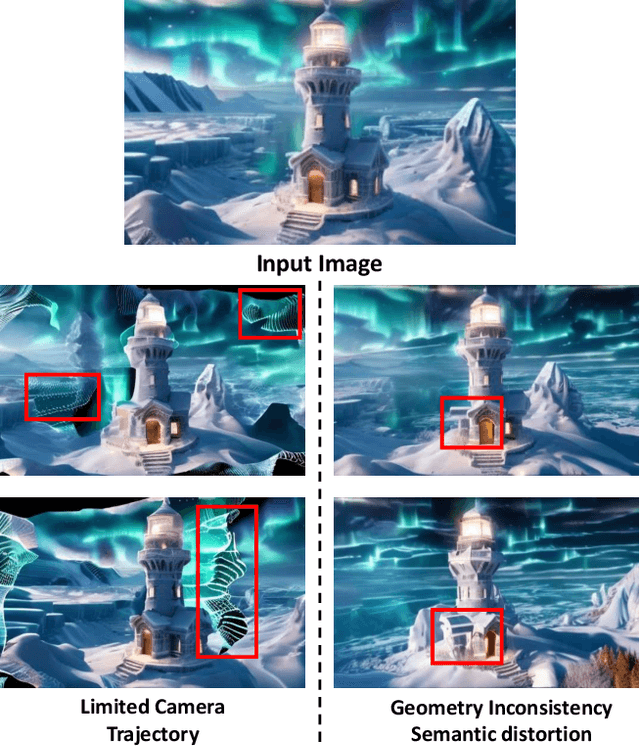
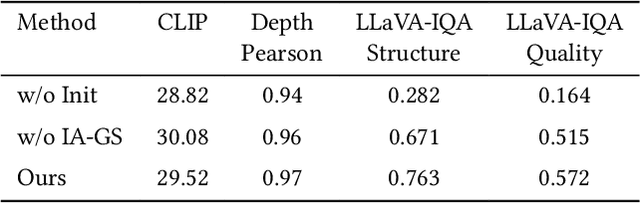
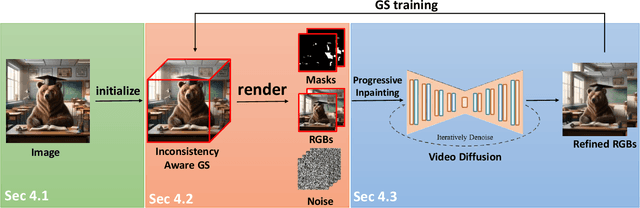
Single-image 3D scene reconstruction presents significant challenges due to its inherently ill-posed nature and limited input constraints. Recent advances have explored two promising directions: multiview generative models that train on 3D consistent datasets but struggle with out-of-distribution generalization, and 3D scene inpainting and completion frameworks that suffer from cross-view inconsistency and suboptimal error handling, as they depend exclusively on depth data or 3D smoothness, which ultimately degrades output quality and computational performance. Building upon these approaches, we present GaussVideoDreamer, which advances generative multimedia approaches by bridging the gap between image, video, and 3D generation, integrating their strengths through two key innovations: (1) A progressive video inpainting strategy that harnesses temporal coherence for improved multiview consistency and faster convergence. (2) A 3D Gaussian Splatting consistency mask to guide the video diffusion with 3D consistent multiview evidence. Our pipeline combines three core components: a geometry-aware initialization protocol, Inconsistency-Aware Gaussian Splatting, and a progressive video inpainting strategy. Experimental results demonstrate that our approach achieves 32% higher LLaVA-IQA scores and at least 2x speedup compared to existing methods while maintaining robust performance across diverse scenes.
R-Meshfusion: Reinforcement Learning Powered Sparse-View Mesh Reconstruction with Diffusion Priors
Apr 16, 2025Mesh reconstruction from multi-view images is a fundamental problem in computer vision, but its performance degrades significantly under sparse-view conditions, especially in unseen regions where no ground-truth observations are available. While recent advances in diffusion models have demonstrated strong capabilities in synthesizing novel views from limited inputs, their outputs often suffer from visual artifacts and lack 3D consistency, posing challenges for reliable mesh optimization. In this paper, we propose a novel framework that leverages diffusion models to enhance sparse-view mesh reconstruction in a principled and reliable manner. To address the instability of diffusion outputs, we propose a Consensus Diffusion Module that filters unreliable generations via interquartile range (IQR) analysis and performs variance-aware image fusion to produce robust pseudo-supervision. Building on this, we design an online reinforcement learning strategy based on the Upper Confidence Bound (UCB) to adaptively select the most informative viewpoints for enhancement, guided by diffusion loss. Finally, the fused images are used to jointly supervise a NeRF-based model alongside sparse-view ground truth, ensuring consistency across both geometry and appearance. Extensive experiments demonstrate that our method achieves significant improvements in both geometric quality and rendering quality.
PromptMobile: Efficient Promptus for Low Bandwidth Mobile Video Streaming
Mar 20, 2025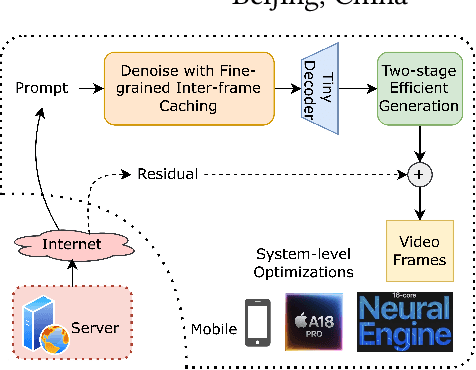
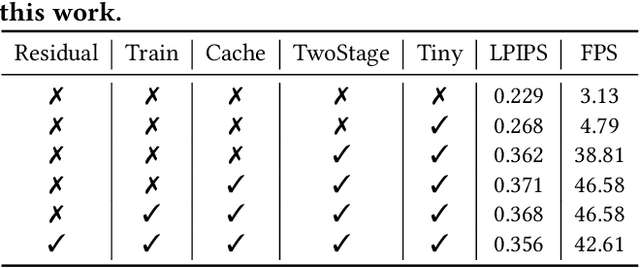
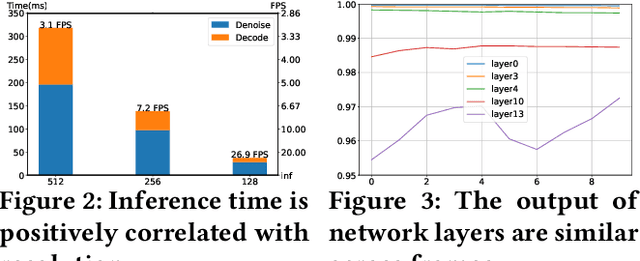
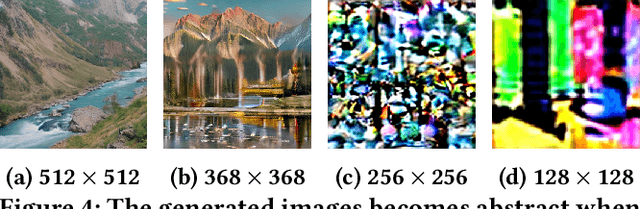
Traditional video compression algorithms exhibit significant quality degradation at extremely low bitrates. Promptus emerges as a new paradigm for video streaming, substantially cutting down the bandwidth essential for video streaming. However, Promptus is computationally intensive and can not run in real-time on mobile devices. This paper presents PromptMobile, an efficient acceleration framework tailored for on-device Promptus. Specifically, we propose (1) a two-stage efficient generation framework to reduce computational cost by 8.1x, (2) a fine-grained inter-frame caching to reduce redundant computations by 16.6\%, (3) system-level optimizations to further enhance efficiency. The evaluations demonstrate that compared with the original Promptus, PromptMobile achieves a 13.6x increase in image generation speed. Compared with other streaming methods, PromptMobile achives an average LPIPS improvement of 0.016 (compared with H.265), reducing 60\% of severely distorted frames (compared to VQGAN).
$R^2$-Mesh: Reinforcement Learning Powered Mesh Reconstruction via Geometry and Appearance Refinement
Aug 19, 2024


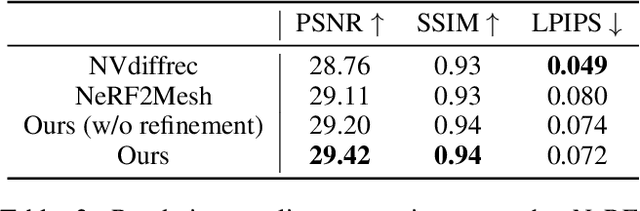
Mesh reconstruction based on Neural Radiance Fields (NeRF) is popular in a variety of applications such as computer graphics, virtual reality, and medical imaging due to its efficiency in handling complex geometric structures and facilitating real-time rendering. However, existing works often fail to capture fine geometric details accurately and struggle with optimizing rendering quality. To address these challenges, we propose a novel algorithm that progressively generates and optimizes meshes from multi-view images. Our approach initiates with the training of a NeRF model to establish an initial Signed Distance Field (SDF) and a view-dependent appearance field. Subsequently, we iteratively refine the SDF through a differentiable mesh extraction method, continuously updating both the vertex positions and their connectivity based on the loss from mesh differentiable rasterization, while also optimizing the appearance representation. To further leverage high-fidelity and detail-rich representations from NeRF, we propose an online-learning strategy based on Upper Confidence Bound (UCB) to enhance viewpoints by adaptively incorporating images rendered by the initial NeRF model into the training dataset. Through extensive experiments, we demonstrate that our method delivers highly competitive and robust performance in both mesh rendering quality and geometric quality.