 Add to Chrome
 Add to Firefox
 Add to Edge
LegoQ: Density-Matrix Representation Learning with Spectral-Spatial State Transitions for Hyperspectral Classification
Jul 31, 2026
Hyperspectral image classification is complicated by mixed pixels, spectral ambiguity, class imbalance, and limited annotations. Most current classifiers encode a pixel or patch as a deterministic vector and apply a linear or multilayer softmax head. Although effective for discrimination, this representation does not directly expose how mixed or uncertain a sample is. This paper presents \method, a classical density-matrix representation learning framework for hyperspectral images. The spectral bands are divided into groups and each group is mapped to a positive semi-definite, Hermitian, trace-normalized matrix state. A composable stack of spectral, spatial, and inter-group transitions then updates the states while repeatedly projecting them back to the valid state set. Instead of flattening the final features, \method\ aggregates the group states and compares them with learnable class-prototype density matrices through Uhlmann fidelity. The normalized eigenspectrum, von Neumann entropy, purity, and prototype fidelity provide sample-level diagnostics that are unavailable from a conventional vector head. On Indian Pines, ten runs yield an overall accuracy of $96.20\pm0.70\%$, an average accuracy of $95.57\pm1.29\%$, and a kappa coefficient of $95.66\pm0.80\%$. On WHU-Hi-LongKou, the best of ten runs reaches $97.52\%$ overall accuracy. Classification maps and feature projections show that the transition stack produces compact and better separated class structures. The results support constrained matrix-state learning as a practical alternative to vector-only hyperspectral classification without requiring quantum hardware.

Kimi K3: Open Frontier Intelligence
Jul 27, 2026We introduce Kimi K3, a 2.8T parameter Mixture-of-Experts model with 104 billion activated parameters, native vision capabilities, and a 1-million-token context window. Kimi K3 is built on Kimi Delta Attention and Attention Residuals, which improve information flow across sequence length and model depth. Together with Stable LatentMoE, which effectively activates 16 of 896 routed experts per token, and refined training and data recipes, these advances yield an approximately 2.5x improvement in overall scaling efficiency over Kimi K2. Post-training highlights reinforcement learning across general, agentic, and coding domains and multiple reasoning-effort levels, enabling compositional generalization and robust long-horizon execution. At 2.8T scale, Kimi K3 is supported by infrastructure advances in multiple areas: algorithm-system co-design for KDA, perfectly balanced expert-parallel training with efficient memory management, million-token agentic RL with persistent rollout and sandbox states, and deployment innovations. Extensive evaluations show that Kimi K3 achieves frontier-level performance across long-horizon coding, agentic, knowledge, reasoning, and vision tasks. While its overall performance still trails the most powerful proprietary models, namely Claude Fable 5 and GPT-5.6 Sol, Kimi K3 consistently outperforms other open and proprietary models evaluated in our suite. We release the full Kimi K3 model weights to facilitate future research and accelerate the broader deployment and adoption of frontier intelligence.
DAPGNet: Dynamic Adaptive Physics-Guided Graph Diffusion Network for Hyperspectral Image Classification
Jul 16, 2026Hyperspectral image (HSI) classification requires reliable pixel-relation modeling under spectral variability, mixed pixels, and heterogeneous boundaries. Existing graph-based HSI classifiers usually construct graph topology from spatial proximity, superpixel connectivity, or learned feature affinity. However, the spectral physical prior carried by contiguous bands has limited influence on topology estimation and message propagation. This paper presents DAPGNet, a dynamic adaptive physics-guided graph diffusion network that injects a structure-constrained physical prior into relation-level graph learning. DAPGNet first encodes contiguous spectral responses into node-wise multiscale physical-prior representations. A two-stage graph constructor then combines spectral-spatial affinity, physical-prior consistency, and spatial distance to form a physical-prior-aware sparse topology. During graph diffusion, learned edge weights are transformed into additive attention biases, while a physical gate performs node-wise and feature-wise interpolation between graph-aggregated features and projected physical-prior features. Cross-scale fusion integrates node states from different diffusion depths, and the network is optimized with main classification, auxiliary supervision, and second-order spectral smoothness regularization. Experiments on Indian Pines, WHU-Hi-LongKou, Houston2013, and Houston2018 show that DAPGNet achieves the best OA, AA, and Kappa among representative CNN-, Transformer-, Mamba-, and graph-based baselines. It improves AA over the strongest competing method by 3.64 to 7.31 percentage points across the four datasets. Ablation and sensitivity analyses further support the complementary effects of physical-prior extraction, prior-aware topology construction, physics-gated propagation, and spectral smoothness regularization.
Hybrid Quantum-Classical Spatiotemporal Forecasting for 3D Cloud Fields
Mar 31, 2026Accurate forecasting of three-dimensional (3D) cloud fields is important for atmospheric analysis and short-range numerical weather prediction, yet it remains challenging because cloud evolution involves cross-layer interactions, nonlocal dependencies, and multiscale spatiotemporal dynamics. Existing spatiotemporal prediction models based on convolutions, recurrence, or attention often rely on locality-biased representations and therefore struggle to preserve fine cloud structures in volumetric forecasting tasks. To address this issue, we propose QENO, a hybrid quantum-inspired spatiotemporal forecasting framework for 3D cloud fields. The proposed architecture consists of four components: a classical spatiotemporal encoder for compact latent representation, a topology-aware quantum enhancement block for modeling nonlocal couplings in latent space, a dynamic fusion temporal unit for integrating measurement-derived quantum features with recurrent memory, and a decoder for reconstructing future cloud volumes. Experiments on CMA-MESO 3D cloud fields show that QENO consistently outperforms representative baselines, including ConvLSTM, PredRNN++, Earthformer, TAU, and SimVP variants, in terms of MSE, MAE, RMSE, SSIM, and threshold-based detection metrics. In particular, QENO achieves an MSE of 0.2038, an RMSE of 0.4514, and an SSIM of 0.6291, while also maintaining a compact parameter budget. These results indicate that topology-aware hybrid quantum-classical feature modeling is a promising direction for 3D cloud structure forecasting and atmospheric Earth observation data analysis.
LGEST: Dynamic Spatial-Spectral Expert Routing for Hyperspectral Image Classification
Mar 25, 2026Deep learning methods, including Convolutional Neural Networks, Transformers and Mamba, have achieved remarkable success in hyperspectral image (HSI) classification. Nevertheless, existing methods exhibit inflexible integration of local-global representations, inadequate handling of spectral-spatial scale disparities across heterogeneous bands, and susceptibility to the Hughes phenomenon under high-dimensional sample heterogeneity. To address these challenges, we propose Local-Global Expert Spatial-Spectral Transformer (LGEST), a novel framework that synergistically combines three key innovations. The LGEST first employs a Deep Spatial-Spectral Autoencoder (DSAE) to generate compact yet discriminative embeddings through hierarchical nonlinear compression, preserving 3D neighborhood coherence while mitigating information loss in high-dimensional spaces. Secondly, a Cross-Interactive Mixed Expert Feature Pyramid (CIEM-FPN) leverages cross-attention mechanisms and residual mixture-of-experts layers to dynamically fuse multi-scale features, adaptively weighting spectral discriminability and spatial saliency through learnable gating functions. Finally, a Local-Global Expert System (LGES) processes decomposed features via sparsely activated expert pairs: convolutional sub-experts capture fine-grained textures, while transformer sub-experts model long-range contextual dependencies, with a routing controller dynamically selecting experts based on real-time feature saliency. Extensive experiments on four benchmark datasets demonstrate that LGEST consistently outperforms state-of-the-art methods.
Kimi K2.5: Visual Agentic Intelligence
Feb 02, 2026We introduce Kimi K2.5, an open-source multimodal agentic model designed to advance general agentic intelligence. K2.5 emphasizes the joint optimization of text and vision so that two modalities enhance each other. This includes a series of techniques such as joint text-vision pre-training, zero-vision SFT, and joint text-vision reinforcement learning. Building on this multimodal foundation, K2.5 introduces Agent Swarm, a self-directed parallel agent orchestration framework that dynamically decomposes complex tasks into heterogeneous sub-problems and executes them concurrently. Extensive evaluations show that Kimi K2.5 achieves state-of-the-art results across various domains including coding, vision, reasoning, and agentic tasks. Agent Swarm also reduces latency by up to $4.5\times$ over single-agent baselines. We release the post-trained Kimi K2.5 model checkpoint to facilitate future research and real-world applications of agentic intelligence.
SGMAGNet: A Baseline Model for 3D Cloud Phase Structure Reconstruction on a New Passive Active Satellite Benchmark
Sep 19, 2025Cloud phase profiles are critical for numerical weather prediction (NWP), as they directly affect radiative transfer and precipitation processes. In this study, we present a benchmark dataset and a baseline framework for transforming multimodal satellite observations into detailed 3D cloud phase structures, aiming toward operational cloud phase profile retrieval and future integration with NWP systems to improve cloud microphysics parameterization. The multimodal observations consist of (1) high--spatiotemporal--resolution, multi-band visible (VIS) and thermal infrared (TIR) imagery from geostationary satellites, and (2) accurate vertical cloud phase profiles from spaceborne lidar (CALIOP\slash CALIPSO) and radar (CPR\slash CloudSat). The dataset consists of synchronized image--profile pairs across diverse cloud regimes, defining a supervised learning task: given VIS/TIR patches, predict the corresponding 3D cloud phase structure. We adopt SGMAGNet as the main model and compare it with several baseline architectures, including UNet variants and SegNet, all designed to capture multi-scale spatial patterns. Model performance is evaluated using standard classification metrics, including Precision, Recall, F1-score, and IoU. The results demonstrate that SGMAGNet achieves superior performance in cloud phase reconstruction, particularly in complex multi-layer and boundary transition regions. Quantitatively, SGMAGNet attains a Precision of 0.922, Recall of 0.858, F1-score of 0.763, and an IoU of 0.617, significantly outperforming all baselines across these key metrics.
Kimi K2: Open Agentic Intelligence
Jul 28, 2025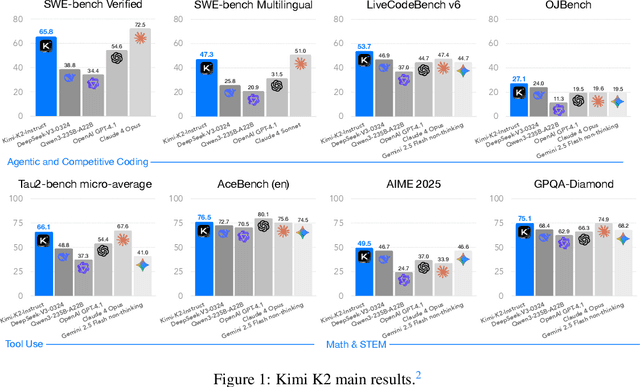
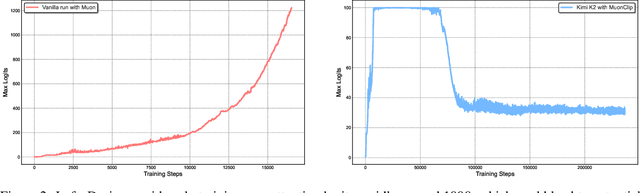
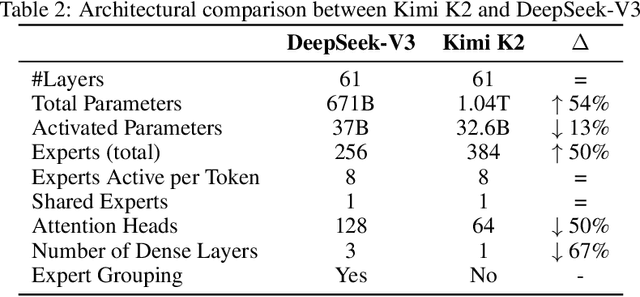
We introduce Kimi K2, a Mixture-of-Experts (MoE) large language model with 32 billion activated parameters and 1 trillion total parameters. We propose the MuonClip optimizer, which improves upon Muon with a novel QK-clip technique to address training instability while enjoying the advanced token efficiency of Muon. Based on MuonClip, K2 was pre-trained on 15.5 trillion tokens with zero loss spike. During post-training, K2 undergoes a multi-stage post-training process, highlighted by a large-scale agentic data synthesis pipeline and a joint reinforcement learning (RL) stage, where the model improves its capabilities through interactions with real and synthetic environments. Kimi K2 achieves state-of-the-art performance among open-source non-thinking models, with strengths in agentic capabilities. Notably, K2 obtains 66.1 on Tau2-Bench, 76.5 on ACEBench (En), 65.8 on SWE-Bench Verified, and 47.3 on SWE-Bench Multilingual -- surpassing most open and closed-sourced baselines in non-thinking settings. It also exhibits strong capabilities in coding, mathematics, and reasoning tasks, with a score of 53.7 on LiveCodeBench v6, 49.5 on AIME 2025, 75.1 on GPQA-Diamond, and 27.1 on OJBench, all without extended thinking. These results position Kimi K2 as one of the most capable open-source large language models to date, particularly in software engineering and agentic tasks. We release our base and post-trained model checkpoints to facilitate future research and applications of agentic intelligence.
RSRWKV: A Linear-Complexity 2D Attention Mechanism for Efficient Remote Sensing Vision Task
Mar 26, 2025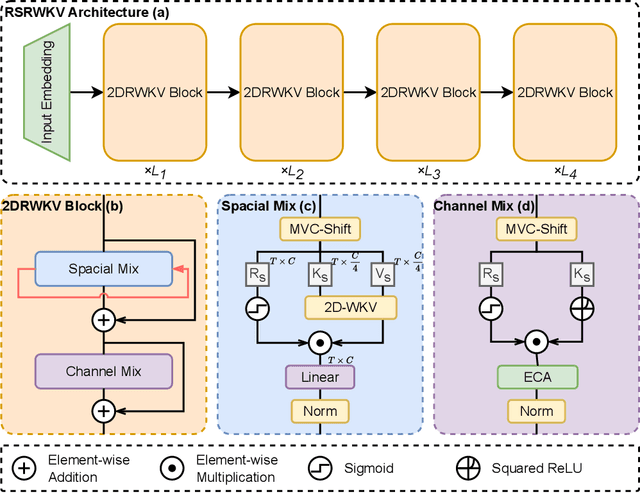
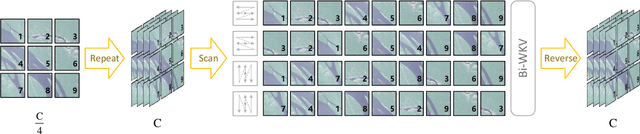
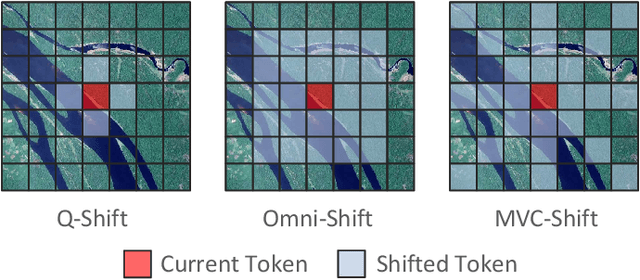
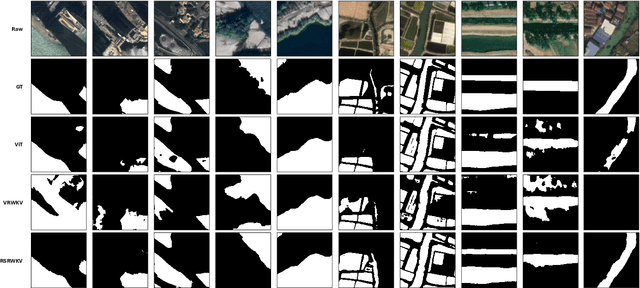
High-resolution remote sensing analysis faces challenges in global context modeling due to scene complexity and scale diversity. While CNNs excel at local feature extraction via parameter sharing, their fixed receptive fields fundamentally restrict long-range dependency modeling. Vision Transformers (ViTs) effectively capture global semantic relationships through self-attention mechanisms but suffer from quadratic computational complexity relative to image resolution, creating critical efficiency bottlenecks for high-resolution imagery. The RWKV model's linear-complexity sequence modeling achieves breakthroughs in NLP but exhibits anisotropic limitations in vision tasks due to its 1D scanning mechanism. To address these challenges, we propose RSRWKV, featuring a novel 2D-WKV scanning mechanism that bridges sequential processing and 2D spatial reasoning while maintaining linear complexity. This enables isotropic context aggregation across multiple directions. The MVC-Shift module enhances multi-scale receptive field coverage, while the ECA module strengthens cross-channel feature interaction and semantic saliency modeling. Experimental results demonstrate RSRWKV's superior performance over CNN and Transformer baselines in classification, detection, and segmentation tasks on NWPU RESISC45, VHR-10.v2, and GLH-Water datasets, offering a scalable solution for high-resolution remote sensing analysis.
DCT-Mamba3D: Spectral Decorrelation and Spatial-Spectral Feature Extraction for Hyperspectral Image Classification
Feb 04, 2025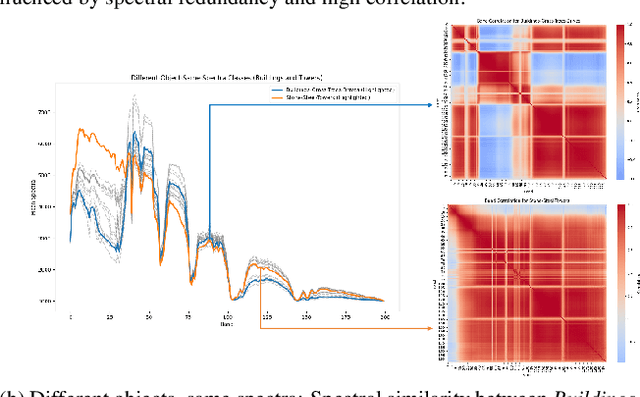
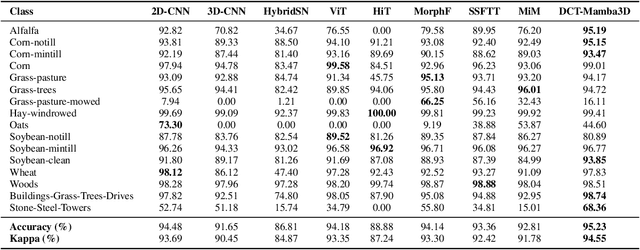


Hyperspectral image classification presents challenges due to spectral redundancy and complex spatial-spectral dependencies. This paper proposes a novel framework, DCT-Mamba3D, for hyperspectral image classification. DCT-Mamba3D incorporates: (1) a 3D spectral-spatial decorrelation module that applies 3D discrete cosine transform basis functions to reduce both spectral and spatial redundancy, enhancing feature clarity across dimensions; (2) a 3D-Mamba module that leverages a bidirectional state-space model to capture intricate spatial-spectral dependencies; and (3) a global residual enhancement module that stabilizes feature representation, improving robustness and convergence. Extensive experiments on benchmark datasets show that our DCT-Mamba3D outperforms the state-of-the-art methods in challenging scenarios such as the same object in different spectra and different objects in the same spectra.