 Add to Chrome
 Add to Firefox
 Add to Edge
Transformers Simulate MLE for Sequence Generation in Bayesian Networks
Jan 05, 2025


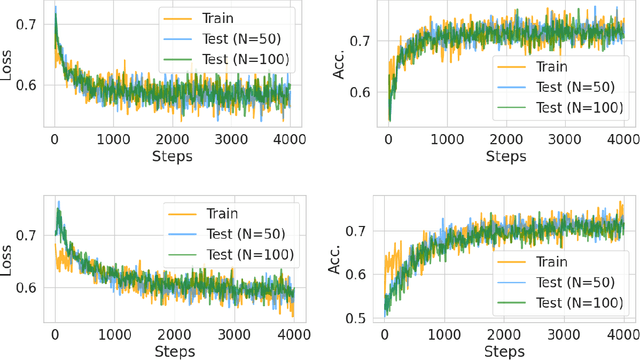
Transformers have achieved significant success in various fields, notably excelling in tasks involving sequential data like natural language processing. Despite these achievements, the theoretical understanding of transformers' capabilities remains limited. In this paper, we investigate the theoretical capabilities of transformers to autoregressively generate sequences in Bayesian networks based on in-context maximum likelihood estimation (MLE). Specifically, we consider a setting where a context is formed by a set of independent sequences generated according to a Bayesian network. We demonstrate that there exists a simple transformer model that can (i) estimate the conditional probabilities of the Bayesian network according to the context, and (ii) autoregressively generate a new sample according to the Bayesian network with estimated conditional probabilities. We further demonstrate in extensive experiments that such a transformer does not only exist in theory, but can also be effectively obtained through training. Our analysis highlights the potential of transformers to learn complex probabilistic models and contributes to a better understanding of large language models as a powerful class of sequence generators.

Adaptive Batch Size Schedules for Distributed Training of Language Models with Data and Model Parallelism
Dec 30, 2024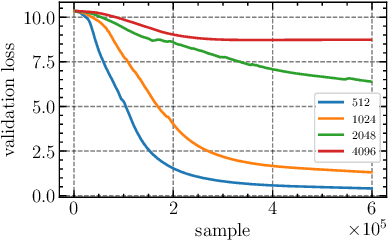
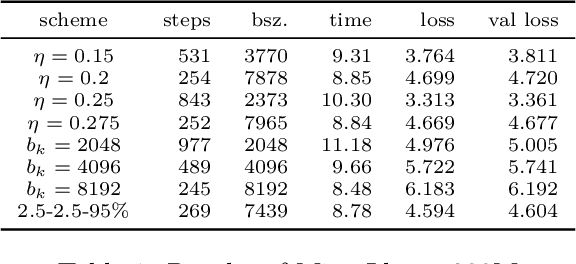
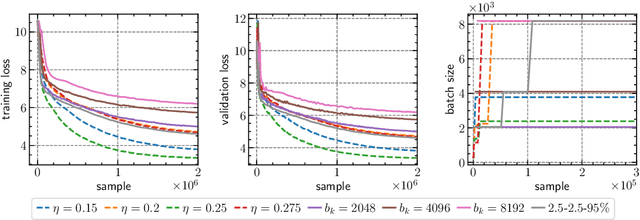
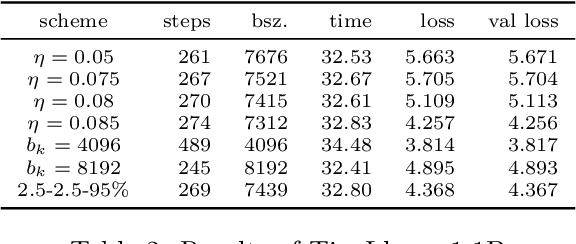
An appropriate choice of batch sizes in large-scale model training is crucial, yet it involves an intrinsic yet inevitable dilemma: large-batch training improves training efficiency in terms of memory utilization, while generalization performance often deteriorates due to small amounts of gradient noise. Despite this dilemma, the common practice of choosing batch sizes in language model training often prioritizes training efficiency -- employing either constant large sizes with data parallelism or implementing batch size warmup schedules. However, such batch size schedule designs remain heuristic and often fail to adapt to training dynamics, presenting the challenge of designing adaptive batch size schedules. Given the abundance of available datasets and the data-hungry nature of language models, data parallelism has become an indispensable distributed training paradigm, enabling the use of larger batch sizes for gradient computation. However, vanilla data parallelism requires replicas of model parameters, gradients, and optimizer states at each worker, which prohibits training larger models with billions of parameters. To optimize memory usage, more advanced parallelism strategies must be employed. In this work, we propose general-purpose and theoretically principled adaptive batch size schedules compatible with data parallelism and model parallelism. We develop a practical implementation with PyTorch Fully Sharded Data Parallel, facilitating the pretraining of language models of different sizes. We empirically demonstrate that our proposed approaches outperform constant batch sizes and heuristic batch size warmup schedules in the pretraining of models in the Llama family, with particular focus on smaller models with up to 3 billion parameters. We also establish theoretical convergence guarantees for such adaptive batch size schedules with Adam for general smooth nonconvex objectives.
AlignAb: Pareto-Optimal Energy Alignment for Designing Nature-Like Antibodies
Dec 30, 2024We present a three-stage framework for training deep learning models specializing in antibody sequence-structure co-design. We first pre-train a language model using millions of antibody sequence data. Then, we employ the learned representations to guide the training of a diffusion model for joint optimization over both sequence and structure of antibodies. During the final alignment stage, we optimize the model to favor antibodies with low repulsion and high attraction to the antigen binding site, enhancing the rationality and functionality of the designs. To mitigate conflicting energy preferences, we extend AbDPO (Antibody Direct Preference Optimization) to guide the model towards Pareto optimality under multiple energy-based alignment objectives. Furthermore, we adopt an iterative learning paradigm with temperature scaling, enabling the model to benefit from diverse online datasets without requiring additional data. In practice, our proposed methods achieve high stability and efficiency in producing a better Pareto front of antibody designs compared to top samples generated by baselines and previous alignment techniques. Through extensive experiments, we showcase the superior performance of our methods in generating nature-like antibodies with high binding affinity consistently.
EGSRAL: An Enhanced 3D Gaussian Splatting based Renderer with Automated Labeling for Large-Scale Driving Scene
Dec 20, 2024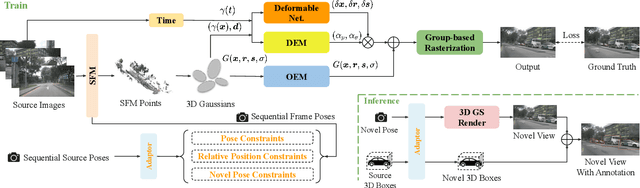
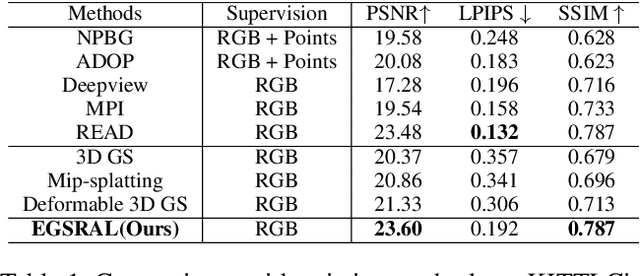
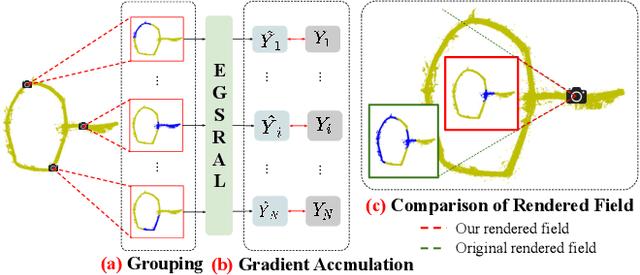
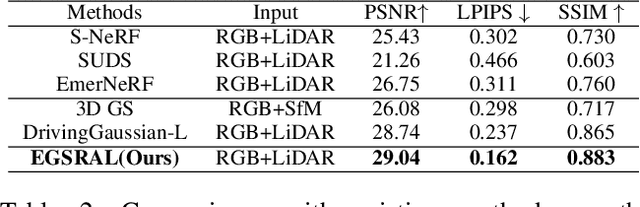
3D Gaussian Splatting (3D GS) has gained popularity due to its faster rendering speed and high-quality novel view synthesis. Some researchers have explored using 3D GS for reconstructing driving scenes. However, these methods often rely on various data types, such as depth maps, 3D boxes, and trajectories of moving objects. Additionally, the lack of annotations for synthesized images limits their direct application in downstream tasks. To address these issues, we propose EGSRAL, a 3D GS-based method that relies solely on training images without extra annotations. EGSRAL enhances 3D GS's capability to model both dynamic objects and static backgrounds and introduces a novel adaptor for auto labeling, generating corresponding annotations based on existing annotations. We also propose a grouping strategy for vanilla 3D GS to address perspective issues in rendering large-scale, complex scenes. Our method achieves state-of-the-art performance on multiple datasets without any extra annotation. For example, the PSNR metric reaches 29.04 on the nuScenes dataset. Moreover, our automated labeling can significantly improve the performance of 2D/3D detection tasks. Code is available at https://github.com/jiangxb98/EGSRAL.
A Real-Time System for Scheduling and Managing UAV Delivery in Urban
Dec 16, 2024


As urban logistics demand continues to grow, UAV delivery has become a key solution to improve delivery efficiency, reduce traffic congestion, and lower logistics costs. However, to fully leverage the potential of UAV delivery networks, efficient swarm scheduling and management are crucial. In this paper, we propose a real-time scheduling and management system based on the ``Airport-Unloading Station" model, aiming to bridge the gap between high-level scheduling algorithms and low-level execution systems. This system, acting as middleware, accurately translates the requirements from the scheduling layer into specific execution instructions, ensuring that the scheduling algorithms perform effectively in real-world environments. Additionally, we implement three collaborative scheduling schemes involving autonomous ground vehicles (AGVs), unmanned aerial vehicles (UAVs), and ground staff to further optimize overall delivery efficiency. Through extensive experiments, this study demonstrates the rationality and feasibility of the proposed management system, providing practical solution for the commercial application of UAVs delivery in urban. Code: https://github.com/chengji253/UAVDeliverySystem
FTP: A Fine-grained Token-wise Pruner for Large Language Models via Token Routing
Dec 16, 2024Recently, large language models (LLMs) have demonstrated superior performance across various tasks by adhering to scaling laws, which significantly increase model size. However, the huge computation overhead during inference hinders the deployment in industrial applications. Many works leverage traditional compression approaches to boost model inference, but these always introduce additional training costs to restore the performance and the pruning results typically show noticeable performance drops compared to the original model when aiming for a specific level of acceleration. To address these issues, we propose a fine-grained token-wise pruning approach for the LLMs, which presents a learnable router to adaptively identify the less important tokens and skip them across model blocks to reduce computational cost during inference. To construct the router efficiently, we present a search-based sparsity scheduler for pruning sparsity allocation, a trainable router combined with our proposed four low-dimensional factors as input and three proposed losses. We conduct extensive experiments across different benchmarks on different LLMs to demonstrate the superiority of our method. Our approach achieves state-of-the-art (SOTA) pruning results, surpassing other existing pruning methods. For instance, our method outperforms BlockPruner and ShortGPT by approximately 10 points on both LLaMA2-7B and Qwen1.5-7B in accuracy retention at comparable token sparsity levels.
On Statistical Rates of Conditional Diffusion Transformers: Approximation, Estimation and Minimax Optimality
Nov 26, 2024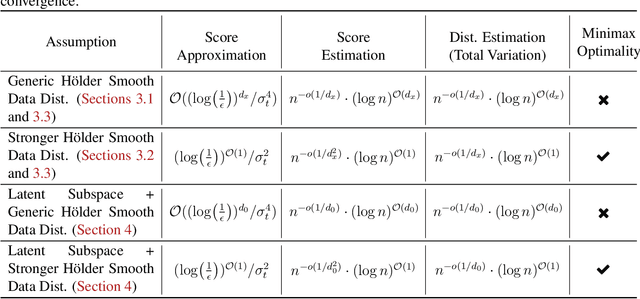
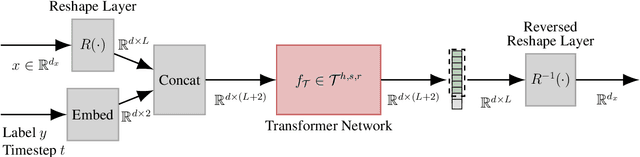
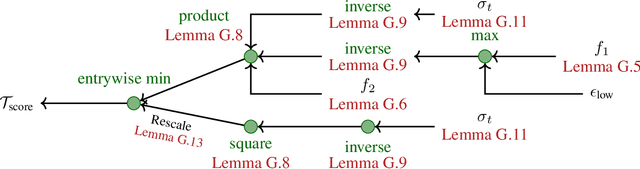
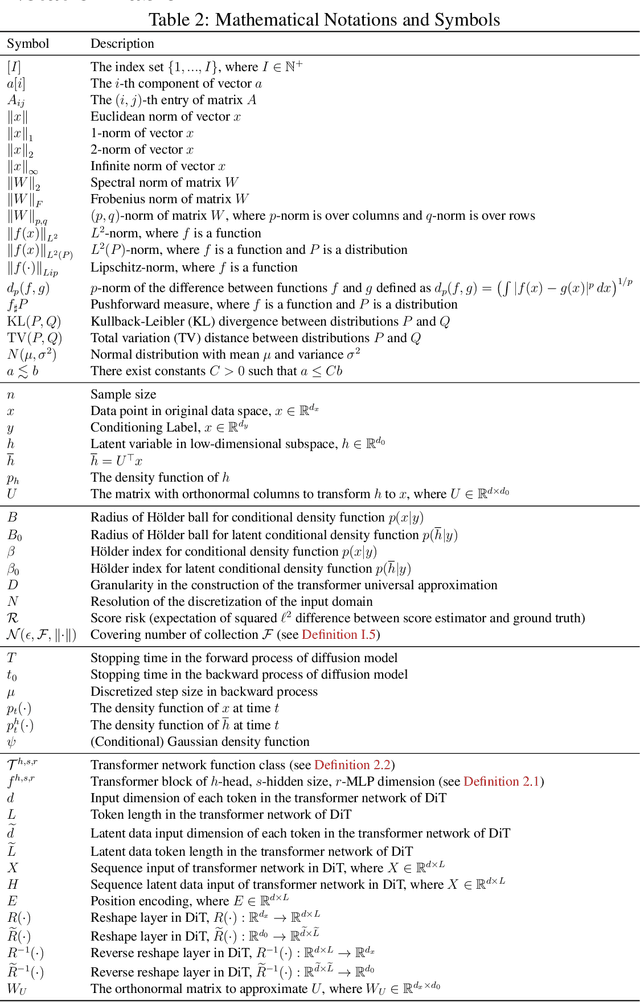
We investigate the approximation and estimation rates of conditional diffusion transformers (DiTs) with classifier-free guidance. We present a comprehensive analysis for ``in-context'' conditional DiTs under four common data assumptions. We show that both conditional DiTs and their latent variants lead to the minimax optimality of unconditional DiTs under identified settings. Specifically, we discretize the input domains into infinitesimal grids and then perform a term-by-term Taylor expansion on the conditional diffusion score function under H\"older smooth data assumption. This enables fine-grained use of transformers' universal approximation through a more detailed piecewise constant approximation and hence obtains tighter bounds. Additionally, we extend our analysis to the latent setting under the linear latent subspace assumption. We not only show that latent conditional DiTs achieve lower bounds than conditional DiTs both in approximation and estimation, but also show the minimax optimality of latent unconditional DiTs. Our findings establish statistical limits for conditional and unconditional DiTs, and offer practical guidance toward developing more efficient and accurate DiT models.
Transformers are Deep Optimizers: Provable In-Context Learning for Deep Model Training
Nov 25, 2024
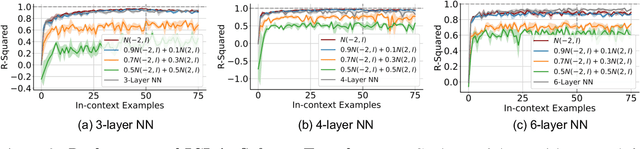
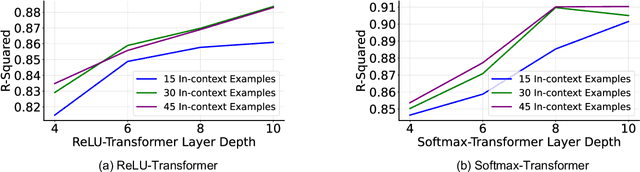
We investigate the transformer's capability for in-context learning (ICL) to simulate the training process of deep models. Our key contribution is providing a positive example of using a transformer to train a deep neural network by gradient descent in an implicit fashion via ICL. Specifically, we provide an explicit construction of a $(2N+4)L$-layer transformer capable of simulating $L$ gradient descent steps of an $N$-layer ReLU network through ICL. We also give the theoretical guarantees for the approximation within any given error and the convergence of the ICL gradient descent. Additionally, we extend our analysis to the more practical setting using Softmax-based transformers. We validate our findings on synthetic datasets for 3-layer, 4-layer, and 6-layer neural networks. The results show that ICL performance matches that of direct training.
Fundamental Limits of Prompt Tuning Transformers: Universality, Capacity and Efficiency
Nov 25, 2024We investigate the statistical and computational limits of prompt tuning for transformer-based foundation models. Our key contributions are prompt tuning on \textit{single-head} transformers with only a \textit{single} self-attention layer: (i) is universal, and (ii) supports efficient (even almost-linear time) algorithms under the Strong Exponential Time Hypothesis (SETH). Statistically, we prove that prompt tuning on such simplest possible transformers are universal approximators for sequence-to-sequence Lipschitz functions. In addition, we provide an exponential-in-$dL$ and -in-$(1/\epsilon)$ lower bound on the required soft-prompt tokens for prompt tuning to memorize any dataset with 1-layer, 1-head transformers. Computationally, we identify a phase transition in the efficiency of prompt tuning, determined by the norm of the \textit{soft-prompt-induced} keys and queries, and provide an upper bound criterion. Beyond this criterion, no sub-quadratic (efficient) algorithm for prompt tuning exists under SETH. Within this criterion, we showcase our theory by proving the existence of almost-linear time prompt tuning inference algorithms. These fundamental limits provide important necessary conditions for designing expressive and efficient prompt tuning methods for practitioners.
One-Layer Transformer Provably Learns One-Nearest Neighbor In Context
Nov 16, 2024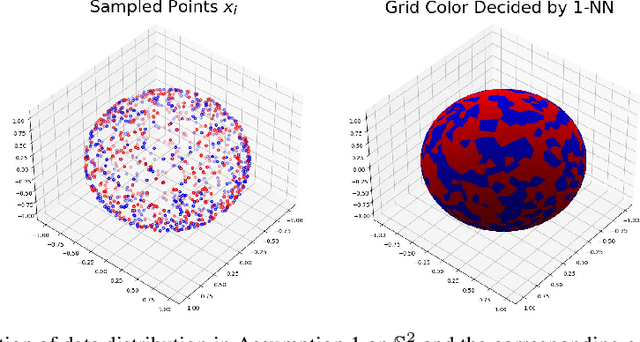
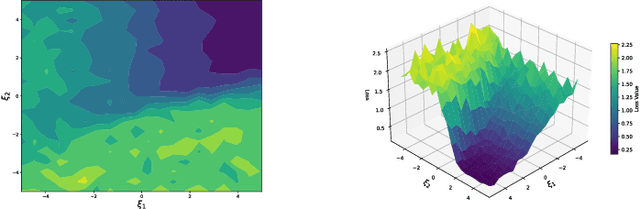
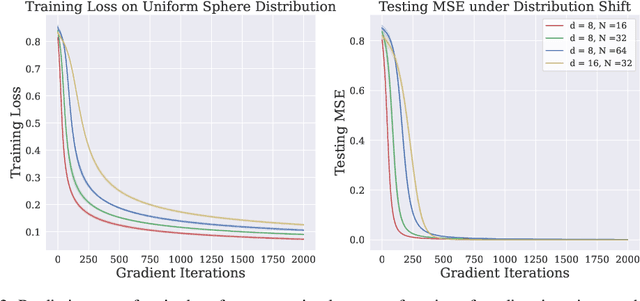
Transformers have achieved great success in recent years. Interestingly, transformers have shown particularly strong in-context learning capability -- even without fine-tuning, they are still able to solve unseen tasks well purely based on task-specific prompts. In this paper, we study the capability of one-layer transformers in learning one of the most classical nonparametric estimators, the one-nearest neighbor prediction rule. Under a theoretical framework where the prompt contains a sequence of labeled training data and unlabeled test data, we show that, although the loss function is nonconvex when trained with gradient descent, a single softmax attention layer can successfully learn to behave like a one-nearest neighbor classifier. Our result gives a concrete example of how transformers can be trained to implement nonparametric machine learning algorithms, and sheds light on the role of softmax attention in transformer models.