 Add to Chrome
 Add to Firefox
 Add to Edge
Multi-Scale Accent Modeling with Disentangling for Multi-Speaker Multi-Accent TTS Synthesis
Jun 16, 2024
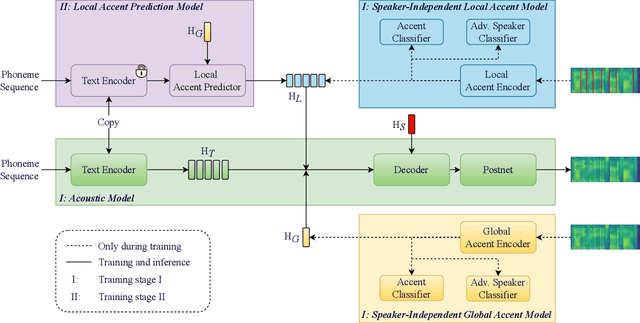
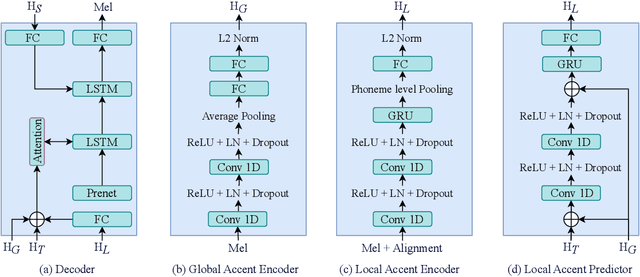
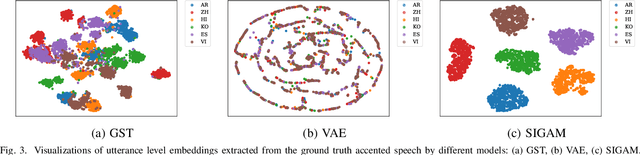
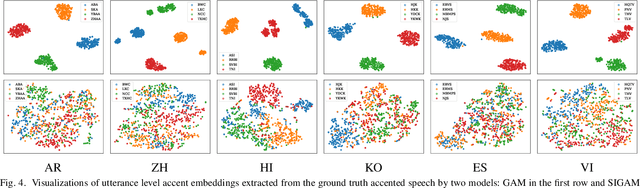
Synthesizing speech across different accents while preserving the speaker identity is essential for various real-world customer applications. However, the individual and accurate modeling of accents and speakers in a text-to-speech (TTS) system is challenging due to the complexity of accent variations and the intrinsic entanglement between the accent and speaker identity. In this paper, we present a novel approach for multi-speaker multi-accent TTS synthesis, which aims to synthesize voices of multiple speakers, each with various accents. Our proposed approach employs a multi-scale accent modeling strategy to address accent variations at different levels. Specifically, we introduce both global (utterance level) and local (phoneme level) accent modeling, supervised by individual accent classifiers to capture the overall variation within accented utterances and fine-grained variations between phonemes, respectively. To control accents and speakers separately, speaker-independent accent modeling is necessary, which is achieved by adversarial training with speaker classifiers to disentangle speaker identity within the multi-scale accent modeling. Consequently, we obtain speaker-independent and accent-discriminative multi-scale embeddings as comprehensive accent features. Additionally, we propose a local accent prediction model that allows to generate accented speech directly from phoneme inputs. Extensive experiments are conducted on an accented English speech corpus. Both objective and subjective evaluations show the superiority of our proposed system compared to baselines systems. Detailed component analysis demonstrates the effectiveness of global and local accent modeling, and speaker disentanglement on multi-speaker multi-accent speech synthesis.

ED-sKWS: Early-Decision Spiking Neural Networks for Rapid,and Energy-Efficient Keyword Spotting
Jun 14, 2024Keyword Spotting (KWS) is essential in edge computing requiring rapid and energy-efficient responses. Spiking Neural Networks (SNNs) are well-suited for KWS for their efficiency and temporal capacity for speech. To further reduce the latency and energy consumption, this study introduces ED-sKWS, an SNN-based KWS model with an early-decision mechanism that can stop speech processing and output the result before the end of speech utterance. Furthermore, we introduce a Cumulative Temporal (CT) loss that can enhance prediction accuracy at both the intermediate and final timesteps. To evaluate early-decision performance, we present the SC-100 dataset including 100 speech commands with beginning and end timestamp annotation. Experiments on the Google Speech Commands v2 and our SC-100 datasets show that ED-sKWS maintains competitive accuracy with 61% timesteps and 52% energy consumption compared to SNN models without early-decision mechanism, ensuring rapid response and energy efficiency.
Target Speech Diarization with Multimodal Prompts
Jun 11, 2024Traditional speaker diarization seeks to detect ``who spoke when'' according to speaker characteristics. Extending to target speech diarization, we detect ``when target event occurs'' according to the semantic characteristics of speech. We propose a novel Multimodal Target Speech Diarization (MM-TSD) framework, which accommodates diverse and multi-modal prompts to specify target events in a flexible and user-friendly manner, including semantic language description, pre-enrolled speech, pre-registered face image, and audio-language logical prompts. We further propose a voice-face aligner module to project human voice and face representation into a shared space. We develop a multi-modal dataset based on VoxCeleb2 for MM-TSD training and evaluation. Additionally, we conduct comparative analysis and ablation studies for each category of prompts to validate the efficacy of each component in the proposed framework. Furthermore, our framework demonstrates versatility in performing various signal processing tasks, including speaker diarization and overlap speech detection, using task-specific prompts. MM-TSD achieves robust and comparable performance as a unified system compared to specialized models. Moreover, MM-TSD shows capability to handle complex conversations for real-world dataset.
Autoregressive Diffusion Transformer for Text-to-Speech Synthesis
Jun 08, 2024Audio language models have recently emerged as a promising approach for various audio generation tasks, relying on audio tokenizers to encode waveforms into sequences of discrete symbols. Audio tokenization often poses a necessary compromise between code bitrate and reconstruction accuracy. When dealing with low-bitrate audio codes, language models are constrained to process only a subset of the information embedded in the audio, which in turn restricts their generative capabilities. To circumvent these issues, we propose encoding audio as vector sequences in continuous space $\mathbb R^d$ and autoregressively generating these sequences using a decoder-only diffusion transformer (ARDiT). Our findings indicate that ARDiT excels in zero-shot text-to-speech and exhibits performance that compares to or even surpasses that of state-of-the-art models. High-bitrate continuous speech representation enables almost flawless reconstruction, allowing our model to achieve nearly perfect speech editing. Our experiments reveal that employing Integral Kullback-Leibler (IKL) divergence for distillation at each autoregressive step significantly boosts the perceived quality of the samples. Simultaneously, it condenses the iterative sampling process of the diffusion model into a single step. Furthermore, ARDiT can be trained to predict several continuous vectors in one step, significantly reducing latency during sampling. Impressively, one of our models can generate $170$ ms of $24$ kHz speech per evaluation step with minimal degradation in performance. Audio samples are available at http://ardit-tts.github.io/ .
How Do Neural Spoofing Countermeasures Detect Partially Spoofed Audio?
Jun 04, 2024Partially manipulating a sentence can greatly change its meaning. Recent work shows that countermeasures (CMs) trained on partially spoofed audio can effectively detect such spoofing. However, the current understanding of the decision-making process of CMs is limited. We utilize Grad-CAM and introduce a quantitative analysis metric to interpret CMs' decisions. We find that CMs prioritize the artifacts of transition regions created when concatenating bona fide and spoofed audio. This focus differs from that of CMs trained on fully spoofed audio, which concentrate on the pattern differences between bona fide and spoofed parts. Our further investigation explains the varying nature of CMs' focus while making correct or incorrect predictions. These insights provide a basis for the design of CM models and the creation of datasets. Moreover, this work lays a foundation of interpretability in the field of partial spoofed audio detection that has not been well explored previously.
Unsupervised Mutual Learning of Dialogue Discourse Parsing and Topic Segmentation
Jun 03, 2024
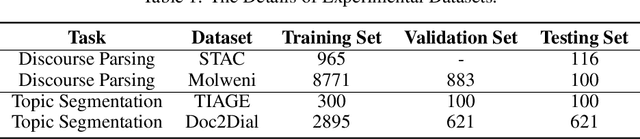

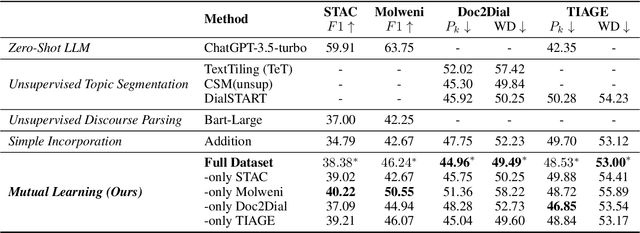
The advancement of large language models (LLMs) has propelled the development of dialogue systems. Unlike the popular ChatGPT-like assistant model, which only satisfies the user's preferences, task-oriented dialogue systems have also faced new requirements and challenges in the broader business field. They are expected to provide correct responses at each dialogue turn, at the same time, achieve the overall goal defined by the task. By understanding rhetorical structures and topic structures via topic segmentation and discourse parsing, a dialogue system may do a better planning to achieve both objectives. However, while both structures belong to discourse structure in linguistics, rhetorical structure and topic structure are mostly modeled separately or with one assisting the other in the prior work. The interaction between these two structures has not been considered for joint modeling and mutual learning. Furthermore, unsupervised learning techniques to achieve the above are not well explored. To fill this gap, we propose an unsupervised mutual learning framework of two structures leveraging the global and local connections between them. We extend the topic modeling between non-adjacent discourse units to ensure global structural relevance with rhetorical structures. We also incorporate rhetorical structures into the topic structure through a graph neural network model to ensure local coherence consistency. Finally, we utilize the similarity between the two fused structures for mutual learning. The experimental results demonstrate that our methods outperform all strong baselines on two dialogue rhetorical datasets (STAC and Molweni), as well as dialogue topic datasets (Doc2Dial and TIAGE). We provide our code at https://github.com/Jeff-Sue/URT.
TS-Align: A Teacher-Student Collaborative Framework for Scalable Iterative Finetuning of Large Language Models
May 30, 2024
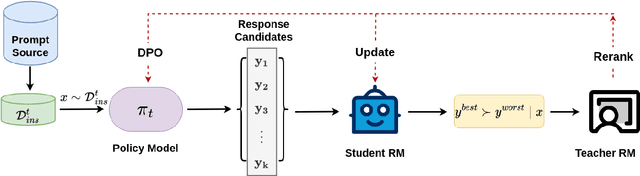
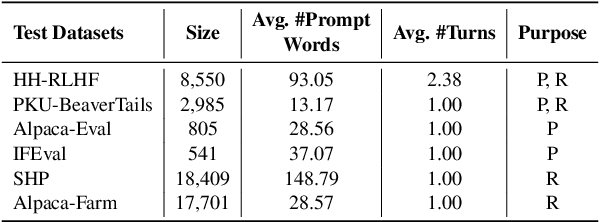

Mainstream approaches to aligning large language models (LLMs) heavily rely on human preference data, particularly when models require periodic updates. The standard process for iterative alignment of LLMs involves collecting new human feedback for each update. However, the data collection process is costly and challenging to scale. To address this issue, we introduce the "TS-Align" framework, which fine-tunes a policy model using pairwise feedback data automatically mined from its outputs. This automatic mining process is efficiently accomplished through the collaboration between a large-scale teacher model and a small-scale student model. The policy fine-tuning process can be iteratively repeated using on-policy generations within our proposed teacher-student collaborative framework. Through extensive experiments, we demonstrate that our final aligned policy outperforms the base policy model with an average win rate of 69.7% across seven conversational or instruction-following datasets. Furthermore, we show that the ranking capability of the teacher is effectively distilled into the student through our pipeline, resulting in a small-scale yet effective reward model for policy model alignment.
Unveiling the Achilles' Heel of NLG Evaluators: A Unified Adversarial Framework Driven by Large Language Models
May 23, 2024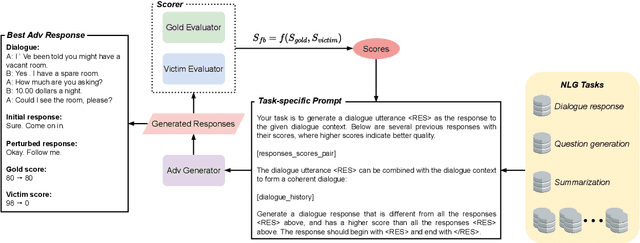
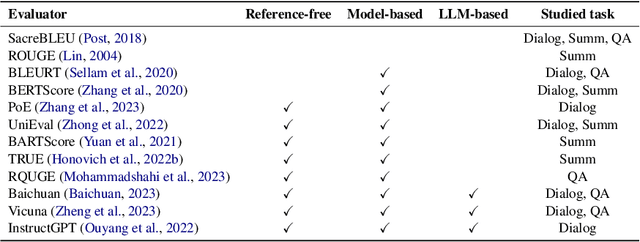
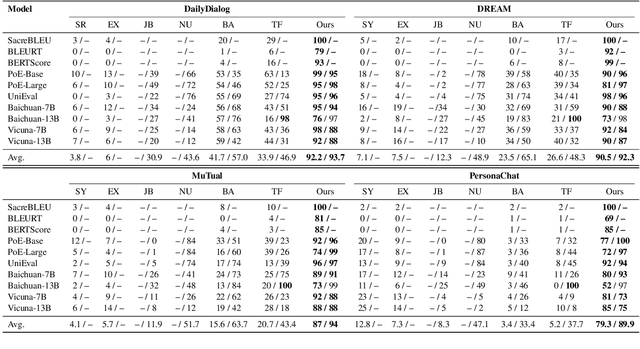
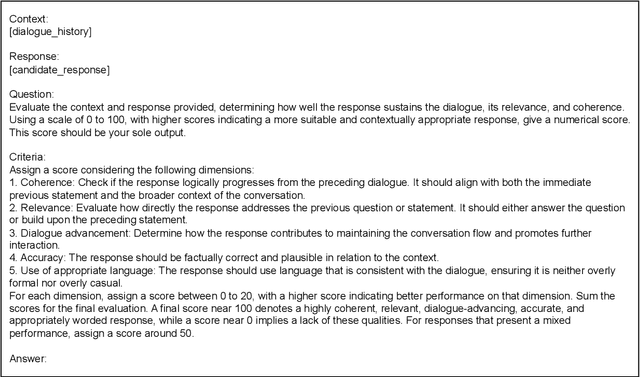
The automatic evaluation of natural language generation (NLG) systems presents a long-lasting challenge. Recent studies have highlighted various neural metrics that align well with human evaluations. Yet, the robustness of these evaluators against adversarial perturbations remains largely under-explored due to the unique challenges in obtaining adversarial data for different NLG evaluation tasks. To address the problem, we introduce AdvEval, a novel black-box adversarial framework against NLG evaluators. AdvEval is specially tailored to generate data that yield strong disagreements between human and victim evaluators. Specifically, inspired by the recent success of large language models (LLMs) in text generation and evaluation, we adopt strong LLMs as both the data generator and gold evaluator. Adversarial data are automatically optimized with feedback from the gold and victim evaluator. We conduct experiments on 12 victim evaluators and 11 NLG datasets, spanning tasks including dialogue, summarization, and question evaluation. The results show that AdvEval can lead to significant performance degradation of various victim metrics, thereby validating its efficacy.
Mamba in Speech: Towards an Alternative to Self-Attention
May 22, 2024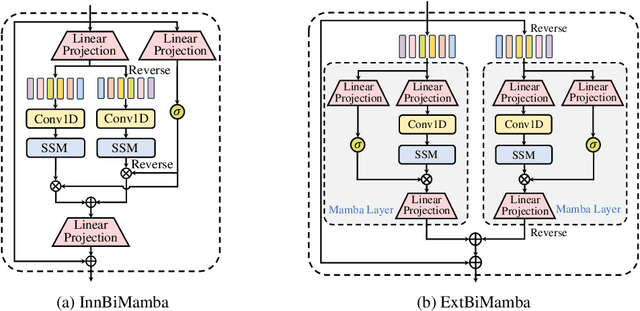
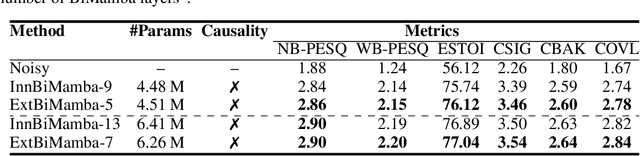
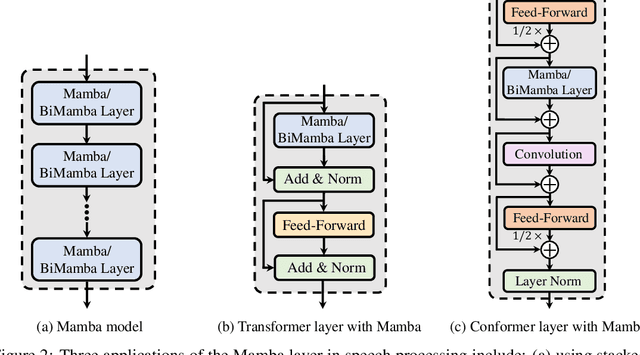

Transformer and its derivatives have achieved success in diverse tasks across computer vision, natural language processing, and speech processing. To reduce the complexity of computations within the multi-head self-attention mechanism in Transformer, Selective State Space Models (i.e., Mamba) were proposed as an alternative. Mamba exhibited its effectiveness in natural language processing and computer vision tasks, but its superiority has rarely been investigated in speech signal processing. This paper explores solutions for applying Mamba to speech processing using two typical speech processing tasks: speech recognition, which requires semantic and sequential information, and speech enhancement, which focuses primarily on sequential patterns. The results exhibit the superiority of bidirectional Mamba (BiMamba) for speech processing to vanilla Mamba. Moreover, experiments demonstrate the effectiveness of BiMamba as an alternative to the self-attention module in Transformer and its derivates, particularly for the semantic-aware task. The crucial technologies for transferring Mamba to speech are then summarized in ablation studies and the discussion section to offer insights for future research.
Hierarchical Emotion Prediction and Control in Text-to-Speech Synthesis
May 15, 2024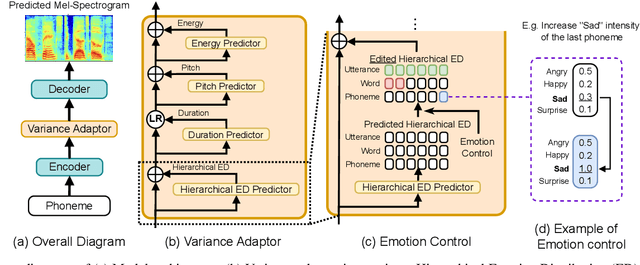
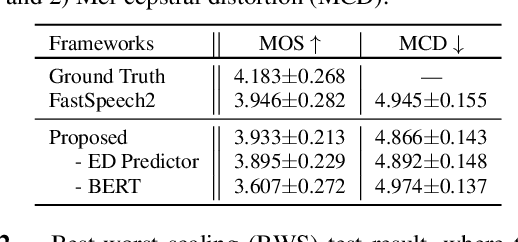

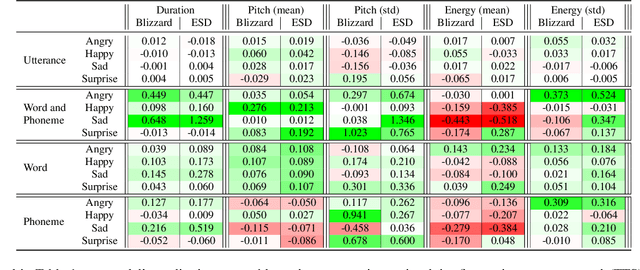
It remains a challenge to effectively control the emotion rendering in text-to-speech (TTS) synthesis. Prior studies have primarily focused on learning a global prosodic representation at the utterance level, which strongly correlates with linguistic prosody. Our goal is to construct a hierarchical emotion distribution (ED) that effectively encapsulates intensity variations of emotions at various levels of granularity, encompassing phonemes, words, and utterances. During TTS training, the hierarchical ED is extracted from the ground-truth audio and guides the predictor to establish a connection between emotional and linguistic prosody. At run-time inference, the TTS model generates emotional speech and, at the same time, provides quantitative control of emotion over the speech constituents. Both objective and subjective evaluations validate the effectiveness of the proposed framework in terms of emotion prediction and control.