 Add to Chrome
 Add to Firefox
 Add to Edge
Interaction-Grounded Learning for Contextual Markov Decision Processes with Personalized Feedback
Feb 09, 2026
In this paper, we study Interaction-Grounded Learning (IGL) [Xie et al., 2021], a paradigm designed for realistic scenarios where the learner receives indirect feedback generated by an unknown mechanism, rather than explicit numerical rewards. While prior work on IGL provides efficient algorithms with provable guarantees, those results are confined to single-step settings, restricting their applicability to modern sequential decision-making systems such as multi-turn Large Language Model (LLM) deployments. To bridge this gap, we propose a computationally efficient algorithm that achieves a sublinear regret guarantee for contextual episodic Markov Decision Processes (MDPs) with personalized feedback. Technically, we extend the reward-estimator construction of Zhang et al. [2024a] from the single-step to the multi-step setting, addressing the unique challenges of decoding latent rewards under MDPs. Building on this estimator, we design an Inverse-Gap-Weighting (IGW) algorithm for policy optimization. Finally, we demonstrate the effectiveness of our method in learning personalized objectives from multi-turn interactions through experiments on both a synthetic episodic MDP and a real-world user booking dataset.

Adversarial Learning in Games with Bandit Feedback: Logarithmic Pure-Strategy Maximin Regret
Feb 06, 2026Learning to play zero-sum games is a fundamental problem in game theory and machine learning. While significant progress has been made in minimizing external regret in the self-play settings or with full-information feedback, real-world applications often force learners to play against unknown, arbitrary opponents and restrict learners to bandit feedback where only the payoff of the realized action is observable. In such challenging settings, it is well-known that $Ω(\sqrt{T})$ external regret is unavoidable (where T is the number of rounds). To overcome this barrier, we investigate adversarial learning in zero-sum games under bandit feedback, aiming to minimize the deficit against the maximin pure strategy -- a metric we term Pure-Strategy Maximin Regret. We analyze this problem under two bandit feedback models: uninformed (only the realized reward is revealed) and informed (both the reward and the opponent's action are revealed). For uninformed bandit learning of normal-form games, we show that the Tsallis-INF algorithm achieves $O(c \log T)$ instance-dependent regret with a game-dependent parameter $c$. Crucially, we prove an information-theoretic lower bound showing that the dependence on c is necessary. To overcome this hardness, we turn to the informed setting and introduce Maximin-UCB, which obtains another regret bound of the form $O(c' \log T)$ for a different game-dependent parameter $c'$ that could potentially be much smaller than $c$. Finally, we generalize both results to bilinear games over an arbitrary, large action set, proposing Tsallis-FTRL-SPM and Maximin-LinUCB for the uninformed and informed setting respectively and establishing similar game-dependent logarithmic regret bounds.
Online Learning for Uninformed Markov Games: Empirical Nash-Value Regret and Non-Stationarity Adaptation
Feb 06, 2026We study online learning in two-player uninformed Markov games, where the opponent's actions and policies are unobserved. In this setting, Tian et al. (2021) show that achieving no-external-regret is impossible without incurring an exponential dependence on the episode length $H$. They then turn to the weaker notion of Nash-value regret and propose a V-learning algorithm with regret $O(K^{2/3})$ after $K$ episodes. However, their algorithm and guarantee do not adapt to the difficulty of the problem: even in the case where the opponent follows a fixed policy and thus $O(\sqrt{K})$ external regret is well-known to be achievable, their result is still the worse rate $O(K^{2/3})$ on a weaker metric. In this work, we fully address both limitations. First, we introduce empirical Nash-value regret, a new regret notion that is strictly stronger than Nash-value regret and naturally reduces to external regret when the opponent follows a fixed policy. Moreover, under this new metric, we propose a parameter-free algorithm that achieves an $O(\min \{\sqrt{K} + (CK)^{1/3},\sqrt{LK}\})$ regret bound, where $C$ quantifies the variance of the opponent's policies and $L$ denotes the number of policy switches (both at most $O(K)$). Therefore, our results not only recover the two extremes -- $O(\sqrt{K})$ external regret when the opponent is fixed and $O(K^{2/3})$ Nash-value regret in the worst case -- but also smoothly interpolate between these extremes by automatically adapting to the opponent's non-stationarity. We achieve so by first providing a new analysis of the epoch-based V-learning algorithm by Mao et al. (2022), establishing an $O(ηC + \sqrt{K/η})$ regret bound, where $η$ is the epoch incremental factor. Next, we show how to adaptively restart this algorithm with an appropriate $η$ in response to the potential non-stationarity of the opponent, eventually achieving our final results.
Swap Regret Minimization Through Response-Based Approachability
Feb 05, 2026We consider the problem of minimizing different notions of swap regret in online optimization. These forms of regret are tightly connected to correlated equilibrium concepts in games, and have been more recently shown to guarantee non-manipulability against strategic adversaries. The only computationally efficient algorithm for minimizing linear swap regret over a general convex set in $\mathbb{R}^d$ was developed recently by Daskalakis, Farina, Fishelson, Pipis, and Schneider (STOC '25). However, it incurs a highly suboptimal regret bound of $Ω(d^4 \sqrt{T})$ and also relies on computationally intensive calls to the ellipsoid algorithm at each iteration. In this paper, we develop a significantly simpler, computationally efficient algorithm that guarantees $O(d^{3/2} \sqrt{T})$ linear swap regret for a general convex set and $O(d \sqrt{T})$ when the set is centrally symmetric. Our approach leverages the powerful response-based approachability framework of Bernstein and Shimkin (JMLR '15) -- previously overlooked in the line of work on swap regret minimization -- combined with geometric preconditioning via the John ellipsoid. Our algorithm simultaneously minimizes profile swap regret, which was recently shown to guarantee non-manipulability. Moreover, we establish a matching information-theoretic lower bound: any learner must incur in expectation $Ω(d \sqrt{T})$ linear swap regret for large enough $T$, even when the set is centrally symmetric. This also shows that the classic algorithm of Gordon, Greenwald, and Marks (ICML '08) is existentially optimal for minimizing linear swap regret, although it is computationally inefficient. Finally, we extend our approach to minimize regret with respect to the set of swap deviations with polynomial dimension, unifying and strengthening recent results in equilibrium computation and online learning.
AgentMath: Empowering Mathematical Reasoning for Large Language Models via Tool-Augmented Agent
Dec 23, 2025Large Reasoning Models (LRMs) like o3 and DeepSeek-R1 have achieved remarkable progress in natural language reasoning with long chain-of-thought. However, they remain computationally inefficient and struggle with accuracy when solving problems requiring complex mathematical operations. In this work, we present AgentMath, an agent framework that seamlessly integrates language models' reasoning capabilities with code interpreters' computational precision to efficiently tackle complex mathematical problems. Our approach introduces three key innovations: (1) An automated method that converts natural language chain-of-thought into structured tool-augmented trajectories, generating high-quality supervised fine-tuning (SFT) data to alleviate data scarcity; (2) A novel agentic reinforcement learning (RL) paradigm that dynamically interleaves natural language generation with real-time code execution. This enables models to autonomously learn optimal tool-use strategies through multi-round interactive feedback, while fostering emergent capabilities in code refinement and error correction; (3) An efficient training system incorporating innovative techniques, including request-level asynchronous rollout scheduling, agentic partial rollout, and prefix-aware weighted load balancing, achieving 4-5x speedup and making efficient RL training feasible on ultra-long sequences with scenarios with massive tool calls.Extensive evaluations show that AgentMath achieves state-of-the-art performance on challenging mathematical competition benchmarks including AIME24, AIME25, and HMMT25. Specifically, AgentMath-30B-A3B attains 90.6%, 86.4%, and 73.8% accuracy respectively, achieving advanced capabilities.These results validate the effectiveness of our approach and pave the way for building more sophisticated and scalable mathematical reasoning agents.
Efficient Swap Multicalibration of Elicitable Properties
Nov 07, 2025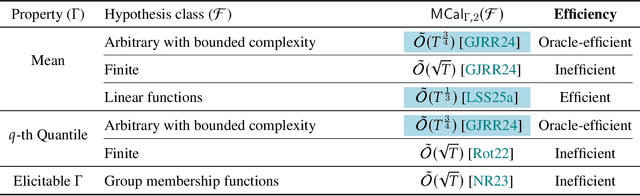
Multicalibration [HJKRR18] is an algorithmic fairness perspective that demands that the predictions of a predictor are correct conditional on themselves and membership in a collection of potentially overlapping subgroups of a population. The work of [NR23] established a surprising connection between multicalibration for an arbitrary property $\Gamma$ (e.g., mean or median) and property elicitation: a property $\Gamma$ can be multicalibrated if and only if it is elicitable, where elicitability is the notion that the true property value of a distribution can be obtained by solving a regression problem over the distribution. In the online setting, [NR23] proposed an inefficient algorithm that achieves $\sqrt T$ $\ell_2$-multicalibration error for a hypothesis class of group membership functions and an elicitable property $\Gamma$, after $T$ rounds of interaction between a forecaster and adversary. In this paper, we generalize multicalibration for an elicitable property $\Gamma$ from group membership functions to arbitrary bounded hypothesis classes and introduce a stronger notion -- swap multicalibration, following [GKR23]. Subsequently, we propose an oracle-efficient algorithm which, when given access to an online agnostic learner, achieves $T^{1/(r+1)}$ $\ell_r$-swap multicalibration error with high probability (for $r\ge2$) for a hypothesis class with bounded sequential Rademacher complexity and an elicitable property $\Gamma$. For the special case of $r=2$, this implies an oracle-efficient algorithm that achieves $T^{1/3}$ $\ell_2$-swap multicalibration error, which significantly improves on the previously established bounds for the problem [NR23, GMS25, LSS25a], and completely resolves an open question raised in [GJRR24] on the possibility of an oracle-efficient algorithm that achieves $\sqrt{T}$ $\ell_2$-mean multicalibration error by answering it in a strongly affirmative sense.
Reinforcement Learning from Adversarial Preferences in Tabular MDPs
Jul 15, 2025We introduce a new framework of episodic tabular Markov decision processes (MDPs) with adversarial preferences, which we refer to as preference-based MDPs (PbMDPs). Unlike standard episodic MDPs with adversarial losses, where the numerical value of the loss is directly observed, in PbMDPs the learner instead observes preferences between two candidate arms, which represent the choices being compared. In this work, we focus specifically on the setting where the reward functions are determined by Borda scores. We begin by establishing a regret lower bound for PbMDPs with Borda scores. As a preliminary step, we present a simple instance to prove a lower bound of $\Omega(\sqrt{HSAT})$ for episodic MDPs with adversarial losses, where $H$ is the number of steps per episode, $S$ is the number of states, $A$ is the number of actions, and $T$ is the number of episodes. Leveraging this construction, we then derive a regret lower bound of $\Omega( (H^2 S K)^{1/3} T^{2/3} )$ for PbMDPs with Borda scores, where $K$ is the number of arms. Next, we develop algorithms that achieve a regret bound of order $T^{2/3}$. We first propose a global optimization approach based on online linear optimization over the set of all occupancy measures, achieving a regret bound of $\tilde{O}((H^2 S^2 K)^{1/3} T^{2/3} )$ under known transitions. However, this approach suffers from suboptimal dependence on the potentially large number of states $S$ and computational inefficiency. To address this, we propose a policy optimization algorithm whose regret is roughly bounded by $\tilde{O}( (H^6 S K^5)^{1/3} T^{2/3} )$ under known transitions, and further extend the result to the unknown-transition setting.
Improved Bounds for Swap Multicalibration and Swap Omniprediction
May 28, 2025In this paper, we consider the related problems of multicalibration -- a multigroup fairness notion and omniprediction -- a simultaneous loss minimization paradigm, both in the distributional and online settings. The recent work of Garg et al. (2024) raised the open problem of whether it is possible to efficiently achieve $O(\sqrt{T})$ $\ell_{2}$-multicalibration error against bounded linear functions. In this paper, we answer this question in a strongly affirmative sense. We propose an efficient algorithm that achieves $O(T^{\frac{1}{3}})$ $\ell_{2}$-swap multicalibration error (both in high probability and expectation). On propagating this bound onward, we obtain significantly improved rates for $\ell_{1}$-swap multicalibration and swap omniprediction for a loss class of convex Lipschitz functions. In particular, we show that our algorithm achieves $O(T^{\frac{2}{3}})$ $\ell_{1}$-swap multicalibration and swap omniprediction errors, thereby improving upon the previous best-known bound of $O(T^{\frac{7}{8}})$. As a consequence of our improved online results, we further obtain several improved sample complexity rates in the distributional setting. In particular, we establish a $O(\varepsilon ^ {-3})$ sample complexity of efficiently learning an $\varepsilon$-swap omnipredictor for the class of convex and Lipschitz functions, $O(\varepsilon ^{-2.5})$ sample complexity of efficiently learning an $\varepsilon$-swap agnostic learner for the squared loss, and $O(\varepsilon ^ {-5}), O(\varepsilon ^ {-2.5})$ sample complexities of learning $\ell_{1}, \ell_{2}$-swap multicalibrated predictors against linear functions, all of which significantly improve on the previous best-known bounds.
Improved Regret and Contextual Linear Extension for Pandora's Box and Prophet Inequality
May 24, 2025We study the Pandora's Box problem in an online learning setting with semi-bandit feedback. In each round, the learner sequentially pays to open up to $n$ boxes with unknown reward distributions, observes rewards upon opening, and decides when to stop. The utility of the learner is the maximum observed reward minus the cumulative cost of opened boxes, and the goal is to minimize regret defined as the gap between the cumulative expected utility and that of the optimal policy. We propose a new algorithm that achieves $\widetilde{O}(\sqrt{nT})$ regret after $T$ rounds, which improves the $\widetilde{O}(n\sqrt{T})$ bound of Agarwal et al. [2024] and matches the known lower bound up to logarithmic factors. To better capture real-life applications, we then extend our results to a natural but challenging contextual linear setting, where each box's expected reward is linear in some known but time-varying $d$-dimensional context and the noise distribution is fixed over time. We design an algorithm that learns both the linear function and the noise distributions, achieving $\widetilde{O}(nd\sqrt{T})$ regret. Finally, we show that our techniques also apply to the online Prophet Inequality problem, where the learner must decide immediately whether or not to accept a revealed reward. In both non-contextual and contextual settings, our approach achieves similar improvements and regret bounds.
Comparator-Adaptive $Φ$-Regret: Improved Bounds, Simpler Algorithms, and Applications to Games
May 22, 2025In the classic expert problem, $\Phi$-regret measures the gap between the learner's total loss and that achieved by applying the best action transformation $\phi \in \Phi$. A recent work by Lu et al., [2025] introduces an adaptive algorithm whose regret against a comparator $\phi$ depends on a certain sparsity-based complexity measure of $\phi$, (almost) recovering and interpolating optimal bounds for standard regret notions such as external, internal, and swap regret. In this work, we propose a general idea to achieve an even better comparator-adaptive $\Phi$-regret bound via much simpler algorithms compared to Lu et al., [2025]. Specifically, we discover a prior distribution over all possible binary transformations and show that it suffices to achieve prior-dependent regret against these transformations. Then, we propose two concrete and efficient algorithms to achieve so, where the first one learns over multiple copies of a prior-aware variant of the Kernelized MWU algorithm of Farina et al., [2022], and the second one learns over multiple copies of a prior-aware variant of the BM-reduction [Blum and Mansour, 2007]. To further showcase the power of our methods and the advantages over Lu et al., [2025] besides the simplicity and better regret bounds, we also show that our second approach can be extended to the game setting to achieve accelerated and adaptive convergence rate to $\Phi$-equilibria for a class of general-sum games. When specified to the special case of correlated equilibria, our bound improves over the existing ones from Anagnostides et al., [2022a,b]