 Add to Chrome
 Add to Firefox
 Add to Edge
Shattering the Autoregressive Curse: Dynamic Epistemic Entropy Orchestrated Erasable Reinforcement Learning for LLMs
Jun 16, 2026
Although reinforcement learning (RL) has expanded the cognitive boundaries of large language models (LLMs), it often remains vulnerable to the autoregressive curse in long-horizon logical reasoning: small epistemic perturbations introduced early in generation can propagate irreversibly along the Markov decision process flow, triggering cascading failures that drive the reasoning trajectory toward collapse. To overcome this autoregressive cascade, in which a single early mistake can compromise all subsequent reasoning steps, we propose dynamic epistemic entropy orchestrated erasable reinforcement learning ($\text{E}^3\text{RL}$). $\text{E}^3\text{RL}$ eliminates reliance on external signals by grounding the model's endogenous local autoregressive cross-entropy as an intrinsic coordinate of epistemic uncertainty. By introducing segment-level adaptive dynamic thresholds and advantage allocation, $\text{E}^3\text{RL}$ enables the model to precisely excise localized logical defects while reusing historical key-value (KV) cache streams, thereby endowing the reasoning process with a self-healing capability. We train $\text{E}^3\text{RL}$ on the DeepMath-103k dataset. Experimental results show that $\text{E}^3\text{RL}$ reshapes the exploration efficiency of long-sequence reasoning and improves sample efficiency while maintaining linear memory overhead. On mathematical reasoning benchmarks such as AIME, $\text{E}^3\text{RL}$ achieves substantial performance gains, with the 4B and 8B parameter models surpassing previous state-of-the-art (SOTA) results by 5.349\% and 6.514\%, respectively. These findings suggest that $\text{E}^3\text{RL}$ shatters the autoregressive curse in long-sequence reasoning and establishes a theoretical and systems-level foundation for the next generation of self-healing artificial general intelligence (AGI).

Early Diagnosis of Wasted Computation in Multi-Agent LLM Systems via Failure-Aware Observability
May 31, 2026Tool-using multi-agent large language model (LLM) systems spend computation through model tokens, tool calls, retries, and code execution before producing an answer. When a run fails, final-answer evaluation reveals the endpoint but usually not the point at which the trajectory stopped making recoverable progress. This paper introduces a failure-aware observability framework for diagnosing wasted computation in multi-agent LLM traces. The framework maps recurring failure modes to online trace signals, including tool reliability, execution recovery, orchestration loops, evidence availability, information change, and budget pressure. We instantiate the framework in a three- agent question-answering system and evaluate it on 165 GAIA validation traces under identical execution caps. Operational failures remain common: 22/53 level-1 runs, 33/86 level-2 runs, and 12/26 level-3 runs fail to produce a usable final answer. The traces expose different mechanisms behind these outcomes, including insufficient evidence, repeated-action loops, max-step termination, tool-failure streaks, and execution calls that succeed without useful output. Mean token use rises from 8,152 tokens at level 1 to 16,389 tokens at level 3, while evidence availability and sentence-level support diverge. A cached 10-trace LLM-judge grounding audit shows that cheap online signals and deeper semantic metrics capture complementary layers of failure. The results position failure-aware observability as a diagnostic layer between raw execution logs and final-answer accuracy.
SELF-EMO: Emotional Self-Evolution from Recognition to Consistent Expression
Apr 20, 2026Emotion Recognition in Conversation (ERC) has become a fundamental capability for large language models (LLMs) in human-centric interaction. Beyond accurate recognition, coherent emotional expression is also crucial, yet both are limited by the scarcity and static nature of high-quality annotated data. In this work, we propose SELF-EMO, a self-evolution framework grounded in the hypothesis that better emotion prediction leads to more consistent emotional responses. We introduce two auxiliary tasks, emotional understanding and emotional expression, and design a role-based self-play paradigm where the model acts as both an emotion recognizer and a dialogue responder. Through iterative interactions, the model generates diverse conversational trajectories, enabling scalable data generation. To ensure quality, we adopt a data flywheel mechanism that filters candidate predictions and responses using a smoothed IoU-based reward and feeds selected samples back for continuous self-improvement without external supervision. We further develop SELF-GRPO, a reinforcement learning algorithm that stabilizes optimization with multi-label alignment rewards and group-level consistency signals. Experiments on IEMOCAP, MELD, and EmoryNLP show that SELF-EMO achieves state-of-the-art performance, improving accuracy by +6.33% on Qwen3-4B and +8.54% on Qwen3-8B, demonstrating strong effectiveness and generalization.
Architecture Matters More Than Scale: A Comparative Study of Retrieval and Memory Augmentation for Financial QA Under SME Compute Constraints
Apr 20, 2026The rapid adoption of artificial intelligence (AI) and large language models (LLMs) is transforming financial analytics by enabling natural language interfaces for reporting, decision support, and automated reasoning. However, limited empirical understanding exists regarding how different LLM-based reasoning architectures perform across realistic financial workflows, particularly under the cost, accuracy, and compliance constraints faced by small and medium-sized enterprises (SMEs). SMEs typically operate within severe infrastructure constraints, lacking cloud GPU budgets, dedicated AI teams, and API-scale inference capacity, making architectural efficiency a first-class concern. To ensure practical relevance, we introduce an explicit SME-constrained evaluation setting in which all experiments are conducted using a locally hosted 8B-parameter instruction-tuned model without cloud-scale infrastructure. This design isolates the impact of architectural choices within a realistic deployment environment. We systematically compare four reasoning architectures: baseline LLM, retrieval-augmented generation (RAG), structured long-term memory, and memory-augmented conversational reasoning across both FinQA and ConvFinQA benchmarks. Results reveal a consistent architectural inversion: structured memory improves precision in deterministic, operand-explicit tasks, while retrieval-based approaches outperform memory-centric methods in conversational, reference-implicit settings. Based on these findings, we propose a hybrid deployment framework that dynamically selects reasoning strategies to balance numerical accuracy, auditability, and infrastructure efficiency, providing a practical pathway for financial AI adoption in resource-constrained environments.
TA-Mem: Tool-Augmented Autonomous Memory Retrieval for LLM in Long-Term Conversational QA
Mar 10, 2026Large Language Model (LLM) has exhibited strong reasoning ability in text-based contexts across various domains, yet the limitation of context window poses challenges for the model on long-range inference tasks and necessitates a memory storage system. While many current storage approaches have been proposed with episodic notes and graph representations of memory, retrieval methods still primarily rely on predefined workflows or static similarity top-k over embeddings. To address this inflexibility, we introduced a novel tool-augmented autonomous memory retrieval framework (TA-Mem), which contains: (1) a memory extraction LLM agent which is prompted to adaptively chuck an input into sub-context based on semantic correlation, and extract information into structured notes, (2) a multi-indexed memory database designed for different types of query methods including both key-based lookup and similarity-based retrieval, (3) a tool-augmented memory retrieval agent which explores the memory autonomously by selecting appropriate tools provided by the database based on the user input, and decides whether to proceed to the next iteration or finalizing the response after reasoning on the fetched memories. The TA-Mem is evaluated on the LoCoMo dataset, achieving significant performance improvements over existing baseline approaches. In addition, an analysis of tool use across different question types also demonstrates the adaptivity of the proposed method.
Tiny-Critic RAG: Empowering Agentic Fallback with Parameter-Efficient Small Language Models
Mar 01, 2026Retrieval-Augmented Generation (RAG) grounds Large Language Models (LLMs) to mitigate factual hallucinations. Recent paradigms shift from static pipelines to Modular and Agentic RAG frameworks, granting models autonomy for multi-hop reasoning or self-correction. However, current reflective RAG heavily relies on massive LLMs as universal evaluators. In high-throughput systems, executing complete forward passes for billion-parameter models merely for binary routing introduces severe computational redundancy. Furthermore, in autonomous agent scenarios, inaccurate retrieval causes models to expend excessive tokens on spurious reasoning and redundant tool calls, inflating Time-to-First-Token (TTFT) and costs. We propose Tiny-Critic RAG, decoupling evaluation by deploying a parameter-efficient Small Language Model (SLM) via Low-Rank Adaptation (LoRA). Acting as a deterministic gatekeeper, Tiny-Critic employs constrained decoding and non-thinking inference modes for ultra-low latency binary routing. Evaluations on noise-injected datasets demonstrate Tiny-Critic RAG achieves routing accuracy comparable to GPT-4o-mini while reducing latency by an order of magnitude, establishing a highly cost-effective paradigm for agent deployment.
Language-based Trial and Error Falls Behind in the Era of Experience
Jan 29, 2026While Large Language Models (LLMs) excel in language-based agentic tasks, their applicability to unseen, nonlinguistic environments (e.g., symbolic or spatial tasks) remains limited. Previous work attributes this performance gap to the mismatch between the pretraining distribution and the testing distribution. In this work, we demonstrate the primary bottleneck is the prohibitive cost of exploration: mastering these tasks requires extensive trial-and-error, which is computationally unsustainable for parameter-heavy LLMs operating in a high dimensional semantic space. To address this, we propose SCOUT (Sub-Scale Collaboration On Unseen Tasks), a novel framework that decouples exploration from exploitation. We employ lightweight "scouts" (e.g., small MLPs) to probe environmental dynamics at a speed and scale far exceeding LLMs. The collected trajectories are utilized to bootstrap the LLM via Supervised Fine-Tuning (SFT), followed by multi-turn Reinforcement Learning (RL) to activate its latent world knowledge. Empirically, SCOUT enables a Qwen2.5-3B-Instruct model to achieve an average score of 0.86, significantly outperforming proprietary models, including Gemini-2.5-Pro (0.60), while saving about 60% GPU hours consumption.
MMRPT: MultiModal Reinforcement Pre-Training via Masked Vision-Dependent Reasoning
Dec 08, 2025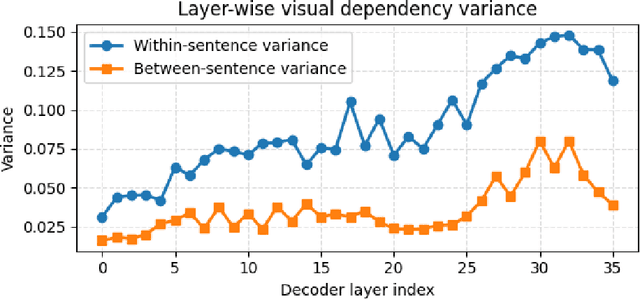
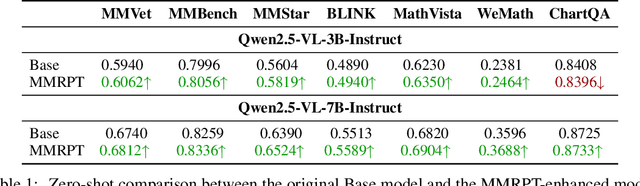
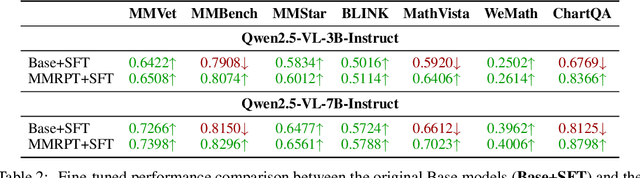
Multimodal pre-training remains constrained by the descriptive bias of image-caption pairs, leading models to favor surface linguistic cues over grounded visual understanding. We introduce MMRPT, a masked multimodal reinforcement pre-training framework that strengthens visual reasoning in MLLMs. We are the first to incorporate reinforcement learning directly into the pre-training of large vision-language models, enabling learning signals that reward visual grounding rather than caption imitation. MMRPT constructs masked multimodal data by estimating sentence-level visual dependency via attention over visual tokens and masking highly vision-dependent segments; the model reconstructs these spans through vision-grounded reasoning guided by a semantic-visual reward. Experiments show consistent zero-shot gains across diverse benchmarks and substantially improved robustness under supervised fine-tuning, demonstrating that reinforcement-driven masked reasoning provides a more reliable and generalizable pre-training objective for multimodal models.
Erase to Improve: Erasable Reinforcement Learning for Search-Augmented LLMs
Oct 01, 2025While search-augmented large language models (LLMs) exhibit impressive capabilities, their reliability in complex multi-hop reasoning remains limited. This limitation arises from three fundamental challenges: decomposition errors, where tasks are incorrectly broken down; retrieval missing, where key evidence fails to be retrieved; and reasoning errors, where flawed logic propagates through the reasoning chain. A single failure in any of these stages can derail the final answer. We propose Erasable Reinforcement Learning (ERL), a novel framework that transforms fragile reasoning into a robust process. ERL explicitly identifies faulty steps, erases them, and regenerates reasoning in place, preventing defective logic from propagating through the reasoning chain. This targeted correction mechanism turns brittle reasoning into a more resilient process. Models trained with ERL, termed ESearch, achieve substantial improvements on HotpotQA, MuSiQue, 2Wiki, and Bamboogle, with the 3B model achieving +8.48% EM and +11.56% F1, and the 7B model achieving +5.38% EM and +7.22% F1 over previous state-of-the-art(SOTA) results. These findings suggest that erasable reinforcement learning provides a powerful paradigm shift for robust multi-step reasoning in LLMs.
StepSearch: Igniting LLMs Search Ability via Step-Wise Proximal Policy Optimization
May 21, 2025Efficient multi-hop reasoning requires Large Language Models (LLMs) based agents to acquire high-value external knowledge iteratively. Previous work has explored reinforcement learning (RL) to train LLMs to perform search-based document retrieval, achieving notable improvements in QA performance, but underperform on complex, multi-hop QA resulting from the sparse rewards from global signal only. To address this gap in existing research, we introduce StepSearch, a framework for search LLMs that trained with step-wise proximal policy optimization method. It consists of richer and more detailed intermediate search rewards and token-level process supervision based on information gain and redundancy penalties to better guide each search step. We constructed a fine-grained question-answering dataset containing sub-question-level search trajectories based on open source datasets through a set of data pipeline method. On standard multi-hop QA benchmarks, it significantly outperforms global-reward baselines, achieving 11.2% and 4.2% absolute improvements for 3B and 7B models over various search with RL baselines using only 19k training data, demonstrating the effectiveness of fine-grained, stepwise supervision in optimizing deep search LLMs. Our implementation is publicly available at https://github.com/zxh20001117/StepSearch.