 Add to Chrome
 Add to Firefox
 Add to Edge
LongDocBench: Benchmarking TOC Hierarchy and Contextual Relationship Recovery in Long Documents
Aug 15, 2026
Parsing visual documents into machine-readable representations is fundamental to document intelligence. Existing benchmarks focus on page-level element recognition, reading order, formula recognition, and table structure. Long documents, however, also require document-level structure recovery. This includes reconstructing cross-page table-of-contents (TOC) hierarchies and identifying typed links from tables and figures to their captions, notes, and sources, often in one-to-many form. Because these structures are covered only partially or subsumed within broader parsing protocols, existing benchmarks cannot directly evaluate two key document-level tasks: \emph{Table-of-Contents Hierarchy Recovery} and \emph{Contextual Relationship Recovery}. To benchmark these two tasks, we introduce \textsc{LongDocBench}, comprising 85 real-world financial reports, textbooks, and academic papers spanning 2,582 pages, with up to 105 pages per document. It provides human-verified annotations for 3,937 heading nodes (mean node depth 3.55; maximum depth 9) and 3,258 contextual relationships annotated across 2,680 table and figure objects. We further evaluate both the downstream utility and recoverability of these structures. Long-document question-answering experiments show that human-verified TOC hierarchies and contextual relationships improve reasoning, with their combination providing complementary benefits. Meanwhile, representative document parsers remain limited on both recovery tasks despite strong page-level performance. To support further progress, we publicly release \textsc{LongDocBench} and its evaluation protocol and reproducible testbed for advancing document-level structure recovery in long documents.

Agentar-Fin-OCR
Mar 11, 2026In this paper, we propose Agentar-Fin-OCR, a document parsing system tailored to financial-domain documents, transforming ultra-long financial PDFs into semantically consistent, highly accurate, structured outputs with auditing-grade provenance. To address finance-specific challenges such as complex layouts, cross-page structural discontinuities, and cell-level referencing capability, Agentar-Fin-OCR combines (1) a Cross-page Contents Consolidation algorithm to restore continuity across pages and a Document-level Heading Hierarchy Reconstruction (DHR) module to build a globally consistent Table of Contents (TOC) tree for structure-aware retrieval, and (2) a difficulty-adaptive curriculum learning training strategy for table parsing, together with a CellBBoxRegressor module that uses structural anchor tokens to localize table cells from decoder hidden states without external detectors. Experiments demonstrate that our model shows high performance on the table parsing metrics of OmniDocBench. To enable realistic evaluation in the financial vertical, we further introduce FinDocBench, a benchmark that includes six financial document categories with expert-verified annotations and evaluation metrics including Table of Contents edit-distance-based similarity (TocEDS), cross-page concatenated TEDS, and Table Cell Intersection over Union (C-IoU). We evaluate a wide range of state-of-the-art models on FinDocBench to assess their capabilities and remaining limitations on financial documents. Overall, Agentar-Fin-OCR and FinDocBench provide a practical foundation for reliable downstream financial document applications.
Efficient RGB-D Scene Understanding via Multi-task Adaptive Learning and Cross-dimensional Feature Guidance
Mar 08, 2026Scene understanding plays a critical role in enabling intelligence and autonomy in robotic systems. Traditional approaches often face challenges, including occlusions, ambiguous boundaries, and the inability to adapt attention based on task-specific requirements and sample variations. To address these limitations, this paper presents an efficient RGB-D scene understanding model that performs a range of tasks, including semantic segmentation, instance segmentation, orientation estimation, panoptic segmentation, and scene classification. The proposed model incorporates an enhanced fusion encoder, which effectively leverages redundant information from both RGB and depth inputs. For semantic segmentation, we introduce normalized focus channel layers and a context feature interaction layer, designed to mitigate issues such as shallow feature misguidance and insufficient local-global feature representation. The instance segmentation task benefits from a non-bottleneck 1D structure, which achieves superior contour representation with fewer parameters. Additionally, we propose a multi-task adaptive loss function that dynamically adjusts the learning strategy for different tasks based on scene variations. Extensive experiments on the NYUv2, SUN RGB-D, and Cityscapes datasets demonstrate that our approach outperforms existing methods in both segmentation accuracy and processing speed.
Real-Time Glottis Detection Framework via Spatial-decoupled Feature Learning for Nasal Transnasal Intubation
Mar 08, 2026Nasotracheal intubation (NTI) is a vital procedure in emergency airway management, where rapid and accurate glottis detection is essential to ensure patient safety. However, existing machine assisted visual detection systems often rely on high performance computational resources and suffer from significant inference delays, which limits their applicability in time critical and resource constrained scenarios. To overcome these limitations, we propose Mobile GlottisNet, a lightweight and efficient glottis detection framework designed for real time inference on embedded and edge devices. The model incorporates structural awareness and spatial alignment mechanisms, enabling robust glottis localization under complex anatomical and visual conditions. We implement a hierarchical dynamic thresholding strategy to enhance sample assignment, and introduce an adaptive feature decoupling module based on deformable convolution to support dynamic spatial reconstruction. A cross layer dynamic weighting scheme further facilitates the fusion of semantic and detail features across multiple scales. Experimental results demonstrate that the model, with a size of only 5MB on both our PID dataset and Clinical datasets, achieves inference speeds of over 62 FPS on devices and 33 FPS on edge platforms, showing great potential in the application of emergency NTI.
ReusStdFlow: A Standardized Reusability Framework for Dynamic Workflow Construction in Agentic AI
Feb 16, 2026To address the ``reusability dilemma'' and structural hallucinations in enterprise Agentic AI,this paper proposes ReusStdFlow, a framework centered on a novel ``Extraction-Storage-Construction'' paradigm. The framework deconstructs heterogeneous, platform-specific Domain Specific Languages (DSLs) into standardized, modular workflow segments. It employs a dual knowledge architecture-integrating graph and vector databases-to facilitate synergistic retrieval of both topological structures and functional semantics. Finally, workflows are intelligently assembled using a retrieval-augmented generation (RAG) strategy. Tested on 200 real-world n8n workflows, the system achieves over 90% accuracy in both extraction and construction. This framework provides a standardized solution for the automated reorganization and efficient reuse of enterprise digital assets.
Fault2Flow: An AlphaEvolve-Optimized Human-in-the-Loop Multi-Agent System for Fault-to-Workflow Automation
Nov 17, 2025Power grid fault diagnosis is a critical process hindered by its reliance on manual, error-prone methods. Technicians must manually extract reasoning logic from dense regulations and attempt to combine it with tacit expert knowledge, which is inefficient, error-prone, and lacks maintainability as ragulations are updated and experience evolves. While Large Language Models (LLMs) have shown promise in parsing unstructured text, no existing framework integrates these two disparate knowledge sources into a single, verified, and executable workflow. To bridge this gap, we propose Fault2Flow, an LLM-based multi-agent system. Fault2Flow systematically: (1) extracts and structures regulatory logic into PASTA-formatted fault trees; (2) integrates expert knowledge via a human-in-the-loop interface for verification; (3) optimizes the reasoning logic using a novel AlphaEvolve module; and (4) synthesizes the final, verified logic into an n8n-executable workflow. Experimental validation on transformer fault diagnosis datasets confirms 100\% topological consistency and high semantic fidelity. Fault2Flow establishes a reproducible path from fault analysis to operational automation, substantially reducing expert workload.
CoMPaSS: Enhancing Spatial Understanding in Text-to-Image Diffusion Models
Dec 17, 2024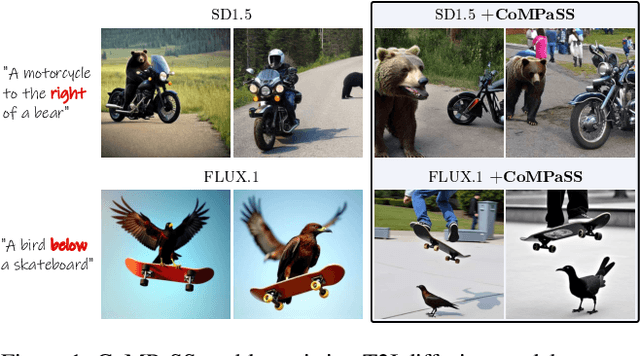

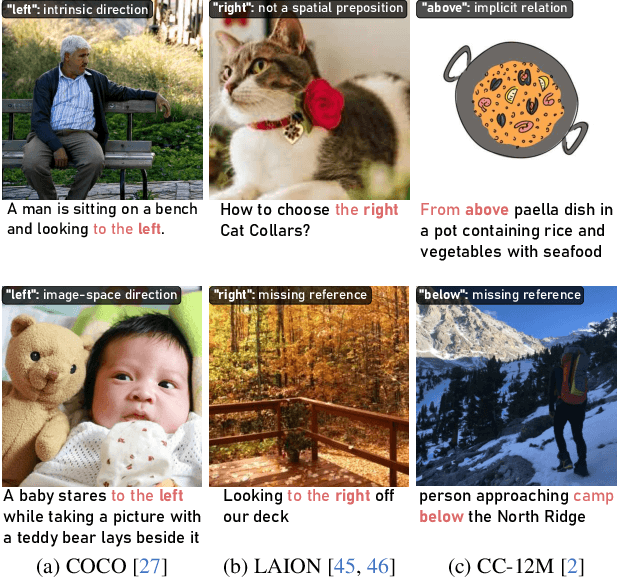
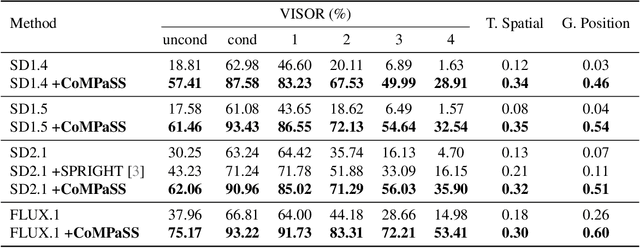
Text-to-image diffusion models excel at generating photorealistic images, but commonly struggle to render accurate spatial relationships described in text prompts. We identify two core issues underlying this common failure: 1) the ambiguous nature of spatial-related data in existing datasets, and 2) the inability of current text encoders to accurately interpret the spatial semantics of input descriptions. We address these issues with CoMPaSS, a versatile training framework that enhances spatial understanding of any T2I diffusion model. CoMPaSS solves the ambiguity of spatial-related data with the Spatial Constraints-Oriented Pairing (SCOP) data engine, which curates spatially-accurate training data through a set of principled spatial constraints. To better exploit the curated high-quality spatial priors, CoMPaSS further introduces a Token ENcoding ORdering (TENOR) module to allow better exploitation of high-quality spatial priors, effectively compensating for the shortcoming of text encoders. Extensive experiments on four popular open-weight T2I diffusion models covering both UNet- and MMDiT-based architectures demonstrate the effectiveness of CoMPaSS by setting new state-of-the-arts with substantial relative gains across well-known benchmarks on spatial relationships generation, including VISOR (+98%), T2I-CompBench Spatial (+67%), and GenEval Position (+131%). Code will be available at https://github.com/blurgyy/CoMPaSS.