 Add to Chrome
 Add to Firefox
 Add to Edge
DataFactory: Collaborative Multi-Agent Framework for Advanced Table Question Answering
Mar 10, 2026
Table Question Answering (TableQA) enables natural language interaction with structured tabular data. However, existing large language model (LLM) approaches face critical limitations: context length constraints that restrict data handling capabilities, hallucination issues that compromise answer reliability, and single-agent architectures that struggle with complex reasoning scenarios involving semantic relationships and multi-hop logic. This paper introduces DataFactory, a multi-agent framework that addresses these limitations through specialized team coordination and automated knowledge transformation. The framework comprises a Data Leader employing the ReAct paradigm for reasoning orchestration, together with dedicated Database and Knowledge Graph teams, enabling the systematic decomposition of complex queries into structured and relational reasoning tasks. We formalize automated data-to-knowledge graph transformation via the mapping function T:D x S x R -> G, and implement natural language-based consultation that - unlike fixed workflow multi-agent systems - enables flexible inter-agent deliberation and adaptive planning to improve coordination robustness. We also apply context engineering strategies that integrate historical patterns and domain knowledge to reduce hallucinations and improve query accuracy. Across TabFact, WikiTableQuestions, and FeTaQA, using eight LLMs from five providers, results show consistent gains. Our approach improves accuracy by 20.2% (TabFact) and 23.9% (WikiTQ) over baselines, with significant effects (Cohen's d > 1). Team coordination also outperforms single-team variants (+5.5% TabFact, +14.4% WikiTQ, +17.1% FeTaQA ROUGE-2). The framework offers design guidelines for multi-agent collaboration and a practical platform for enterprise data analysis through integrated structured querying and graph-based knowledge representation.
* Published in Information Processing & Management, 2026

Global River Forecasting with a Topology-Informed AI Foundation Model
Feb 25, 2026River systems operate as inherently interconnected continuous networks, meaning river hydrodynamic simulation ought to be a systemic process. However, widespread hydrology data scarcity often restricts data-driven forecasting to isolated predictions. To achieve systemic simulation and reduce reliance on river observations, we present GraphRiverCast (GRC), a topology-informed AI foundation model designed to simulate multivariate river hydrodynamics in global river systems. GRC is capable of operating in a "ColdStart" mode, generating predictions without relying on historical river states for initialization. In 7-day global pseudo-hindcasts, GRC-ColdStart functions as a robust standalone simulator, achieving a Nash-Sutcliffe Efficiency (NSE) of approximately 0.82 without exhibiting the significant error accumulation typical of autoregressive paradigms. Ablation studies reveal that topological encoding serves as indispensable structural information in the absence of historical states, explicitly guiding hydraulic connectivity and network-scale mass redistribution to reconstruct flow dynamics. Furthermore, when adapted locally via a pre-training and fine-tuning strategy, GRC consistently outperforms physics-based and locally-trained AI baselines. Crucially, this superiority extends from gauged reaches to full river networks, underscoring the necessity of topology encoding and physics-based pre-training. Built on a physics-aligned neural operator architecture, GRC enables rapid and cross-scale adaptive simulation, establishing a collaborative paradigm bridging global hydrodynamic knowledge with local hydrological reality.
Explainable LLM-driven Multi-dimensional Distillation for E-Commerce Relevance Learning
Nov 20, 2024Effective query-item relevance modeling is pivotal for enhancing user experience and safeguarding user satisfaction in e-commerce search systems. Recently, benefiting from the vast inherent knowledge, Large Language Model (LLM) approach demonstrates strong performance and long-tail generalization ability compared with previous neural-based specialized relevance learning methods. Though promising, current LLM-based methods encounter the following inadequacies in practice: First, the massive parameters and computational demands make it difficult to be deployed online. Second, distilling LLM models to online models is a feasible direction, but the LLM relevance modeling is a black box, and its rich intrinsic knowledge is difficult to extract and apply online. To improve the interpretability of LLM and boost the performance of online relevance models via LLM, we propose an Explainable LLM-driven Multi-dimensional Distillation framework for e-commerce relevance learning, which comprises two core components: (1) An Explainable LLM for relevance modeling (ELLM-rele), which decomposes the relevance learning into intermediate steps and models relevance learning as a Chain-of-Thought (CoT) reasoning, thereby enhancing both interpretability and performance of LLM. (2) A Multi-dimensional Knowledge Distillation (MKD) architecture that transfers the knowledge of ELLM-rele to current deployable interaction-based and representation-based student models from both the relevance score distribution and CoT reasoning aspects. Through distilling the probabilistic and CoT reasoning knowledge, MKD improves both the semantic interaction and long-tail generalization abilities of student models. Extensive offline evaluations and online experiments on Taobao search ad scene demonstrate that our proposed framework significantly enhances e-commerce relevance learning performance and user experience.
Dance of the ADS: Orchestrating Failures through Historically-Informed Scenario Fuzzing
Jul 05, 2024
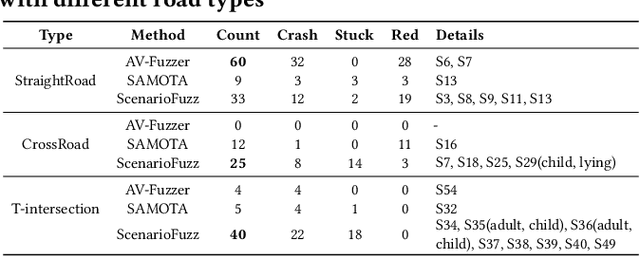

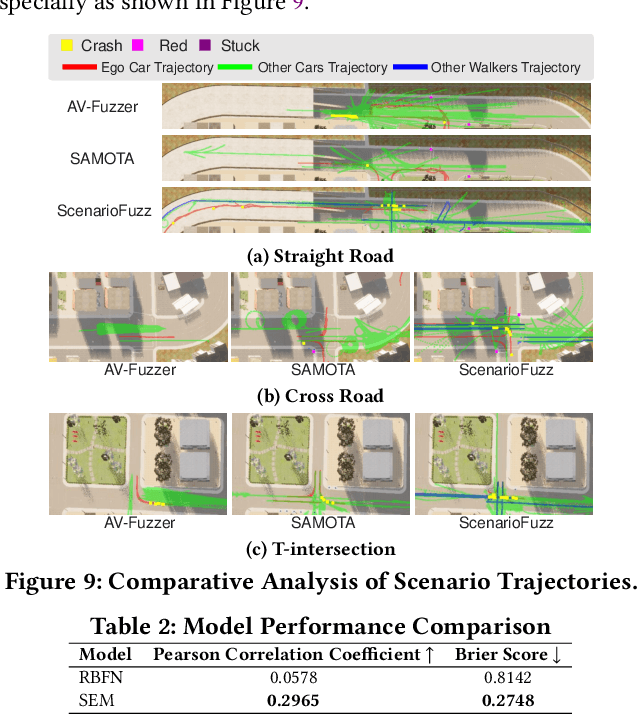
As autonomous driving systems (ADS) advance towards higher levels of autonomy, orchestrating their safety verification becomes increasingly intricate. This paper unveils ScenarioFuzz, a pioneering scenario-based fuzz testing methodology. Designed like a choreographer who understands the past performances, it uncovers vulnerabilities in ADS without the crutch of predefined scenarios. Leveraging map road networks, such as OPENDRIVE, we extract essential data to form a foundational scenario seed corpus. This corpus, enriched with pertinent information, provides the necessary boundaries for fuzz testing in the absence of starting scenarios. Our approach integrates specialized mutators and mutation techniques, combined with a graph neural network model, to predict and filter out high-risk scenario seeds, optimizing the fuzzing process using historical test data. Compared to other methods, our approach reduces the time cost by an average of 60.3%, while the number of error scenarios discovered per unit of time increases by 103%. Furthermore, we propose a self-supervised collision trajectory clustering method, which aids in identifying and summarizing 54 high-risk scenario categories prone to inducing ADS faults. Our experiments have successfully uncovered 58 bugs across six tested systems, emphasizing the critical safety concerns of ADS.
K-ESConv: Knowledge Injection for Emotional Support Dialogue Systems via Prompt Learning
Dec 16, 2023Automatic psychological counseling requires mass of professional knowledge that can be found in online counseling forums. Motivated by this, we propose K-ESConv, a novel prompt learning based knowledge injection method for emotional support dialogue system, transferring forum knowledge to response generation. We evaluate our model on an emotional support dataset ESConv, where the model retrieves and incorporates knowledge from external professional emotional Q\&A forum. Experiment results show that the proposed method outperforms existing baselines on both automatic evaluation and human evaluation, which shows that our approach significantly improves the correlation and diversity of responses and provides more comfort and better suggestion for the seeker.
DemoSG: Demonstration-enhanced Schema-guided Generation for Low-resource Event Extraction
Oct 16, 2023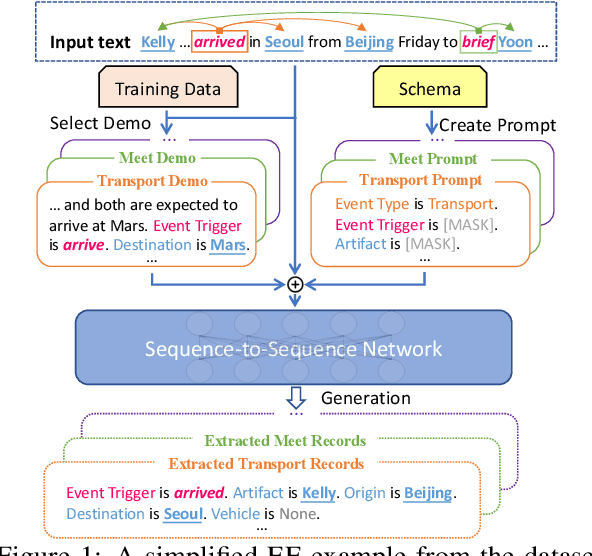
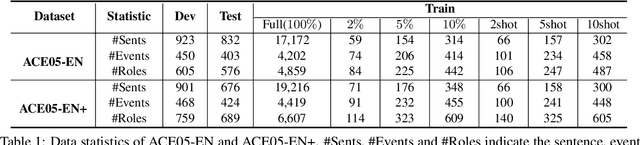
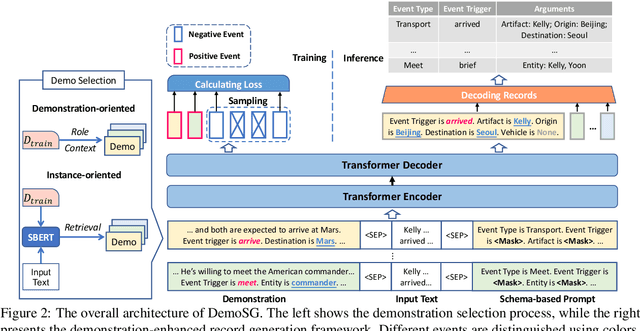
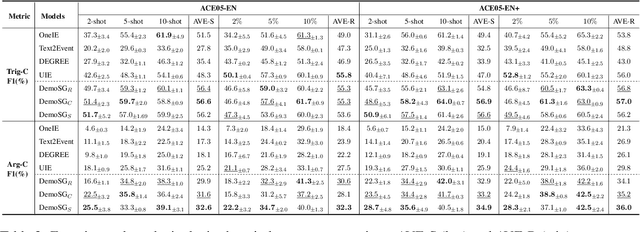
Most current Event Extraction (EE) methods focus on the high-resource scenario, which requires a large amount of annotated data and can hardly be applied to low-resource domains. To address EE more effectively with limited resources, we propose the Demonstration-enhanced Schema-guided Generation (DemoSG) model, which benefits low-resource EE from two aspects: Firstly, we propose the demonstration-based learning paradigm for EE to fully use the annotated data, which transforms them into demonstrations to illustrate the extraction process and help the model learn effectively. Secondly, we formulate EE as a natural language generation task guided by schema-based prompts, thereby leveraging label semantics and promoting knowledge transfer in low-resource scenarios. We conduct extensive experiments under in-domain and domain adaptation low-resource settings on three datasets, and study the robustness of DemoSG. The results show that DemoSG significantly outperforms current methods in low-resource scenarios.
DemoNSF: A Multi-task Demonstration-based Generative Framework for Noisy Slot Filling Task
Oct 16, 2023Recently, prompt-based generative frameworks have shown impressive capabilities in sequence labeling tasks. However, in practical dialogue scenarios, relying solely on simplistic templates and traditional corpora presents a challenge for these methods in generalizing to unknown input perturbations. To address this gap, we propose a multi-task demonstration based generative framework for noisy slot filling, named DemoNSF. Specifically, we introduce three noisy auxiliary tasks, namely noisy recovery (NR), random mask (RM), and hybrid discrimination (HD), to implicitly capture semantic structural information of input perturbations at different granularities. In the downstream main task, we design a noisy demonstration construction strategy for the generative framework, which explicitly incorporates task-specific information and perturbed distribution during training and inference. Experiments on two benchmarks demonstrate that DemoNSF outperforms all baseline methods and achieves strong generalization. Further analysis provides empirical guidance for the practical application of generative frameworks. Our code is released at https://github.com/dongguanting/Demo-NSF.
Type-aware Decoding via Explicitly Aggregating Event Information for Document-level Event Extraction
Oct 16, 2023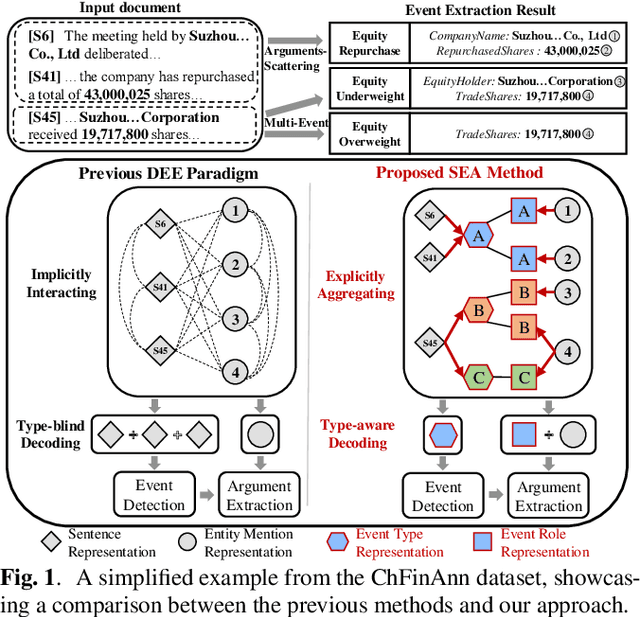
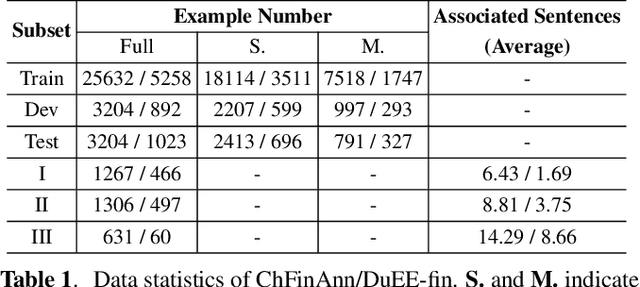
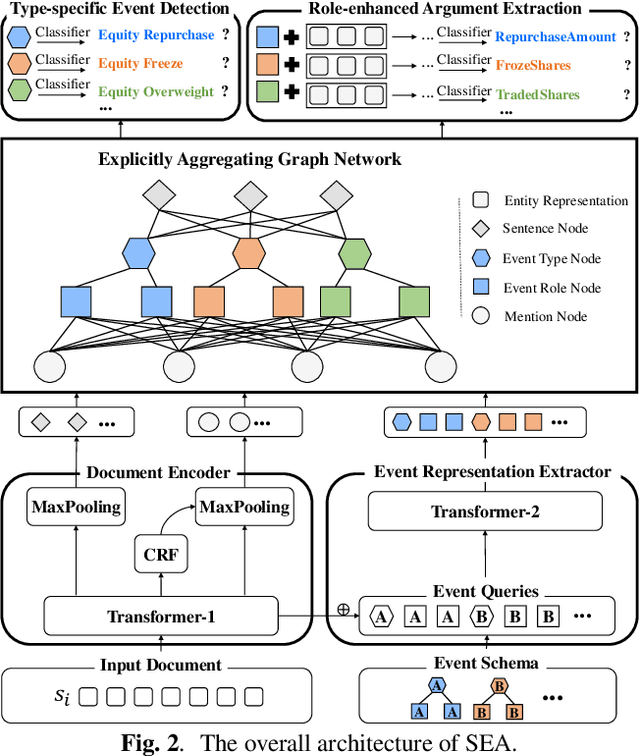
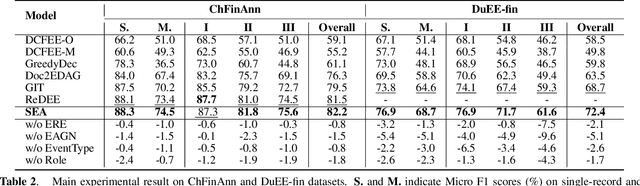
Document-level event extraction (DEE) faces two main challenges: arguments-scattering and multi-event. Although previous methods attempt to address these challenges, they overlook the interference of event-unrelated sentences during event detection and neglect the mutual interference of different event roles during argument extraction. Therefore, this paper proposes a novel Schema-based Explicitly Aggregating~(SEA) model to address these limitations. SEA aggregates event information into event type and role representations, enabling the decoding of event records based on specific type-aware representations. By detecting each event based on its event type representation, SEA mitigates the interference caused by event-unrelated information. Furthermore, SEA extracts arguments for each role based on its role-aware representations, reducing mutual interference between different roles. Experimental results on the ChFinAnn and DuEE-fin datasets show that SEA outperforms the SOTA methods.
A Multi-Task Semantic Decomposition Framework with Task-specific Pre-training for Few-Shot NER
Aug 28, 2023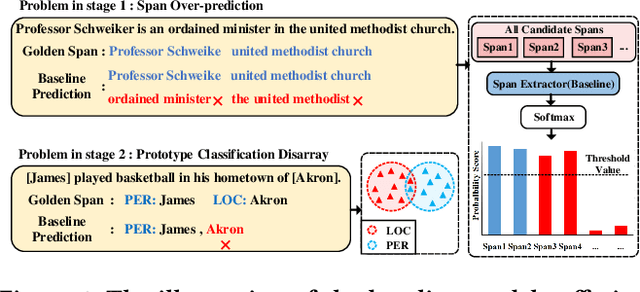
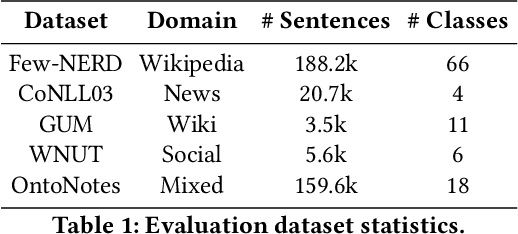


The objective of few-shot named entity recognition is to identify named entities with limited labeled instances. Previous works have primarily focused on optimizing the traditional token-wise classification framework, while neglecting the exploration of information based on NER data characteristics. To address this issue, we propose a Multi-Task Semantic Decomposition Framework via Joint Task-specific Pre-training (MSDP) for few-shot NER. Drawing inspiration from demonstration-based and contrastive learning, we introduce two novel pre-training tasks: Demonstration-based Masked Language Modeling (MLM) and Class Contrastive Discrimination. These tasks effectively incorporate entity boundary information and enhance entity representation in Pre-trained Language Models (PLMs). In the downstream main task, we introduce a multi-task joint optimization framework with the semantic decomposing method, which facilitates the model to integrate two different semantic information for entity classification. Experimental results of two few-shot NER benchmarks demonstrate that MSDP consistently outperforms strong baselines by a large margin. Extensive analyses validate the effectiveness and generalization of MSDP.
PCRED: Zero-shot Relation Triplet Extraction with Potential Candidate Relation Selection and Entity Boundary Detection
Dec 13, 2022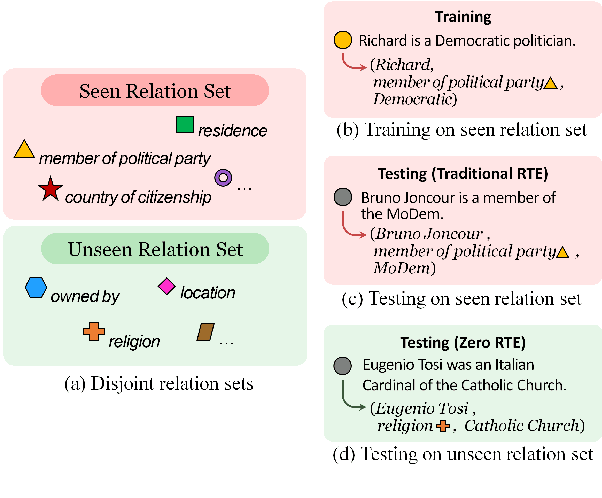
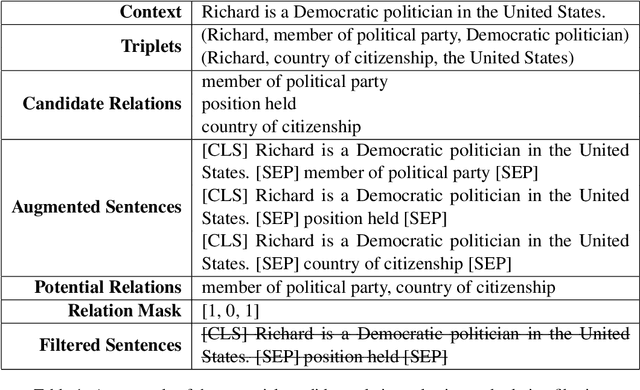
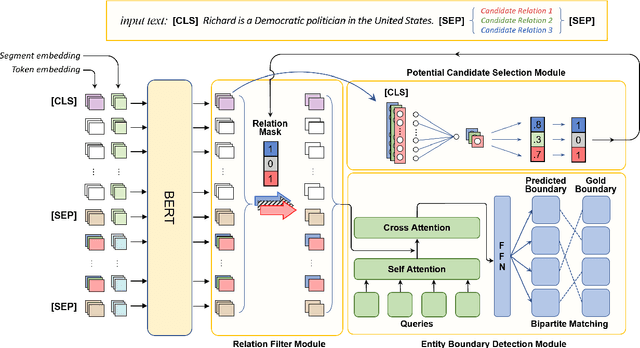

Zero-shot relation triplet extraction (ZeroRTE) aims to extract relation triplets from unstructured texts under the zero-shot setting, where the relation sets at the training and testing stages are disjoint. Previous state-of-the-art method handles this challenging task by leveraging pretrained language models to generate data as additional training samples, which increases the training cost and severely constrains the model performance. To address the above issues, we propose a novel method named PCRED for ZeroRTE with Potential Candidate Relation Selection and Entity Boundary Detection. The remarkable characteristic of PCRED is that it does not rely on additional data and still achieves promising performance. The model adopts a relation-first paradigm, recognizing unseen relations through candidate relation selection. With this approach, the semantics of relations are naturally infused in the context. Entities are extracted based on the context and the semantics of relations subsequently. We evaluate our model on two ZeroRTE datasets. The experiment results show that our method consistently outperforms previous works. Our code will be available at https://anonymous.4open.science/r/PCRED.