 Add to Chrome
 Add to Firefox
 Add to Edge
DT-Guard: Intent-Driven Reasoning-Active Training for Reasoning-Free LLM Safety Guardrail
Jul 07, 2026
Large language models deployed in open-world applications require safety guardrails that are both robust to complex risks and efficient enough for low-latency runtime moderation. Existing guardrails face a practical trade-off between lightweight classification-based models, which are efficient but often struggle with concealed intent, ambiguous semantics, and borderline safety decisions, and reasoning-based guards, which improve judgment quality but introduce additional token generation and inference latency. We present DT-Guard, a content safety guardrail model based on a Reasoning-Active Training, Reasoning-Free Inference paradigm. The key idea is to use reasoning supervision during training while emitting only structured safety labels at inference time. DT-Guard formulates safety judgment as a progressive decision process, Intent - Category - Safety, and constructs an intent-driven dataset with intent labels, risk categories, safety labels, and structured reasoning trajectories. To further improve hard-case robustness, we propose Rollout-Guided Progressive Hard-Case Optimization (RG-PHO), which uses multi-rollout consistency to identify stably mastered, persistently failed, and preference-unstable samples, and applies targeted supervised and preference optimization accordingly. At inference time, DT-Guard directly generates structured labels without explicit reasoning traces, preserving deployment efficiency. Experiments on prompt-side and response-side safety benchmarks show that DT-Guard achieves average F1 scores of 0.886 and 0.870, respectively. With only a 4B backbone, it reaches a dual-side average F1 of 0.878, outperforming strong 8B guardrail baselines. These results demonstrate that reasoning supervision can be effectively internalized into low-latency safety discrimination.

Beyond Scene Priors: Fine-Grained Traffic Scene Reasoning with Benchmarking and Query-Guided Small-Object Focus
Jul 05, 2026In safety-critical traffic scenarios, answering complex questions relies on minute, localized visual cues. However, standard Multimodal Large Language Models (MLLMs) tend to over-attend to backgrounds, overwhelming crucial small objects during visual-language alignment, a failure mode we term 'critical evidence dilution.' Furthermore, existing visual question answering (VQA) datasets rarely expose this flaw, as they lack large-scale, distractor-heavy evaluations that require pinpointing local evidence. To bridge this evaluation and architecture gap, we introduce the Fine-Grained Traffic Reasoning Benchmark (FGTR-Bench) and the Text-Guided Small-Object Reasoning MLLM (TSR-MLLM). FGTR-Bench comprises 40,236 single-image Multiple-Choice Questions (MCQs) created via multi-agent generation, consistency checks, and expert audits, alongside a disjoint 4,947-sample blind test split. To resolve evidence dilution, TSR-MLLM, built on Qwen3-VL-4B, uses a query-conditioned Text-Guided Small-Object Focus (TG-SOF) map. Applied once at the decoder boundary, the map adds sparse Top-K gated residuals to the most question-relevant vision slots while leaving text tokens unchanged. Together with lightweight decoder adaptation, TSR-MLLM preserves single-pass inference without external detectors or image re-encoding. Under matched settings, TSR-MLLM outperforms the strongest 4B baseline by 2.1 points on FGTR-Bench (74.1% overall), with larger gains on evidence-local tracks. Furthermore, it remains competitive on DriveQA-V (CARLA Signs) under greedy decoding without task-specific fine-tuning.
Type-aware Decoding via Explicitly Aggregating Event Information for Document-level Event Extraction
Oct 16, 2023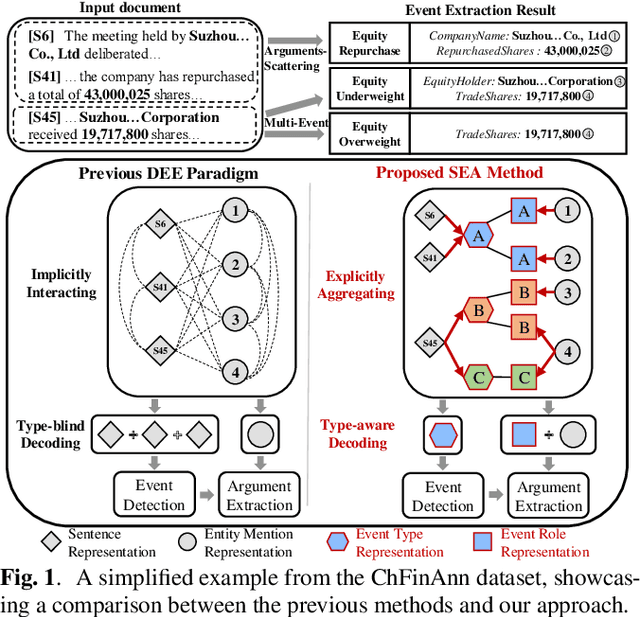
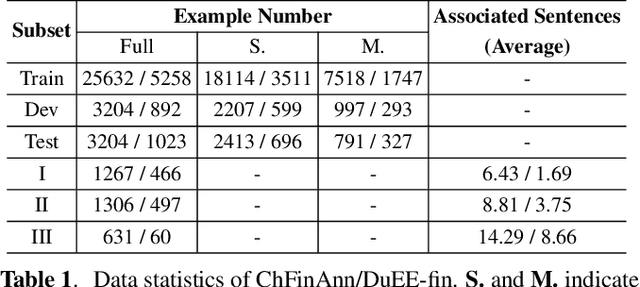
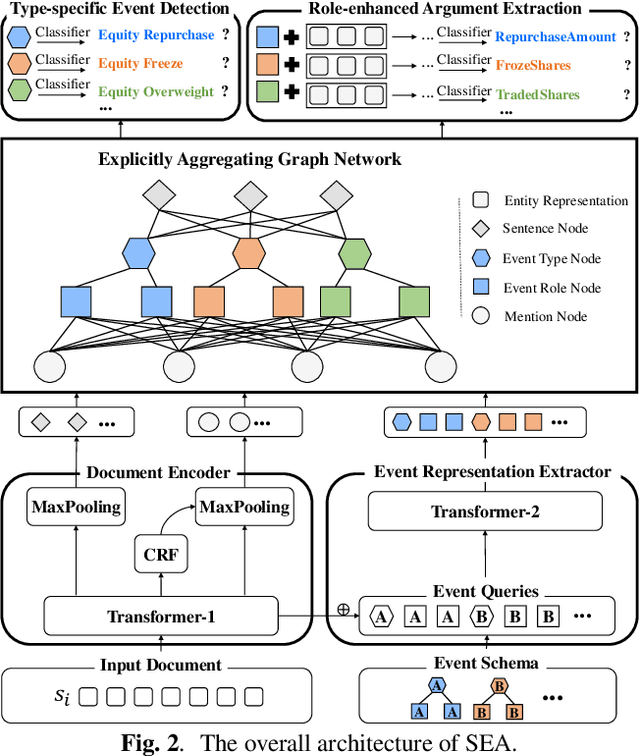
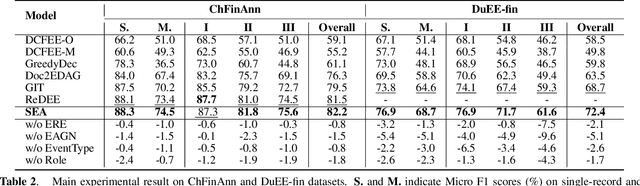
Document-level event extraction (DEE) faces two main challenges: arguments-scattering and multi-event. Although previous methods attempt to address these challenges, they overlook the interference of event-unrelated sentences during event detection and neglect the mutual interference of different event roles during argument extraction. Therefore, this paper proposes a novel Schema-based Explicitly Aggregating~(SEA) model to address these limitations. SEA aggregates event information into event type and role representations, enabling the decoding of event records based on specific type-aware representations. By detecting each event based on its event type representation, SEA mitigates the interference caused by event-unrelated information. Furthermore, SEA extracts arguments for each role based on its role-aware representations, reducing mutual interference between different roles. Experimental results on the ChFinAnn and DuEE-fin datasets show that SEA outperforms the SOTA methods.
DemoSG: Demonstration-enhanced Schema-guided Generation for Low-resource Event Extraction
Oct 16, 2023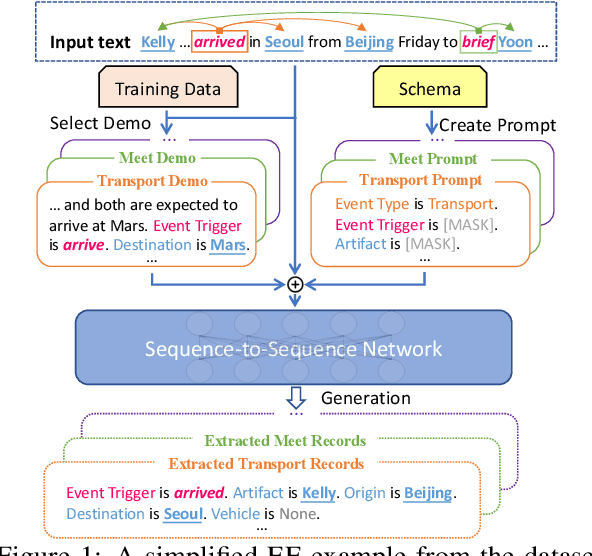
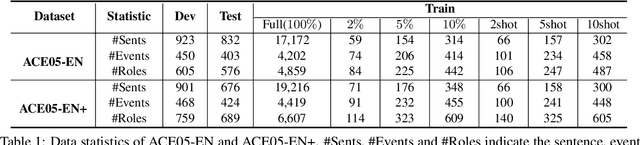
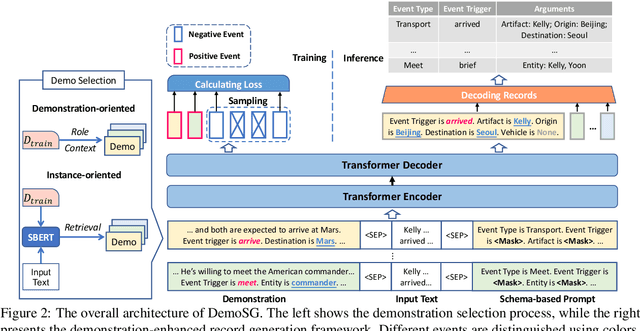
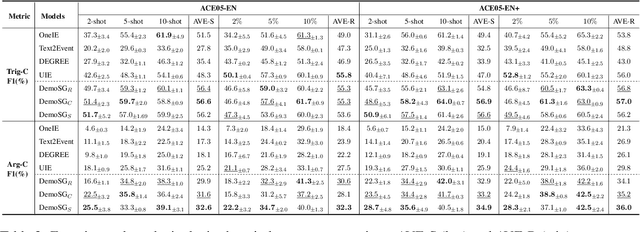
Most current Event Extraction (EE) methods focus on the high-resource scenario, which requires a large amount of annotated data and can hardly be applied to low-resource domains. To address EE more effectively with limited resources, we propose the Demonstration-enhanced Schema-guided Generation (DemoSG) model, which benefits low-resource EE from two aspects: Firstly, we propose the demonstration-based learning paradigm for EE to fully use the annotated data, which transforms them into demonstrations to illustrate the extraction process and help the model learn effectively. Secondly, we formulate EE as a natural language generation task guided by schema-based prompts, thereby leveraging label semantics and promoting knowledge transfer in low-resource scenarios. We conduct extensive experiments under in-domain and domain adaptation low-resource settings on three datasets, and study the robustness of DemoSG. The results show that DemoSG significantly outperforms current methods in low-resource scenarios.