 Add to Chrome
 Add to Firefox
 Add to Edge
Is Four Enough? Automated Reasoning Approaches and Dual Bounds for Condorcet Dimensions of Elections
Apr 21, 2026
In an election where $n$ voters rank $m$ candidates, a Condorcet winning set is a committee of $k$ candidates such that for any outside candidate, a majority of voters prefer some committee member. Condorcet's paradox shows that some elections admit no Condorcet winning sets with a single candidate (i.e., $k=1$), and the same can be shown for $k=2$. On the other hand, recent work proves that a set of size $k=5$ exists for every election. This leaves an important theoretical gap between the best known lower bound $(k\geq 3)$ and upper bound $(k \leq 5)$ for the number of candidates needed to guarantee existence. We aim to close the gap between the existence guarantees and impossibility results for Condorcet winning sets. We explore an automated reasoning approach to tighten these bounds. We design a mixed-integer linear program (MILP) to search for elections that would serve as counter-examples to conjectured bounds. We employ a number of optimizations, such as symmetry breaking, subsampling, and constraint generation, to enhance the search and model effectively infinite electorates. Furthermore, we analyze the dual of the linear programming relaxation as a path towards obtaining a new upper bound. Despite extensive search on moderate-sized elections, we fail to find any election requiring a committee larger than size 3. Motivated by our experimental results in this direction, we simplify the dual linear program and formulate a conjecture which, if true, implies that a winning set of size 4 always exists. Our automated reasoning results provide strong empirical evidence that the Condorcet dimension of any election may be smaller than currently known upper bounds, at least for small instances. We offer a general-purpose framework for searching elections in ranked voting and a new, concrete analytical path via duality toward proving that smaller committees suffice.

Learning and Computation of $Φ$-Equilibria at the Frontier of Tractability
Feb 25, 2025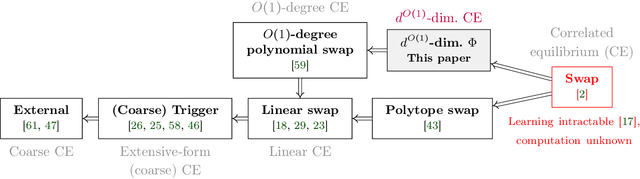

$\Phi$-equilibria -- and the associated notion of $\Phi$-regret -- are a powerful and flexible framework at the heart of online learning and game theory, whereby enriching the set of deviations $\Phi$ begets stronger notions of rationality. Recently, Daskalakis, Farina, Fishelson, Pipis, and Schneider (STOC '24) -- abbreviated as DFFPS -- settled the existence of efficient algorithms when $\Phi$ contains only linear maps under a general, $d$-dimensional convex constraint set $\mathcal{X}$. In this paper, we significantly extend their work by resolving the case where $\Phi$ is $k$-dimensional; degree-$\ell$ polynomials constitute a canonical such example with $k = d^{O(\ell)}$. In particular, positing only oracle access to $\mathcal{X}$, we obtain two main positive results: i) a $\text{poly}(n, d, k, \text{log}(1/\epsilon))$-time algorithm for computing $\epsilon$-approximate $\Phi$-equilibria in $n$-player multilinear games, and ii) an efficient online algorithm that incurs average $\Phi$-regret at most $\epsilon$ using $\text{poly}(d, k)/\epsilon^2$ rounds. We also show nearly matching lower bounds in the online learning setting, thereby obtaining for the first time a family of deviations that captures the learnability of $\Phi$-regret. From a technical standpoint, we extend the framework of DFFPS from linear maps to the more challenging case of maps with polynomial dimension. At the heart of our approach is a polynomial-time algorithm for computing an expected fixed point of any $\phi : \mathcal{X} \to \mathcal{X}$ based on the ellipsoid against hope (EAH) algorithm of Papadimitriou and Roughgarden (JACM '08). In particular, our algorithm for computing $\Phi$-equilibria is based on executing EAH in a nested fashion -- each step of EAH itself being implemented by invoking a separate call to EAH.
Expected Variational Inequalities
Feb 25, 2025
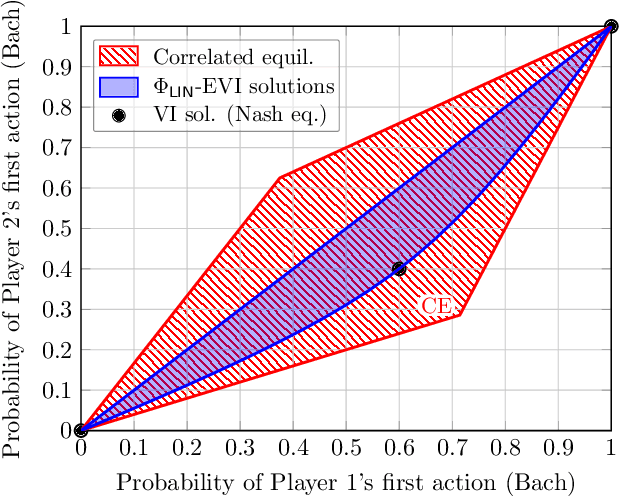
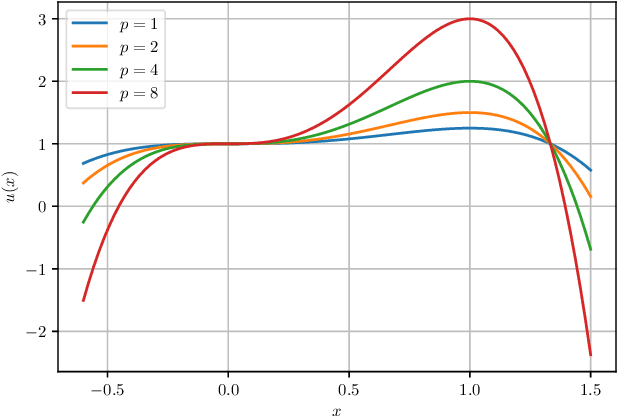
Variational inequalities (VIs) encompass many fundamental problems in diverse areas ranging from engineering to economics and machine learning. However, their considerable expressivity comes at the cost of computational intractability. In this paper, we introduce and analyze a natural relaxation -- which we refer to as expected variational inequalities (EVIs) -- where the goal is to find a distribution that satisfies the VI constraint in expectation. By adapting recent techniques from game theory, we show that, unlike VIs, EVIs can be solved in polynomial time under general (nonmonotone) operators. EVIs capture the seminal notion of correlated equilibria, but enjoy a greater reach beyond games. We also employ our framework to capture and generalize several existing disparate results, including from settings such as smooth games, and games with coupled constraints or nonconcave utilities.