 Add to Chrome
 Add to Firefox
 Add to Edge
Beyond Cascaded Architectures: An End-to-end Generative Framework for Industrial Advertising
May 26, 2025
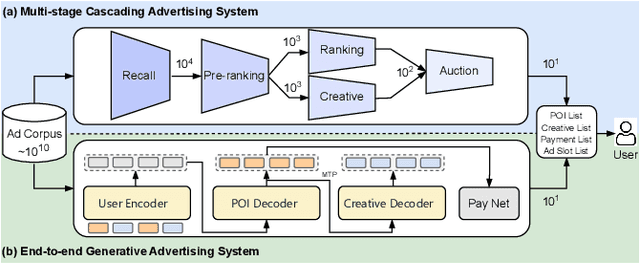
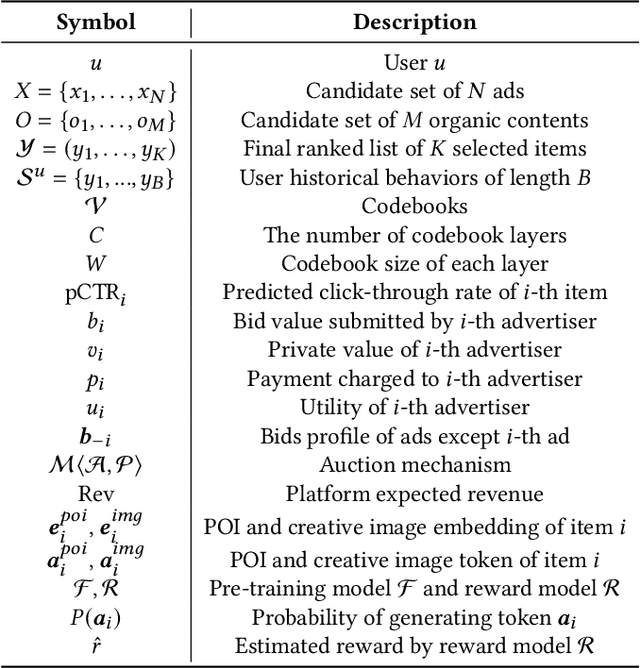
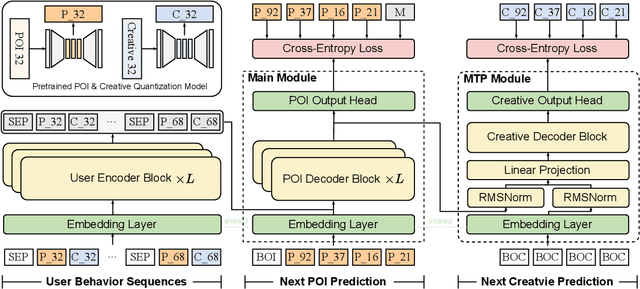
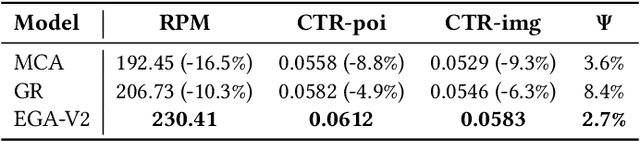
Traditional online industrial advertising systems suffer from the limitations of multi-stage cascaded architectures, which often discard high-potential candidates prematurely and distribute decision logic across disconnected modules. While recent generative recommendation approaches provide end-to-end solutions, they fail to address critical advertising requirements of key components for real-world deployment, such as explicit bidding, creative selection, ad allocation, and payment computation. To bridge this gap, we introduce End-to-End Generative Advertising (EGA), the first unified framework that holistically models user interests, point-of-interest (POI) and creative generation, ad allocation, and payment optimization within a single generative model. Our approach employs hierarchical tokenization and multi-token prediction to jointly generate POI recommendations and ad creatives, while a permutation-aware reward model and token-level bidding strategy ensure alignment with both user experiences and advertiser objectives. Additionally, we decouple allocation from payment using a differentiable ex-post regret minimization mechanism, guaranteeing approximate incentive compatibility at the POI level. Through extensive offline evaluations and large-scale online experiments on real-world advertising platforms, we demonstrate that EGA significantly outperforms traditional cascaded systems in both performance and practicality. Our results highlight its potential as a pioneering fully generative advertising solution, paving the way for next-generation industrial ad systems.

Denoising Concept Vectors with Sparse Autoencoders for Improved Language Model Steering
May 21, 2025Linear Concept Vectors have proven effective for steering large language models (LLMs). While existing approaches like linear probing and difference-in-means derive these vectors from LLM hidden representations, diverse data introduces noises (i.e., irrelevant features) that challenge steering robustness. To address this, we propose Sparse Autoencoder-Denoised Concept Vectors (SDCV), which uses Sparse Autoencoders to filter out noisy features from hidden representations. When applied to linear probing and difference-in-means, our method improves their steering success rates. We validate our noise hypothesis through counterfactual experiments and feature visualizations.
SeedBench: A Multi-task Benchmark for Evaluating Large Language Models in Seed Science
May 19, 2025Seed science is essential for modern agriculture, directly influencing crop yields and global food security. However, challenges such as interdisciplinary complexity and high costs with limited returns hinder progress, leading to a shortage of experts and insufficient technological support. While large language models (LLMs) have shown promise across various fields, their application in seed science remains limited due to the scarcity of digital resources, complex gene-trait relationships, and the lack of standardized benchmarks. To address this gap, we introduce SeedBench -- the first multi-task benchmark specifically designed for seed science. Developed in collaboration with domain experts, SeedBench focuses on seed breeding and simulates key aspects of modern breeding processes. We conduct a comprehensive evaluation of 26 leading LLMs, encompassing proprietary, open-source, and domain-specific fine-tuned models. Our findings not only highlight the substantial gaps between the power of LLMs and the real-world seed science problems, but also make a foundational step for research on LLMs for seed design.
Who You Are Matters: Bridging Topics and Social Roles via LLM-Enhanced Logical Recommendation
May 16, 2025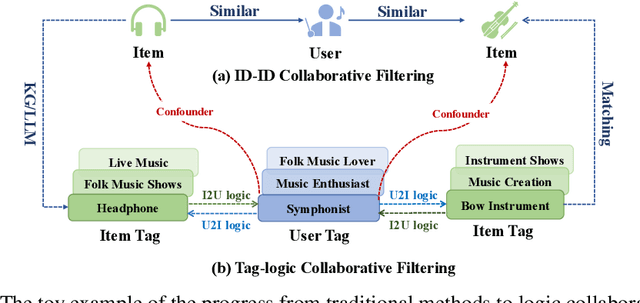
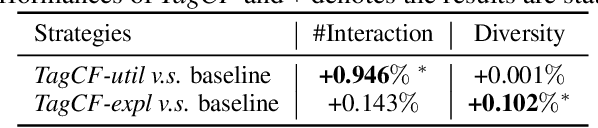
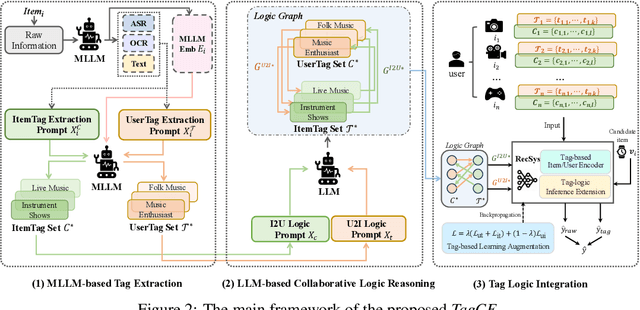
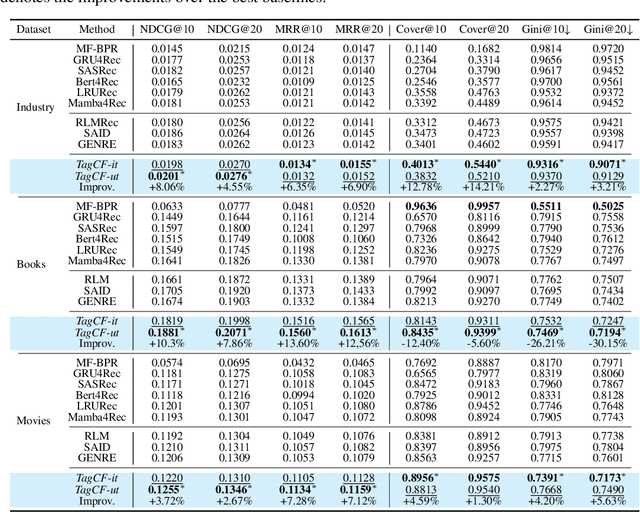
Recommender systems filter contents/items valuable to users by inferring preferences from user features and historical behaviors. Mainstream approaches follow the learning-to-rank paradigm, which focus on discovering and modeling item topics (e.g., categories), and capturing user preferences on these topics based on historical interactions. However, this paradigm often neglects the modeling of user characteristics and their social roles, which are logical confounders influencing the correlated interest and user preference transition. To bridge this gap, we introduce the user role identification task and the behavioral logic modeling task that aim to explicitly model user roles and learn the logical relations between item topics and user social roles. We show that it is possible to explicitly solve these tasks through an efficient integration framework of Large Language Model (LLM) and recommendation systems, for which we propose TagCF. On the one hand, the exploitation of the LLM's world knowledge and logic inference ability produces a virtual logic graph that reveals dynamic and expressive knowledge of users, augmenting the recommendation performance. On the other hand, the user role aligns the user behavioral logic with the observed user feedback, refining our understanding of user behaviors. Additionally, we also show that the extracted user-item logic graph is empirically a general knowledge that can benefit a wide range of recommendation tasks, and conduct experiments on industrial and several public datasets as verification.
TartanGround: A Large-Scale Dataset for Ground Robot Perception and Navigation
May 15, 2025We present TartanGround, a large-scale, multi-modal dataset to advance the perception and autonomy of ground robots operating in diverse environments. This dataset, collected in various photorealistic simulation environments includes multiple RGB stereo cameras for 360-degree coverage, along with depth, optical flow, stereo disparity, LiDAR point clouds, ground truth poses, semantic segmented images, and occupancy maps with semantic labels. Data is collected using an integrated automatic pipeline, which generates trajectories mimicking the motion patterns of various ground robot platforms, including wheeled and legged robots. We collect 910 trajectories across 70 environments, resulting in 1.5 million samples. Evaluations on occupancy prediction and SLAM tasks reveal that state-of-the-art methods trained on existing datasets struggle to generalize across diverse scenes. TartanGround can serve as a testbed for training and evaluation of a broad range of learning-based tasks, including occupancy prediction, SLAM, neural scene representation, perception-based navigation, and more, enabling advancements in robotic perception and autonomy towards achieving robust models generalizable to more diverse scenarios. The dataset and codebase for data collection will be made publicly available upon acceptance. Webpage: https://tartanair.org/tartanground
RetroInfer: A Vector-Storage Approach for Scalable Long-Context LLM Inference
May 05, 2025The growing context lengths of large language models (LLMs) pose significant challenges for efficient inference, primarily due to GPU memory and bandwidth constraints. We present RetroInfer, a novel system that reconceptualizes the key-value (KV) cache as a vector storage system which exploits the inherent attention sparsity to accelerate long-context LLM inference. At its core is the wave index, an Attention-aWare VEctor index that enables efficient and accurate retrieval of critical tokens through techniques such as tripartite attention approximation, accuracy-bounded attention estimation, and segmented clustering. Complementing this is the wave buffer, which coordinates KV cache placement and overlaps computation and data transfer across GPU and CPU to sustain high throughput. Unlike prior sparsity-based methods that struggle with token selection and hardware coordination, RetroInfer delivers robust performance without compromising model accuracy. Experiments on long-context benchmarks show up to 4.5X speedup over full attention within GPU memory limits and up to 10.5X over sparse attention baselines when KV cache is extended to CPU memory, all while preserving full-attention-level accuracy.
R1-Reward: Training Multimodal Reward Model Through Stable Reinforcement Learning
May 05, 2025Multimodal Reward Models (MRMs) play a crucial role in enhancing the performance of Multimodal Large Language Models (MLLMs). While recent advancements have primarily focused on improving the model structure and training data of MRMs, there has been limited exploration into the effectiveness of long-term reasoning capabilities for reward modeling and how to activate these capabilities in MRMs. In this paper, we explore how Reinforcement Learning (RL) can be used to improve reward modeling. Specifically, we reformulate the reward modeling problem as a rule-based RL task. However, we observe that directly applying existing RL algorithms, such as Reinforce++, to reward modeling often leads to training instability or even collapse due to the inherent limitations of these algorithms. To address this issue, we propose the StableReinforce algorithm, which refines the training loss, advantage estimation strategy, and reward design of existing RL methods. These refinements result in more stable training dynamics and superior performance. To facilitate MRM training, we collect 200K preference data from diverse datasets. Our reward model, R1-Reward, trained using the StableReinforce algorithm on this dataset, significantly improves performance on multimodal reward modeling benchmarks. Compared to previous SOTA models, R1-Reward achieves a $8.4\%$ improvement on the VL Reward-Bench and a $14.3\%$ improvement on the Multimodal Reward Bench. Moreover, with more inference compute, R1-Reward's performance is further enhanced, highlighting the potential of RL algorithms in optimizing MRMs.
6D Pose Estimation on Spoons and Hands
May 05, 2025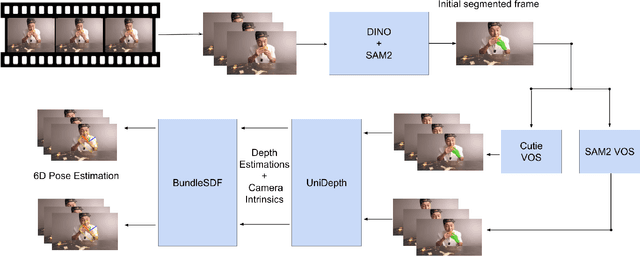
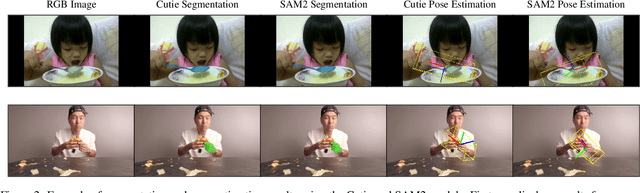
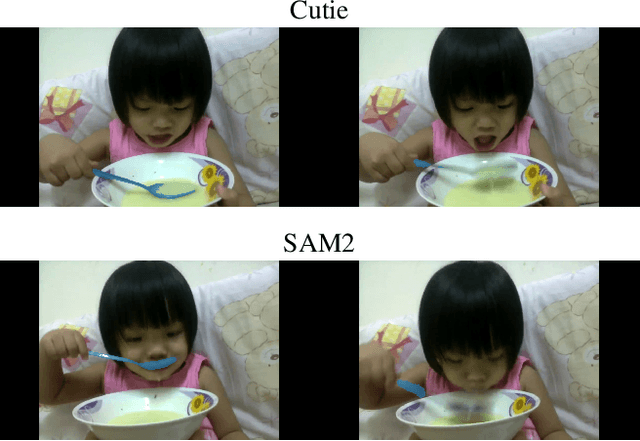
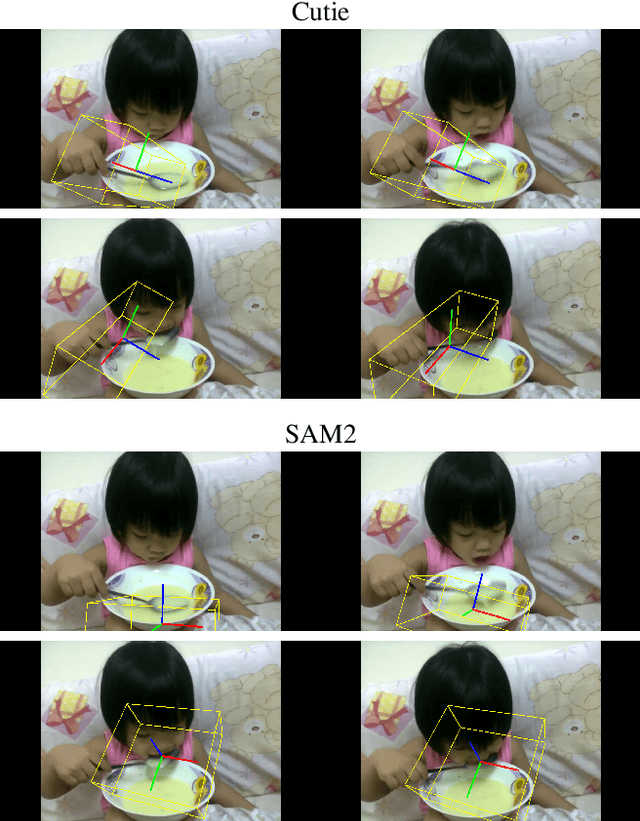
Accurate dietary monitoring is essential for promoting healthier eating habits. A key area of research is how people interact and consume food using utensils and hands. By tracking their position and orientation, it is possible to estimate the volume of food being consumed, or monitor eating behaviours, highly useful insights into nutritional intake that can be more reliable than popular methods such as self-reporting. Hence, this paper implements a system that analyzes stationary video feed of people eating, using 6D pose estimation to track hand and spoon movements to capture spatial position and orientation. In doing so, we examine the performance of two state-of-the-art (SOTA) video object segmentation (VOS) models, both quantitatively and qualitatively, and identify main sources of error within the system.
Integrating Learning-Based Manipulation and Physics-Based Locomotion for Whole-Body Badminton Robot Control
Apr 24, 2025Learning-based methods, such as imitation learning (IL) and reinforcement learning (RL), can produce excel control policies over challenging agile robot tasks, such as sports robot. However, no existing work has harmonized learning-based policy with model-based methods to reduce training complexity and ensure the safety and stability for agile badminton robot control. In this paper, we introduce \ourmethod, a novel hybrid control system for agile badminton robots. Specifically, we propose a model-based strategy for chassis locomotion which provides a base for arm policy. We introduce a physics-informed ``IL+RL'' training framework for learning-based arm policy. In this train framework, a model-based strategy with privileged information is used to guide arm policy training during both IL and RL phases. In addition, we train the critic model during IL phase to alleviate the performance drop issue when transitioning from IL to RL. We present results on our self-engineered badminton robot, achieving 94.5% success rate against the serving machine and 90.7% success rate against human players. Our system can be easily generalized to other agile mobile manipulation tasks such as agile catching and table tennis. Our project website: https://dreamstarring.github.io/HAMLET/.
TileLang: A Composable Tiled Programming Model for AI Systems
Apr 24, 2025Modern AI workloads rely heavily on optimized computing kernels for both training and inference. These AI kernels follow well-defined data-flow patterns, such as moving tiles between DRAM and SRAM and performing a sequence of computations on those tiles. However, writing high-performance kernels remains complex despite the clarity of these patterns. Achieving peak performance requires careful, hardware-centric optimizations to fully leverage modern accelerators. While domain-specific compilers attempt to reduce the burden of writing high-performance kernels, they often struggle with usability and expressiveness gaps. In this paper, we present TileLang, a generalized tiled programming model for more efficient AI Kernel programming. TileLang decouples scheduling space (thread binding, layout, tensorize and pipeline) from dataflow, and encapsulated them as a set of customization annotations and primitives. This approach allows users to focus on the kernel's data-flow itself, while leaving most other optimizations to compilers. We conduct comprehensive experiments on commonly-used devices, across numerous experiments, our evaluation shows that TileLang can achieve state-of-the-art performance in key kernels, demonstrating that its unified block-and-thread paradigm and transparent scheduling capabilities deliver both the power and flexibility demanded by modern AI system development.