 Add to Chrome
 Add to Firefox
 Add to Edge
SGMatch: Semantic-Guided Non-Rigid Shape Matching with Flow Regularization
Mar 13, 2026
Establishing accurate point-to-point correspondences between non-rigid 3D shapes remains a critical challenge, particularly under non-isometric deformations and topological noise. Existing functional map pipelines suffer from ambiguities that geometric descriptors alone cannot resolve, and spatial inconsistencies inherent in the projection of truncated spectral bases to dense pointwise correspondences. In this paper, we introduce SGMatch, a learning-based framework for semantic-guided non-rigid shape matching. Specifically, we design a Semantic-Guided Local Cross-Attention module that integrates semantic features from vision foundation models into geometric descriptors while preserving local structural continuity. Furthermore, we introduce a regularization objective based on conditional flow matching, which supervises a time-varying velocity field to encourage spatial smoothness of the recovered correspondences. Experimental results on multiple benchmarks demonstrate that SGMatch achieves competitive performance across near-isometric settings and consistent improvements under non-isometric deformations and topological noise.

SpecDM: Hyperspectral Dataset Synthesis with Pixel-level Semantic Annotations
Feb 24, 2025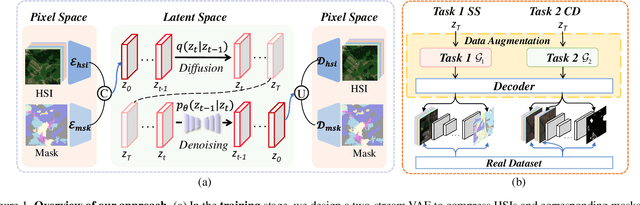
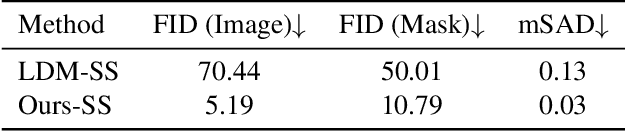
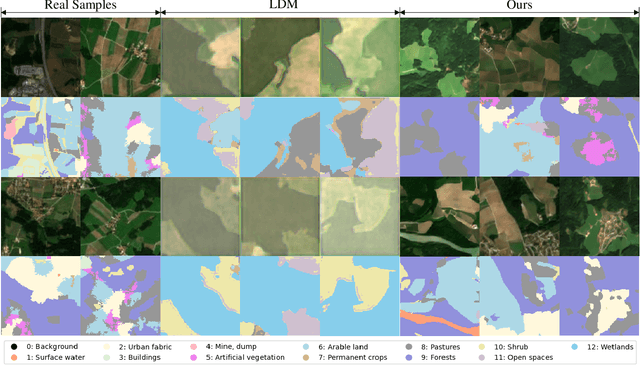
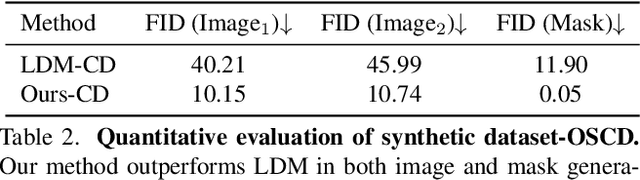
In hyperspectral remote sensing field, some downstream dense prediction tasks, such as semantic segmentation (SS) and change detection (CD), rely on supervised learning to improve model performance and require a large amount of manually annotated data for training. However, due to the needs of specific equipment and special application scenarios, the acquisition and annotation of hyperspectral images (HSIs) are often costly and time-consuming. To this end, our work explores the potential of generative diffusion model in synthesizing HSIs with pixel-level annotations. The main idea is to utilize a two-stream VAE to learn the latent representations of images and corresponding masks respectively, learn their joint distribution during the diffusion model training, and finally obtain the image and mask through their respective decoders. To the best of our knowledge, it is the first work to generate high-dimensional HSIs with annotations. Our proposed approach can be applied in various kinds of dataset generation. We select two of the most widely used dense prediction tasks: semantic segmentation and change detection, and generate datasets suitable for these tasks. Experiments demonstrate that our synthetic datasets have a positive impact on the improvement of these downstream tasks.