 Add to Chrome
 Add to Firefox
 Add to Edge
FLIGHT: Fibonacci Lattice-based Inference for Geometric Heading in real-Time
Feb 26, 2026
Estimating camera motion from monocular video is a fundamental problem in computer vision, central to tasks such as SLAM, visual odometry, and structure-from-motion. Existing methods that recover the camera's heading under known rotation, whether from an IMU or an optimization algorithm, tend to perform well in low-noise, low-outlier conditions, but often decrease in accuracy or become computationally expensive as noise and outlier levels increase. To address these limitations, we propose a novel generalization of the Hough transform on the unit sphere (S(2)) to estimate the camera's heading. First, the method extracts correspondences between two frames and generates a great circle of directions compatible with each pair of correspondences. Then, by discretizing the unit sphere using a Fibonacci lattice as bin centers, each great circle casts votes for a range of directions, ensuring that features unaffected by noise or dynamic objects vote consistently for the correct motion direction. Experimental results on three datasets demonstrate that the proposed method is on the Pareto frontier of accuracy versus efficiency. Additionally, experiments on SLAM show that the proposed method reduces RMSE by correcting the heading during camera pose initialization.

Robust Frame-to-Frame Camera Rotation Estimation in Crowded Scenes
Sep 15, 2023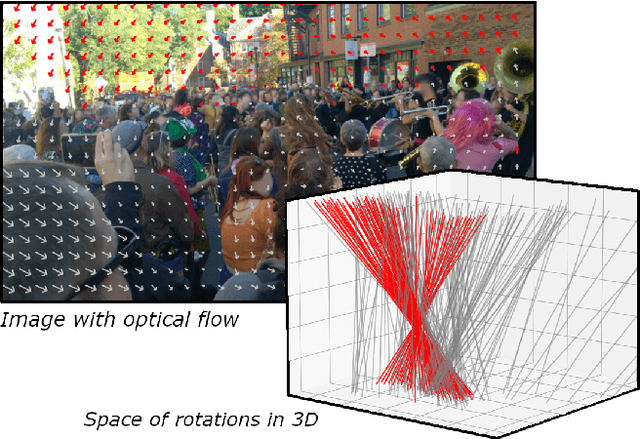
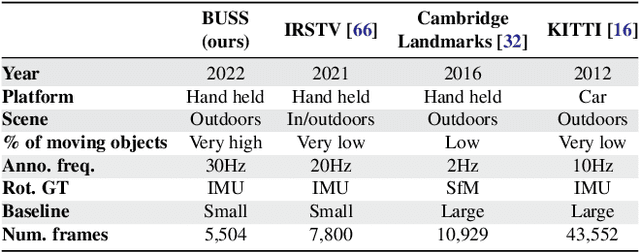

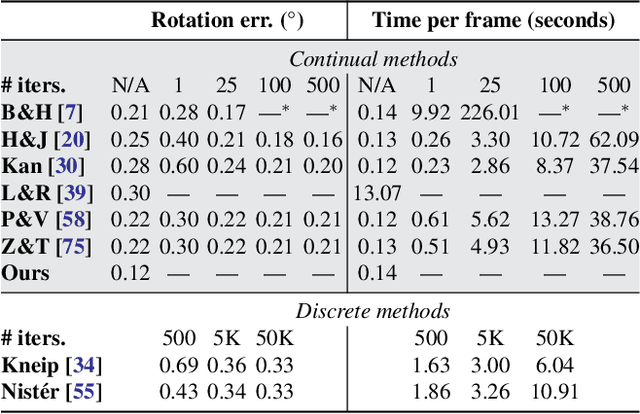
We present an approach to estimating camera rotation in crowded, real-world scenes from handheld monocular video. While camera rotation estimation is a well-studied problem, no previous methods exhibit both high accuracy and acceptable speed in this setting. Because the setting is not addressed well by other datasets, we provide a new dataset and benchmark, with high-accuracy, rigorously verified ground truth, on 17 video sequences. Methods developed for wide baseline stereo (e.g., 5-point methods) perform poorly on monocular video. On the other hand, methods used in autonomous driving (e.g., SLAM) leverage specific sensor setups, specific motion models, or local optimization strategies (lagging batch processing) and do not generalize well to handheld video. Finally, for dynamic scenes, commonly used robustification techniques like RANSAC require large numbers of iterations, and become prohibitively slow. We introduce a novel generalization of the Hough transform on SO(3) to efficiently and robustly find the camera rotation most compatible with optical flow. Among comparably fast methods, ours reduces error by almost 50\% over the next best, and is more accurate than any method, irrespective of speed. This represents a strong new performance point for crowded scenes, an important setting for computer vision. The code and the dataset are available at https://fabiendelattre.com/robust-rotation-estimation.