 Add to Chrome
 Add to Firefox
 Add to Edge
Nemotron 3 Nano Omni: Efficient and Open Multimodal Intelligence
Apr 27, 2026
We introduce Nemotron 3 Nano Omni, the latest model in the Nemotron multimodal series and the first to natively support audio inputs alongside text, images, and video. Nemotron 3 Nano Omni delivers consistent accuracy improvements over its predecessor, Nemotron Nano V2 VL, across all modalities, enabled by advances in architecture, training data and recipes. In particular, Nemotron 3 delivers leading results in real-world document understanding, long audio-video comprehension, and agentic computer use. Built on the highly efficient Nemotron 3 Nano 30B-A3B backbone, Nemotron 3 Nano Omni further incorporates innovative multimodal token-reduction techniques to deliver substantially lower inference latency and higher throughput than other models of similar size. We are releasing model checkpoints in BF16, FP8, and FP4 formats, along with portions of the training data and codebase to facilitate further research and development.

Nemotron 3 Super: Open, Efficient Mixture-of-Experts Hybrid Mamba-Transformer Model for Agentic Reasoning
Apr 14, 2026We describe the pre-training, post-training, and quantization of Nemotron 3 Super, a 120 billion (active 12 billion) parameter hybrid Mamba-Attention Mixture-of-Experts model. Nemotron 3 Super is the first model in the Nemotron 3 family to 1) be pre-trained in NVFP4, 2) leverage LatentMoE, a new Mixture-of-Experts architecture that optimizes for both accuracy per FLOP and accuracy per parameter, and 3) include MTP layers for inference acceleration through native speculative decoding. We pre-trained Nemotron 3 Super on 25 trillion tokens followed by post-training using supervised fine tuning (SFT) and reinforcement learning (RL). The final model supports up to 1M context length and achieves comparable accuracy on common benchmarks, while also achieving up to 2.2x and 7.5x higher inference throughput compared to GPT-OSS-120B and Qwen3.5-122B, respectively. Nemotron 3 Super datasets, along with the base, post-trained, and quantized checkpoints, are open-sourced on HuggingFace.
NVIDIA Nemotron 3: Efficient and Open Intelligence
Dec 24, 2025We introduce the Nemotron 3 family of models - Nano, Super, and Ultra. These models deliver strong agentic, reasoning, and conversational capabilities. The Nemotron 3 family uses a Mixture-of-Experts hybrid Mamba-Transformer architecture to provide best-in-class throughput and context lengths of up to 1M tokens. Super and Ultra models are trained with NVFP4 and incorporate LatentMoE, a novel approach that improves model quality. The two larger models also include MTP layers for faster text generation. All Nemotron 3 models are post-trained using multi-environment reinforcement learning enabling reasoning, multi-step tool use, and support granular reasoning budget control. Nano, the smallest model, outperforms comparable models in accuracy while remaining extremely cost-efficient for inference. Super is optimized for collaborative agents and high-volume workloads such as IT ticket automation. Ultra, the largest model, provides state-of-the-art accuracy and reasoning performance. Nano is released together with its technical report and this white paper, while Super and Ultra will follow in the coming months. We will openly release the model weights, pre- and post-training software, recipes, and all data for which we hold redistribution rights.
Nemotron 3 Nano: Open, Efficient Mixture-of-Experts Hybrid Mamba-Transformer Model for Agentic Reasoning
Dec 23, 2025We present Nemotron 3 Nano 30B-A3B, a Mixture-of-Experts hybrid Mamba-Transformer language model. Nemotron 3 Nano was pretrained on 25 trillion text tokens, including more than 3 trillion new unique tokens over Nemotron 2, followed by supervised fine tuning and large-scale RL on diverse environments. Nemotron 3 Nano achieves better accuracy than our previous generation Nemotron 2 Nano while activating less than half of the parameters per forward pass. It achieves up to 3.3x higher inference throughput than similarly-sized open models like GPT-OSS-20B and Qwen3-30B-A3B-Thinking-2507, while also being more accurate on popular benchmarks. Nemotron 3 Nano demonstrates enhanced agentic, reasoning, and chat abilities and supports context lengths up to 1M tokens. We release both our pretrained Nemotron 3 Nano 30B-A3B Base and post-trained Nemotron 3 Nano 30B-A3B checkpoints on Hugging Face.
ProfBench: Multi-Domain Rubrics requiring Professional Knowledge to Answer and Judge
Oct 21, 2025

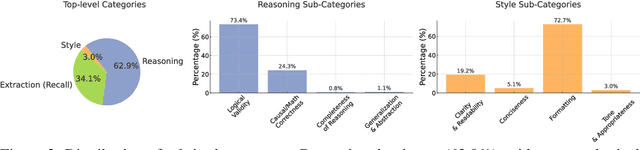
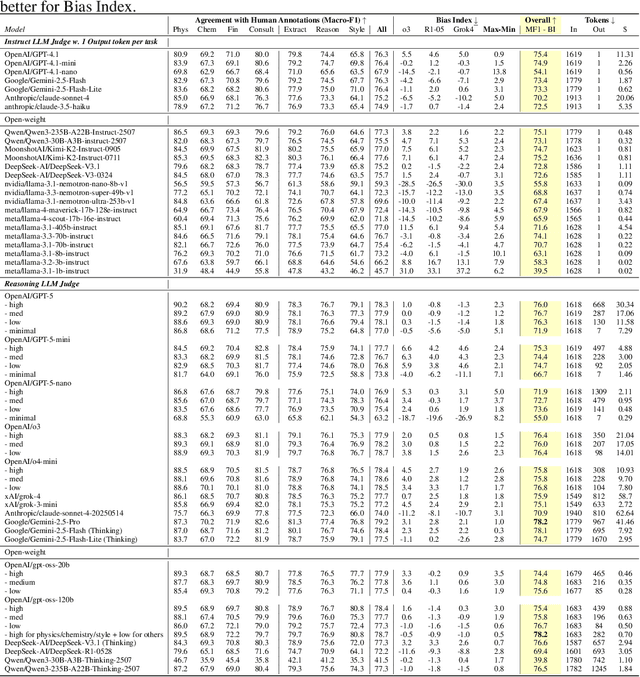
Evaluating progress in large language models (LLMs) is often constrained by the challenge of verifying responses, limiting assessments to tasks like mathematics, programming, and short-form question-answering. However, many real-world applications require evaluating LLMs in processing professional documents, synthesizing information, and generating comprehensive reports in response to user queries. We introduce ProfBench: a set of over 7000 response-criterion pairs as evaluated by human-experts with professional knowledge across Physics PhD, Chemistry PhD, Finance MBA and Consulting MBA. We build robust and affordable LLM-Judges to evaluate ProfBench rubrics, by mitigating self-enhancement bias and reducing the cost of evaluation by 2-3 orders of magnitude, to make it fair and accessible to the broader community. Our findings reveal that ProfBench poses significant challenges even for state-of-the-art LLMs, with top-performing models like GPT-5-high achieving only 65.9\% overall performance. Furthermore, we identify notable performance disparities between proprietary and open-weight models and provide insights into the role that extended thinking plays in addressing complex, professional-domain tasks. Data: https://huggingface.co/datasets/nvidia/ProfBench and Code: https://github.com/NVlabs/ProfBench
HelpSteer3-Preference: Open Human-Annotated Preference Data across Diverse Tasks and Languages
May 16, 2025Preference datasets are essential for training general-domain, instruction-following language models with Reinforcement Learning from Human Feedback (RLHF). Each subsequent data release raises expectations for future data collection, meaning there is a constant need to advance the quality and diversity of openly available preference data. To address this need, we introduce HelpSteer3-Preference, a permissively licensed (CC-BY-4.0), high-quality, human-annotated preference dataset comprising of over 40,000 samples. These samples span diverse real-world applications of large language models (LLMs), including tasks relating to STEM, coding and multilingual scenarios. Using HelpSteer3-Preference, we train Reward Models (RMs) that achieve top performance on RM-Bench (82.4%) and JudgeBench (73.7%). This represents a substantial improvement (~10% absolute) over the previously best-reported results from existing RMs. We demonstrate HelpSteer3-Preference can also be applied to train Generative RMs and how policy models can be aligned with RLHF using our RMs. Dataset (CC-BY-4.0): https://huggingface.co/datasets/nvidia/HelpSteer3#preference
Nemotron-H: A Family of Accurate and Efficient Hybrid Mamba-Transformer Models
Apr 10, 2025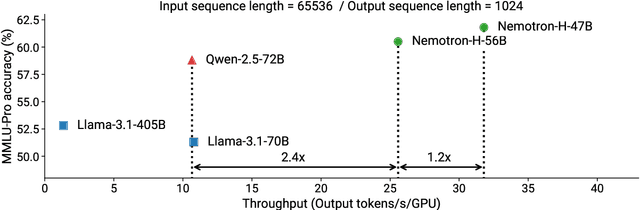

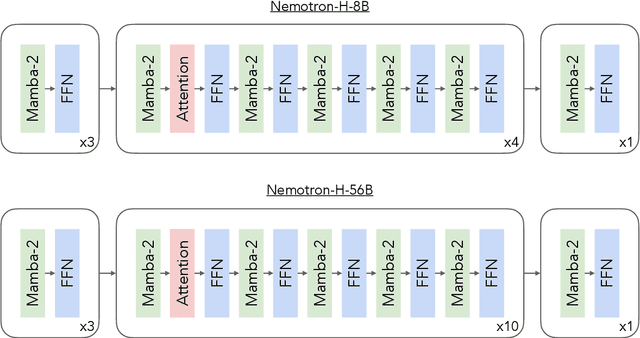
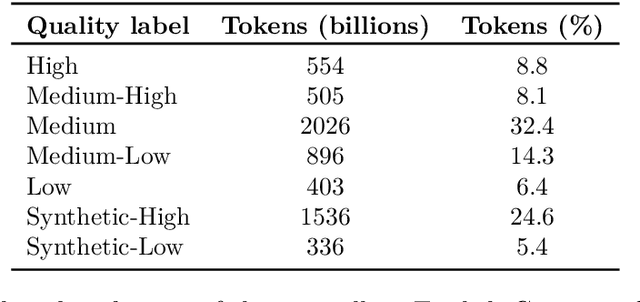
As inference-time scaling becomes critical for enhanced reasoning capabilities, it is increasingly becoming important to build models that are efficient to infer. We introduce Nemotron-H, a family of 8B and 56B/47B hybrid Mamba-Transformer models designed to reduce inference cost for a given accuracy level. To achieve this goal, we replace the majority of self-attention layers in the common Transformer model architecture with Mamba layers that perform constant computation and require constant memory per generated token. We show that Nemotron-H models offer either better or on-par accuracy compared to other similarly-sized state-of-the-art open-sourced Transformer models (e.g., Qwen-2.5-7B/72B and Llama-3.1-8B/70B), while being up to 3$\times$ faster at inference. To further increase inference speed and reduce the memory required at inference time, we created Nemotron-H-47B-Base from the 56B model using a new compression via pruning and distillation technique called MiniPuzzle. Nemotron-H-47B-Base achieves similar accuracy to the 56B model, but is 20% faster to infer. In addition, we introduce an FP8-based training recipe and show that it can achieve on par results with BF16-based training. This recipe is used to train the 56B model. All Nemotron-H models will be released, with support in Hugging Face, NeMo, and Megatron-LM.
Dedicated Feedback and Edit Models Empower Inference-Time Scaling for Open-Ended General-Domain Tasks
Mar 06, 2025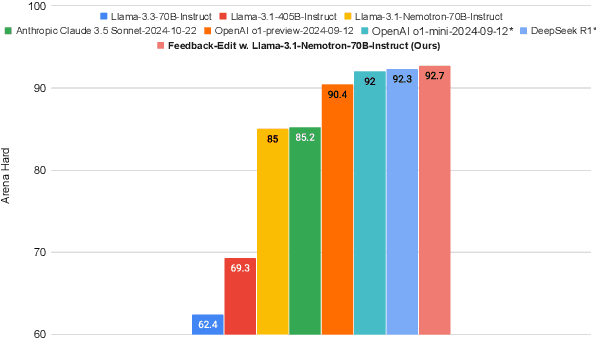
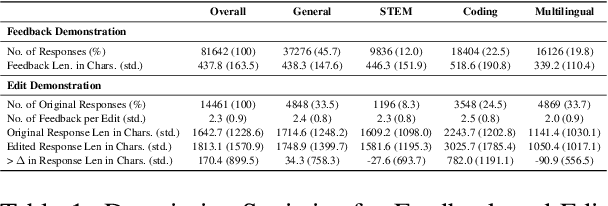
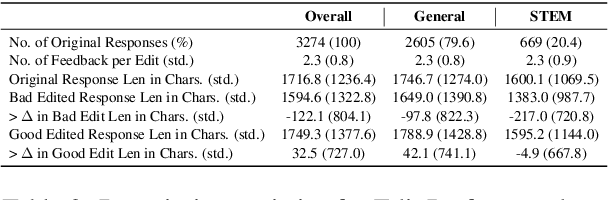
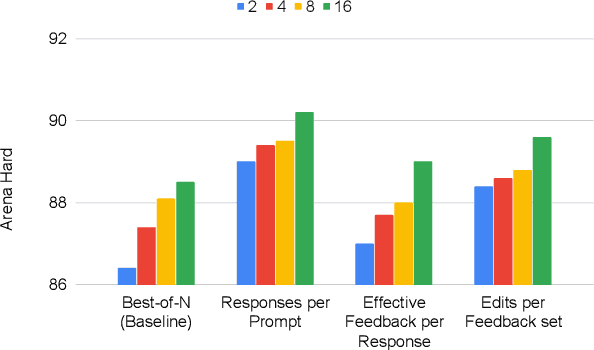
Inference-Time Scaling has been critical to the success of recent models such as OpenAI o1 and DeepSeek R1. However, many techniques used to train models for inference-time scaling require tasks to have answers that can be verified, limiting their application to domains such as math, coding and logical reasoning. We take inspiration from how humans make first attempts, ask for detailed feedback from others and make improvements based on such feedback across a wide spectrum of open-ended endeavors. To this end, we collect data for and train dedicated Feedback and Edit Models that are capable of performing inference-time scaling for open-ended general-domain tasks. In our setup, one model generates an initial response, which are given feedback by a second model, that are then used by a third model to edit the response. We show that performance on Arena Hard, a benchmark strongly predictive of Chatbot Arena Elo can be boosted by scaling the number of initial response drafts, effective feedback and edited responses. When scaled optimally, our setup based on 70B models from the Llama 3 family can reach SoTA performance on Arena Hard at 92.7 as of 5 Mar 2025, surpassing OpenAI o1-preview-2024-09-12 with 90.4 and DeepSeek R1 with 92.3.
Nemotron-4 340B Technical Report
Jun 17, 2024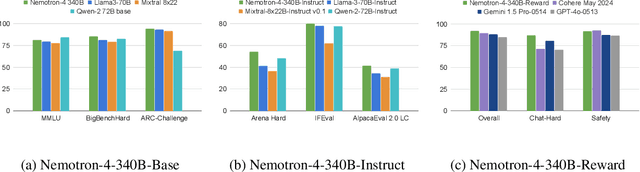

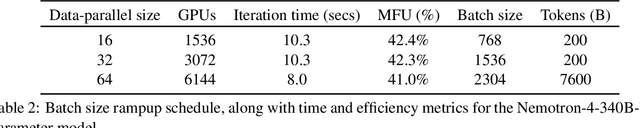
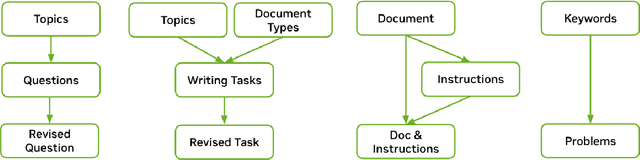
We release the Nemotron-4 340B model family, including Nemotron-4-340B-Base, Nemotron-4-340B-Instruct, and Nemotron-4-340B-Reward. Our models are open access under the NVIDIA Open Model License Agreement, a permissive model license that allows distribution, modification, and use of the models and its outputs. These models perform competitively to open access models on a wide range of evaluation benchmarks, and were sized to fit on a single DGX H100 with 8 GPUs when deployed in FP8 precision. We believe that the community can benefit from these models in various research studies and commercial applications, especially for generating synthetic data to train smaller language models. Notably, over 98% of data used in our model alignment process is synthetically generated, showcasing the effectiveness of these models in generating synthetic data. To further support open research and facilitate model development, we are also open-sourcing the synthetic data generation pipeline used in our model alignment process.
Evaluating the Social Impact of Generative AI Systems in Systems and Society
Jun 12, 2023Generative AI systems across modalities, ranging from text, image, audio, and video, have broad social impacts, but there exists no official standard for means of evaluating those impacts and which impacts should be evaluated. We move toward a standard approach in evaluating a generative AI system for any modality, in two overarching categories: what is able to be evaluated in a base system that has no predetermined application and what is able to be evaluated in society. We describe specific social impact categories and how to approach and conduct evaluations in the base technical system, then in people and society. Our framework for a base system defines seven categories of social impact: bias, stereotypes, and representational harms; cultural values and sensitive content; disparate performance; privacy and data protection; financial costs; environmental costs; and data and content moderation labor costs. Suggested methods for evaluation apply to all modalities and analyses of the limitations of existing evaluations serve as a starting point for necessary investment in future evaluations. We offer five overarching categories for what is able to be evaluated in society, each with their own subcategories: trustworthiness and autonomy; inequality, marginalization, and violence; concentration of authority; labor and creativity; and ecosystem and environment. Each subcategory includes recommendations for mitigating harm. We are concurrently crafting an evaluation repository for the AI research community to contribute existing evaluations along the given categories. This version will be updated following a CRAFT session at ACM FAccT 2023.