 Add to Chrome
 Add to Firefox
 Add to Edge
Nemotron-Labs-3-Puzzle-75B-A9B: Compressing Hybrid MoE LLMs
Jul 05, 2026
We present Nemotron-Labs-3-Puzzle-75B-A9B, a compressed variant of Nemotron-3-Super optimized for interactive deployment. We designed the model to maximize server throughput under high user throughput constraints. In interactive serving workloads on a single 8xB200 node, Puzzle-75B-A9B achieves approximately 2x higher server throughput than Nemotron-3-Super at matched user throughput constraints. In ultra-long-context deployment on a single H100 GPU, the compressed model increases 1M-token concurrency from 1 request to 8 requests. Puzzle-75B-A9B is constructed using a multi-stage pipeline that combines the Iterative Puzzle compression framework with knowledge distillation, reinforcement learning, quantization, and a Multi-Token Prediction head. The compression process jointly optimizes heterogeneous MoE pruning, active parameter budget, and Mamba pruning to improve inference efficiency while preserving model quality. We evaluate Puzzle-75B-A9B on a broad suite of reasoning, coding, multilingual, long-context, and agentic benchmarks. Despite substantial compression, the model retains strong downstream accuracy relative to the parent model across a wide range of tasks. These results demonstrate that large hybrid MoE models can be substantially optimized for deployment efficiency while maintaining strong downstream capability.

Is Higher Team Gender Diversity Correlated with Better Scientific Impact?
Jun 23, 2026Collaborative research involving scholars of various genders constitutes a prominent theme in scientific research that has garnered substantial attention. While several studies have investigated the connection between gender-specific collaboration patterns and the scientific impact of paper, the specific gender diversity factors that contribute to enhanced scientific impact remain largely unexplored. In this study, we analyze the correlation between gender diversity and the scientific impact of papers using the examples of Natural Language Processing (NLP) and Library and Information Science (LIS) domains. Our findings reveal three key observations: First, significant gender disparities exist in both NLP and LIS domains, with underrepresentation of female scholars. The gender disparity is more pronounced in the NLP domain compared to the LIS domain. Second, based on papers from the NLP and LIS domains, we find that papers with different gender compositions achieve varying numbers of citations, with mixed-gender collaborations gradually obtaining higher average citation counts compared to same-gender collaborations. Lastly, there is an inverted U-shaped relationship between the gender diversity of paper collaborations and the number of citations received by those papers. Based on the most impactful gender diversity calculations, the ideal gender ratio for NLP and LIS teams within a range where one gender constitutes 5% to 15% of the total number of authors. This paper contributes to the exploration of the most impactful gender diversity in collaborative research and offers insights to guide more effective scientific paper collaboration.
Nemotron 3 Ultra: Open, Efficient Mixture-of-Experts Hybrid Mamba-Transformer Model for Agentic Reasoning
Jun 12, 2026We introduce Nemotron 3 Ultra, a 550 billion total and 55 billion active parameter Mixture-of-Experts Hybrid Mamba-Attention language model. We pre-trained Nemotron 3 Ultra on 20 trillion text tokens, then extended the context length to 1M tokens, and post-trained using Supervised Fine Tuning (SFT), Reinforcement Learning (RL), and Multi-teacher On-Policy Distillation (MOPD). Nemotron 3 Ultra is our most capable model yet, employing multiple key technologies - LatentMoE, Multi Token Prediction (MTP), NVFP4 pre-training, multi-environment RLVR, MOPD, and reasoning budget control. Nemotron 3 Ultra achieves up to ~6x higher inference throughput as compared to state-of-the-art publicly available LLMs while attaining on-par accuracy. The state-of-the-art accuracy, high inference throughput, and 1M token context length make Nemotron 3 Ultra ideal for long-running autonomous agentic tasks. We open-source the base, post-trained, and quantized checkpoints, along with the training data and recipe on HuggingFace.
Nemotron 3 Super: Open, Efficient Mixture-of-Experts Hybrid Mamba-Transformer Model for Agentic Reasoning
Apr 14, 2026We describe the pre-training, post-training, and quantization of Nemotron 3 Super, a 120 billion (active 12 billion) parameter hybrid Mamba-Attention Mixture-of-Experts model. Nemotron 3 Super is the first model in the Nemotron 3 family to 1) be pre-trained in NVFP4, 2) leverage LatentMoE, a new Mixture-of-Experts architecture that optimizes for both accuracy per FLOP and accuracy per parameter, and 3) include MTP layers for inference acceleration through native speculative decoding. We pre-trained Nemotron 3 Super on 25 trillion tokens followed by post-training using supervised fine tuning (SFT) and reinforcement learning (RL). The final model supports up to 1M context length and achieves comparable accuracy on common benchmarks, while also achieving up to 2.2x and 7.5x higher inference throughput compared to GPT-OSS-120B and Qwen3.5-122B, respectively. Nemotron 3 Super datasets, along with the base, post-trained, and quantized checkpoints, are open-sourced on HuggingFace.
NVIDIA Nemotron 3: Efficient and Open Intelligence
Dec 24, 2025We introduce the Nemotron 3 family of models - Nano, Super, and Ultra. These models deliver strong agentic, reasoning, and conversational capabilities. The Nemotron 3 family uses a Mixture-of-Experts hybrid Mamba-Transformer architecture to provide best-in-class throughput and context lengths of up to 1M tokens. Super and Ultra models are trained with NVFP4 and incorporate LatentMoE, a novel approach that improves model quality. The two larger models also include MTP layers for faster text generation. All Nemotron 3 models are post-trained using multi-environment reinforcement learning enabling reasoning, multi-step tool use, and support granular reasoning budget control. Nano, the smallest model, outperforms comparable models in accuracy while remaining extremely cost-efficient for inference. Super is optimized for collaborative agents and high-volume workloads such as IT ticket automation. Ultra, the largest model, provides state-of-the-art accuracy and reasoning performance. Nano is released together with its technical report and this white paper, while Super and Ultra will follow in the coming months. We will openly release the model weights, pre- and post-training software, recipes, and all data for which we hold redistribution rights.
Nemotron 3 Nano: Open, Efficient Mixture-of-Experts Hybrid Mamba-Transformer Model for Agentic Reasoning
Dec 23, 2025We present Nemotron 3 Nano 30B-A3B, a Mixture-of-Experts hybrid Mamba-Transformer language model. Nemotron 3 Nano was pretrained on 25 trillion text tokens, including more than 3 trillion new unique tokens over Nemotron 2, followed by supervised fine tuning and large-scale RL on diverse environments. Nemotron 3 Nano achieves better accuracy than our previous generation Nemotron 2 Nano while activating less than half of the parameters per forward pass. It achieves up to 3.3x higher inference throughput than similarly-sized open models like GPT-OSS-20B and Qwen3-30B-A3B-Thinking-2507, while also being more accurate on popular benchmarks. Nemotron 3 Nano demonstrates enhanced agentic, reasoning, and chat abilities and supports context lengths up to 1M tokens. We release both our pretrained Nemotron 3 Nano 30B-A3B Base and post-trained Nemotron 3 Nano 30B-A3B checkpoints on Hugging Face.
ProfBench: Multi-Domain Rubrics requiring Professional Knowledge to Answer and Judge
Oct 21, 2025

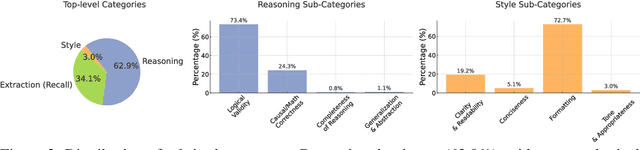
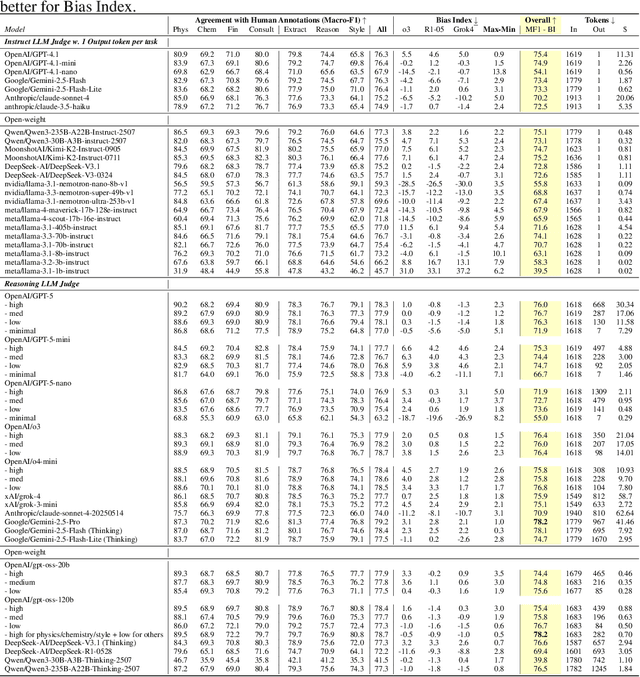
Evaluating progress in large language models (LLMs) is often constrained by the challenge of verifying responses, limiting assessments to tasks like mathematics, programming, and short-form question-answering. However, many real-world applications require evaluating LLMs in processing professional documents, synthesizing information, and generating comprehensive reports in response to user queries. We introduce ProfBench: a set of over 7000 response-criterion pairs as evaluated by human-experts with professional knowledge across Physics PhD, Chemistry PhD, Finance MBA and Consulting MBA. We build robust and affordable LLM-Judges to evaluate ProfBench rubrics, by mitigating self-enhancement bias and reducing the cost of evaluation by 2-3 orders of magnitude, to make it fair and accessible to the broader community. Our findings reveal that ProfBench poses significant challenges even for state-of-the-art LLMs, with top-performing models like GPT-5-high achieving only 65.9\% overall performance. Furthermore, we identify notable performance disparities between proprietary and open-weight models and provide insights into the role that extended thinking plays in addressing complex, professional-domain tasks. Data: https://huggingface.co/datasets/nvidia/ProfBench and Code: https://github.com/NVlabs/ProfBench
NVIDIA Nemotron Nano 2: An Accurate and Efficient Hybrid Mamba-Transformer Reasoning Model
Aug 21, 2025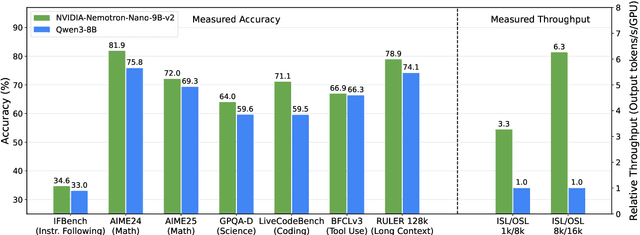

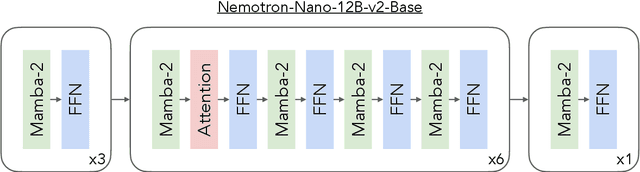
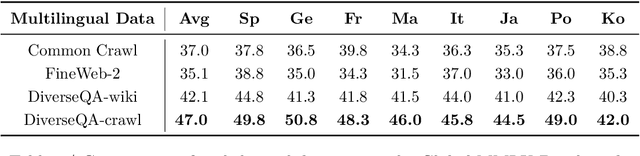
We introduce Nemotron-Nano-9B-v2, a hybrid Mamba-Transformer language model designed to increase throughput for reasoning workloads while achieving state-of-the-art accuracy compared to similarly-sized models. Nemotron-Nano-9B-v2 builds on the Nemotron-H architecture, in which the majority of the self-attention layers in the common Transformer architecture are replaced with Mamba-2 layers, to achieve improved inference speed when generating the long thinking traces needed for reasoning. We create Nemotron-Nano-9B-v2 by first pre-training a 12-billion-parameter model (Nemotron-Nano-12B-v2-Base) on 20 trillion tokens using an FP8 training recipe. After aligning Nemotron-Nano-12B-v2-Base, we employ the Minitron strategy to compress and distill the model with the goal of enabling inference on up to 128k tokens on a single NVIDIA A10G GPU (22GiB of memory, bfloat16 precision). Compared to existing similarly-sized models (e.g., Qwen3-8B), we show that Nemotron-Nano-9B-v2 achieves on-par or better accuracy on reasoning benchmarks while achieving up to 6x higher inference throughput in reasoning settings like 8k input and 16k output tokens. We are releasing Nemotron-Nano-9B-v2, Nemotron-Nano12B-v2-Base, and Nemotron-Nano-9B-v2-Base checkpoints along with the majority of our pre- and post-training datasets on Hugging Face.
HelpSteer3-Preference: Open Human-Annotated Preference Data across Diverse Tasks and Languages
May 16, 2025Preference datasets are essential for training general-domain, instruction-following language models with Reinforcement Learning from Human Feedback (RLHF). Each subsequent data release raises expectations for future data collection, meaning there is a constant need to advance the quality and diversity of openly available preference data. To address this need, we introduce HelpSteer3-Preference, a permissively licensed (CC-BY-4.0), high-quality, human-annotated preference dataset comprising of over 40,000 samples. These samples span diverse real-world applications of large language models (LLMs), including tasks relating to STEM, coding and multilingual scenarios. Using HelpSteer3-Preference, we train Reward Models (RMs) that achieve top performance on RM-Bench (82.4%) and JudgeBench (73.7%). This represents a substantial improvement (~10% absolute) over the previously best-reported results from existing RMs. We demonstrate HelpSteer3-Preference can also be applied to train Generative RMs and how policy models can be aligned with RLHF using our RMs. Dataset (CC-BY-4.0): https://huggingface.co/datasets/nvidia/HelpSteer3#preference
Llama-Nemotron: Efficient Reasoning Models
May 02, 2025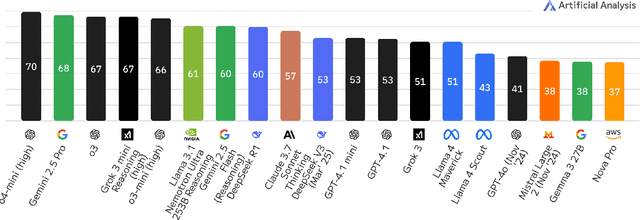
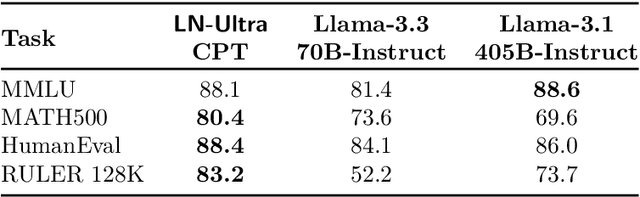
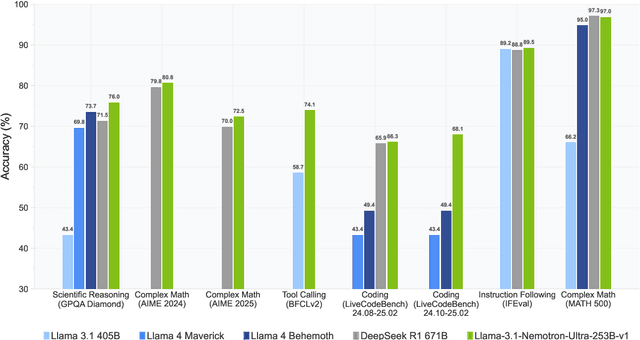
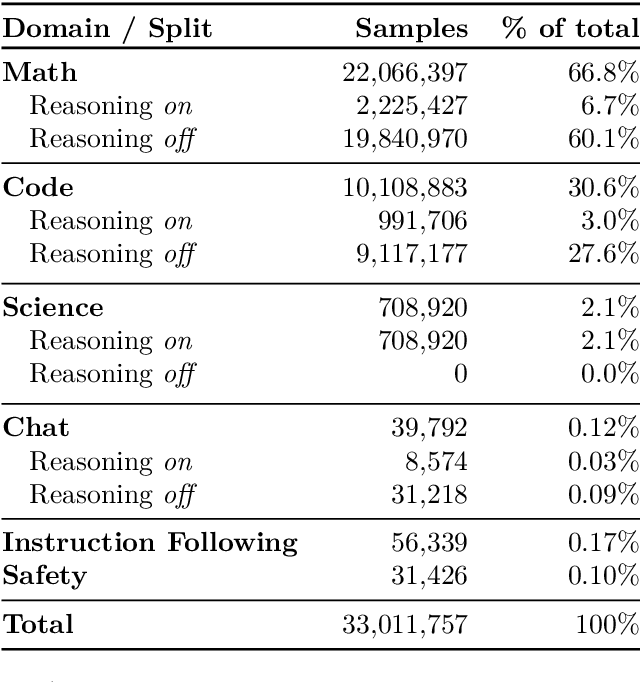
We introduce the Llama-Nemotron series of models, an open family of heterogeneous reasoning models that deliver exceptional reasoning capabilities, inference efficiency, and an open license for enterprise use. The family comes in three sizes -- Nano (8B), Super (49B), and Ultra (253B) -- and performs competitively with state-of-the-art reasoning models such as DeepSeek-R1 while offering superior inference throughput and memory efficiency. In this report, we discuss the training procedure for these models, which entails using neural architecture search from Llama 3 models for accelerated inference, knowledge distillation, and continued pretraining, followed by a reasoning-focused post-training stage consisting of two main parts: supervised fine-tuning and large scale reinforcement learning. Llama-Nemotron models are the first open-source models to support a dynamic reasoning toggle, allowing users to switch between standard chat and reasoning modes during inference. To further support open research and facilitate model development, we provide the following resources: 1. We release the Llama-Nemotron reasoning models -- LN-Nano, LN-Super, and LN-Ultra -- under the commercially permissive NVIDIA Open Model License Agreement. 2. We release the complete post-training dataset: Llama-Nemotron-Post-Training-Dataset. 3. We also release our training codebases: NeMo, NeMo-Aligner, and Megatron-LM.