 Add to Chrome
 Add to Firefox
 Add to Edge
Ego-Exo4D: Understanding Skilled Human Activity from First- and Third-Person Perspectives
Nov 30, 2023

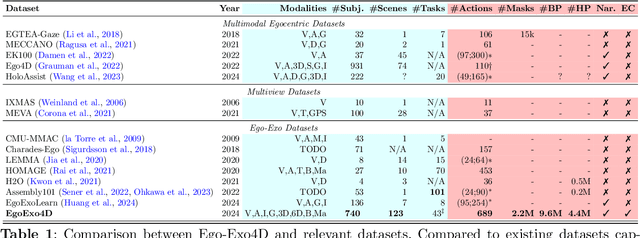

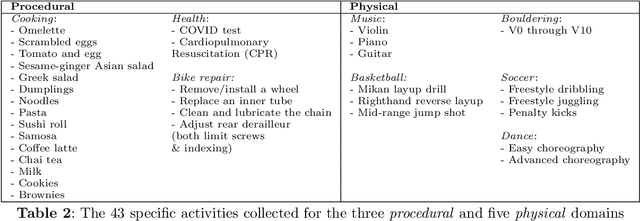
We present Ego-Exo4D, a diverse, large-scale multimodal multiview video dataset and benchmark challenge. Ego-Exo4D centers around simultaneously-captured egocentric and exocentric video of skilled human activities (e.g., sports, music, dance, bike repair). More than 800 participants from 13 cities worldwide performed these activities in 131 different natural scene contexts, yielding long-form captures from 1 to 42 minutes each and 1,422 hours of video combined. The multimodal nature of the dataset is unprecedented: the video is accompanied by multichannel audio, eye gaze, 3D point clouds, camera poses, IMU, and multiple paired language descriptions -- including a novel "expert commentary" done by coaches and teachers and tailored to the skilled-activity domain. To push the frontier of first-person video understanding of skilled human activity, we also present a suite of benchmark tasks and their annotations, including fine-grained activity understanding, proficiency estimation, cross-view translation, and 3D hand/body pose. All resources will be open sourced to fuel new research in the community.

Centre Stage: Centricity-based Audio-Visual Temporal Action Detection
Nov 28, 2023Previous one-stage action detection approaches have modelled temporal dependencies using only the visual modality. In this paper, we explore different strategies to incorporate the audio modality, using multi-scale cross-attention to fuse the two modalities. We also demonstrate the correlation between the distance from the timestep to the action centre and the accuracy of the predicted boundaries. Thus, we propose a novel network head to estimate the closeness of timesteps to the action centre, which we call the centricity score. This leads to increased confidence for proposals that exhibit more precise boundaries. Our method can be integrated with other one-stage anchor-free architectures and we demonstrate this on three recent baselines on the EPIC-Kitchens-100 action detection benchmark where we achieve state-of-the-art performance. Detailed ablation studies showcase the benefits of fusing audio and our proposed centricity scores. Code and models for our proposed method are publicly available at https://github.com/hanielwang/Audio-Visual-TAD.git
Learning Temporal Sentence Grounding From Narrated EgoVideos
Oct 26, 2023
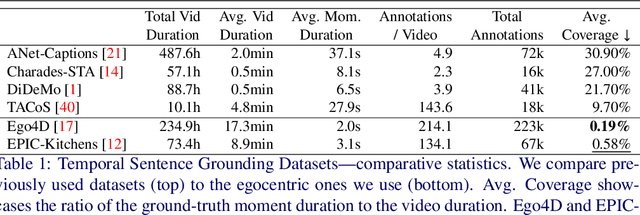
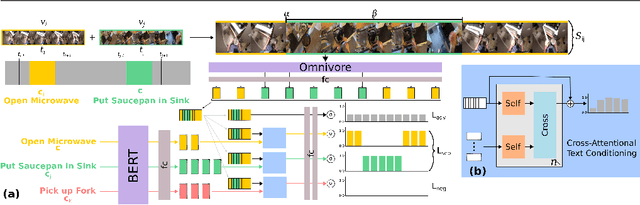
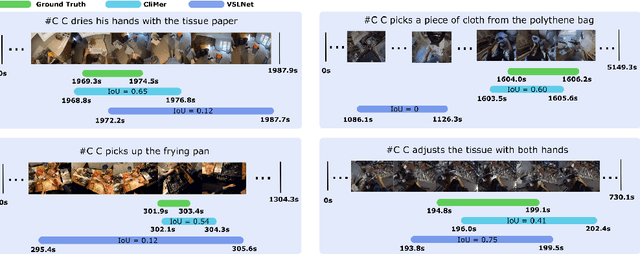
The onset of long-form egocentric datasets such as Ego4D and EPIC-Kitchens presents a new challenge for the task of Temporal Sentence Grounding (TSG). Compared to traditional benchmarks on which this task is evaluated, these datasets offer finer-grained sentences to ground in notably longer videos. In this paper, we develop an approach for learning to ground sentences in these datasets using only narrations and their corresponding rough narration timestamps. We propose to artificially merge clips to train for temporal grounding in a contrastive manner using text-conditioning attention. This Clip Merging (CliMer) approach is shown to be effective when compared with a high performing TSG method -- e.g. mean R@1 improves from 3.9 to 5.7 on Ego4D and from 10.7 to 13.0 on EPIC-Kitchens. Code and data splits available from: https://github.com/keflanagan/CliMer
An Outlook into the Future of Egocentric Vision
Aug 14, 2023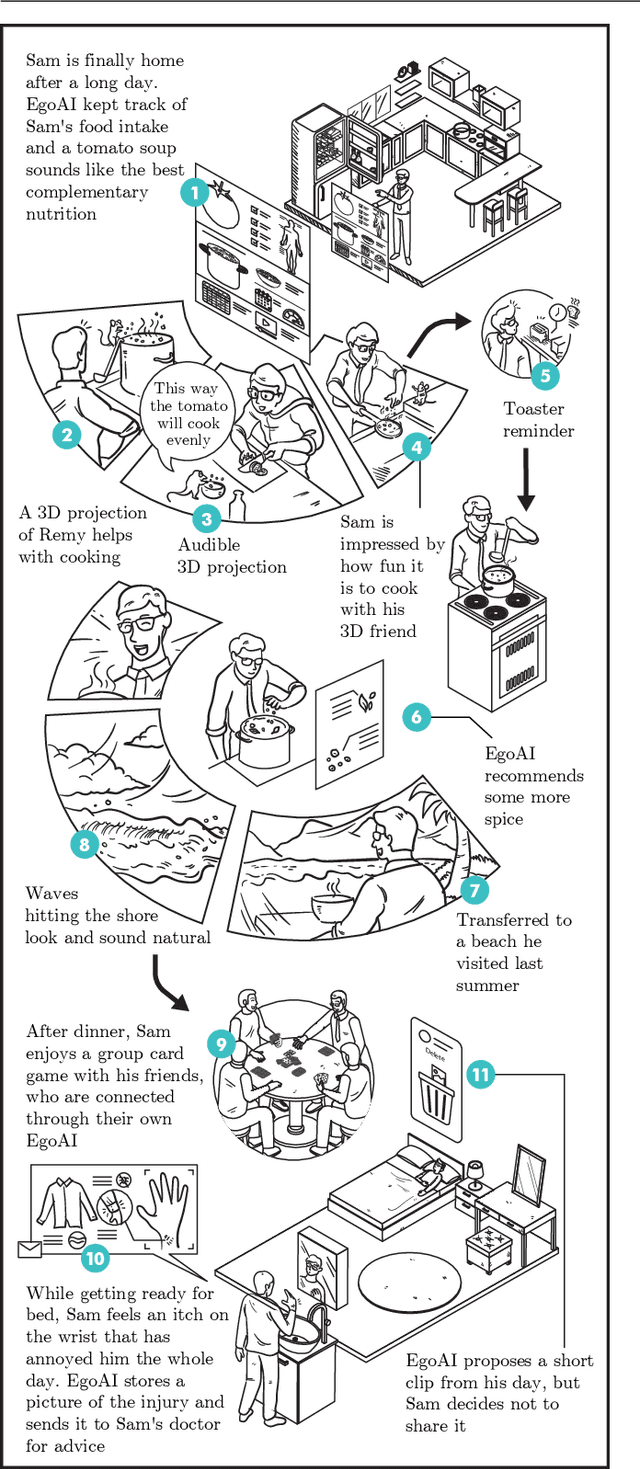

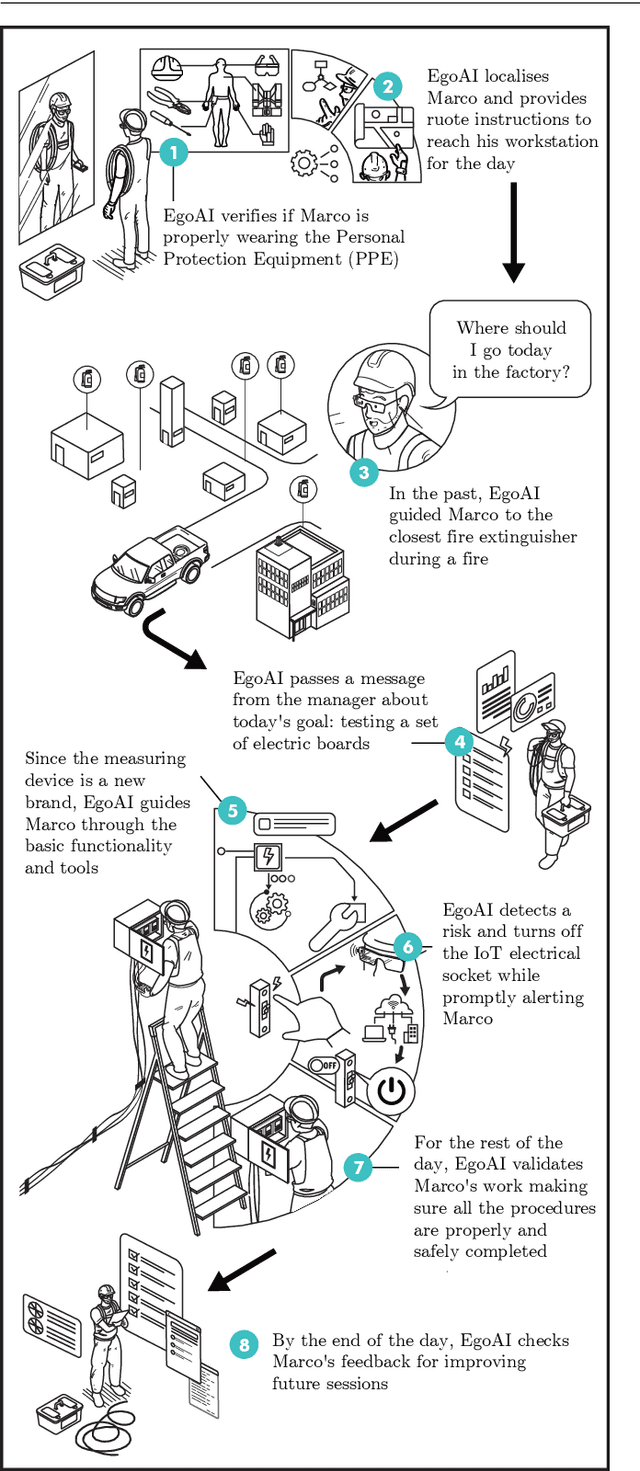
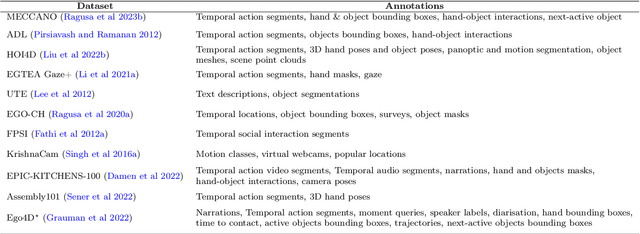
What will the future be? We wonder! In this survey, we explore the gap between current research in egocentric vision and the ever-anticipated future, where wearable computing, with outward facing cameras and digital overlays, is expected to be integrated in our every day lives. To understand this gap, the article starts by envisaging the future through character-based stories, showcasing through examples the limitations of current technology. We then provide a mapping between this future and previously defined research tasks. For each task, we survey its seminal works, current state-of-the-art methodologies and available datasets, then reflect on shortcomings that limit its applicability to future research. Note that this survey focuses on software models for egocentric vision, independent of any specific hardware. The paper concludes with recommendations for areas of immediate explorations so as to unlock our path to the future always-on, personalised and life-enhancing egocentric vision.
What can a cook in Italy teach a mechanic in India? Action Recognition Generalisation Over Scenarios and Locations
Jun 14, 2023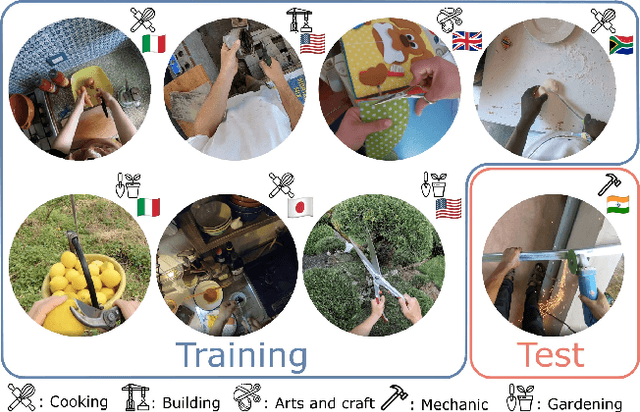


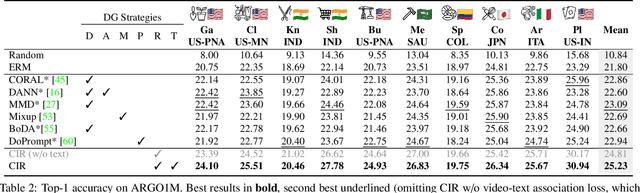
We propose and address a new generalisation problem: can a model trained for action recognition successfully classify actions when they are performed within a previously unseen scenario and in a previously unseen location? To answer this question, we introduce the Action Recognition Generalisation Over scenarios and locations dataset (ARGO1M), which contains 1.1M video clips from the large-scale Ego4D dataset, across 10 scenarios and 13 locations. We demonstrate recognition models struggle to generalise over 10 proposed test splits, each of an unseen scenario in an unseen location. We thus propose CIR, a method to represent each video as a Cross-Instance Reconstruction of videos from other domains. Reconstructions are paired with text narrations to guide the learning of a domain generalisable representation. We provide extensive analysis and ablations on ARGO1M that show CIR outperforms prior domain generalisation works on all test splits. Code and data: https://chiaraplizz.github.io/what-can-a-cook/.
EPIC Fields: Marrying 3D Geometry and Video Understanding
Jun 14, 2023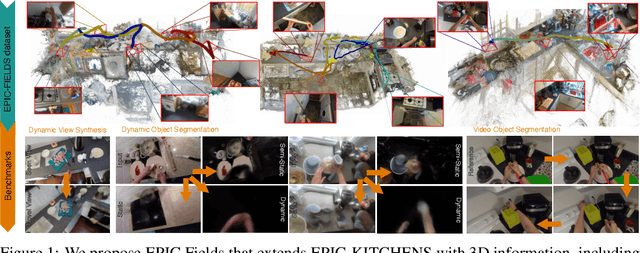
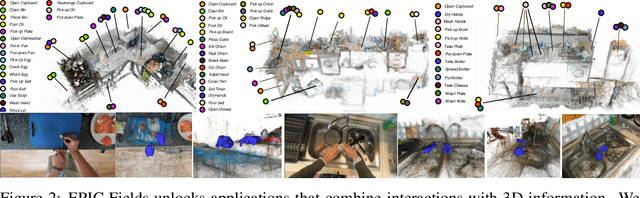
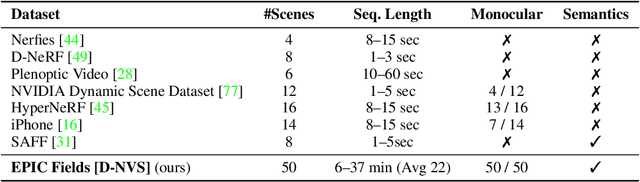
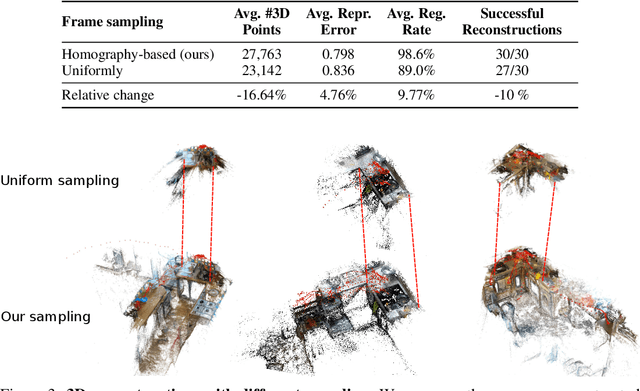
Neural rendering is fuelling a unification of learning, 3D geometry and video understanding that has been waiting for more than two decades. Progress, however, is still hampered by a lack of suitable datasets and benchmarks. To address this gap, we introduce EPIC Fields, an augmentation of EPIC-KITCHENS with 3D camera information. Like other datasets for neural rendering, EPIC Fields removes the complex and expensive step of reconstructing cameras using photogrammetry, and allows researchers to focus on modelling problems. We illustrate the challenge of photogrammetry in egocentric videos of dynamic actions and propose innovations to address them. Compared to other neural rendering datasets, EPIC Fields is better tailored to video understanding because it is paired with labelled action segments and the recent VISOR segment annotations. To further motivate the community, we also evaluate two benchmark tasks in neural rendering and segmenting dynamic objects, with strong baselines that showcase what is not possible today. We also highlight the advantage of geometry in semi-supervised video object segmentations on the VISOR annotations. EPIC Fields reconstructs 96% of videos in EPICKITCHENS, registering 19M frames in 99 hours recorded in 45 kitchens.
Perception Test: A Diagnostic Benchmark for Multimodal Video Models
May 23, 2023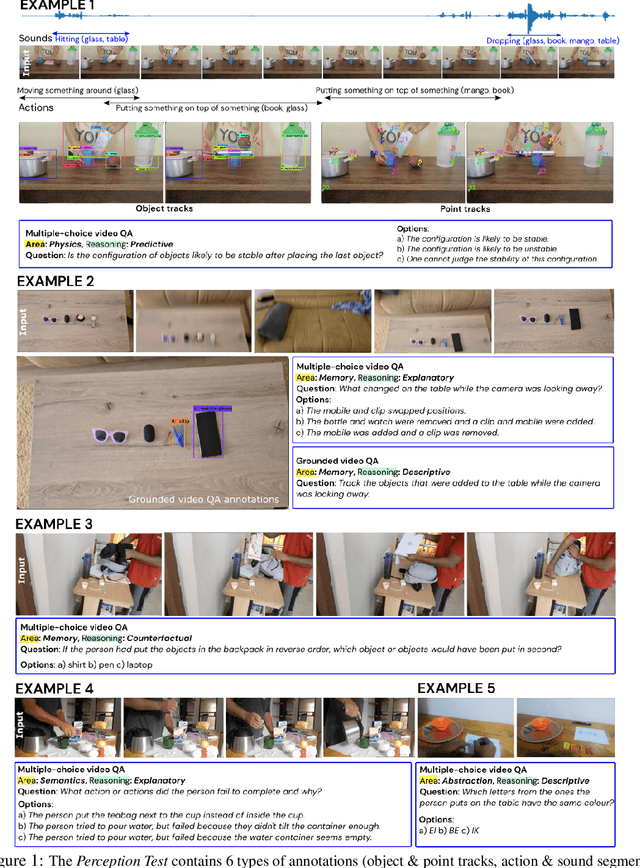
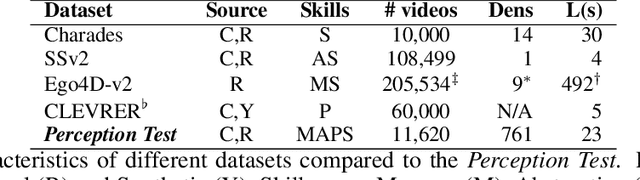
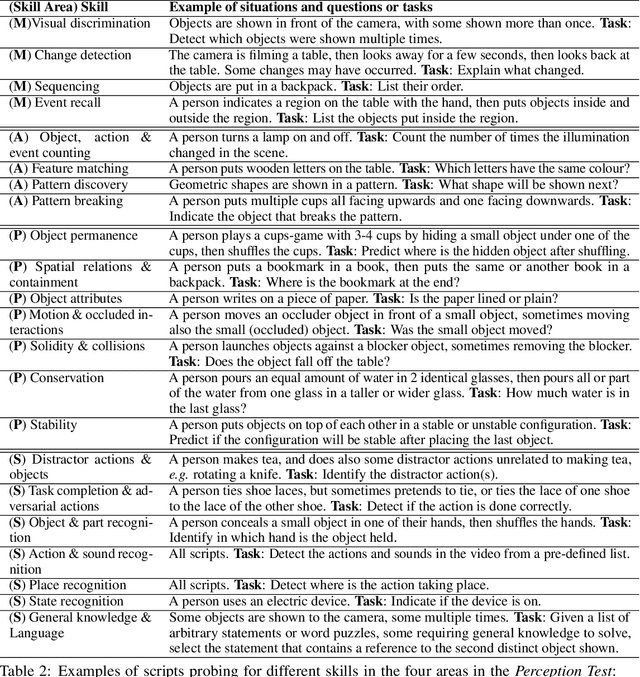
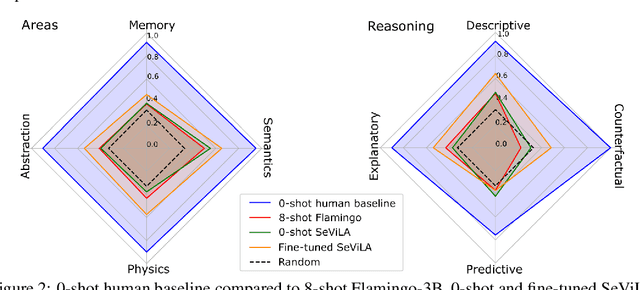
We propose a novel multimodal video benchmark - the Perception Test - to evaluate the perception and reasoning skills of pre-trained multimodal models (e.g. Flamingo, BEiT-3, or GPT-4). Compared to existing benchmarks that focus on computational tasks (e.g. classification, detection or tracking), the Perception Test focuses on skills (Memory, Abstraction, Physics, Semantics) and types of reasoning (descriptive, explanatory, predictive, counterfactual) across video, audio, and text modalities, to provide a comprehensive and efficient evaluation tool. The benchmark probes pre-trained models for their transfer capabilities, in a zero-shot / few-shot or limited finetuning regime. For these purposes, the Perception Test introduces 11.6k real-world videos, 23s average length, designed to show perceptually interesting situations, filmed by around 100 participants worldwide. The videos are densely annotated with six types of labels (multiple-choice and grounded video question-answers, object and point tracks, temporal action and sound segments), enabling both language and non-language evaluations. The fine-tuning and validation splits of the benchmark are publicly available (CC-BY license), in addition to a challenge server with a held-out test split. Human baseline results compared to state-of-the-art video QA models show a significant gap in performance (91.4% vs 43.6%), suggesting that there is significant room for improvement in multimodal video understanding. Dataset, baselines code, and challenge server are available at https://github.com/deepmind/perception_test
Use Your Head: Improving Long-Tail Video Recognition
Apr 03, 2023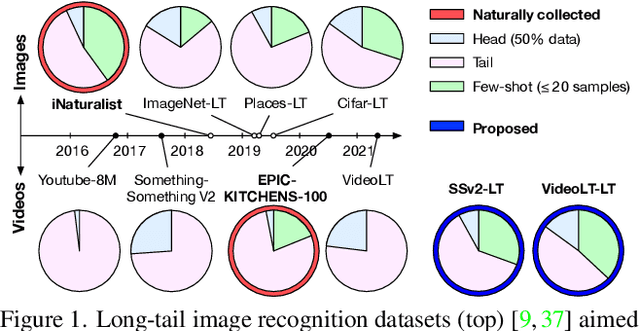
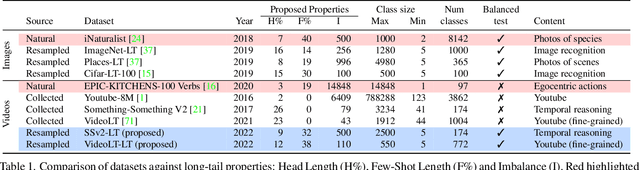


This paper presents an investigation into long-tail video recognition. We demonstrate that, unlike naturally-collected video datasets and existing long-tail image benchmarks, current video benchmarks fall short on multiple long-tailed properties. Most critically, they lack few-shot classes in their tails. In response, we propose new video benchmarks that better assess long-tail recognition, by sampling subsets from two datasets: SSv2 and VideoLT. We then propose a method, Long-Tail Mixed Reconstruction, which reduces overfitting to instances from few-shot classes by reconstructing them as weighted combinations of samples from head classes. LMR then employs label mixing to learn robust decision boundaries. It achieves state-of-the-art average class accuracy on EPIC-KITCHENS and the proposed SSv2-LT and VideoLT-LT. Benchmarks and code at: tobyperrett.github.io/lmr
Epic-Sounds: A Large-scale Dataset of Actions That Sound
Feb 01, 2023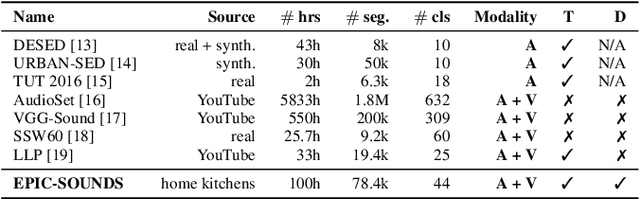
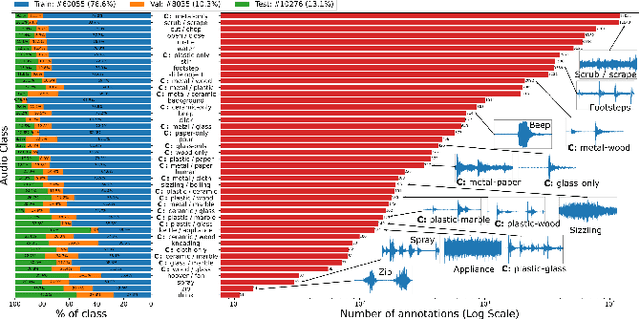
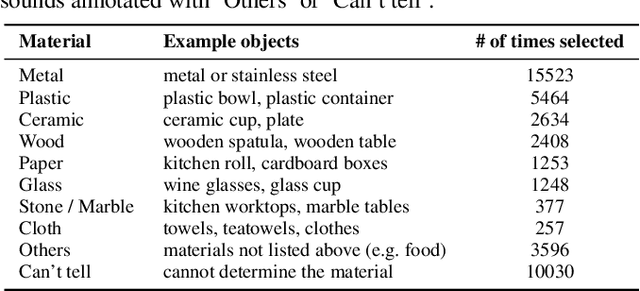
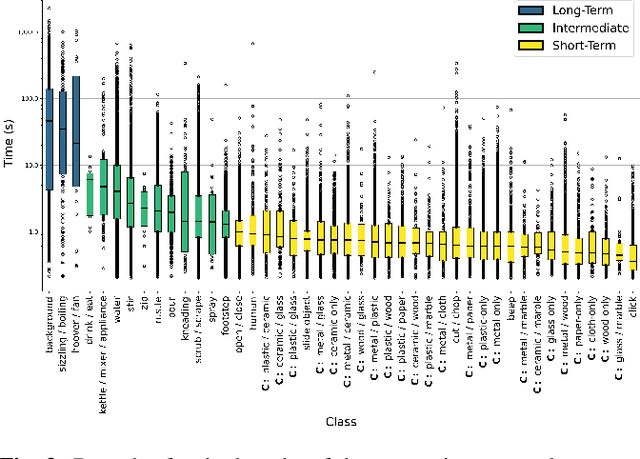
We introduce EPIC-SOUNDS, a large-scale dataset of audio annotations capturing temporal extents and class labels within the audio stream of the egocentric videos. We propose an annotation pipeline where annotators temporally label distinguishable audio segments and describe the action that could have caused this sound. We identify actions that can be discriminated purely from audio, through grouping these free-form descriptions of audio into classes. For actions that involve objects colliding, we collect human annotations of the materials of these objects (e.g. a glass object being placed on a wooden surface), which we verify from visual labels, discarding ambiguities. Overall, EPIC-SOUNDS includes 78.4k categorised segments of audible events and actions, distributed across 44 classes as well as 39.2k non-categorised segments. We train and evaluate two state-of-the-art audio recognition models on our dataset, highlighting the importance of audio-only labels and the limitations of current models to recognise actions that sound.
Refining Action Boundaries for One-stage Detection
Oct 25, 2022Current one-stage action detection methods, which simultaneously predict action boundaries and the corresponding class, do not estimate or use a measure of confidence in their boundary predictions, which can lead to inaccurate boundaries. We incorporate the estimation of boundary confidence into one-stage anchor-free detection, through an additional prediction head that predicts the refined boundaries with higher confidence. We obtain state-of-the-art performance on the challenging EPIC-KITCHENS-100 action detection as well as the standard THUMOS14 action detection benchmarks, and achieve improvement on the ActivityNet-1.3 benchmark.