 Add to Chrome
 Add to Firefox
 Add to Edge
Whareformer: Learning to Track What is Where in Long Egocentric Videos
Jul 09, 2026
The recently established 'Out of Sight, Not out of Mind' (OSNOM) task for egocentric videos focuses on tracking objects that are moved by the camera wearer, online, maintaining knowledge of instance locations throughout the video even when they leave the field of view or become heavily occluded. In this paper, we propose the first learning-based solution to the OSNOM task: Whareformer, a transformer-based model with two components: an updatable memory of established tracks and a track assignment module that associates observations with existing tracks in a feed-forward manner. Whareformer jointly reasons over evolving object appearance (what) and updated 3D location (where), and employs a dedicated New Track token to reason about novel objects. Thanks to its design choices of using relative distances and evolving track representations, Whareformer is trained on a small set of 56 videos but achieves SOTA performance on 260 long test videos from three datasets: EPIC-KITCHENS-100 (unseen videos), IT3DEgo, and HD-EPIC, with significant absolute improvements over prior work.

Syn4D: A Multiview Synthetic 4D Dataset
May 06, 2026Dense 3D reconstruction and tracking of dynamic scenes from monocular video remains an important open challenge in computer vision. Progress in this area has been constrained by the scarcity of high-quality datasets with dense, complete, and accurate geometric annotations. To address this limitation, we introduce Syn4D, a multiview synthetic dataset of dynamic scenes that includes ground-truth camera motion, depth maps, dense tracking, and parametric human pose annotations. A key feature of Syn4D is the ability to unproject any pixel into 3D to any time and to any camera. We conduct extensive evaluations across multiple downstream tasks to demonstrate the utility and effectiveness of the proposed dataset, including 4D scene reconstruction, 3D point tracking, geometry-aware camera retargeting, and human pose estimation. The experimental results highlight Syn4D's potential to facilitate research in dynamic scene understanding and spatiotemporal modeling.
Task Alignment: A simple and effective proxy for model merging in computer vision
Apr 14, 2026Efficiently merging several models fine-tuned for different tasks, but stemming from the same pretrained base model, is of great practical interest. Despite extensive prior work, most evaluations of model merging in computer vision are restricted to image classification using CLIP, where different classification datasets define different tasks. In this work, our goal is to make model merging more practical and show its relevance on challenging scenarios beyond this specific setting. In most vision scenarios, different tasks rely on trainable and usually heterogeneous decoders. Differently from previous studies with frozen decoders, where merged models can be evaluated right away, the non-trivial cost of decoder training renders hyperparameter selection based on downstream performance impractical. To address this, we introduce the task alignment proxy, and show how it can be used to speed up hyperparameter selection by orders of magnitude while retaining performance. Equipped with the task alignment proxy, we extend the applicability of model merging to multi-task vision models beyond CLIP-based classification.
Layered Motion Fusion: Lifting Motion Segmentation to 3D in Egocentric Videos
Jun 05, 2025Computer vision is largely based on 2D techniques, with 3D vision still relegated to a relatively narrow subset of applications. However, by building on recent advances in 3D models such as neural radiance fields, some authors have shown that 3D techniques can at last improve outputs extracted from independent 2D views, by fusing them into 3D and denoising them. This is particularly helpful in egocentric videos, where the camera motion is significant, but only under the assumption that the scene itself is static. In fact, as shown in the recent analysis conducted by EPIC Fields, 3D techniques are ineffective when it comes to studying dynamic phenomena, and, in particular, when segmenting moving objects. In this paper, we look into this issue in more detail. First, we propose to improve dynamic segmentation in 3D by fusing motion segmentation predictions from a 2D-based model into layered radiance fields (Layered Motion Fusion). However, the high complexity of long, dynamic videos makes it challenging to capture the underlying geometric structure, and, as a result, hinders the fusion of motion cues into the (incomplete) scene geometry. We address this issue through test-time refinement, which helps the model to focus on specific frames, thereby reducing the data complexity. This results in a synergy between motion fusion and the refinement, and in turn leads to segmentation predictions of the 3D model that surpass the 2D baseline by a large margin. This demonstrates that 3D techniques can enhance 2D analysis even for dynamic phenomena in a challenging and realistic setting.
Geo4D: Leveraging Video Generators for Geometric 4D Scene Reconstruction
Apr 10, 2025We introduce Geo4D, a method to repurpose video diffusion models for monocular 3D reconstruction of dynamic scenes. By leveraging the strong dynamic prior captured by such video models, Geo4D can be trained using only synthetic data while generalizing well to real data in a zero-shot manner. Geo4D predicts several complementary geometric modalities, namely point, depth, and ray maps. It uses a new multi-modal alignment algorithm to align and fuse these modalities, as well as multiple sliding windows, at inference time, thus obtaining robust and accurate 4D reconstruction of long videos. Extensive experiments across multiple benchmarks show that Geo4D significantly surpasses state-of-the-art video depth estimation methods, including recent methods such as MonST3R, which are also designed to handle dynamic scenes.
DUNE: Distilling a Universal Encoder from Heterogeneous 2D and 3D Teachers
Mar 18, 2025Recent multi-teacher distillation methods have unified the encoders of multiple foundation models into a single encoder, achieving competitive performance on core vision tasks like classification, segmentation, and depth estimation. This led us to ask: Could similar success be achieved when the pool of teachers also includes vision models specialized in diverse tasks across both 2D and 3D perception? In this paper, we define and investigate the problem of heterogeneous teacher distillation, or co-distillation, a challenging multi-teacher distillation scenario where teacher models vary significantly in both (a) their design objectives and (b) the data they were trained on. We explore data-sharing strategies and teacher-specific encoding, and introduce DUNE, a single encoder excelling in 2D vision, 3D understanding, and 3D human perception. Our model achieves performance comparable to that of its larger teachers, sometimes even outperforming them, on their respective tasks. Notably, DUNE surpasses MASt3R in Map-free Visual Relocalization with a much smaller encoder.
LUDVIG: Learning-free Uplifting of 2D Visual features to Gaussian Splatting scenes
Oct 18, 2024

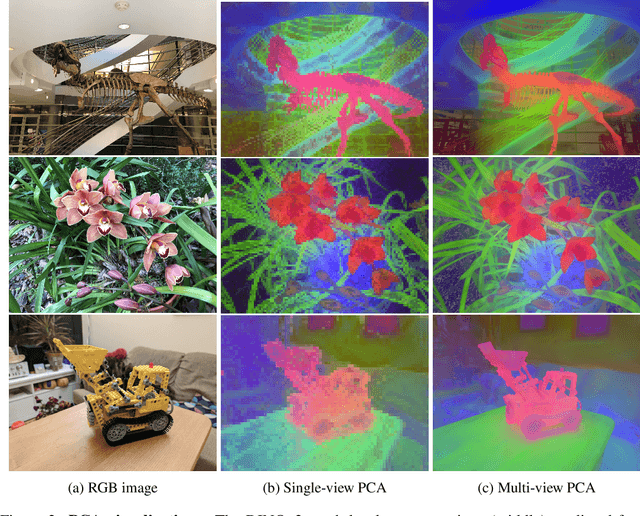

We address the task of uplifting visual features or semantic masks from 2D vision models to 3D scenes represented by Gaussian Splatting. Whereas common approaches rely on iterative optimization-based procedures, we show that a simple yet effective aggregation technique yields excellent results. Applied to semantic masks from Segment Anything (SAM), our uplifting approach leads to segmentation quality comparable to the state of the art. We then extend this method to generic DINOv2 features, integrating 3D scene geometry through graph diffusion, and achieve competitive segmentation results despite DINOv2 not being trained on millions of annotated masks like SAM.
UNIC: Universal Classification Models via Multi-teacher Distillation
Aug 09, 2024Pretrained models have become a commodity and offer strong results on a broad range of tasks. In this work, we focus on classification and seek to learn a unique encoder able to take from several complementary pretrained models. We aim at even stronger generalization across a variety of classification tasks. We propose to learn such an encoder via multi-teacher distillation. We first thoroughly analyse standard distillation when driven by multiple strong teachers with complementary strengths. Guided by this analysis, we gradually propose improvements to the basic distillation setup. Among those, we enrich the architecture of the encoder with a ladder of expendable projectors, which increases the impact of intermediate features during distillation, and we introduce teacher dropping, a regularization mechanism that better balances the teachers' influence. Our final distillation strategy leads to student models of the same capacity as any of the teachers, while retaining or improving upon the performance of the best teacher for each task. Project page and code: https://europe.naverlabs.com/unic
What could go wrong? Discovering and describing failure modes in computer vision
Aug 08, 2024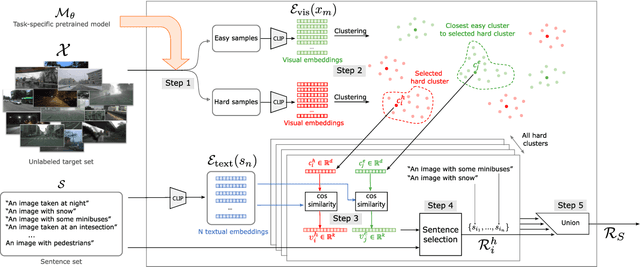
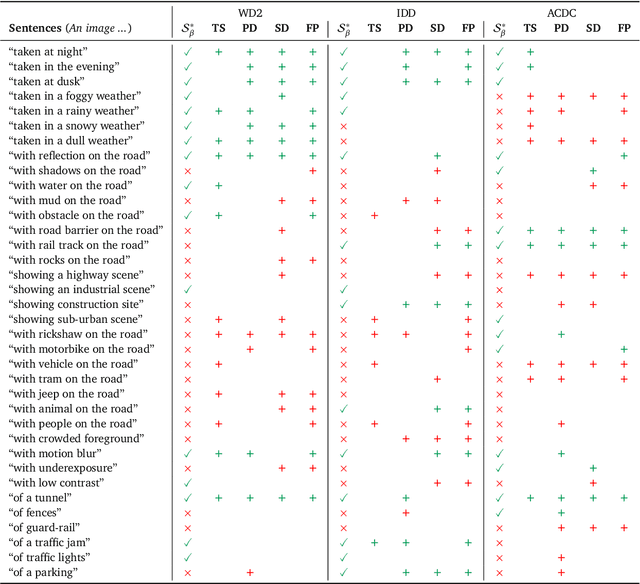
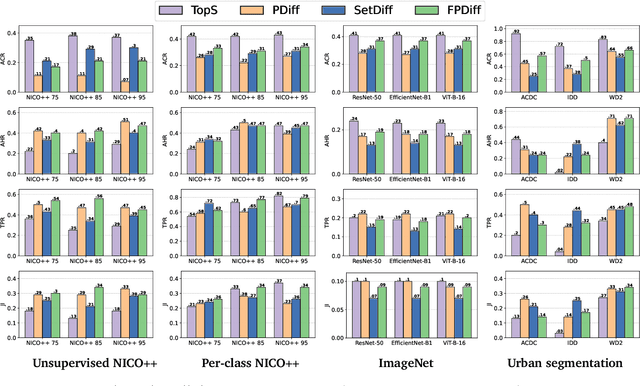

Deep learning models are effective, yet brittle. Even carefully trained, their behavior tends to be hard to predict when confronted with out-of-distribution samples. In this work, our goal is to propose a simple yet effective solution to predict and describe via natural language potential failure modes of computer vision models. Given a pretrained model and a set of samples, our aim is to find sentences that accurately describe the visual conditions in which the model underperforms. In order to study this important topic and foster future research on it, we formalize the problem of Language-Based Error Explainability (LBEE) and propose a set of metrics to evaluate and compare different methods for this task. We propose solutions that operate in a joint vision-and-language embedding space, and can characterize through language descriptions model failures caused, e.g., by objects unseen during training or adverse visual conditions. We experiment with different tasks, such as classification under the presence of dataset bias and semantic segmentation in unseen environments, and show that the proposed methodology isolates nontrivial sentences associated with specific error causes. We hope our work will help practitioners better understand the behavior of models, increasing their overall safety and interpretability.
PANDAS: Prototype-based Novel Class Discovery and Detection
Feb 27, 2024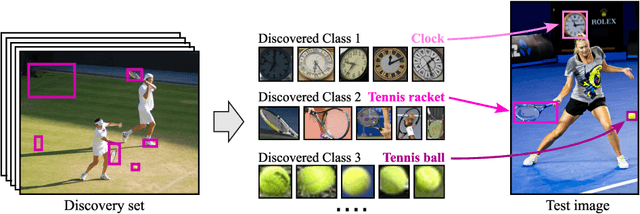
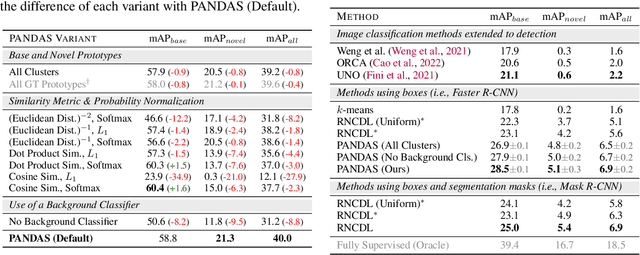
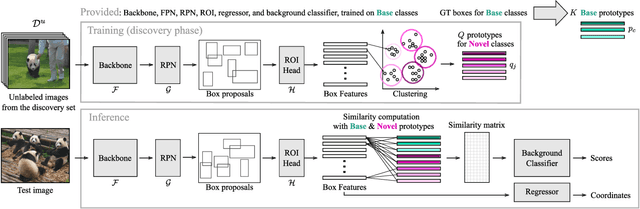

Object detectors are typically trained once and for all on a fixed set of classes. However, this closed-world assumption is unrealistic in practice, as new classes will inevitably emerge after the detector is deployed in the wild. In this work, we look at ways to extend a detector trained for a set of base classes so it can i) spot the presence of novel classes, and ii) automatically enrich its repertoire to be able to detect those newly discovered classes together with the base ones. We propose PANDAS, a method for novel class discovery and detection. It discovers clusters representing novel classes from unlabeled data, and represents old and new classes with prototypes. During inference, a distance-based classifier uses these prototypes to assign a label to each detected object instance. The simplicity of our method makes it widely applicable. We experimentally demonstrate the effectiveness of PANDAS on the VOC 2012 and COCO-to-LVIS benchmarks. It performs favorably against the state of the art for this task while being computationally more affordable.