 Add to Chrome
 Add to Firefox
 Add to Edge
Lite2Relight: 3D-aware Single Image Portrait Relighting
Jul 15, 2024
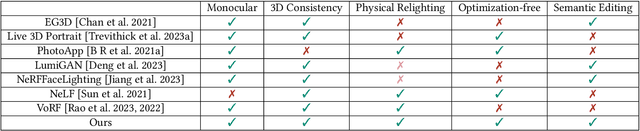
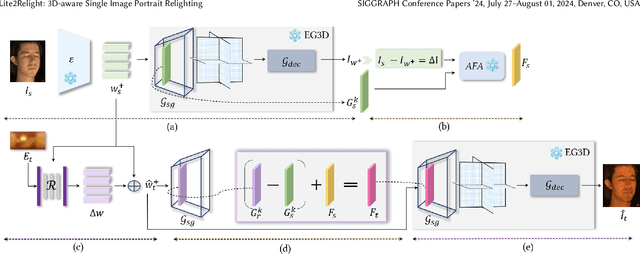
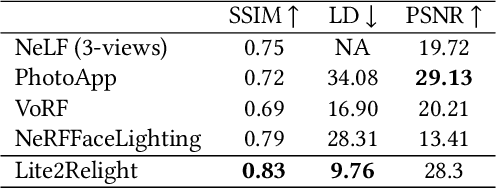
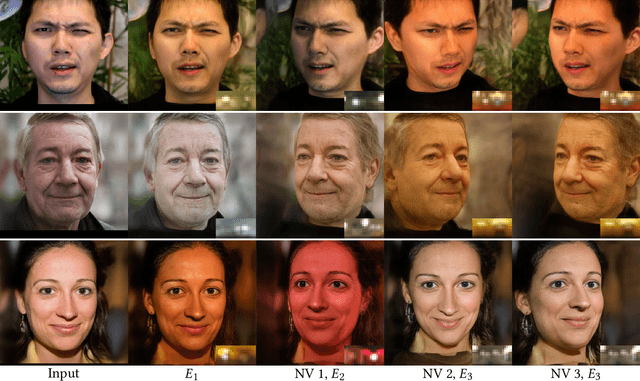
Achieving photorealistic 3D view synthesis and relighting of human portraits is pivotal for advancing AR/VR applications. Existing methodologies in portrait relighting demonstrate substantial limitations in terms of generalization and 3D consistency, coupled with inaccuracies in physically realistic lighting and identity preservation. Furthermore, personalization from a single view is difficult to achieve and often requires multiview images during the testing phase or involves slow optimization processes. This paper introduces Lite2Relight, a novel technique that can predict 3D consistent head poses of portraits while performing physically plausible light editing at interactive speed. Our method uniquely extends the generative capabilities and efficient volumetric representation of EG3D, leveraging a lightstage dataset to implicitly disentangle face reflectance and perform relighting under target HDRI environment maps. By utilizing a pre-trained geometry-aware encoder and a feature alignment module, we map input images into a relightable 3D space, enhancing them with a strong face geometry and reflectance prior. Through extensive quantitative and qualitative evaluations, we show that our method outperforms the state-of-the-art methods in terms of efficacy, photorealism, and practical application. This includes producing 3D-consistent results of the full head, including hair, eyes, and expressions. Lite2Relight paves the way for large-scale adoption of photorealistic portrait editing in various domains, offering a robust, interactive solution to a previously constrained problem. Project page: https://vcai.mpi-inf.mpg.de/projects/Lite2Relight/

Live2Diff: Live Stream Translation via Uni-directional Attention in Video Diffusion Models
Jul 11, 2024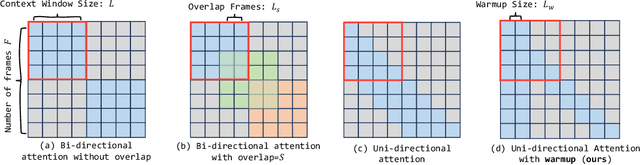
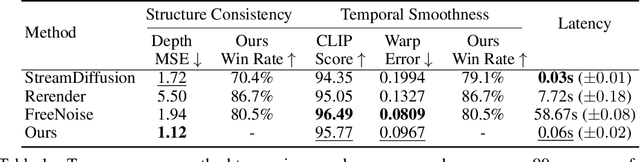
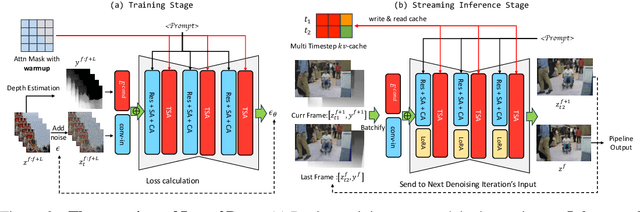
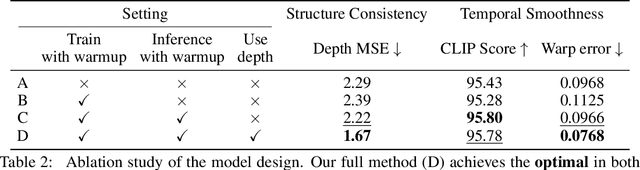
Large Language Models have shown remarkable efficacy in generating streaming data such as text and audio, thanks to their temporally uni-directional attention mechanism, which models correlations between the current token and previous tokens. However, video streaming remains much less explored, despite a growing need for live video processing. State-of-the-art video diffusion models leverage bi-directional temporal attention to model the correlations between the current frame and all the surrounding (i.e. including future) frames, which hinders them from processing streaming videos. To address this problem, we present Live2Diff, the first attempt at designing a video diffusion model with uni-directional temporal attention, specifically targeting live streaming video translation. Compared to previous works, our approach ensures temporal consistency and smoothness by correlating the current frame with its predecessors and a few initial warmup frames, without any future frames. Additionally, we use a highly efficient denoising scheme featuring a KV-cache mechanism and pipelining, to facilitate streaming video translation at interactive framerates. Extensive experiments demonstrate the effectiveness of the proposed attention mechanism and pipeline, outperforming previous methods in terms of temporal smoothness and/or efficiency.
DICE: End-to-end Deformation Capture of Hand-Face Interactions from a Single Image
Jun 26, 2024

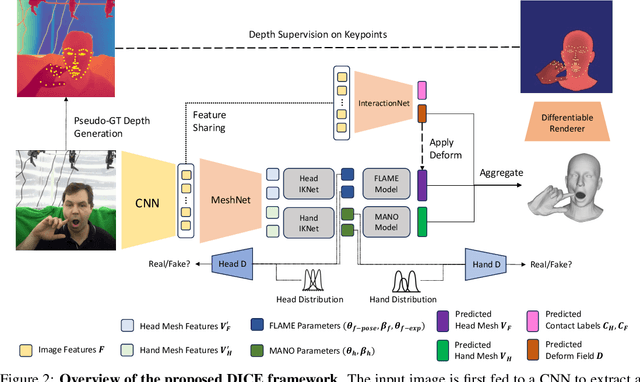
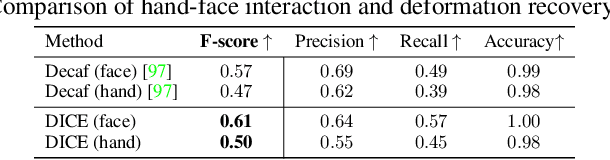
Reconstructing 3D hand-face interactions with deformations from a single image is a challenging yet crucial task with broad applications in AR, VR, and gaming. The challenges stem from self-occlusions during single-view hand-face interactions, diverse spatial relationships between hands and face, complex deformations, and the ambiguity of the single-view setting. The first and only method for hand-face interaction recovery, Decaf, introduces a global fitting optimization guided by contact and deformation estimation networks trained on studio-collected data with 3D annotations. However, Decaf suffers from a time-consuming optimization process and limited generalization capability due to its reliance on 3D annotations of hand-face interaction data. To address these issues, we present DICE, the first end-to-end method for Deformation-aware hand-face Interaction reCovEry from a single image. DICE estimates the poses of hands and faces, contacts, and deformations simultaneously using a Transformer-based architecture. It features disentangling the regression of local deformation fields and global mesh vertex locations into two network branches, enhancing deformation and contact estimation for precise and robust hand-face mesh recovery. To improve generalizability, we propose a weakly-supervised training approach that augments the training set using in-the-wild images without 3D ground-truth annotations, employing the depths of 2D keypoints estimated by off-the-shelf models and adversarial priors of poses for supervision. Our experiments demonstrate that DICE achieves state-of-the-art performance on a standard benchmark and in-the-wild data in terms of accuracy and physical plausibility. Additionally, our method operates at an interactive rate (20 fps) on an Nvidia 4090 GPU, whereas Decaf requires more than 15 seconds for a single image. Our code will be publicly available upon publication.
D-NPC: Dynamic Neural Point Clouds for Non-Rigid View Synthesis from Monocular Video
Jun 14, 2024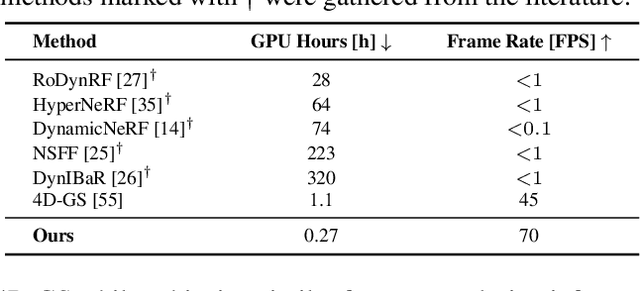
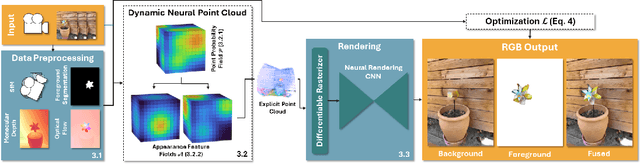
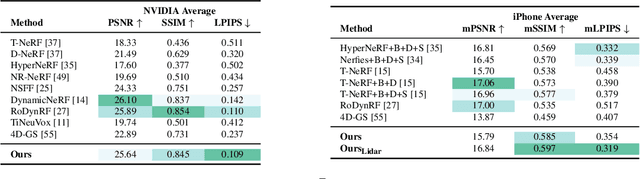
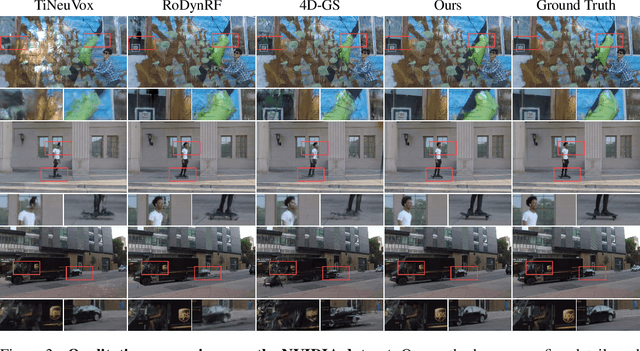
Dynamic reconstruction and spatiotemporal novel-view synthesis of non-rigidly deforming scenes recently gained increased attention. While existing work achieves impressive quality and performance on multi-view or teleporting camera setups, most methods fail to efficiently and faithfully recover motion and appearance from casual monocular captures. This paper contributes to the field by introducing a new method for dynamic novel view synthesis from monocular video, such as casual smartphone captures. Our approach represents the scene as a $\textit{dynamic neural point cloud}$, an implicit time-conditioned point distribution that encodes local geometry and appearance in separate hash-encoded neural feature grids for static and dynamic regions. By sampling a discrete point cloud from our model, we can efficiently render high-quality novel views using a fast differentiable rasterizer and neural rendering network. Similar to recent work, we leverage advances in neural scene analysis by incorporating data-driven priors like monocular depth estimation and object segmentation to resolve motion and depth ambiguities originating from the monocular captures. In addition to guiding the optimization process, we show that these priors can be exploited to explicitly initialize our scene representation to drastically improve optimization speed and final image quality. As evidenced by our experimental evaluation, our dynamic point cloud model not only enables fast optimization and real-time frame rates for interactive applications, but also achieves competitive image quality on monocular benchmark sequences. Our project page is available at https://moritzkappel.github.io/projects/dnpc.
Learning Images Across Scales Using Adversarial Training
Jun 13, 2024
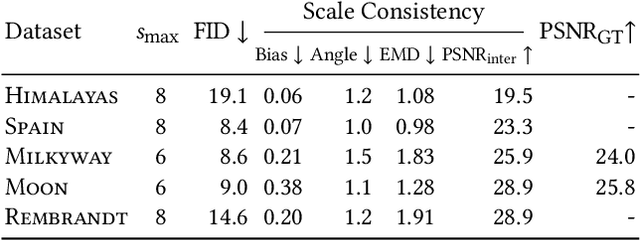
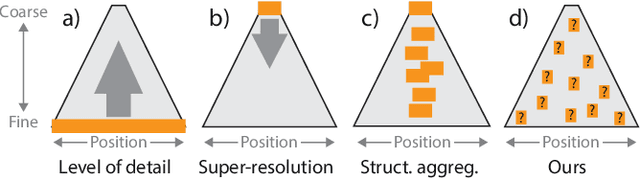
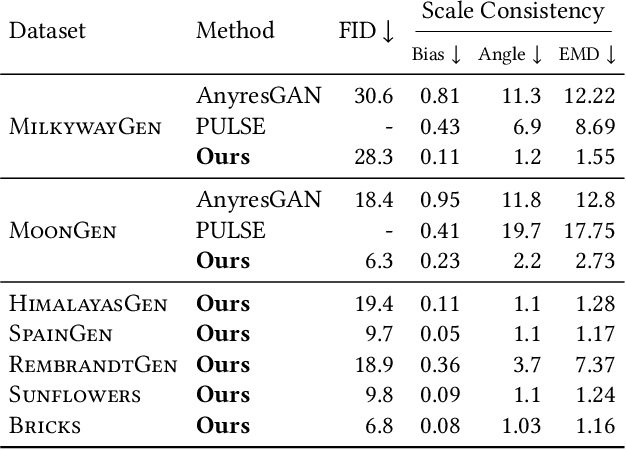
The real world exhibits rich structure and detail across many scales of observation. It is difficult, however, to capture and represent a broad spectrum of scales using ordinary images. We devise a novel paradigm for learning a representation that captures an orders-of-magnitude variety of scales from an unstructured collection of ordinary images. We treat this collection as a distribution of scale-space slices to be learned using adversarial training, and additionally enforce coherency across slices. Our approach relies on a multiscale generator with carefully injected procedural frequency content, which allows to interactively explore the emerging continuous scale space. Training across vastly different scales poses challenges regarding stability, which we tackle using a supervision scheme that involves careful sampling of scales. We show that our generator can be used as a multiscale generative model, and for reconstructions of scale spaces from unstructured patches. Significantly outperforming the state of the art, we demonstrate zoom-in factors of up to 256x at high quality and scale consistency.
FaceGPT: Self-supervised Learning to Chat about 3D Human Faces
Jun 11, 2024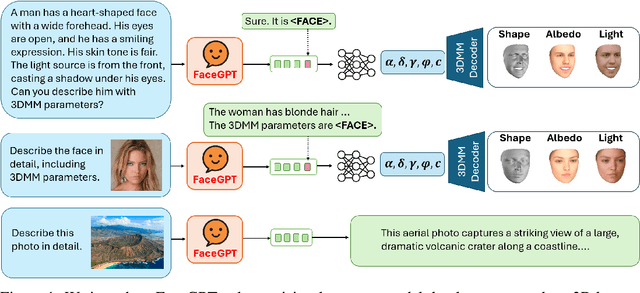
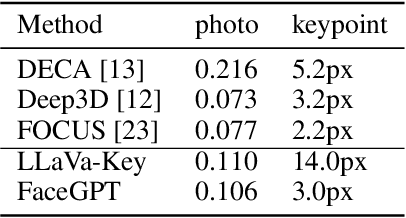
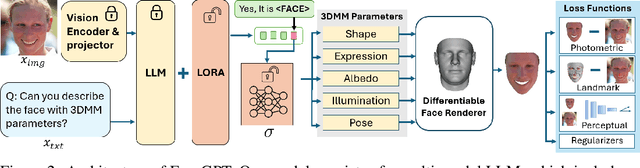
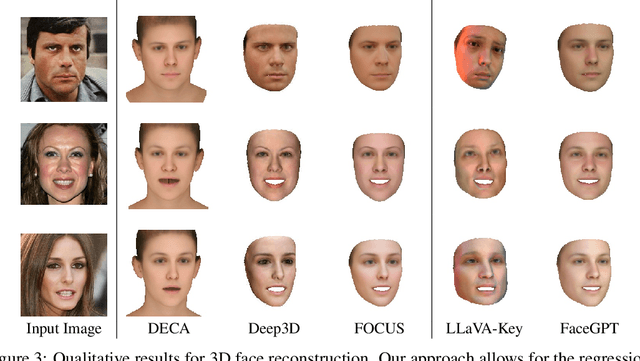
We introduce FaceGPT, a self-supervised learning framework for Large Vision-Language Models (VLMs) to reason about 3D human faces from images and text. Typical 3D face reconstruction methods are specialized algorithms that lack semantic reasoning capabilities. FaceGPT overcomes this limitation by embedding the parameters of a 3D morphable face model (3DMM) into the token space of a VLM, enabling the generation of 3D faces from both textual and visual inputs. FaceGPT is trained in a self-supervised manner as a model-based autoencoder from in-the-wild images. In particular, the hidden state of LLM is projected into 3DMM parameters and subsequently rendered as 2D face image to guide the self-supervised learning process via image-based reconstruction. Without relying on expensive 3D annotations of human faces, FaceGPT obtains a detailed understanding about 3D human faces, while preserving the capacity to understand general user instructions. Our experiments demonstrate that FaceGPT not only achieves high-quality 3D face reconstructions but also retains the ability for general-purpose visual instruction following. Furthermore, FaceGPT learns fully self-supervised to generate 3D faces based on complex textual inputs, which opens a new direction in human face analysis.
Neural Gaussian Scale-Space Fields
May 31, 2024


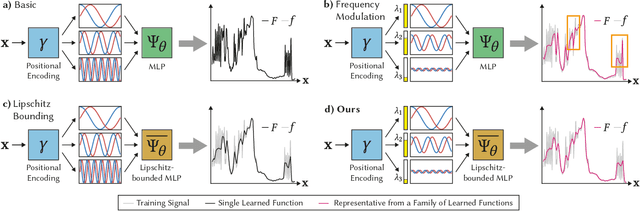
Gaussian scale spaces are a cornerstone of signal representation and processing, with applications in filtering, multiscale analysis, anti-aliasing, and many more. However, obtaining such a scale space is costly and cumbersome, in particular for continuous representations such as neural fields. We present an efficient and lightweight method to learn the fully continuous, anisotropic Gaussian scale space of an arbitrary signal. Based on Fourier feature modulation and Lipschitz bounding, our approach is trained self-supervised, i.e., training does not require any manual filtering. Our neural Gaussian scale-space fields faithfully capture multiscale representations across a broad range of modalities, and support a diverse set of applications. These include images, geometry, light-stage data, texture anti-aliasing, and multiscale optimization.
Zero-Shot Video Semantic Segmentation based on Pre-Trained Diffusion Models
May 27, 2024We introduce the first zero-shot approach for Video Semantic Segmentation (VSS) based on pre-trained diffusion models. A growing research direction attempts to employ diffusion models to perform downstream vision tasks by exploiting their deep understanding of image semantics. Yet, the majority of these approaches have focused on image-related tasks like semantic correspondence and segmentation, with less emphasis on video tasks such as VSS. Ideally, diffusion-based image semantic segmentation approaches can be applied to videos in a frame-by-frame manner. However, we find their performance on videos to be subpar due to the absence of any modeling of temporal information inherent in the video data. To this end, we tackle this problem and introduce a framework tailored for VSS based on pre-trained image and video diffusion models. We propose building a scene context model based on the diffusion features, where the model is autoregressively updated to adapt to scene changes. This context model predicts per-frame coarse segmentation maps that are temporally consistent. To refine these maps further, we propose a correspondence-based refinement strategy that aggregates predictions temporally, resulting in more confident predictions. Finally, we introduce a masked modulation approach to upsample the coarse maps to the full resolution at a high quality. Experiments show that our proposed approach outperforms existing zero-shot image semantic segmentation approaches significantly on various VSS benchmarks without any training or fine-tuning. Moreover, it rivals supervised VSS approaches on the VSPW dataset despite not being explicitly trained for VSS.
Evolutive Rendering Models
May 27, 2024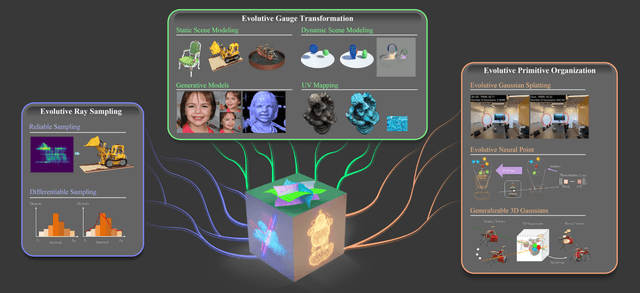
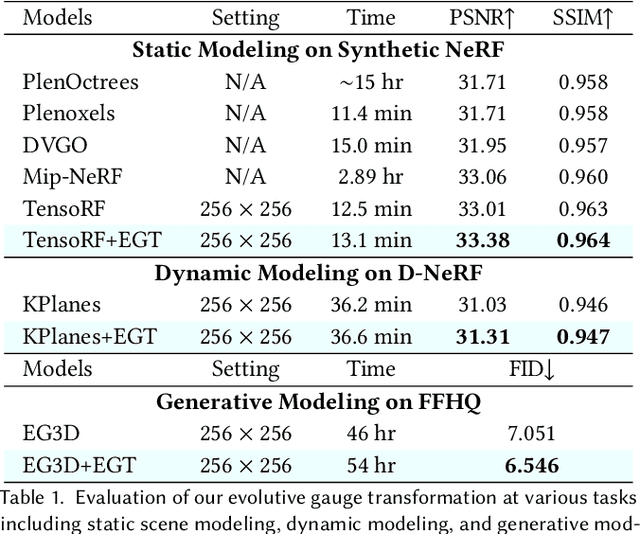
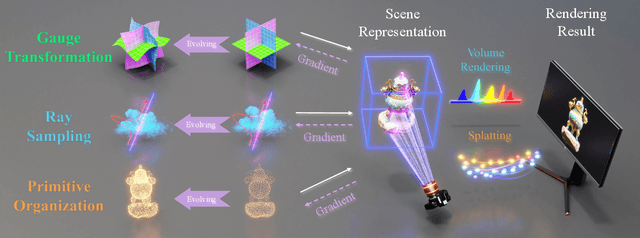
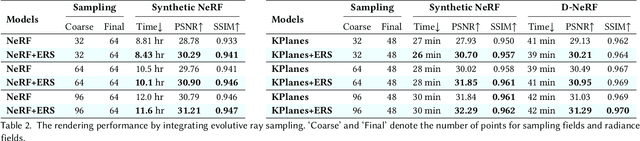
The landscape of computer graphics has undergone significant transformations with the recent advances of differentiable rendering models. These rendering models often rely on heuristic designs that may not fully align with the final rendering objectives. We address this gap by pioneering \textit{evolutive rendering models}, a methodology where rendering models possess the ability to evolve and adapt dynamically throughout the rendering process. In particular, we present a comprehensive learning framework that enables the optimization of three principal rendering elements, including the gauge transformations, the ray sampling mechanisms, and the primitive organization. Central to this framework is the development of differentiable versions of these rendering elements, allowing for effective gradient backpropagation from the final rendering objectives. A detailed analysis of gradient characteristics is performed to facilitate a stable and goal-oriented elements evolution. Our extensive experiments demonstrate the large potential of evolutive rendering models for enhancing the rendering performance across various domains, including static and dynamic scene representations, generative modeling, and texture mapping.
EventEgo3D: 3D Human Motion Capture from Egocentric Event Streams
Apr 12, 2024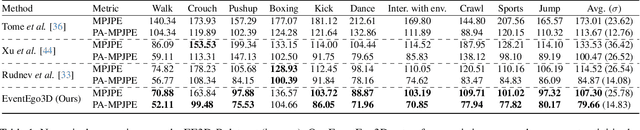
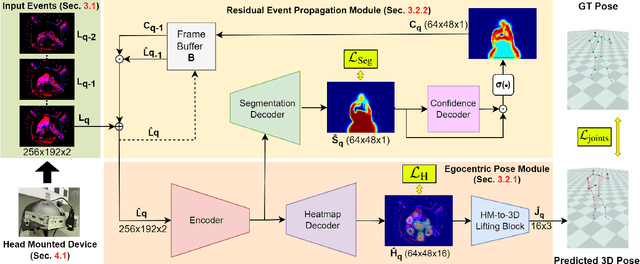
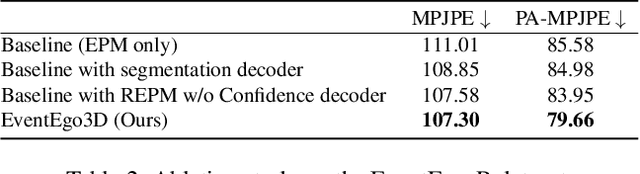
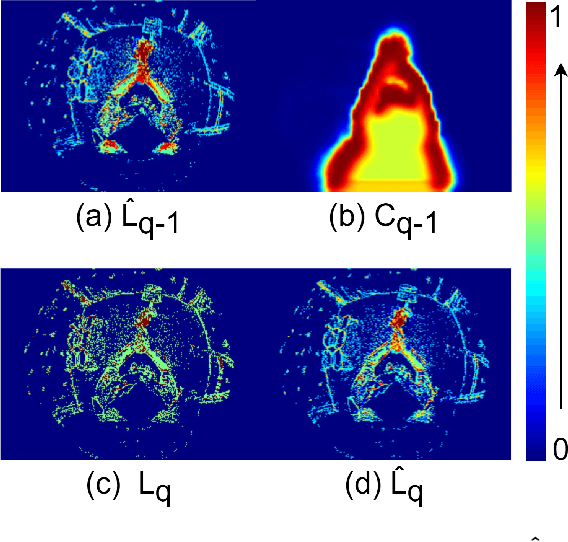
Monocular egocentric 3D human motion capture is a challenging and actively researched problem. Existing methods use synchronously operating visual sensors (e.g. RGB cameras) and often fail under low lighting and fast motions, which can be restricting in many applications involving head-mounted devices. In response to the existing limitations, this paper 1) introduces a new problem, i.e., 3D human motion capture from an egocentric monocular event camera with a fisheye lens, and 2) proposes the first approach to it called EventEgo3D (EE3D). Event streams have high temporal resolution and provide reliable cues for 3D human motion capture under high-speed human motions and rapidly changing illumination. The proposed EE3D framework is specifically tailored for learning with event streams in the LNES representation, enabling high 3D reconstruction accuracy. We also design a prototype of a mobile head-mounted device with an event camera and record a real dataset with event observations and the ground-truth 3D human poses (in addition to the synthetic dataset). Our EE3D demonstrates robustness and superior 3D accuracy compared to existing solutions across various challenging experiments while supporting real-time 3D pose update rates of 140Hz.