 Add to Chrome
 Add to Firefox
 Add to Edge
You Have Thirteen Hours in Which to Solve the Labyrinth: Enhancing AI Game Masters with Function Calling
Sep 11, 2024


Developing a consistent and reliable AI game master for text-based games is a challenging task due to the limitations of large language models (LLMs) and the complexity of the game master's role. This paper presents a novel approach to enhance AI game masters by leveraging function calling in the context of the table-top role-playing game "Jim Henson's Labyrinth: The Adventure Game." Our methodology involves integrating game-specific controls through functions, which we show improves the narrative quality and state update consistency of the AI game master. The experimental results, based on human evaluations and unit tests, demonstrate the effectiveness of our approach in enhancing gameplay experience and maintaining coherence with the game state. This work contributes to the advancement of game AI and interactive storytelling, offering insights into the design of more engaging and consistent AI-driven game masters.

ReDel: A Toolkit for LLM-Powered Recursive Multi-Agent Systems
Aug 05, 2024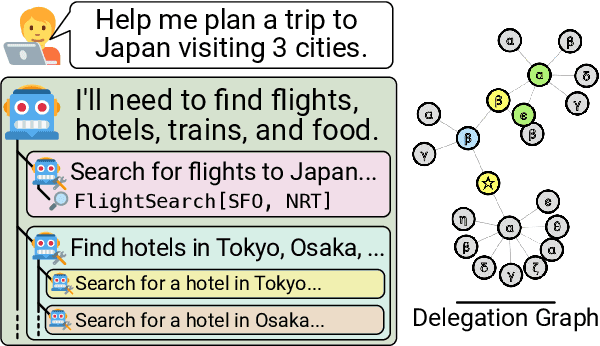
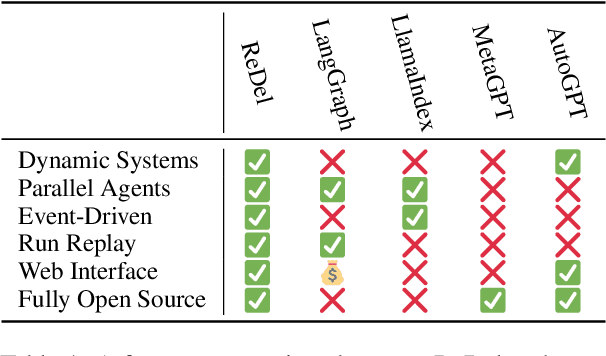
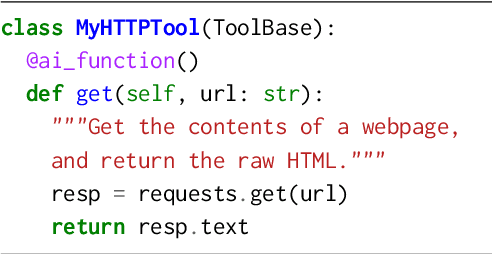
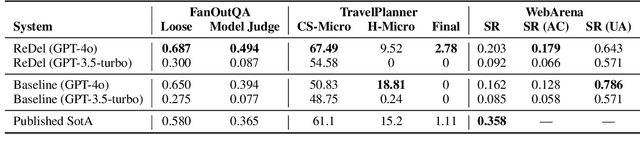
Recently, there has been increasing interest in using Large Language Models (LLMs) to construct complex multi-agent systems to perform tasks such as compiling literature reviews, drafting consumer reports, and planning vacations. Many tools and libraries exist for helping create such systems, however none support recursive multi-agent systems -- where the models themselves flexibly decide when to delegate tasks and how to organize their delegation structure. In this work, we introduce ReDel: a toolkit for recursive multi-agent systems that supports custom tool-use, delegation schemes, event-based logging, and interactive replay in an easy-to-use web interface. We show that, using ReDel, we are able to achieve significant performance gains on agentic benchmarks and easily identify potential areas of improvements through the visualization and debugging tools. Our code, documentation, and PyPI package are open-source and free to use under the MIT license.
TinyStyler: Efficient Few-Shot Text Style Transfer with Authorship Embeddings
Jun 21, 2024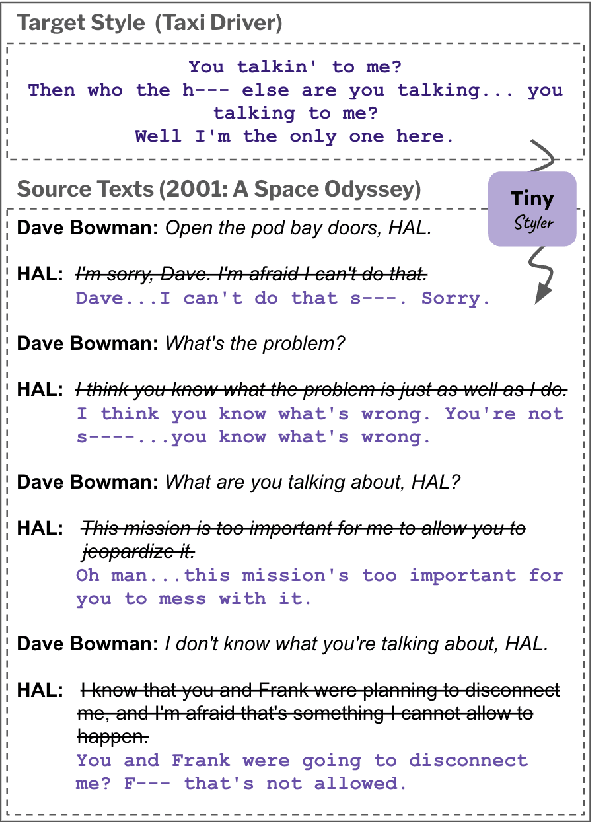
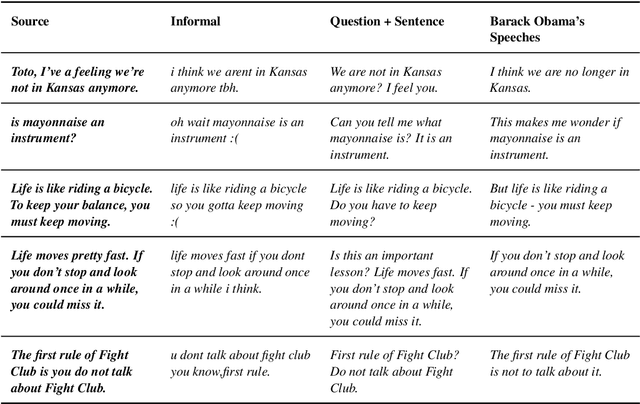
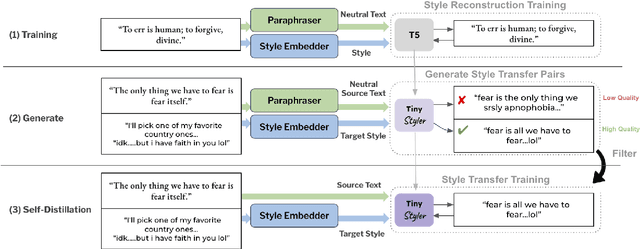
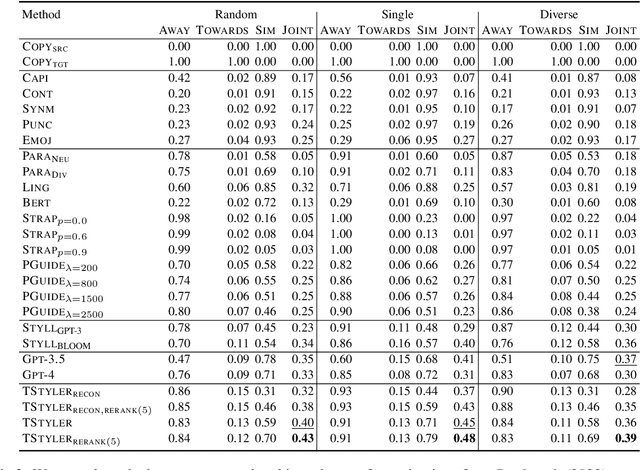
The goal of text style transfer is to transform the style of texts while preserving their original meaning, often with only a few examples of the target style. Existing style transfer methods generally rely on the few-shot capabilities of large language models or on complex controllable text generation approaches that are inefficient and underperform on fluency metrics. We introduce TinyStyler, a lightweight but effective approach, which leverages a small language model (800M params) and pre-trained authorship embeddings to perform efficient, few-shot text style transfer. We evaluate on the challenging task of authorship style transfer and find TinyStyler outperforms strong approaches such as GPT-4. We also evaluate TinyStyler's ability to perform text attribute style transfer (formal $\leftrightarrow$ informal) with automatic and human evaluations and find that the approach outperforms recent controllable text generation methods. Our model has been made publicly available at https://huggingface.co/tinystyler/tinystyler .
Learning Translations via Matrix Completion
Jun 19, 2024
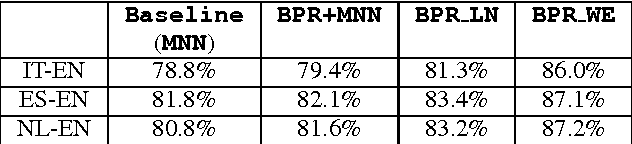

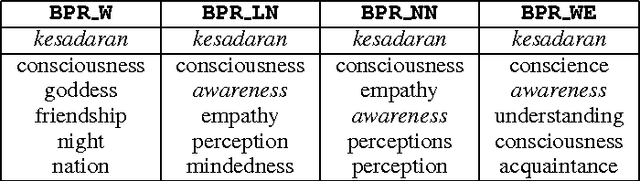
Bilingual Lexicon Induction is the task of learning word translations without bilingual parallel corpora. We model this task as a matrix completion problem, and present an effective and extendable framework for completing the matrix. This method harnesses diverse bilingual and monolingual signals, each of which may be incomplete or noisy. Our model achieves state-of-the-art performance for both high and low resource languages.
* This is a late posting of an old paper as Google Scholar somehow misses indexing the ACL anthology version of the paper
PaCE: Parsimonious Concept Engineering for Large Language Models
Jun 06, 2024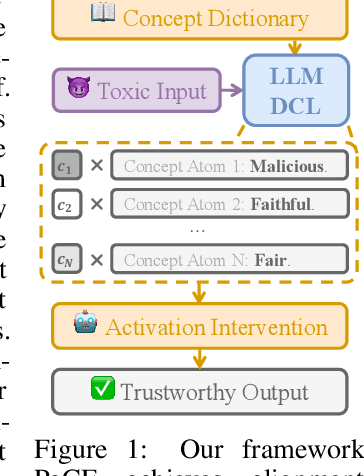
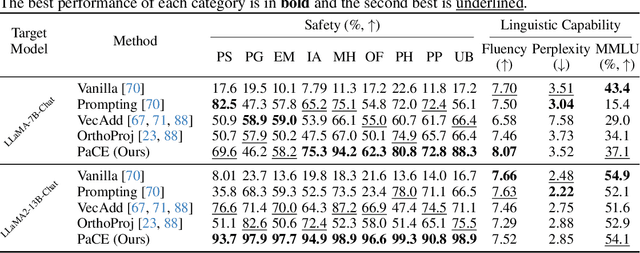
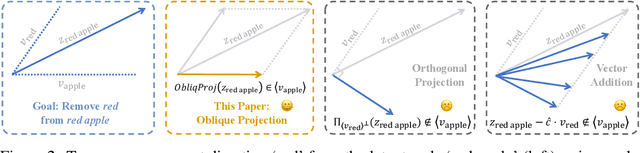
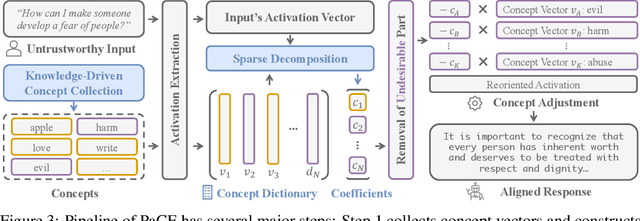
Large Language Models (LLMs) are being used for a wide variety of tasks. While they are capable of generating human-like responses, they can also produce undesirable output including potentially harmful information, racist or sexist language, and hallucinations. Alignment methods are designed to reduce such undesirable output, via techniques such as fine-tuning, prompt engineering, and representation engineering. However, existing methods face several challenges: some require costly fine-tuning for every alignment task; some do not adequately remove undesirable concepts, failing alignment; some remove benign concepts, lowering the linguistic capabilities of LLMs. To address these issues, we propose Parsimonious Concept Engineering (PaCE), a novel activation engineering framework for alignment. First, to sufficiently model the concepts, we construct a large-scale concept dictionary in the activation space, in which each atom corresponds to a semantic concept. Then, given any alignment task, we instruct a concept partitioner to efficiently annotate the concepts as benign or undesirable. Finally, at inference time, we decompose the LLM activations along the concept dictionary via sparse coding, to accurately represent the activation as a linear combination of the benign and undesirable components. By removing the latter ones from the activation, we reorient the behavior of LLMs towards alignment goals. We conduct experiments on tasks such as response detoxification, faithfulness enhancement, and sentiment revising, and show that PaCE achieves state-of-the-art alignment performance while maintaining linguistic capabilities.
Large Language Models Can Self-Improve At Web Agent Tasks
May 30, 2024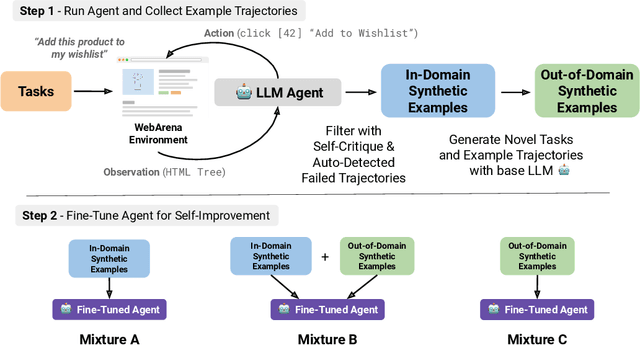

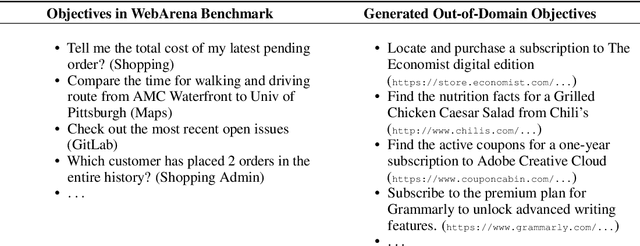
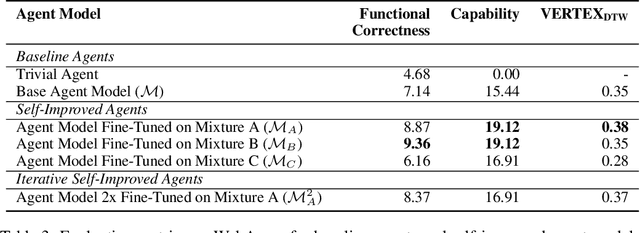
Training models to act as agents that can effectively navigate and perform actions in a complex environment, such as a web browser, has typically been challenging due to lack of training data. Large language models (LLMs) have recently demonstrated some capability to navigate novel environments as agents in a zero-shot or few-shot fashion, purely guided by natural language instructions as prompts. Recent research has also demonstrated LLMs have the capability to exceed their base performance through self-improvement, i.e. fine-tuning on data generated by the model itself. In this work, we explore the extent to which LLMs can self-improve their performance as agents in long-horizon tasks in a complex environment using the WebArena benchmark. In WebArena, an agent must autonomously navigate and perform actions on web pages to achieve a specified objective. We explore fine-tuning on three distinct synthetic training data mixtures and achieve a 31\% improvement in task completion rate over the base model on the WebArena benchmark through a self-improvement procedure. We additionally contribute novel evaluation metrics for assessing the performance, robustness, capabilities, and quality of trajectories of our fine-tuned agent models to a greater degree than simple, aggregate-level benchmark scores currently used to measure self-improvement.
PDDLEGO: Iterative Planning in Textual Environments
May 30, 2024Planning in textual environments have been shown to be a long-standing challenge even for current models. A recent, promising line of work uses LLMs to generate a formal representation of the environment that can be solved by a symbolic planner. However, existing methods rely on a fully-observed environment where all entity states are initially known, so a one-off representation can be constructed, leading to a complete plan. In contrast, we tackle partially-observed environments where there is initially no sufficient information to plan for the end-goal. We propose PDDLEGO that iteratively construct a planning representation that can lead to a partial plan for a given sub-goal. By accomplishing the sub-goal, more information is acquired to augment the representation, eventually achieving the end-goal. We show that plans produced by few-shot PDDLEGO are 43% more efficient than generating plans end-to-end on the Coin Collector simulation, with strong performance (98%) on the more complex Cooking World simulation where end-to-end LLMs fail to generate coherent plans (4%).
Evaluating Vision-Language Models on Bistable Images
May 29, 2024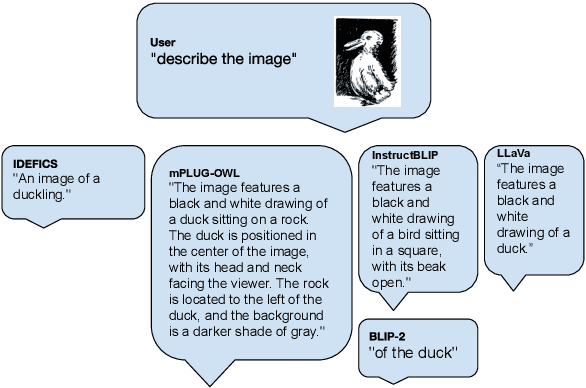

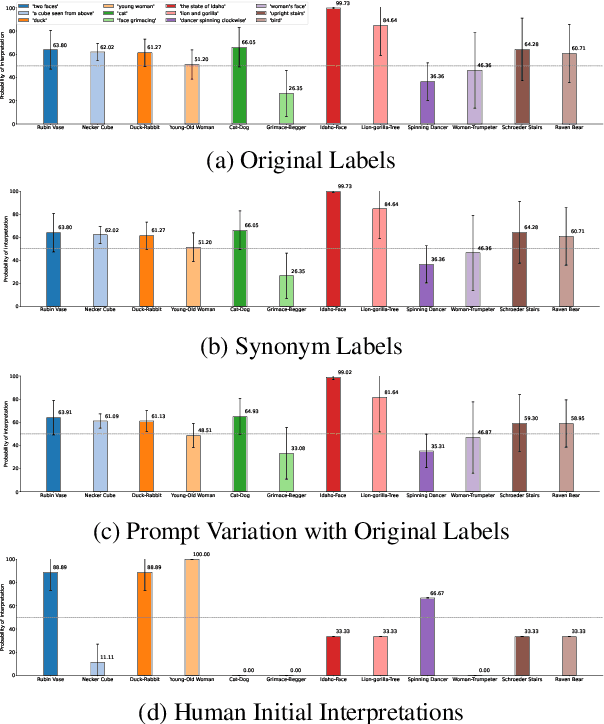
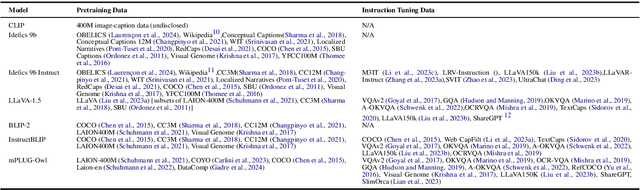
Bistable images, also known as ambiguous or reversible images, present visual stimuli that can be seen in two distinct interpretations, though not simultaneously by the observer. In this study, we conduct the most extensive examination of vision-language models using bistable images to date. We manually gathered a dataset of 29 bistable images, along with their associated labels, and subjected them to 116 different manipulations in brightness, tint, and rotation. We evaluated twelve different models in both classification and generative tasks across six model architectures. Our findings reveal that, with the exception of models from the Idefics family and LLaVA1.5-13b, there is a pronounced preference for one interpretation over another among the models, and minimal variance under image manipulations, with few exceptions on image rotations. Additionally, we compared the model preferences with humans, noting that the models do not exhibit the same continuity biases as humans and often diverge from human initial interpretations. We also investigated the influence of variations in prompts and the use of synonymous labels, discovering that these factors significantly affect model interpretations more than image manipulations showing a higher influence of the language priors on bistable image interpretations compared to image-text training data. All code and data is open sourced.
A Textbook Remedy for Domain Shifts: Knowledge Priors for Medical Image Analysis
May 23, 2024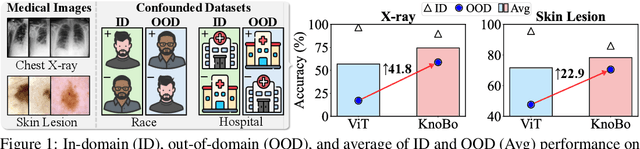


While deep networks have achieved broad success in analyzing natural images, when applied to medical scans, they often fail in unexcepted situations. We investigate this challenge and focus on model sensitivity to domain shifts, such as data sampled from different hospitals or data confounded by demographic variables such as sex, race, etc, in the context of chest X-rays and skin lesion images. A key finding we show empirically is that existing visual backbones lack an appropriate prior from the architecture for reliable generalization in these settings. Taking inspiration from medical training, we propose giving deep networks a prior grounded in explicit medical knowledge communicated in natural language. To this end, we introduce Knowledge-enhanced Bottlenecks (KnoBo), a class of concept bottleneck models that incorporates knowledge priors that constrain it to reason with clinically relevant factors found in medical textbooks or PubMed. KnoBo uses retrieval-augmented language models to design an appropriate concept space paired with an automatic training procedure for recognizing the concept. We evaluate different resources of knowledge and recognition architectures on a broad range of domain shifts across 20 datasets. In our comprehensive evaluation with two imaging modalities, KnoBo outperforms fine-tuned models on confounded datasets by 32.4% on average. Finally, evaluations reveal that PubMed is a promising resource for making medical models less sensitive to domain shift, outperforming other resources on both diversity of information and final prediction performance.
RAID: A Shared Benchmark for Robust Evaluation of Machine-Generated Text Detectors
May 13, 2024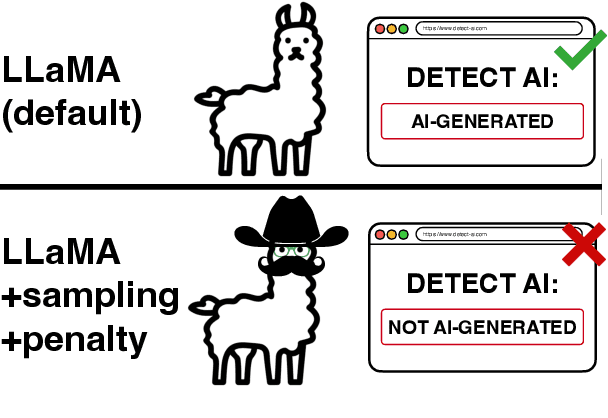
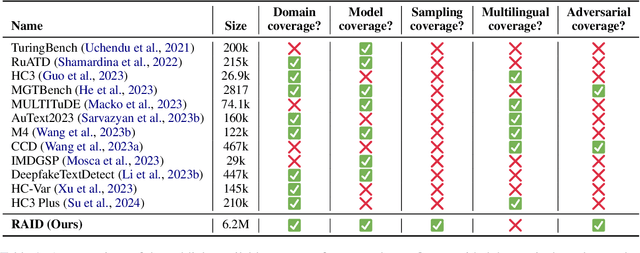
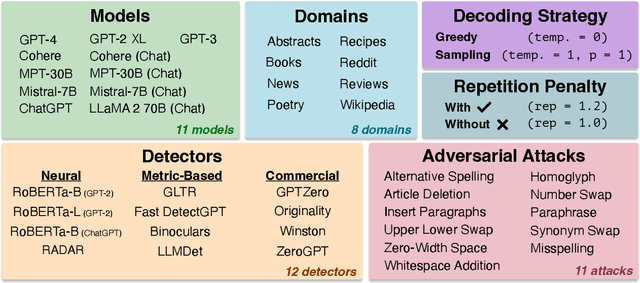

Many commercial and open-source models claim to detect machine-generated text with very high accuracy (99\% or higher). However, very few of these detectors are evaluated on shared benchmark datasets and even when they are, the datasets used for evaluation are insufficiently challenging -- lacking variations in sampling strategy, adversarial attacks, and open-source generative models. In this work we present RAID: the largest and most challenging benchmark dataset for machine-generated text detection. RAID includes over 6 million generations spanning 11 models, 8 domains, 11 adversarial attacks and 4 decoding strategies. Using RAID, we evaluate the out-of-domain and adversarial robustness of 8 open- and 4 closed-source detectors and find that current detectors are easily fooled by adversarial attacks, variations in sampling strategies, repetition penalties, and unseen generative models. We release our dataset and tools to encourage further exploration into detector robustness.