 Add to Chrome
 Add to Firefox
 Add to Edge
Through the PRISM: Principle-Aware, Interpretable, and Multi-Scale Evaluation of Visual Designs
May 30, 2026
Effective visual communication stems from the harmony of multiple design principles, such as readability, contrast, alignment, overlap, and coherence, which collectively govern clarity and intent of the communicator. While human designers reason holistically over these principles, machine agents typically condense them into a single heuristic score, offering limited interpretability and diagnostic precision. To address this gap, we introduce PRISM (PRinciple-aware, Interpretable, and Structure-guided Design Modifications), a benchmark that systematically perturbs professional layouts from the Crello dataset along measurable design principles. The benchmark comprises 100K perturbed training samples and 10K perturbed validation designs, each isolating a specific principle violation for controlled analysis of multimodal reasoning about design quality. We show that models like Qwen-2.5-VL and GPT-4o-mini are largely insensitive to targeted principle degradations, whereas GPT-4o exhibits global awareness without fine-grained disentanglement. Building on these insights, we propose a multi-scale evaluation framework that integrates lightweight scorers for quantitative assessment, instruction-tuned vision-language models for localised feedback, and prompt-based methods for global reasoning. Our framework provides interpretable explanations of design failures. Using these localised insights, we show targeted refinements that improve layout quality. Together, PRISM and our framework lay the foundation for interpretable design-literate multimodal reasoning systems.

A Textbook Remedy for Domain Shifts: Knowledge Priors for Medical Image Analysis
May 23, 2024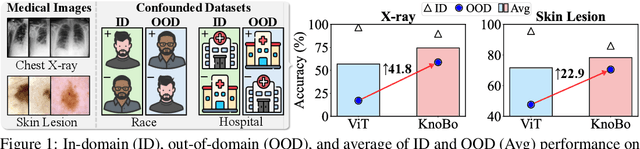


While deep networks have achieved broad success in analyzing natural images, when applied to medical scans, they often fail in unexcepted situations. We investigate this challenge and focus on model sensitivity to domain shifts, such as data sampled from different hospitals or data confounded by demographic variables such as sex, race, etc, in the context of chest X-rays and skin lesion images. A key finding we show empirically is that existing visual backbones lack an appropriate prior from the architecture for reliable generalization in these settings. Taking inspiration from medical training, we propose giving deep networks a prior grounded in explicit medical knowledge communicated in natural language. To this end, we introduce Knowledge-enhanced Bottlenecks (KnoBo), a class of concept bottleneck models that incorporates knowledge priors that constrain it to reason with clinically relevant factors found in medical textbooks or PubMed. KnoBo uses retrieval-augmented language models to design an appropriate concept space paired with an automatic training procedure for recognizing the concept. We evaluate different resources of knowledge and recognition architectures on a broad range of domain shifts across 20 datasets. In our comprehensive evaluation with two imaging modalities, KnoBo outperforms fine-tuned models on confounded datasets by 32.4% on average. Finally, evaluations reveal that PubMed is a promising resource for making medical models less sensitive to domain shift, outperforming other resources on both diversity of information and final prediction performance.
CREPE: Can Vision-Language Foundation Models Reason Compositionally?
Dec 13, 2022A fundamental characteristic common to both human vision and natural language is their compositional nature. Yet, despite the performance gains contributed by large vision and language pretraining, we find that - across 6 architectures trained with 4 algorithms on massive datasets - they exhibit little compositionality. To arrive at this conclusion, we introduce a new compositionality evaluation benchmark CREPE which measures two important aspects of compositionality identified by cognitive science literature: systematicity and productivity. To measure systematicity, CREPE consists of three test datasets. The three test sets are designed to test models trained on three of the popular training datasets: CC-12M, YFCC-15M, and LAION-400M. They contain 385K, 385K, and 373K image-text pairs and 237K, 210K, and 178K hard negative captions. To test productivity, CREPE contains 17K image-text pairs with nine different complexities plus 246K hard negative captions with atomic, swapping, and negation foils. The datasets are generated by repurposing the Visual Genome scene graphs and region descriptions and applying handcrafted templates and GPT-3. For systematicity, we find that model performance decreases consistently when novel compositions dominate the retrieval set, with Recall@1 dropping by up to 8%. For productivity, models' retrieval success decays as complexity increases, frequently nearing random chance at high complexity. These results hold regardless of model and training dataset size.
Measuring Compositional Consistency for Video Question Answering
Apr 14, 2022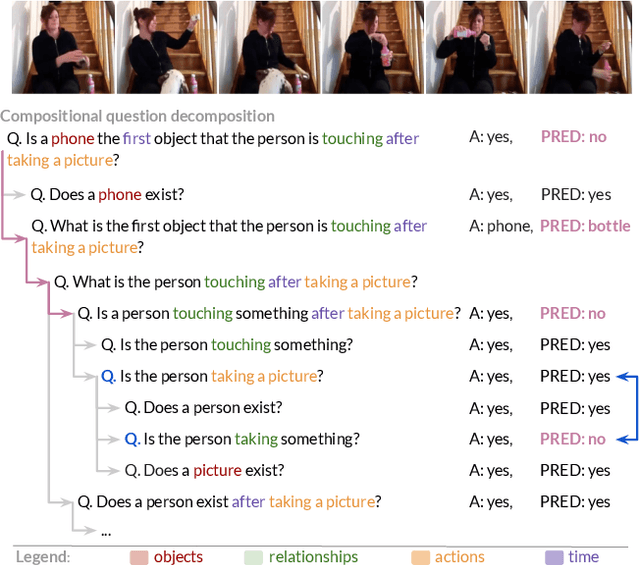
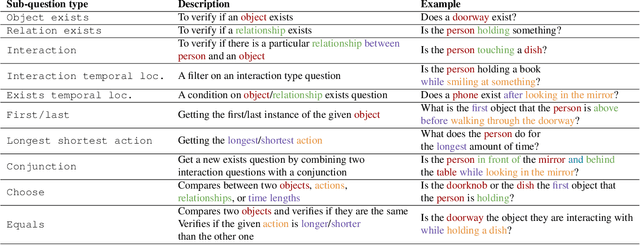
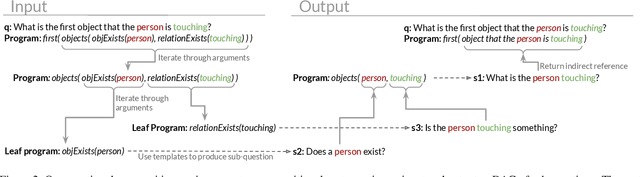
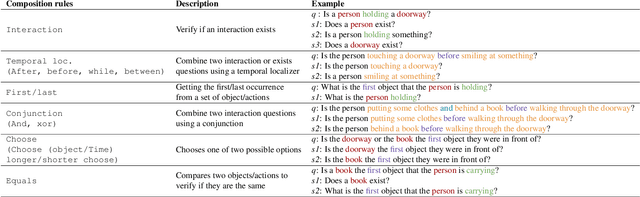
Recent video question answering benchmarks indicate that state-of-the-art models struggle to answer compositional questions. However, it remains unclear which types of compositional reasoning cause models to mispredict. Furthermore, it is difficult to discern whether models arrive at answers using compositional reasoning or by leveraging data biases. In this paper, we develop a question decomposition engine that programmatically deconstructs a compositional question into a directed acyclic graph of sub-questions. The graph is designed such that each parent question is a composition of its children. We present AGQA-Decomp, a benchmark containing $2.3M$ question graphs, with an average of $11.49$ sub-questions per graph, and $4.55M$ total new sub-questions. Using question graphs, we evaluate three state-of-the-art models with a suite of novel compositional consistency metrics. We find that models either cannot reason correctly through most compositions or are reliant on incorrect reasoning to reach answers, frequently contradicting themselves or achieving high accuracies when failing at intermediate reasoning steps.
* To appear in CVPR 2022. 23 pages, 12 figures and 12 tables