 Add to Chrome
 Add to Firefox
 Add to Edge
Efficient Semantic Segmentation via Lightweight Multiple-Information Interaction Network
Oct 03, 2024
Recently, the integration of the local modeling capabilities of Convolutional Neural Networks (CNNs) with the global dependency strengths of Transformers has created a sensation in the semantic segmentation community. However, substantial computational workloads and high hardware memory demands remain major obstacles to their further application in real-time scenarios. In this work, we propose a lightweight multiple-information interaction network for real-time semantic segmentation, called LMIINet, which effectively combines CNNs and Transformers while reducing redundant computations and memory footprint. It features Lightweight Feature Interaction Bottleneck (LFIB) modules comprising efficient convolutions that enhance context integration. Additionally, improvements are made to the Flatten Transformer by enhancing local and global feature interaction to capture detailed semantic information. The incorporation of a combination coefficient learning scheme in both LFIB and Transformer blocks facilitates improved feature interaction. Extensive experiments demonstrate that LMIINet excels in balancing accuracy and efficiency. With only 0.72M parameters and 11.74G FLOPs, LMIINet achieves 72.0% mIoU at 100 FPS on the Cityscapes test set and 69.94% mIoU at 160 FPS on the CamVid test dataset using a single RTX2080Ti GPU.

LithoHoD: A Litho Simulator-Powered Framework for IC Layout Hotspot Detection
Sep 16, 2024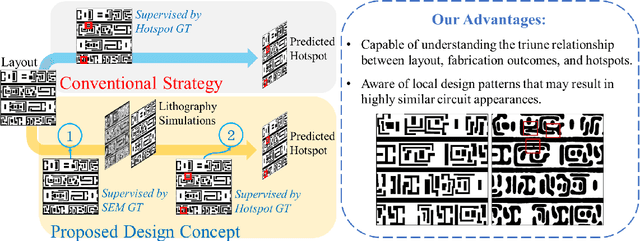
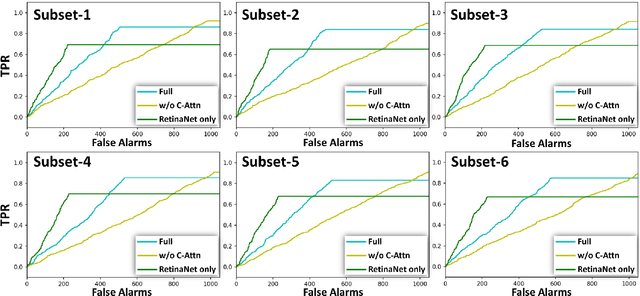
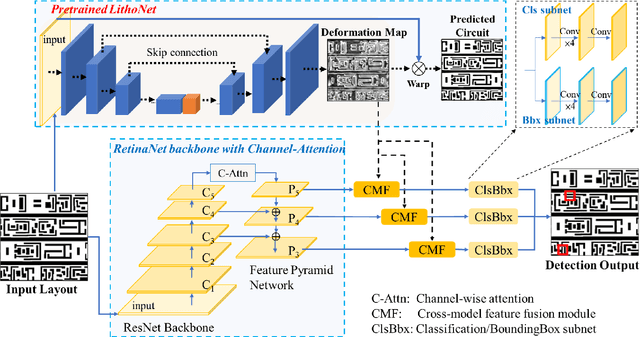
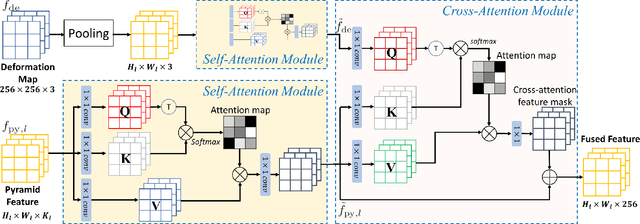
Recent advances in VLSI fabrication technology have led to die shrinkage and increased layout density, creating an urgent demand for advanced hotspot detection techniques. However, by taking an object detection network as the backbone, recent learning-based hotspot detectors learn to recognize only the problematic layout patterns in the training data. This fact makes these hotspot detectors difficult to generalize to real-world scenarios. We propose a novel lithography simulator-powered hotspot detection framework to overcome this difficulty. Our framework integrates a lithography simulator with an object detection backbone, merging the extracted latent features from both the simulator and the object detector via well-designed cross-attention blocks. Consequently, the proposed framework can be used to detect potential hotspot regions based on I) the variation of possible circuit shape deformation estimated by the lithography simulator, and ii) the problematic layout patterns already known. To this end, we utilize RetinaNet with a feature pyramid network as the object detection backbone and leverage LithoNet as the lithography simulator. Extensive experiments demonstrate that our proposed simulator-guided hotspot detection framework outperforms previous state-of-the-art methods on real-world data.
Make Graph-based Referring Expression Comprehension Great Again through Expression-guided Dynamic Gating and Regression
Sep 05, 2024


One common belief is that with complex models and pre-training on large-scale datasets, transformer-based methods for referring expression comprehension (REC) perform much better than existing graph-based methods. We observe that since most graph-based methods adopt an off-the-shelf detector to locate candidate objects (i.e., regions detected by the object detector), they face two challenges that result in subpar performance: (1) the presence of significant noise caused by numerous irrelevant objects during reasoning, and (2) inaccurate localization outcomes attributed to the provided detector. To address these issues, we introduce a plug-and-adapt module guided by sub-expressions, called dynamic gate constraint (DGC), which can adaptively disable irrelevant proposals and their connections in graphs during reasoning. We further introduce an expression-guided regression strategy (EGR) to refine location prediction. Extensive experimental results on the RefCOCO, RefCOCO+, RefCOCOg, Flickr30K, RefClef, and Ref-reasoning datasets demonstrate the effectiveness of the DGC module and the EGR strategy in consistently boosting the performances of various graph-based REC methods. Without any pretaining, the proposed graph-based method achieves better performance than the state-of-the-art (SOTA) transformer-based methods.
Towards Robust Online Domain Adaptive Semantic Segmentation under Adverse Weather Conditions
Sep 02, 2024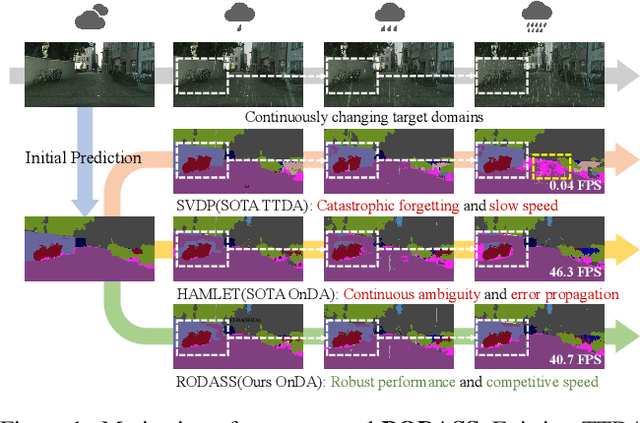
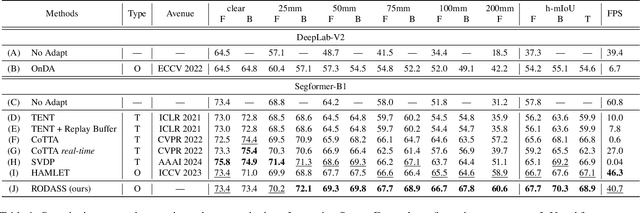
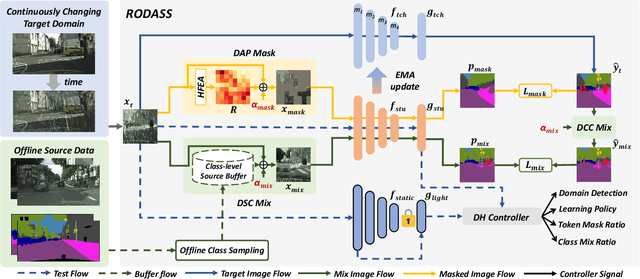

Online Domain Adaptation (OnDA) is designed to handle unforeseeable domain changes at minimal cost that occur during the deployment of the model, lacking clear boundaries between the domain, such as sudden weather events. However, existing OnDA methods that rely solely on the model itself to adapt to the current domain often misidentify ambiguous classes amidst continuous domain shifts and pass on this erroneous knowledge to the next domain. To tackle this, we propose \textbf{RODASS}, a \textbf{R}obust \textbf{O}nline \textbf{D}omain \textbf{A}daptive \textbf{S}emantic \textbf{S}egmentation framework, which dynamically detects domain shifts and adjusts hyper-parameters to minimize training costs and error propagation. Specifically, we introduce the \textbf{D}ynamic \textbf{A}mbiguous \textbf{P}atch \textbf{Mask} (\textbf{DAP Mask}) strategy, which dynamically selects highly disturbed regions and masks these regions, mitigating error accumulation in ambiguous classes and enhancing the model's robustness against external noise in dynamic natural environments. Additionally, we present the \textbf{D}ynamic \textbf{S}ource \textbf{C}lass \textbf{Mix} (\textbf{DSC Mix}), a domain-aware mix method that augments target domain scenes with class-level source buffers, reducing the high uncertainty and noisy labels, thereby accelerating adaptation and offering a more efficient solution for online domain adaptation. Our approach outperforms state-of-the-art methods on widely used OnDA benchmarks while maintaining approximately 40 frames per second (FPS).
Attention-Guided Multi-scale Interaction Network for Face Super-Resolution
Sep 01, 2024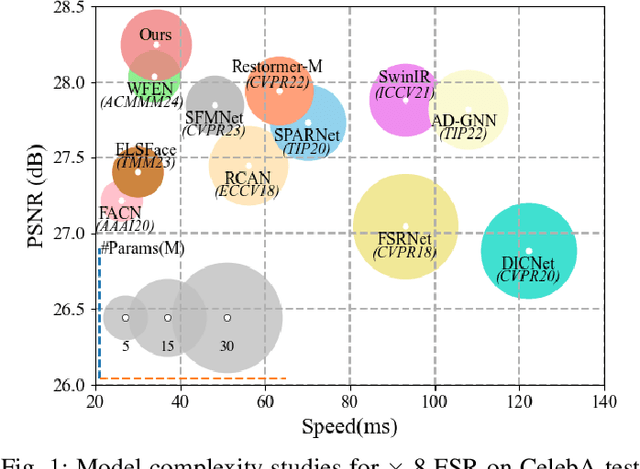
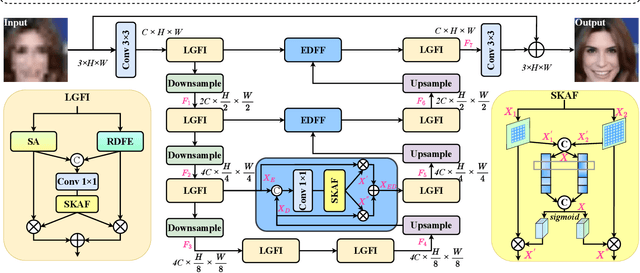
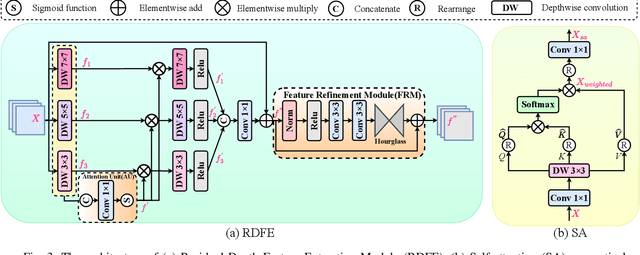
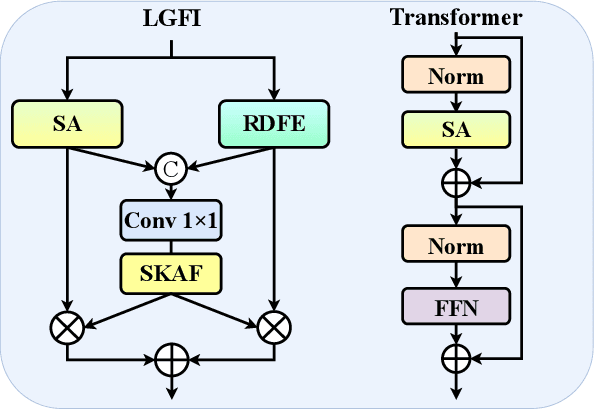
Recently, CNN and Transformer hybrid networks demonstrated excellent performance in face super-resolution (FSR) tasks. Since numerous features at different scales in hybrid networks, how to fuse these multi-scale features and promote their complementarity is crucial for enhancing FSR. However, existing hybrid network-based FSR methods ignore this, only simply combining the Transformer and CNN. To address this issue, we propose an attention-guided Multi-scale interaction network (AMINet), which contains local and global feature interactions as well as encoder-decoder phases feature interactions. Specifically, we propose a Local and Global Feature Interaction Module (LGFI) to promote fusions of global features and different receptive fields' local features extracted by our Residual Depth Feature Extraction Module (RDFE). Additionally, we propose a Selective Kernel Attention Fusion Module (SKAF) to adaptively select fusions of different features within LGFI and encoder-decoder phases. Our above design allows the free flow of multi-scale features from within modules and between encoder and decoder, which can promote the complementarity of different scale features to enhance FSR. Comprehensive experiments confirm that our method consistently performs well with less computational consumption and faster inference.
Graph Unfolding and Sampling for Transitory Video Summarization via Gershgorin Disc Alignment
Aug 03, 2024User-generated videos (UGVs) uploaded from mobile phones to social media sites like YouTube and TikTok are short and non-repetitive. We summarize a transitory UGV into several keyframes in linear time via fast graph sampling based on Gershgorin disc alignment (GDA). Specifically, we first model a sequence of $N$ frames in a UGV as an $M$-hop path graph $\mathcal{G}^o$ for $M \ll N$, where the similarity between two frames within $M$ time instants is encoded as a positive edge based on feature similarity. Towards efficient sampling, we then "unfold" $\mathcal{G}^o$ to a $1$-hop path graph $\mathcal{G}$, specified by a generalized graph Laplacian matrix $\mathcal{L}$, via one of two graph unfolding procedures with provable performance bounds. We show that maximizing the smallest eigenvalue $\lambda_{\min}(\mathbf{B})$ of a coefficient matrix $\mathbf{B} = \textit{diag}\left(\mathbf{h}\right) + \mu \mathcal{L}$, where $\mathbf{h}$ is the binary keyframe selection vector, is equivalent to minimizing a worst-case signal reconstruction error. We maximize instead the Gershgorin circle theorem (GCT) lower bound $\lambda^-_{\min}(\mathbf{B})$ by choosing $\mathbf{h}$ via a new fast graph sampling algorithm that iteratively aligns left-ends of Gershgorin discs for all graph nodes (frames). Extensive experiments on multiple short video datasets show that our algorithm achieves comparable or better video summarization performance compared to state-of-the-art methods, at a substantially reduced complexity.
Domain-adaptive Video Deblurring via Test-time Blurring
Jul 12, 2024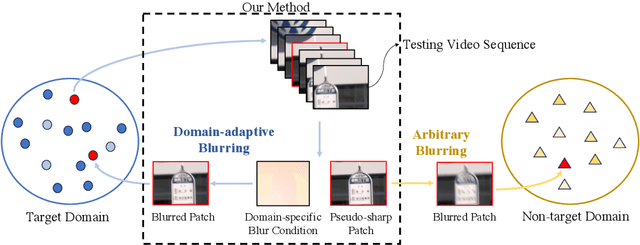

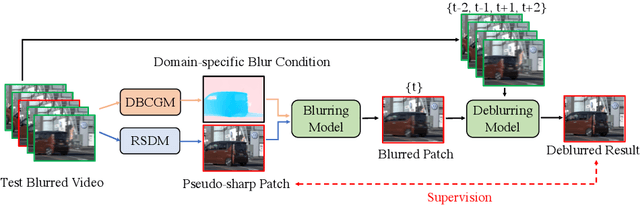
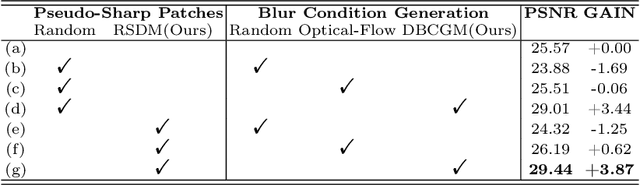
Dynamic scene video deblurring aims to remove undesirable blurry artifacts captured during the exposure process. Although previous video deblurring methods have achieved impressive results, they suffer from significant performance drops due to the domain gap between training and testing videos, especially for those captured in real-world scenarios. To address this issue, we propose a domain adaptation scheme based on a blurring model to achieve test-time fine-tuning for deblurring models in unseen domains. Since blurred and sharp pairs are unavailable for fine-tuning during inference, our scheme can generate domain-adaptive training pairs to calibrate a deblurring model for the target domain. First, a Relative Sharpness Detection Module is proposed to identify relatively sharp regions from the blurry input images and regard them as pseudo-sharp images. Next, we utilize a blurring model to produce blurred images based on the pseudo-sharp images extracted during testing. To synthesize blurred images in compliance with the target data distribution, we propose a Domain-adaptive Blur Condition Generation Module to create domain-specific blur conditions for the blurring model. Finally, the generated pseudo-sharp and blurred pairs are used to fine-tune a deblurring model for better performance. Extensive experimental results demonstrate that our approach can significantly improve state-of-the-art video deblurring methods, providing performance gains of up to 7.54dB on various real-world video deblurring datasets. The source code is available at https://github.com/Jin-Ting-He/DADeblur.
Heterogeneous window transformer for image denoising
Jul 08, 2024Deep networks can usually depend on extracting more structural information to improve denoising results. However, they may ignore correlation between pixels from an image to pursue better denoising performance. Window transformer can use long- and short-distance modeling to interact pixels to address mentioned problem. To make a tradeoff between distance modeling and denoising time, we propose a heterogeneous window transformer (HWformer) for image denoising. HWformer first designs heterogeneous global windows to capture global context information for improving denoising effects. To build a bridge between long and short-distance modeling, global windows are horizontally and vertically shifted to facilitate diversified information without increasing denoising time. To prevent the information loss phenomenon of independent patches, sparse idea is guided a feed-forward network to extract local information of neighboring patches. The proposed HWformer only takes 30% of popular Restormer in terms of denoising time.
AnySR: Realizing Image Super-Resolution as Any-Scale, Any-Resource
Jul 05, 2024
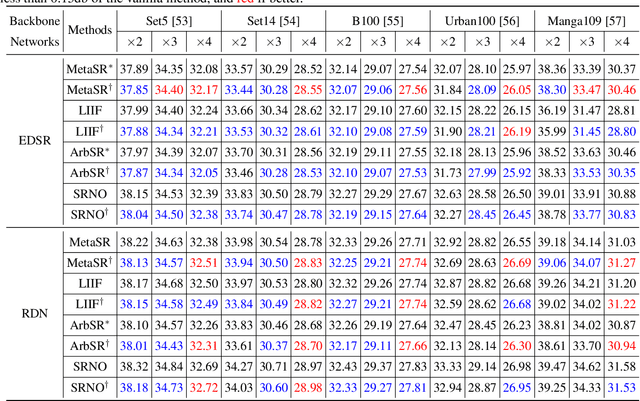
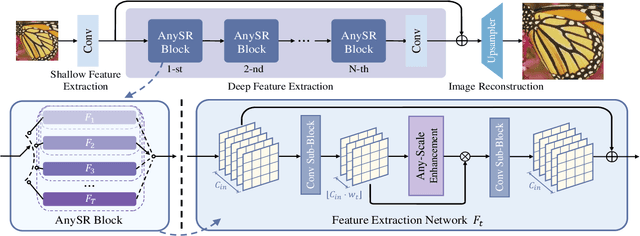
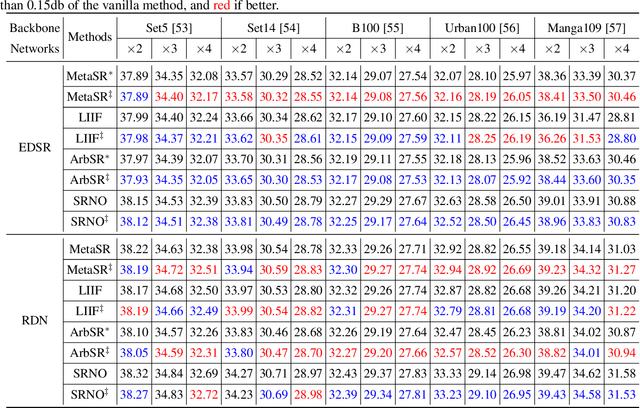
In an effort to improve the efficiency and scalability of single-image super-resolution (SISR) applications, we introduce AnySR, to rebuild existing arbitrary-scale SR methods into any-scale, any-resource implementation. As a contrast to off-the-shelf methods that solve SR tasks across various scales with the same computing costs, our AnySR innovates in: 1) building arbitrary-scale tasks as any-resource implementation, reducing resource requirements for smaller scales without additional parameters; 2) enhancing any-scale performance in a feature-interweaving fashion, inserting scale pairs into features at regular intervals and ensuring correct feature/scale processing. The efficacy of our AnySR is fully demonstrated by rebuilding most existing arbitrary-scale SISR methods and validating on five popular SISR test datasets. The results show that our AnySR implements SISR tasks in a computing-more-efficient fashion, and performs on par with existing arbitrary-scale SISR methods. For the first time, we realize SISR tasks as not only any-scale in literature, but also as any-resource. Code is available at https://github.com/CrispyFeSo4/AnySR.
Frequency-Assisted Mamba for Remote Sensing Image Super-Resolution
May 08, 2024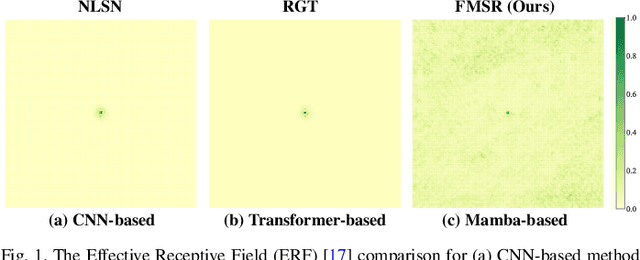
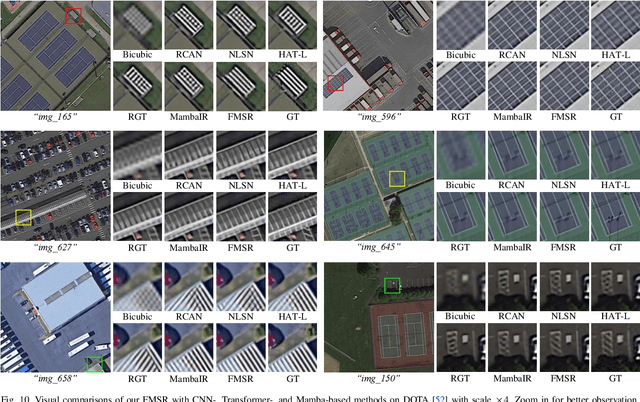
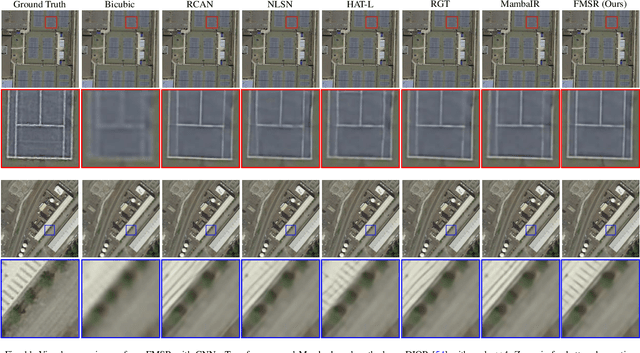
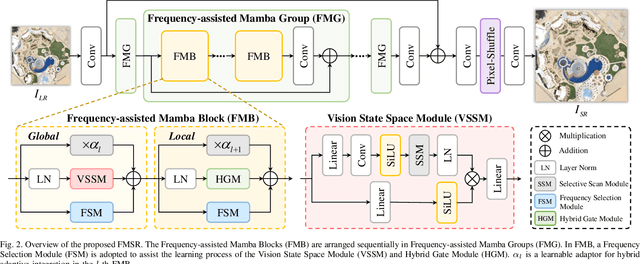
Recent progress in remote sensing image (RSI) super-resolution (SR) has exhibited remarkable performance using deep neural networks, e.g., Convolutional Neural Networks and Transformers. However, existing SR methods often suffer from either a limited receptive field or quadratic computational overhead, resulting in sub-optimal global representation and unacceptable computational costs in large-scale RSI. To alleviate these issues, we develop the first attempt to integrate the Vision State Space Model (Mamba) for RSI-SR, which specializes in processing large-scale RSI by capturing long-range dependency with linear complexity. To achieve better SR reconstruction, building upon Mamba, we devise a Frequency-assisted Mamba framework, dubbed FMSR, to explore the spatial and frequent correlations. In particular, our FMSR features a multi-level fusion architecture equipped with the Frequency Selection Module (FSM), Vision State Space Module (VSSM), and Hybrid Gate Module (HGM) to grasp their merits for effective spatial-frequency fusion. Recognizing that global and local dependencies are complementary and both beneficial for SR, we further recalibrate these multi-level features for accurate feature fusion via learnable scaling adaptors. Extensive experiments on AID, DOTA, and DIOR benchmarks demonstrate that our FMSR outperforms state-of-the-art Transformer-based methods HAT-L in terms of PSNR by 0.11 dB on average, while consuming only 28.05% and 19.08% of its memory consumption and complexity, respectively.