 Add to Chrome
 Add to Firefox
 Add to Edge
Know When to Stop: Segment-Level Credit Assignment for Reducing Overthinking
Jul 01, 2026
Reasoning language models frequently overthink: generating extended chains of behaviors such as hedging, approach abandonment, and self contradiction that consume tokens without improving answers. We show that these behaviors are not merely a consequence of length; even when controlling for response length, incorrect traces exhibit higher rates of unproductive self-reflection than correct ones. Addressing this requires identifying where self-reflection helps vs hurts, but obtaining these step-level annotations is costly. We observe that intermediate answer commitments within reasoning traces can provide a cheap proxy: by comparing each final answer candidate in the trace to the ground truth, we can determine whether subsequent reflection is productive without any additional supervision. Building on this insight, we propose DASH (Drift Aware advantage SHaping), which assigns segment-level credit based on whether each reasoning segment leads toward or away from correctness. On competition-level math benchmarks, DASH achieves the highest accuracy where overthinking is prevalent (AIME25: 50.8% vs. 45.4% GRPO) while reducing overthinking behaviors and achieving more productive self-correction than baselines.

What Do Safety-Aligned LLMs Learn From Mixed Compliance Demonstrations?
Jun 18, 2026Prior work has shown that in-context demonstrations can jailbreak language models, but it remains unclear how models interpret different types of compliance demonstrations. We study this by mixing benign compliance demonstrations (non-harmful request, helpful response) with harmful compliance demonstrations (harmful request, helpful response) and testing three hypotheses about how demonstration composition drives harmful compliance. Across four models, we find that benign and harmful demonstrations are not interchangeable: benign demonstrations can either reduce or increase harmful compliance depending on the model. We further show that preference optimization is the critical training stage that prevents benign demonstrations from increasing harmful compliance, that demonstration ordering exhibits strong recency bias, and that models differ in how refusal interacts with in-context learning: some adopt demonstrated formatting even when refusing, while others override all in-context signals upon refusal. Taken together, this work moves beyond showing that demonstration-based jailbreaking works to characterizing how it works: what models extract from compliance demonstrations depends on demonstration content, ordering, and training methodology.
Decomposing the Delta: What Do Models Actually Learn from Preference Pairs?
Apr 09, 2026Preference optimization methods such as DPO and KTO are widely used for aligning language models, yet little is understood about what properties of preference data drive downstream reasoning gains. We ask: what aspects of a preference pair improve a reasoning model's performance on general reasoning tasks? We investigate two distinct notions of quality delta in preference data: generator-level delta, arising from the differences in capability between models that generate chosen and rejected reasoning traces, and sample-level delta, arising from differences in judged quality differences within an individual preference pair. To study generator-level delta, we vary the generator's scale and model family, and to study sample-level delta, we employ an LLM-as-a-judge to rate the quality of generated traces along multiple reasoning-quality dimensions. We find that increasing generator-level delta steadily improves performance on out-of-domain reasoning tasks and filtering data by sample-level delta can enable more data-efficient training. Our results suggest a twofold recipe for improving reasoning performance through preference optimization: maximize generator-level delta when constructing preference pairs and exploit sample-level delta to select the most informative training examples.
Can Memory-Augmented Language Models Generalize on Reasoning-in-a-Haystack Tasks?
Mar 10, 2025Large language models often expose their brittleness in reasoning tasks, especially while executing long chains of reasoning over context. We propose MemReasoner, a new and simple memory-augmented LLM architecture, in which the memory learns the relative order of facts in context, and enables hopping over them, while the decoder selectively attends to the memory. MemReasoner is trained end-to-end, with optional supporting fact supervision of varying degrees. We train MemReasoner, along with existing memory-augmented transformer models and a state-space model, on two distinct synthetic multi-hop reasoning tasks. Experiments performed under a variety of challenging scenarios, including the presence of long distractor text or target answer changes in test set, show strong generalization of MemReasoner on both single- and two-hop tasks. This generalization of MemReasoner is achieved using none-to-weak supporting fact supervision (using none and 1\% of supporting facts for one- and two-hop tasks, respectively). In contrast, baseline models overall struggle to generalize and benefit far less from using full supporting fact supervision. The results highlight the importance of explicit memory mechanisms, combined with additional weak supervision, for improving large language model's context processing ability toward reasoning tasks.
Adapting to Evolving Adversaries with Regularized Continual Robust Training
Feb 06, 2025


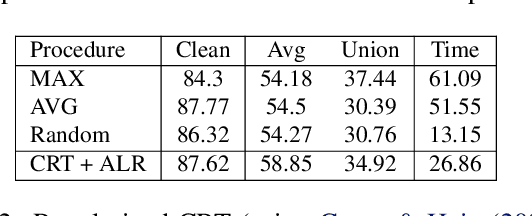
Robust training methods typically defend against specific attack types, such as Lp attacks with fixed budgets, and rarely account for the fact that defenders may encounter new attacks over time. A natural solution is to adapt the defended model to new adversaries as they arise via fine-tuning, a method which we call continual robust training (CRT). However, when implemented naively, fine-tuning on new attacks degrades robustness on previous attacks. This raises the question: how can we improve the initial training and fine-tuning of the model to simultaneously achieve robustness against previous and new attacks? We present theoretical results which show that the gap in a model's robustness against different attacks is bounded by how far each attack perturbs a sample in the model's logit space, suggesting that regularizing with respect to this logit space distance can help maintain robustness against previous attacks. Extensive experiments on 3 datasets (CIFAR-10, CIFAR-100, and ImageNette) and over 100 attack combinations demonstrate that the proposed regularization improves robust accuracy with little overhead in training time. Our findings and open-source code lay the groundwork for the deployment of models robust to evolving attacks.
Position Paper: Beyond Robustness Against Single Attack Types
May 02, 2024Current research on defending against adversarial examples focuses primarily on achieving robustness against a single attack type such as $\ell_2$ or $\ell_{\infty}$-bounded attacks. However, the space of possible perturbations is much larger and currently cannot be modeled by a single attack type. The discrepancy between the focus of current defenses and the space of attacks of interest calls to question the practicality of existing defenses and the reliability of their evaluation. In this position paper, we argue that the research community should look beyond single attack robustness, and we draw attention to three potential directions involving robustness against multiple attacks: simultaneous multiattack robustness, unforeseen attack robustness, and a newly defined problem setting which we call continual adaptive robustness. We provide a unified framework which rigorously defines these problem settings, synthesize existing research in these fields, and outline open directions. We hope that our position paper inspires more research in simultaneous multiattack, unforeseen attack, and continual adaptive robustness.
Larimar: Large Language Models with Episodic Memory Control
Mar 18, 2024Efficient and accurate updating of knowledge stored in Large Language Models (LLMs) is one of the most pressing research challenges today. This paper presents Larimar - a novel, brain-inspired architecture for enhancing LLMs with a distributed episodic memory. Larimar's memory allows for dynamic, one-shot updates of knowledge without the need for computationally expensive re-training or fine-tuning. Experimental results on multiple fact editing benchmarks demonstrate that Larimar attains accuracy comparable to most competitive baselines, even in the challenging sequential editing setup, but also excels in speed - yielding speed-ups of 4-10x depending on the base LLM - as well as flexibility due to the proposed architecture being simple, LLM-agnostic, and hence general. We further provide mechanisms for selective fact forgetting and input context length generalization with Larimar and show their effectiveness.
PatchCURE: Improving Certifiable Robustness, Model Utility, and Computation Efficiency of Adversarial Patch Defenses
Oct 19, 2023


State-of-the-art defenses against adversarial patch attacks can now achieve strong certifiable robustness with a marginal drop in model utility. However, this impressive performance typically comes at the cost of 10-100x more inference-time computation compared to undefended models -- the research community has witnessed an intense three-way trade-off between certifiable robustness, model utility, and computation efficiency. In this paper, we propose a defense framework named PatchCURE to approach this trade-off problem. PatchCURE provides sufficient "knobs" for tuning defense performance and allows us to build a family of defenses: the most robust PatchCURE instance can match the performance of any existing state-of-the-art defense (without efficiency considerations); the most efficient PatchCURE instance has similar inference efficiency as undefended models. Notably, PatchCURE achieves state-of-the-art robustness and utility performance across all different efficiency levels, e.g., 16-23% absolute clean accuracy and certified robust accuracy advantages over prior defenses when requiring computation efficiency to be close to undefended models. The family of PatchCURE defenses enables us to flexibly choose appropriate defenses to satisfy given computation and/or utility constraints in practice.
Characterizing the Optimal 0-1 Loss for Multi-class Classification with a Test-time Attacker
Feb 21, 2023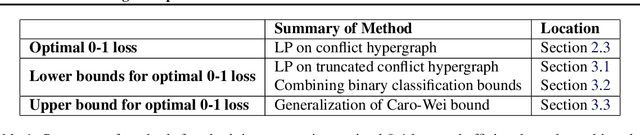
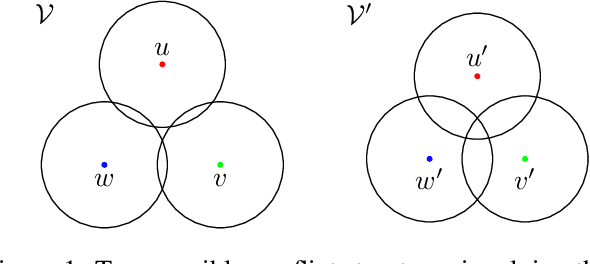
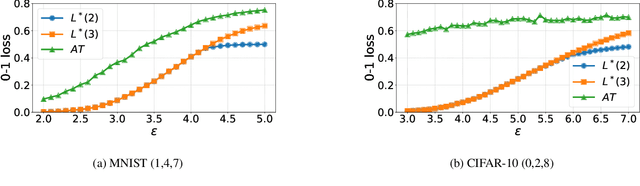
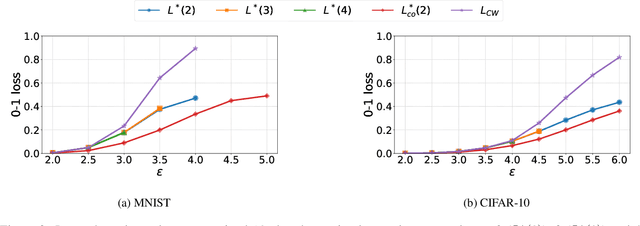
Finding classifiers robust to adversarial examples is critical for their safe deployment. Determining the robustness of the best possible classifier under a given threat model for a given data distribution and comparing it to that achieved by state-of-the-art training methods is thus an important diagnostic tool. In this paper, we find achievable information-theoretic lower bounds on loss in the presence of a test-time attacker for multi-class classifiers on any discrete dataset. We provide a general framework for finding the optimal 0-1 loss that revolves around the construction of a conflict hypergraph from the data and adversarial constraints. We further define other variants of the attacker-classifier game that determine the range of the optimal loss more efficiently than the full-fledged hypergraph construction. Our evaluation shows, for the first time, an analysis of the gap to optimal robustness for classifiers in the multi-class setting on benchmark datasets.
MultiRobustBench: Benchmarking Robustness Against Multiple Attacks
Feb 21, 2023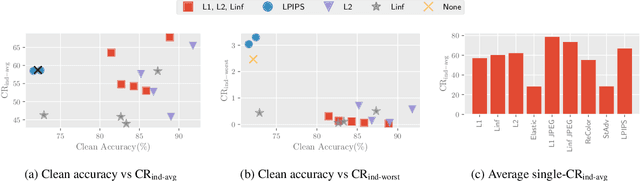
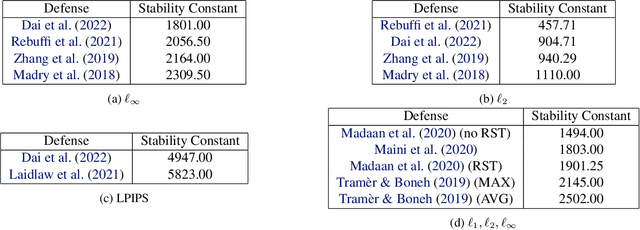
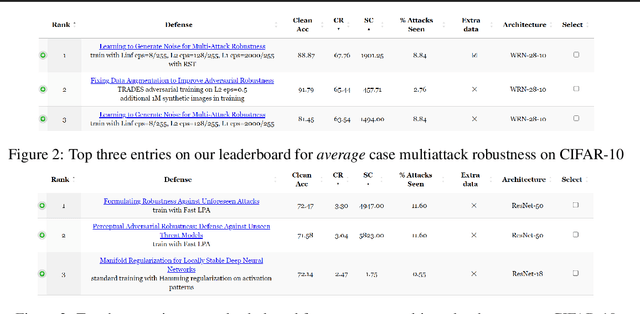
The bulk of existing research in defending against adversarial examples focuses on defending against a single (typically bounded Lp-norm) attack, but for a practical setting, machine learning (ML) models should be robust to a wide variety of attacks. In this paper, we present the first unified framework for considering multiple attacks against ML models. Our framework is able to model different levels of learner's knowledge about the test-time adversary, allowing us to model robustness against unforeseen attacks and robustness against unions of attacks. Using our framework, we present the first leaderboard, MultiRobustBench, for benchmarking multiattack evaluation which captures performance across attack types and attack strengths. We evaluate the performance of 16 defended models for robustness against a set of 9 different attack types, including Lp-based threat models, spatial transformations, and color changes, at 20 different attack strengths (180 attacks total). Additionally, we analyze the state of current defenses against multiple attacks. Our analysis shows that while existing defenses have made progress in terms of average robustness across the set of attacks used, robustness against the worst-case attack is still a big open problem as all existing models perform worse than random guessing.