 Add to Chrome
 Add to Firefox
 Add to Edge
MatchingPolicy: Correspondence-Aware Policy Enables Cross-Object In-Context Learning
Aug 17, 2026
In-context imitation learning enables few-shot policy generalization but struggles to maintain performance on unseen objects and novel scenarios. To address this, we introduce MatchingPolicy, a correspondence-driven framework that explicitly decouples demonstration-to-scene matching from policy learning. Central to our method is a correspondence-aware diffusion policy that conditions robotic actions directly on dense semantic correspondences. This architectural separation resolves the inherent conflict between correspondence identification and action adaptation, enabling robust out-of-distribution transfer. Our framework integrates vision foundation models with a novel two-stage matching algorithm to dynamically establish reliable correspondences. Extensive evaluations on RLBench and real-world manipulation tasks confirm that MatchingPolicy achieves superior few-shot performance, generalizing reliably across unseen object instances and semantic categories.

GeniWorld: A Generalizable Interactive World Model for Robotic Manipulation via Visual Actions
Aug 06, 2026Generalist robot policies exhibit strong capabilities, but their robustness in complex and unseen environments remains limited. Scaling robot learning and evaluation in diverse real-world environments remains costly and challenging. Action-conditioned world models offer a promising alternative, but they often suffer from limited action controllability and poor generalization to out-of-distribution (OOD) scenarios. To this end, we present GeniWorld, an interactive world model for robots that generalizes robustly across unseen scenarios. Building on pretrained video generative models, we use URDF-based rendering to transform numerical actions into visual action representations, enabling spatially grounded action control. By explicitly decoupling embodiment kinematics from environmental dynamics, our model mitigates scene overfitting and facilitates modeling of robot-environment interactions. To achieve closed-loop control, we construct an autoregressive video prediction model integrated with high-frequency robot kinematic control, enabling interaction with both robot policies and human teleoperators. In our experiments, even when trained solely on limited fixed-scene data, our model achieves superior in-domain performance and robust zero-shot generalization to highly randomized, unseen environments. For downstream applications, GeniWorld serves as a scalable policy evaluator that remains reliable under environmental perturbations. Furthermore, even with limited real-world demonstrations, GeniWorld generates diverse manipulation trajectories within the world model, improving downstream policy performance and robustness in complex environments.
MaskWAM: Unifying Mask Prompting and Prediction for World-Action Models
Jun 11, 2026World Action Models (WAMs) present a promising paradigm for robotic control via video prediction. However, current WAMs suffer from fundamental spatial bottlenecks: standard text inputs introduce referential ambiguity in cluttered scenes, while unstructured RGB predictions lack semantic grounding and remain biased by task-irrelevant backgrounds. To overcome these limitations, we introduce MaskWAM, an object-centric world-action model. By jointly integrating masks as both explicit inputs and predictions via a unified Mixture of Transformers (MoT), MaskWAM unlocks robust policy generalization. This design provides two key benefits: (1) predicting future masks yields object-centric semantic supervision that suppresses visual noise, significantly enhancing even standard text-conditioned WAMs; and (2) coupling this predictive supervision with first-frame visual prompts, such as target object masks, establishes a precise spatial anchor that substantially reduces language ambiguity. Crucially, as WAMs are inherently vision-driven architectures, direct mask conditioning yields substantially stronger guidance than text alone, establishing a precise and robust paradigm for manipulating unseen objects. Evaluations on LIBERO, RoboTwin, and real-world tasks demonstrate that MaskWAM significantly outperforms baselines in both language-clear and language-ambiguous tasks.
Universal Pose Pretraining for Generalizable Vision-Language-Action Policies
Feb 23, 2026Existing Vision-Language-Action (VLA) models often suffer from feature collapse and low training efficiency because they entangle high-level perception with sparse, embodiment-specific action supervision. Since these models typically rely on VLM backbones optimized for Visual Question Answering (VQA), they excel at semantic identification but often overlook subtle 3D state variations that dictate distinct action patterns. To resolve these misalignments, we propose Pose-VLA, a decoupled paradigm that separates VLA training into a pre-training phase for extracting universal 3D spatial priors in a unified camera-centric space, and a post-training phase for efficient embodiment alignment within robot-specific action space. By introducing discrete pose tokens as a universal representation, Pose-VLA seamlessly integrates spatial grounding from diverse 3D datasets with geometry-level trajectories from robotic demonstrations. Our framework follows a two-stage pre-training pipeline, establishing fundamental spatial grounding via poses followed by motion alignment through trajectory supervision. Extensive evaluations demonstrate that Pose-VLA achieves state-of-the-art results on RoboTwin 2.0 with a 79.5% average success rate and competitive performance on LIBERO at 96.0%. Real-world experiments further showcase robust generalization across diverse objects using only 100 demonstrations per task, validating the efficiency of our pre-training paradigm.
LM-Gaussian: Boost Sparse-view 3D Gaussian Splatting with Large Model Priors
Sep 05, 2024

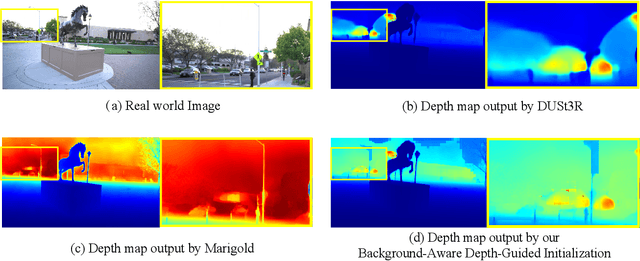

We aim to address sparse-view reconstruction of a 3D scene by leveraging priors from large-scale vision models. While recent advancements such as 3D Gaussian Splatting (3DGS) have demonstrated remarkable successes in 3D reconstruction, these methods typically necessitate hundreds of input images that densely capture the underlying scene, making them time-consuming and impractical for real-world applications. However, sparse-view reconstruction is inherently ill-posed and under-constrained, often resulting in inferior and incomplete outcomes. This is due to issues such as failed initialization, overfitting on input images, and a lack of details. To mitigate these challenges, we introduce LM-Gaussian, a method capable of generating high-quality reconstructions from a limited number of images. Specifically, we propose a robust initialization module that leverages stereo priors to aid in the recovery of camera poses and the reliable point clouds. Additionally, a diffusion-based refinement is iteratively applied to incorporate image diffusion priors into the Gaussian optimization process to preserve intricate scene details. Finally, we utilize video diffusion priors to further enhance the rendered images for realistic visual effects. Overall, our approach significantly reduces the data acquisition requirements compared to previous 3DGS methods. We validate the effectiveness of our framework through experiments on various public datasets, demonstrating its potential for high-quality 360-degree scene reconstruction. Visual results are on our website.