 Add to Chrome
 Add to Firefox
 Add to Edge
Joint Optimization of Data- and Model-Driven Probing Beams and Beam Predictor
Sep 27, 2024
Hierarchical search in millimeter-wave (mmWave) communications incurs significant beam training overhead and delay, especially in a dynamic environment. Deep learning-enabled beam prediction is promising to significantly mitigate the overhead and delay, efficiently utilizing the site-specific channel prior. In this work, we propose to jointly optimize a data- and model-driven probe beam module and a cascaded data-driven beam predictor, with limitations in that the probe and communicate beams are restricted within the manifold space of uniform planer array and quantization of the phase modulator. First, The probe beam module senses the mmWave channel with a complex-valued neural network and outputs the counterpart RSRPs of probe beams. Second, the beam predictor estimates the RSRPs in the entire beamspace to minimize the prediction cross entropy and selects the optimal beam with the maximum RSRP value for data transmission. Additionally, we propose to add noise to the phase variables in the probe beam module, against quantization error. Simulation results show the effectiveness of our proposed scheme.

Visual Data Diagnosis and Debiasing with Concept Graphs
Sep 26, 2024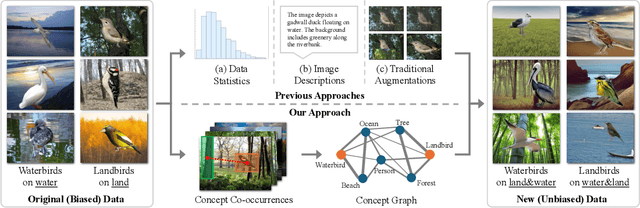
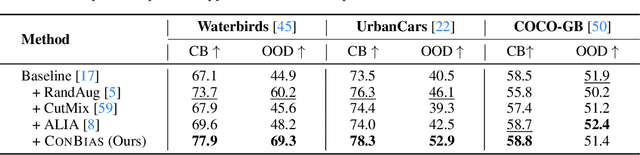
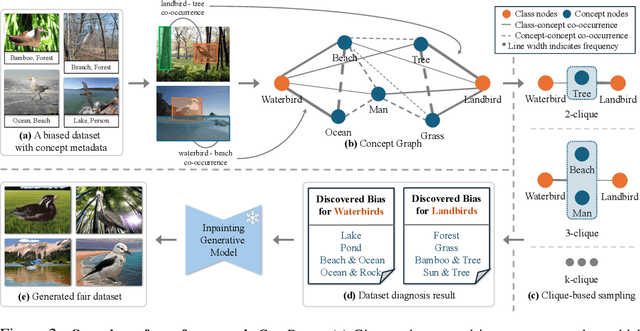
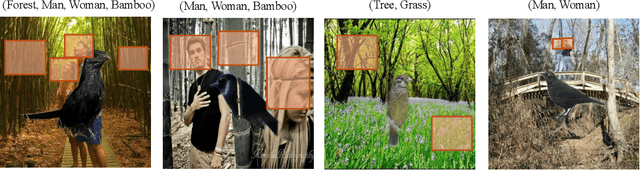
The widespread success of deep learning models today is owed to the curation of extensive datasets significant in size and complexity. However, such models frequently pick up inherent biases in the data during the training process, leading to unreliable predictions. Diagnosing and debiasing datasets is thus a necessity to ensure reliable model performance. In this paper, we present CONBIAS, a novel framework for diagnosing and mitigating Concept co-occurrence Biases in visual datasets. CONBIAS represents visual datasets as knowledge graphs of concepts, enabling meticulous analysis of spurious concept co-occurrences to uncover concept imbalances across the whole dataset. Moreover, we show that by employing a novel clique-based concept balancing strategy, we can mitigate these imbalances, leading to enhanced performance on downstream tasks. Extensive experiments show that data augmentation based on a balanced concept distribution augmented by CONBIAS improves generalization performance across multiple datasets compared to state-of-the-art methods. We will make our code and data publicly available.
Improving Tree Probability Estimation with Stochastic Optimization and Variance Reduction
Sep 09, 2024Probability estimation of tree topologies is one of the fundamental tasks in phylogenetic inference. The recently proposed subsplit Bayesian networks (SBNs) provide a powerful probabilistic graphical model for tree topology probability estimation by properly leveraging the hierarchical structure of phylogenetic trees. However, the expectation maximization (EM) method currently used for learning SBN parameters does not scale up to large data sets. In this paper, we introduce several computationally efficient methods for training SBNs and show that variance reduction could be the key for better performance. Furthermore, we also introduce the variance reduction technique to improve the optimization of SBN parameters for variational Bayesian phylogenetic inference (VBPI). Extensive synthetic and real data experiments demonstrate that our methods outperform previous baseline methods on the tasks of tree topology probability estimation as well as Bayesian phylogenetic inference using SBNs.
Make Your ViT-based Multi-view 3D Detectors Faster via Token Compression
Sep 01, 2024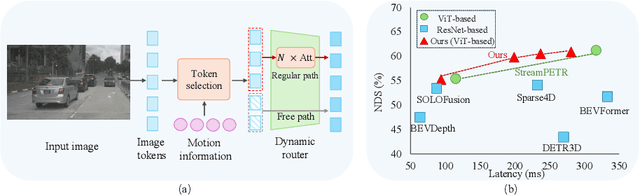
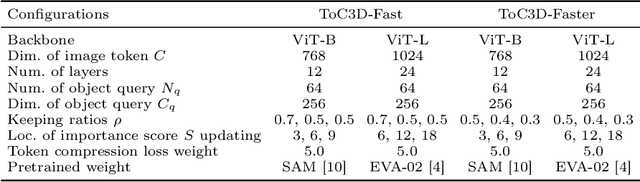
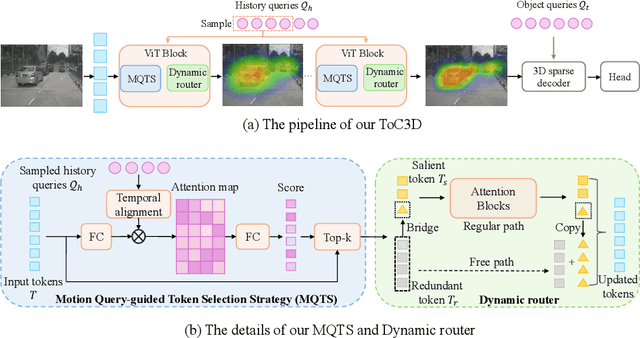
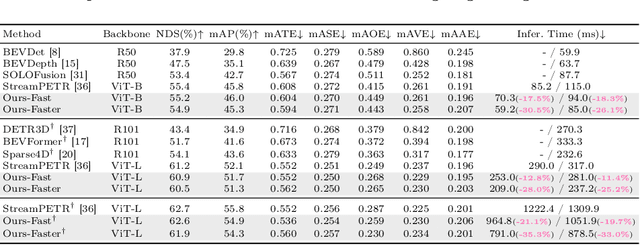
Slow inference speed is one of the most crucial concerns for deploying multi-view 3D detectors to tasks with high real-time requirements like autonomous driving. Although many sparse query-based methods have already attempted to improve the efficiency of 3D detectors, they neglect to consider the backbone, especially when using Vision Transformers (ViT) for better performance. To tackle this problem, we explore the efficient ViT backbones for multi-view 3D detection via token compression and propose a simple yet effective method called TokenCompression3D (ToC3D). By leveraging history object queries as foreground priors of high quality, modeling 3D motion information in them, and interacting them with image tokens through the attention mechanism, ToC3D can effectively determine the magnitude of information densities of image tokens and segment the salient foreground tokens. With the introduced dynamic router design, ToC3D can weigh more computing resources to important foreground tokens while compressing the information loss, leading to a more efficient ViT-based multi-view 3D detector. Extensive results on the large-scale nuScenes dataset show that our method can nearly maintain the performance of recent SOTA with up to 30% inference speedup, and the improvements are consistent after scaling up the ViT and input resolution. The code will be made at https://github.com/DYZhang09/ToC3D.
Variational Bayesian Phylogenetic Inference with Semi-implicit Branch Length Distributions
Aug 09, 2024Reconstructing the evolutionary history relating a collection of molecular sequences is the main subject of modern Bayesian phylogenetic inference. However, the commonly used Markov chain Monte Carlo methods can be inefficient due to the complicated space of phylogenetic trees, especially when the number of sequences is large. An alternative approach is variational Bayesian phylogenetic inference (VBPI) which transforms the inference problem into an optimization problem. While effective, the default diagonal lognormal approximation for the branch lengths of the tree used in VBPI is often insufficient to capture the complexity of the exact posterior. In this work, we propose a more flexible family of branch length variational posteriors based on semi-implicit hierarchical distributions using graph neural networks. We show that this semi-implicit construction emits straightforward permutation equivariant distributions, and therefore can handle the non-Euclidean branch length space across different tree topologies with ease. To deal with the intractable marginal probability of semi-implicit variational distributions, we develop several alternative lower bounds for stochastic optimization. We demonstrate the effectiveness of our proposed method over baseline methods on benchmark data examples, in terms of both marginal likelihood estimation and branch length posterior approximation.
Generalized Maximum Likelihood Estimation for Perspective-n-Point Problem
Aug 04, 2024The Perspective-n-Point (PnP) problem has been widely studied in the literature and applied in various vision-based pose estimation scenarios. However, existing methods ignore the anisotropy uncertainty of observations, as demonstrated in several real-world datasets in this paper. This oversight may lead to suboptimal and inaccurate estimation, particularly in the presence of noisy observations. To this end, we propose a generalized maximum likelihood PnP solver, named GMLPnP, that minimizes the determinant criterion by iterating the GLS procedure to estimate the pose and uncertainty simultaneously. Further, the proposed method is decoupled from the camera model. Results of synthetic and real experiments show that our method achieves better accuracy in common pose estimation scenarios, GMLPnP improves rotation/translation accuracy by 4.7%/2.0% on TUM-RGBD and 18.6%/18.4% on KITTI-360 dataset compared to the best baseline. It is more accurate under very noisy observations in a vision-based UAV localization task, outperforming the best baseline by 34.4% in translation estimation accuracy.
Generalizable Human Gaussians for Sparse View Synthesis
Jul 17, 2024Recent progress in neural rendering has brought forth pioneering methods, such as NeRF and Gaussian Splatting, which revolutionize view rendering across various domains like AR/VR, gaming, and content creation. While these methods excel at interpolating {\em within the training data}, the challenge of generalizing to new scenes and objects from very sparse views persists. Specifically, modeling 3D humans from sparse views presents formidable hurdles due to the inherent complexity of human geometry, resulting in inaccurate reconstructions of geometry and textures. To tackle this challenge, this paper leverages recent advancements in Gaussian Splatting and introduces a new method to learn generalizable human Gaussians that allows photorealistic and accurate view-rendering of a new human subject from a limited set of sparse views in a feed-forward manner. A pivotal innovation of our approach involves reformulating the learning of 3D Gaussian parameters into a regression process defined on the 2D UV space of a human template, which allows leveraging the strong geometry prior and the advantages of 2D convolutions. In addition, a multi-scaffold is proposed to effectively represent the offset details. Our method outperforms recent methods on both within-dataset generalization as well as cross-dataset generalization settings.
EVALALIGN: Supervised Fine-Tuning Multimodal LLMs with Human-Aligned Data for Evaluating Text-to-Image Models
Jun 27, 2024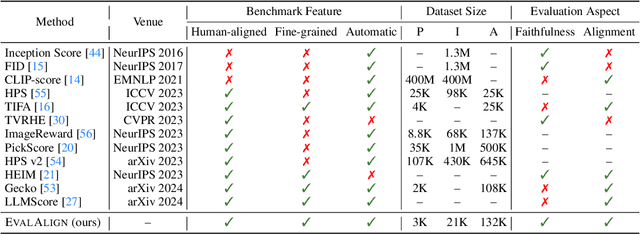
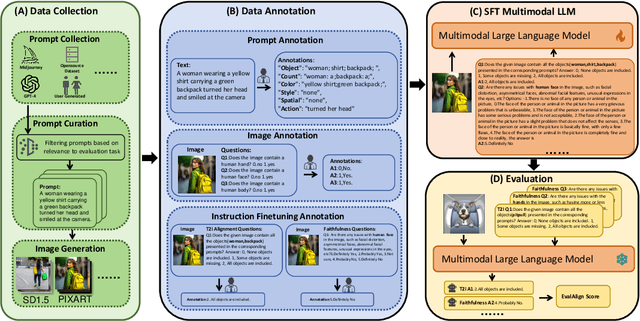
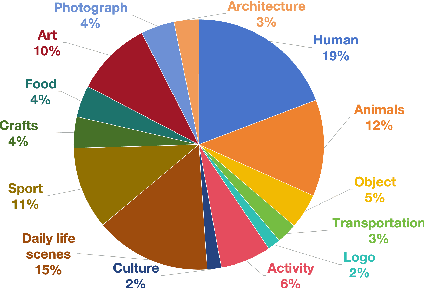
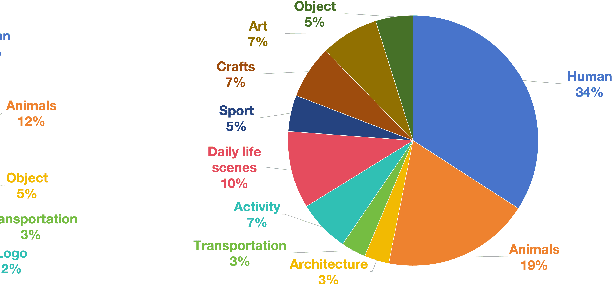
The recent advancements in text-to-image generative models have been remarkable. Yet, the field suffers from a lack of evaluation metrics that accurately reflect the performance of these models, particularly lacking fine-grained metrics that can guide the optimization of the models. In this paper, we propose EvalAlign, a metric characterized by its accuracy, stability, and fine granularity. Our approach leverages the capabilities of Multimodal Large Language Models (MLLMs) pre-trained on extensive datasets. We develop evaluation protocols that focus on two key dimensions: image faithfulness and text-image alignment. Each protocol comprises a set of detailed, fine-grained instructions linked to specific scoring options, enabling precise manual scoring of the generated images. We Supervised Fine-Tune (SFT) the MLLM to align closely with human evaluative judgments, resulting in a robust evaluation model. Our comprehensive tests across 24 text-to-image generation models demonstrate that EvalAlign not only provides superior metric stability but also aligns more closely with human preferences than existing metrics, confirming its effectiveness and utility in model assessment.
EvalAlign: Evaluating Text-to-Image Models through Precision Alignment of Multimodal Large Models with Supervised Fine-Tuning to Human Annotations
Jun 24, 2024The recent advancements in text-to-image generative models have been remarkable. Yet, the field suffers from a lack of evaluation metrics that accurately reflect the performance of these models, particularly lacking fine-grained metrics that can guide the optimization of the models. In this paper, we propose EvalAlign, a metric characterized by its accuracy, stability, and fine granularity. Our approach leverages the capabilities of Multimodal Large Language Models (MLLMs) pre-trained on extensive datasets. We develop evaluation protocols that focus on two key dimensions: image faithfulness and text-image alignment. Each protocol comprises a set of detailed, fine-grained instructions linked to specific scoring options, enabling precise manual scoring of the generated images. We Supervised Fine-Tune (SFT) the MLLM to align closely with human evaluative judgments, resulting in a robust evaluation model. Our comprehensive tests across 24 text-to-image generation models demonstrate that EvalAlign not only provides superior metric stability but also aligns more closely with human preferences than existing metrics, confirming its effectiveness and utility in model assessment.
Unlocking the Global Synergies in Low-Rank Adapters
Jun 21, 2024Low-rank Adaption (LoRA) has been the de-facto parameter-efficient fine-tuning technique for large language models. We present HeteroLoRA, a light-weight search algorithm that leverages zero-cost proxies to allocate the limited LoRA trainable parameters across the model for better fine-tuned performance. In addition to the allocation for the standard LoRA-adapted models, we also demonstrate the efficacy of HeteroLoRA by performing the allocation in a more challenging search space that includes LoRA modules and LoRA-adapted shortcut connections. Experiments show that HeteroLoRA enables improvements in model performance given the same parameter budge. For example, on MRPC, we see an improvement of 1.6% in accuracy with similar training parameter budget. We will open-source our algorithm once the paper is accepted.