 Add to Chrome
 Add to Firefox
 Add to Edge
OpenView: Empowering MLLMs with Out-of-view VQA
Dec 21, 2025
Recent multimodal large language models (MLLMs) show great potential in natural image understanding. Yet, they perform well, mainly on reasoning in-view contents within the image frame. This paper presents the first study on out-of-view (OOV) understanding, i.e., the ability to reason objects, activities, and scenes beyond the visible frame of a perspective view. Our technical contributions are threefold. First, we design OpenView, a four-stage pipeline to massively generate multi-choice VQA by leveraging panoramic imagery to enable context-rich and spatial-grounded VQA synthesis with free-view framing. Second, we curate OpenView-Dataset, a high-quality synthetic dataset from diverse real-world panoramas to empower MLLMs upon supervised fine-tuning. Third, we build OpenView-Bench, a benchmark that jointly measures choice and rationale accuracy for interpretable and diagnosable evaluation. Experimental results show that despite having a large gap from human performance in OOV VQA answer selection, upon empowered by OpenView, multiple MLLMs can consistently boost their performance, uplifted from 48.6% to 64.1% on average. Code, benchmark, and data will be available at https://github.com/q1xiangchen/OpenView.

ART: Articulated Reconstruction Transformer
Dec 16, 2025We introduce ART, Articulated Reconstruction Transformer -- a category-agnostic, feed-forward model that reconstructs complete 3D articulated objects from only sparse, multi-state RGB images. Previous methods for articulated object reconstruction either rely on slow optimization with fragile cross-state correspondences or use feed-forward models limited to specific object categories. In contrast, ART treats articulated objects as assemblies of rigid parts, formulating reconstruction as part-based prediction. Our newly designed transformer architecture maps sparse image inputs to a set of learnable part slots, from which ART jointly decodes unified representations for individual parts, including their 3D geometry, texture, and explicit articulation parameters. The resulting reconstructions are physically interpretable and readily exportable for simulation. Trained on a large-scale, diverse dataset with per-part supervision, and evaluated across diverse benchmarks, ART achieves significant improvements over existing baselines and establishes a new state of the art for articulated object reconstruction from image inputs.
ASAP-Textured Gaussians: Enhancing Textured Gaussians with Adaptive Sampling and Anisotropic Parameterization
Dec 16, 2025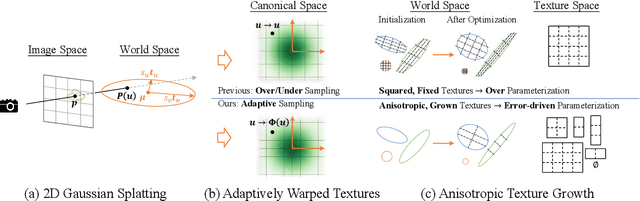
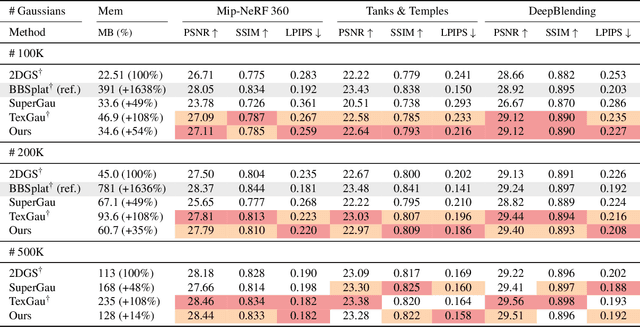
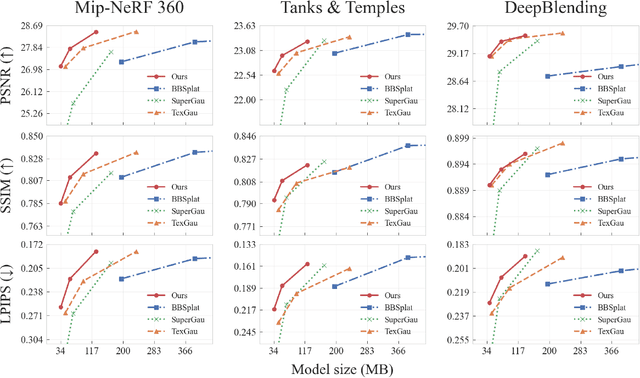
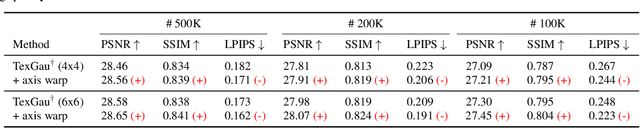
Recent advances have equipped 3D Gaussian Splatting with texture parameterizations to capture spatially varying attributes, improving the performance of both appearance modeling and downstream tasks. However, the added texture parameters introduce significant memory efficiency challenges. Rather than proposing new texture formulations, we take a step back to examine the characteristics of existing textured Gaussian methods and identify two key limitations in common: (1) Textures are typically defined in canonical space, leading to inefficient sampling that wastes textures' capacity on low-contribution regions; and (2) texture parameterization is uniformly assigned across all Gaussians, regardless of their visual complexity, resulting in over-parameterization. In this work, we address these issues through two simple yet effective strategies: adaptive sampling based on the Gaussian density distribution and error-driven anisotropic parameterization that allocates texture resources according to rendering error. Our proposed ASAP Textured Gaussians, short for Adaptive Sampling and Anisotropic Parameterization, significantly improve the quality efficiency tradeoff, achieving high-fidelity rendering with far fewer texture parameters.
Beyond Training: Enabling Self-Evolution of Agents with MOBIMEM
Dec 15, 2025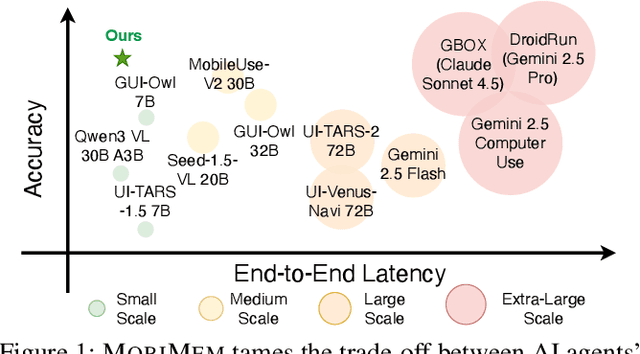
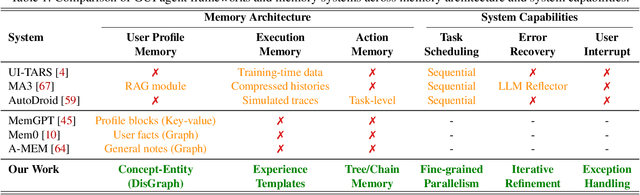
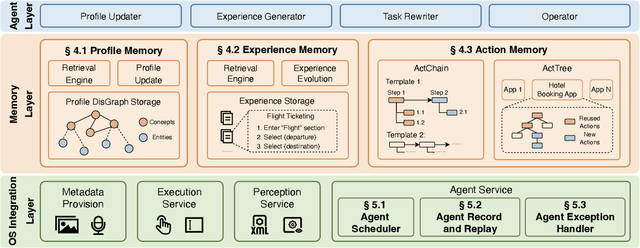
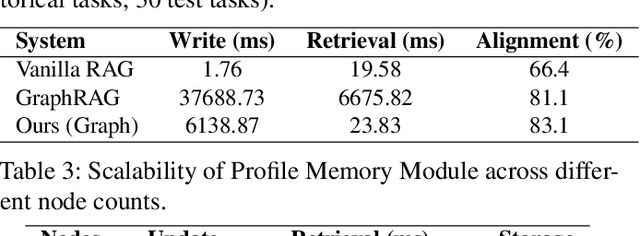
Large Language Model (LLM) agents are increasingly deployed to automate complex workflows in mobile and desktop environments. However, current model-centric agent architectures struggle to self-evolve post-deployment: improving personalization, capability, and efficiency typically requires continuous model retraining/fine-tuning, which incurs prohibitive computational overheads and suffers from an inherent trade-off between model accuracy and inference efficiency. To enable iterative self-evolution without model retraining, we propose MOBIMEM, a memory-centric agent system. MOBIMEM first introduces three specialized memory primitives to decouple agent evolution from model weights: (1) Profile Memory uses a lightweight distance-graph (DisGraph) structure to align with user preferences, resolving the accuracy-latency trade-off in user profile retrieval; (2) Experience Memory employs multi-level templates to instantiate execution logic for new tasks, ensuring capability generalization; and (3) Action Memory records fine-grained interaction sequences, reducing the reliance on expensive model inference. Building upon this memory architecture, MOBIMEM further integrates a suite of OS-inspired services to orchestrate execution: a scheduler that coordinates parallel sub-task execution and memory operations; an agent record-and-replay (AgentRR) mechanism that enables safe and efficient action reuse; and a context-aware exception handling that ensures graceful recovery from user interruptions and runtime errors. Evaluation on AndroidWorld and top-50 apps shows that MOBIMEM achieves 83.1% profile alignment with 23.83 ms retrieval time (280x faster than GraphRAG baselines), improves task success rates by up to 50.3%, and reduces end-to-end latency by up to 9x on mobile devices.
Unified Camera Positional Encoding for Controlled Video Generation
Dec 08, 2025Transformers have emerged as a universal backbone across 3D perception, video generation, and world models for autonomous driving and embodied AI, where understanding camera geometry is essential for grounding visual observations in three-dimensional space. However, existing camera encoding methods often rely on simplified pinhole assumptions, restricting generalization across the diverse intrinsics and lens distortions in real-world cameras. We introduce Relative Ray Encoding, a geometry-consistent representation that unifies complete camera information, including 6-DoF poses, intrinsics, and lens distortions. To evaluate its capability under diverse controllability demands, we adopt camera-controlled text-to-video generation as a testbed task. Within this setting, we further identify pitch and roll as two components effective for Absolute Orientation Encoding, enabling full control over the initial camera orientation. Together, these designs form UCPE (Unified Camera Positional Encoding), which integrates into a pretrained video Diffusion Transformer through a lightweight spatial attention adapter, adding less than 1% trainable parameters while achieving state-of-the-art camera controllability and visual fidelity. To facilitate systematic training and evaluation, we construct a large video dataset covering a wide range of camera motions and lens types. Extensive experiments validate the effectiveness of UCPE in camera-controllable video generation and highlight its potential as a general camera representation for Transformers across future multi-view, video, and 3D tasks. Code will be available at https://github.com/chengzhag/UCPE.
SEMC: Structure-Enhanced Mixture-of-Experts Contrastive Learning for Ultrasound Standard Plane Recognition
Nov 16, 2025Ultrasound standard plane recognition is essential for clinical tasks such as disease screening, organ evaluation, and biometric measurement. However, existing methods fail to effectively exploit shallow structural information and struggle to capture fine-grained semantic differences through contrastive samples generated by image augmentations, ultimately resulting in suboptimal recognition of both structural and discriminative details in ultrasound standard planes. To address these issues, we propose SEMC, a novel Structure-Enhanced Mixture-of-Experts Contrastive learning framework that combines structure-aware feature fusion with expert-guided contrastive learning. Specifically, we first introduce a novel Semantic-Structure Fusion Module (SSFM) to exploit multi-scale structural information and enhance the model's ability to perceive fine-grained structural details by effectively aligning shallow and deep features. Then, a novel Mixture-of-Experts Contrastive Recognition Module (MCRM) is designed to perform hierarchical contrastive learning and classification across multi-level features using a mixture-of-experts (MoE) mechanism, further improving class separability and recognition performance. More importantly, we also curate a large-scale and meticulously annotated liver ultrasound dataset containing six standard planes. Extensive experimental results on our in-house dataset and two public datasets demonstrate that SEMC outperforms recent state-of-the-art methods across various metrics.
Continual Unlearning for Text-to-Image Diffusion Models: A Regularization Perspective
Nov 11, 2025Machine unlearning--the ability to remove designated concepts from a pre-trained model--has advanced rapidly, particularly for text-to-image diffusion models. However, existing methods typically assume that unlearning requests arrive all at once, whereas in practice they often arrive sequentially. We present the first systematic study of continual unlearning in text-to-image diffusion models and show that popular unlearning methods suffer from rapid utility collapse: after only a few requests, models forget retained knowledge and generate degraded images. We trace this failure to cumulative parameter drift from the pre-training weights and argue that regularization is crucial to addressing it. To this end, we study a suite of add-on regularizers that (1) mitigate drift and (2) remain compatible with existing unlearning methods. Beyond generic regularizers, we show that semantic awareness is essential for preserving concepts close to the unlearning target, and propose a gradient-projection method that constrains parameter drift orthogonal to their subspace. This substantially improves continual unlearning performance and is complementary to other regularizers for further gains. Taken together, our study establishes continual unlearning as a fundamental challenge in text-to-image generation and provides insights, baselines, and open directions for advancing safe and accountable generative AI.
Uncertainty Matters in Dynamic Gaussian Splatting for Monocular 4D Reconstruction
Oct 14, 2025Reconstructing dynamic 3D scenes from monocular input is fundamentally under-constrained, with ambiguities arising from occlusion and extreme novel views. While dynamic Gaussian Splatting offers an efficient representation, vanilla models optimize all Gaussian primitives uniformly, ignoring whether they are well or poorly observed. This limitation leads to motion drifts under occlusion and degraded synthesis when extrapolating to unseen views. We argue that uncertainty matters: Gaussians with recurring observations across views and time act as reliable anchors to guide motion, whereas those with limited visibility are treated as less reliable. To this end, we introduce USplat4D, a novel Uncertainty-aware dynamic Gaussian Splatting framework that propagates reliable motion cues to enhance 4D reconstruction. Our key insight is to estimate time-varying per-Gaussian uncertainty and leverages it to construct a spatio-temporal graph for uncertainty-aware optimization. Experiments on diverse real and synthetic datasets show that explicitly modeling uncertainty consistently improves dynamic Gaussian Splatting models, yielding more stable geometry under occlusion and high-quality synthesis at extreme viewpoints.
MiniBEE: A New Form Factor for Compact Bimanual Dexterity
Oct 02, 2025Bimanual robot manipulators can achieve impressive dexterity, but typically rely on two full six- or seven- degree-of-freedom arms so that paired grippers can coordinate effectively. This traditional framework increases system complexity while only exploiting a fraction of the overall workspace for dexterous interaction. We introduce the MiniBEE (Miniature Bimanual End-effector), a compact system in which two reduced-mobility arms (3+ DOF each) are coupled into a kinematic chain that preserves full relative positioning between grippers. To guide our design, we formulate a kinematic dexterity metric that enlarges the dexterous workspace while keeping the mechanism lightweight and wearable. The resulting system supports two complementary modes: (i) wearable kinesthetic data collection with self-tracked gripper poses, and (ii) deployment on a standard robot arm, extending dexterity across its entire workspace. We present kinematic analysis and design optimization methods for maximizing dexterous range, and demonstrate an end-to-end pipeline in which wearable demonstrations train imitation learning policies that perform robust, real-world bimanual manipulation.
Incorporating Visual Cortical Lateral Connection Properties into CNN: Recurrent Activation and Excitatory-Inhibitory Separation
Sep 18, 2025The original Convolutional Neural Networks (CNNs) and their modern updates such as the ResNet are heavily inspired by the mammalian visual system. These models include afferent connections (retina and LGN to the visual cortex) and long-range projections (connections across different visual cortical areas). However, in the mammalian visual system, there are connections within each visual cortical area, known as lateral (or horizontal) connections. These would roughly correspond to connections within CNN feature maps, and this important architectural feature is missing in current CNN models. In this paper, we present how such lateral connections can be modeled within the standard CNN framework, and test its benefits and analyze its emergent properties in relation to the biological visual system. We will focus on two main architectural features of lateral connections: (1) recurrent activation and (2) separation of excitatory and inhibitory connections. We show that recurrent CNN using weight sharing is equivalent to lateral connections, and propose a custom loss function to separate excitatory and inhibitory weights. The addition of these two leads to increased classification accuracy, and importantly, the activation properties and connection properties of the resulting model show properties similar to those observed in the biological visual system. We expect our approach to help align CNN closer to its biological counterpart and better understand the principles of visual cortical computation.