 Add to Chrome
 Add to Firefox
 Add to Edge
FELT: Generating Tactile Signals from Vision for Visuo-Tactile Manipulation
Jul 22, 2026
The sense of touch is central to manipulation, especially when vision is occluded or ambiguous. Although combining vision and touch improves manipulation, learning robust visuo-tactile policies requires substantial tactile data. Such data remains scarcer than visual data, because tactile sensors are fragile, specialized, and hard to standardize. To address this, we present Feature-Extracted Latent Tactile (FELT), a learning-based framework that synthesizes per-finger pressure tactile images from RGB observations, reducing the need for tactile-equipped data collection. FELT uses a large frozen visual encoder and a lightweight query decoder to predict tactile signals in a single feed-forward pass. To respect the physical topology of dual-finger tactile sensors, FELT decodes the left and right tactile sensor panels through separate branches, capturing the asymmetric contact patterns during interactions such as wiping, insertion, and in-hand rotation. At inference time, FELT only requires RGB data, allowing us to augment existing vision-only data with tactile observations, either as generated tactile images or as latent tactile features. Experiments on four contact-rich manipulation tasks demonstrate that both generated tactile images and latent tactile features improve policy success over vision-only baselines, with latent feature requiring no real tactile sensor during policy training or deployment. Supplementary material is available on our anonymous website: https://felt-tactile.github.io/.

MiniBEE: A New Form Factor for Compact Bimanual Dexterity
Oct 02, 2025Bimanual robot manipulators can achieve impressive dexterity, but typically rely on two full six- or seven- degree-of-freedom arms so that paired grippers can coordinate effectively. This traditional framework increases system complexity while only exploiting a fraction of the overall workspace for dexterous interaction. We introduce the MiniBEE (Miniature Bimanual End-effector), a compact system in which two reduced-mobility arms (3+ DOF each) are coupled into a kinematic chain that preserves full relative positioning between grippers. To guide our design, we formulate a kinematic dexterity metric that enlarges the dexterous workspace while keeping the mechanism lightweight and wearable. The resulting system supports two complementary modes: (i) wearable kinesthetic data collection with self-tracked gripper poses, and (ii) deployment on a standard robot arm, extending dexterity across its entire workspace. We present kinematic analysis and design optimization methods for maximizing dexterous range, and demonstrate an end-to-end pipeline in which wearable demonstrations train imitation learning policies that perform robust, real-world bimanual manipulation.
A Compact, Low-cost Force and Torque Sensor for Robot Fingers with LED-based Displacement Sensing
Oct 04, 2024


Force/torque sensing is an important modality for robotic manipulation, but commodity solutions, generally developed with other applications in mind, do not generally fit the needs of robot hands. This paper introduces a novel method for six-axis force/torque sensing, using LEDs to sense the displacement between two plates connected by a transparent elastomer. Our method allows for finger-size packaging with no amplification electronics, low cost manufacturing, and easy integration into a complete hand. On test forces between 0-2 N, our prototype sensor exhibits a mean error between 0.05 and 0.07 N across the three force directions, suggesting future applicability to fine manipulation tasks.
Task-Based Design and Policy Co-Optimization for Tendon-driven Underactuated Kinematic Chains
May 23, 2024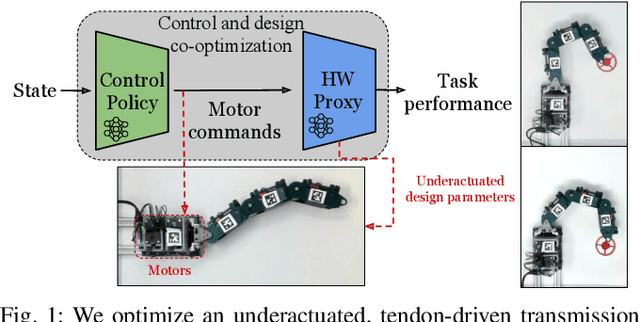
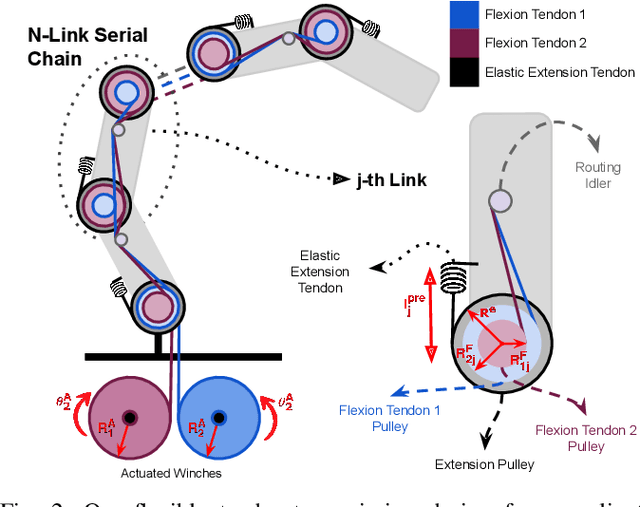

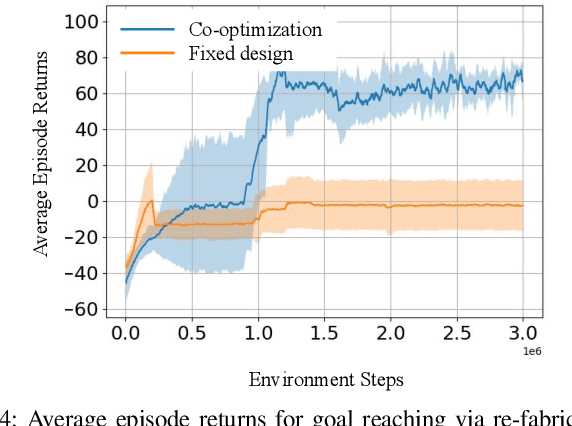
Underactuated manipulators reduce the number of bulky motors, thereby enabling compact and mechanically robust designs. However, fewer actuators than joints means that the manipulator can only access a specific manifold within the joint space, which is particular to a given hardware configuration and can be low-dimensional and/or discontinuous. Determining an appropriate set of hardware parameters for this class of mechanisms, therefore, is difficult - even for traditional task-based co-optimization methods. In this paper, our goal is to implement a task-based design and policy co-optimization method for underactuated, tendon-driven manipulators. We first formulate a general model for an underactuated, tendon-driven transmission. We then use this model to co-optimize a three-link, two-actuator kinematic chain using reinforcement learning. We demonstrate that our optimized tendon transmission and control policy can be transferred reliably to physical hardware with real-world reaching experiments.