 Add to Chrome
 Add to Firefox
 Add to Edge
MosaicKV: Serving Long-Context LLM with Dynamic Two-D KV Cache Compression
Jul 01, 2026
Long-context LLM services now sustain prompts with hundreds of thousands to millions of tokens, making the key-value (KV) cache a first-order serving cost. Because the cache grows linearly with context length, it can exhaust GPU memory, force smaller batches, and reduce serving throughput. Prior KV cache compression techniques typically target only the sequence dimension or only the channel dimension, which leaves limited headroom as context windows scale. Compressing both dimensions promises higher memory reduction, but applying the two forms of compression directly leads to significant accuracy loss. This paper introduces MosaicKV, a dynamic two-D (dimensional) KV cache compression system for extremely long-context serving. MosaicKV uses dynamic two-D compression to address the accuracy challenge, exploiting the non-uniform importance distribution of elements within the KV cache. Instead of applying one compression pattern globally, MosaicKV identifies important elements for each KV vector and selects compression strategies at the granularity of KV cache segments. To address the performance challenge, where fine-grained sparsity and compression management overhead can offset the gains from compression, MosaicKV introduces compressed KV cache management. This mechanism uses underutilized GPU and CPU resources to maintain compressed KV caches and accelerate attention computation. Evaluation on an H800 GPU with multiple LLMs shows that MosaicKV delivers up to 16x attention speedup, 4.8x lower decode latency, and 7.3x higher throughput than the uncompressed baseline. At the same time, it reduces memory usage by 3x and incurs only 1.76% average accuracy loss on LongBench and RULER.

DeltaBox: Scaling Stateful AI Agents with Millisecond-Level Sandbox Checkpoint/Rollback
May 21, 2026LLM-powered AI agents require high-frequency state exploration (e.g., test-time tree search and reinforcement learning), relying on rapid checkpoint and rollback (C/R) of the complete sandbox state, including files and process state (e.g., memory, contexts, etc.). Existing mechanisms duplicate the entire state, causing hundreds of milliseconds to seconds of latency per C/R, which severely bottlenecks deep search and large-scale fan-outs. This paper observes that subsequent checkpoints in AI agents are highly similar. Therefore, instead of full duplication, a sandbox should only duplicate the changes between consecutive checkpoints (Key Insight). However, it is non-trivial to realize the idea, mainly due to the missing OS supports. This paper proposes a new OS-level abstraction, DeltaState, to enable the change-based transactional C/R for AI agents with two co-designed OS mechanisms. First, DeltaFS enables change-based filesystem C/R by organizing the file states into layers and dynamically freezing the writable layer and inserting a new one during checkpoint, reducing file updates to copy-on-write, and making rollback a simple layer switch. Second, DeltaCR enables change-based process state C/R using incremental dumps, and accelerates rollback by bypassing traditional pipelines to directly fork() from a frozen template process. We then present DeltaBox, a novel agent sandbox achieving millisecond level C/R through the two new mechanisms. Evaluations on SWE-bench and RL micro-benchmarks show DeltaBox completes checkpoint and rollback in millisecond-level latency (14ms and 5ms, respectively), empowering agents to explore substantially more nodes under fixed time budgets.
When Answers Stray from Questions: Hallucination Detection via Question-Answer Orthogonal Decomposition
May 14, 2026Hallucination detection in large language models (LLMs) requires balancing accu racy, efficiency, and robustness to distribution shift. Black-box consistency methods are effective but demand repeated inference; single-pass white-box probes are effi cient yet treat answer representations in isolation, often degrading sharply under domain shift. We propose QAOD (Question-Answer Orthogonal Decomposition), a single-pass framework that projects away the question-aligned direction from the answer representation to obtain a question-orthogonal component that suppresses domain-conditioned variation. To identify informative signals, QAOD further selects layers via diversity-penalized Fisher scoring and discriminative neurons via Fisher importance. To address both in-domain detection and cross-domain generalization, we design two complementary probing strategies: pairing the or thogonal component with question context yields a joint probe that maximizes in-domain discriminability, while using the orthogonal component alone preserves domain-agnostic factuality signals for robust transfer. QAOD's joint probe achieves the best in-domain AUROC across all evaluated model-dataset pairs, while the orthogonal-only probe delivers the strongest OOD transfer, surpassing the best white-box baseline by up to 21% on BioASQ at under 25% of generation cost.
SkVM: Compiling Skills for Efficient Execution Everywhere
Apr 06, 2026LLM agents increasingly adopt skills as a reusable unit of composition. While skills are shared across diverse agent platforms, current systems treat them as raw context, causing the same skill to behave inconsistently for different agents. This fragility undermines skill portability and execution efficiency. To address this challenge, we analyze 118,000 skills and draw inspiration from traditional compiler design. We treat skills as code and LLMs as heterogeneous processors. To make portability actionable, we decompose a skill's requirements into a set of primitive capabilities, and measure how well each model-harness pair supports them. Based on these capability profiles, we propose SkVM, a compilation and runtime system designed for portable and efficient skill execution. At compile time, SkVM performs capability-based compilation, environment binding, and concurrency extraction. At runtime, SkVM applies JIT code solidification and adaptive recompilation for performance optimization. We evaluate SkVM across eight LLMs of varying scales and three agent harnesses, covering SkillsBench and representative skill tasks. Results demonstrate that SkVM significantly improves task completion rates across different models and environments while reducing token consumption by up to 40%. In terms of performance, SkVM achieves up to 3.2x speedup with enhanced parallelism, and 19-50x latency reduction through code solidification.
SkillRT: Compiling Skills for Efficient Execution Everywhere
Apr 03, 2026LLM agents increasingly adopt skills as a reusable unit of composition. While skills are shared across diverse agent platforms, current systems treat them as raw context, causing the same skill to behave inconsistently for different agents. This fragility undermines skill portability and execution efficiency. To address this challenge, we analyze 118,000 skills and draw inspiration from traditional compiler design. We treat skills as code and LLMs as heterogeneous processors. To make portability actionable, we decompose a skill's requirements into a set of primitive capabilities, and measure how well each model-harness pair supports them. Based on these capability profiles, we propose SkillRT, a compilation and runtime system designed for portable and efficient skill execution. At compile time, SkillRT performs capability-based compilation, environment binding, and concurrency extraction. At runtime, SkillRT applies JIT code solidification and adaptive recompilation for performance optimization. We evaluate SkillRT across eight LLMs of varying scales and three agent harnesses, covering SkillsBench and representative skill tasks. Results demonstrate that SkillRT significantly improves task completion rates across different models and environments while reducing token consumption by up to 40%. In terms of performance, SkillRT achieves up to 3.2x speedup with enhanced parallelism, and 19-50x latency reduction through code solidification.
FlexServe: A Fast and Secure LLM Serving System for Mobile Devices with Flexible Resource Isolation
Mar 10, 2026Device-side Large Language Models (LLMs) have witnessed explosive growth, offering higher privacy and availability compared to cloud-side LLMs. During LLM inference, both model weights and user data are valuable, and attackers may even compromise the OS kernel to steal them. ARM TrustZone is the de facto hardware-based isolation technology on mobile devices, used to protect sensitive applications from a compromised OS. However, protecting LLM inference with TrustZone incurs significant overhead due to its inflexible isolation of memory and the NPU. To address these challenges, this paper introduces FlexServe, a fast and secure LLM serving system for mobile devices. It first introduces a Flexible Resource Isolation mechanism to construct Flexible Secure Memory (Flex-Mem) and Flexible Secure NPU (Flex-NPU). Both memory pages and the NPU can be efficiently switched between unprotected and protected modes. Based on these mechanisms, FlexServe designs a fast and secure LLM inference framework within TrustZone's secure world. The LLM-Aware Memory Management and Secure Inference Pipeline are introduced to accelerate inference. A Multi-Model Scheduler is proposed to optimize multi-model workflows. We implement a prototype of FlexServe and compare it with two TrustZone-based strawman designs. The results show that FlexServe achieves an average $10.05\times$ speedup in Time to First Token (TTFT) compared to the strawman, and an average $2.44\times$ TTFT speedup compared to an optimized strawman with pipeline and secure NPU enabled. For multi-model agent workflows, the end-to-end speedup is up to $24.30\times$ and $4.05\times$ compared to the strawman and optimized strawman, respectively.
Beyond Training: Enabling Self-Evolution of Agents with MOBIMEM
Dec 15, 2025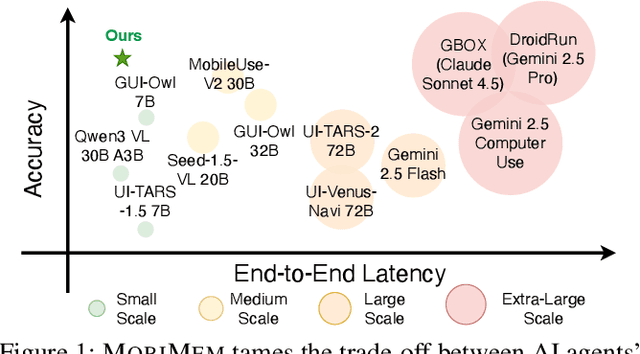
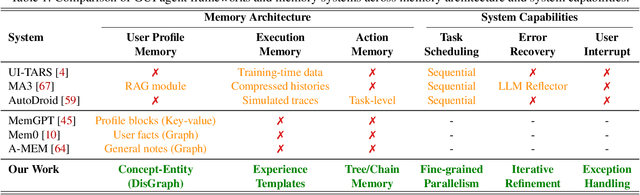
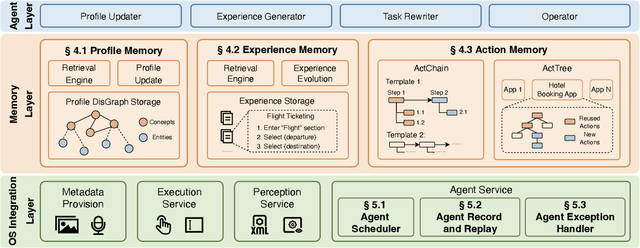
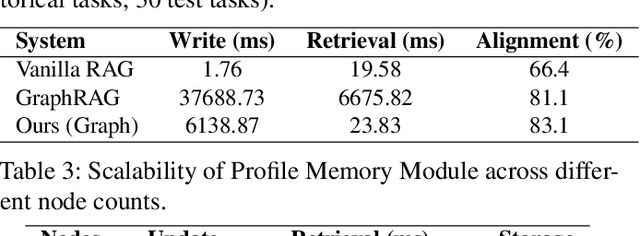
Large Language Model (LLM) agents are increasingly deployed to automate complex workflows in mobile and desktop environments. However, current model-centric agent architectures struggle to self-evolve post-deployment: improving personalization, capability, and efficiency typically requires continuous model retraining/fine-tuning, which incurs prohibitive computational overheads and suffers from an inherent trade-off between model accuracy and inference efficiency. To enable iterative self-evolution without model retraining, we propose MOBIMEM, a memory-centric agent system. MOBIMEM first introduces three specialized memory primitives to decouple agent evolution from model weights: (1) Profile Memory uses a lightweight distance-graph (DisGraph) structure to align with user preferences, resolving the accuracy-latency trade-off in user profile retrieval; (2) Experience Memory employs multi-level templates to instantiate execution logic for new tasks, ensuring capability generalization; and (3) Action Memory records fine-grained interaction sequences, reducing the reliance on expensive model inference. Building upon this memory architecture, MOBIMEM further integrates a suite of OS-inspired services to orchestrate execution: a scheduler that coordinates parallel sub-task execution and memory operations; an agent record-and-replay (AgentRR) mechanism that enables safe and efficient action reuse; and a context-aware exception handling that ensures graceful recovery from user interruptions and runtime errors. Evaluation on AndroidWorld and top-50 apps shows that MOBIMEM achieves 83.1% profile alignment with 23.83 ms retrieval time (280x faster than GraphRAG baselines), improves task success rates by up to 50.3%, and reduces end-to-end latency by up to 9x on mobile devices.
Get Experience from Practice: LLM Agents with Record & Replay
May 23, 2025AI agents, empowered by Large Language Models (LLMs) and communication protocols such as MCP and A2A, have rapidly evolved from simple chatbots to autonomous entities capable of executing complex, multi-step tasks, demonstrating great potential. However, the LLMs' inherent uncertainty and heavy computational resource requirements pose four significant challenges to the development of safe and efficient agents: reliability, privacy, cost and performance. Existing approaches, like model alignment, workflow constraints and on-device model deployment, can partially alleviate some issues but often with limitations, failing to fundamentally resolve these challenges. This paper proposes a new paradigm called AgentRR (Agent Record & Replay), which introduces the classical record-and-replay mechanism into AI agent frameworks. The core idea is to: 1. Record an agent's interaction trace with its environment and internal decision process during task execution, 2. Summarize this trace into a structured "experience" encapsulating the workflow and constraints, and 3. Replay these experiences in subsequent similar tasks to guide the agent's behavior. We detail a multi-level experience abstraction method and a check function mechanism in AgentRR: the former balances experience specificity and generality, while the latter serves as a trust anchor to ensure completeness and safety during replay. In addition, we explore multiple application modes of AgentRR, including user-recorded task demonstration, large-small model collaboration and privacy-aware agent execution, and envision an experience repository for sharing and reusing knowledge to further reduce deployment cost.
L3: DIMM-PIM Integrated Architecture and Coordination for Scalable Long-Context LLM Inference
Apr 24, 2025Large Language Models (LLMs) increasingly require processing long text sequences, but GPU memory limitations force difficult trade-offs between memory capacity and bandwidth. While HBM-based acceleration offers high bandwidth, its capacity remains constrained. Offloading data to host-side DIMMs improves capacity but introduces costly data swapping overhead. We identify that the critical memory bottleneck lies in the decoding phase of multi-head attention (MHA) exclusively, which demands substantial capacity for storing KV caches and high bandwidth for attention computation. Our key insight reveals this operation uniquely aligns with modern DIMM-based processing-in-memory (PIM) architectures, which offers scalability of both capacity and bandwidth. Based on this observation and insight, we propose L3, a hardware-software co-designed system integrating DIMM-PIM and GPU devices. L3 introduces three innovations: First, hardware redesigns resolve data layout mismatches and computational element mismatches in DIMM-PIM, enhancing LLM inference utilization. Second, communication optimization enables hiding the data transfer overhead with the computation. Third, an adaptive scheduler coordinates GPU-DIMM-PIM operations to maximize parallelism between devices. Evaluations using real-world traces show L3 achieves up to 6.1$\times$ speedup over state-of-the-art HBM-PIM solutions while significantly improving batch sizes.
PipeWeaver: Addressing Data Dynamicity in Large Multimodal Model Training with Dynamic Interleaved Pipeline
Apr 19, 2025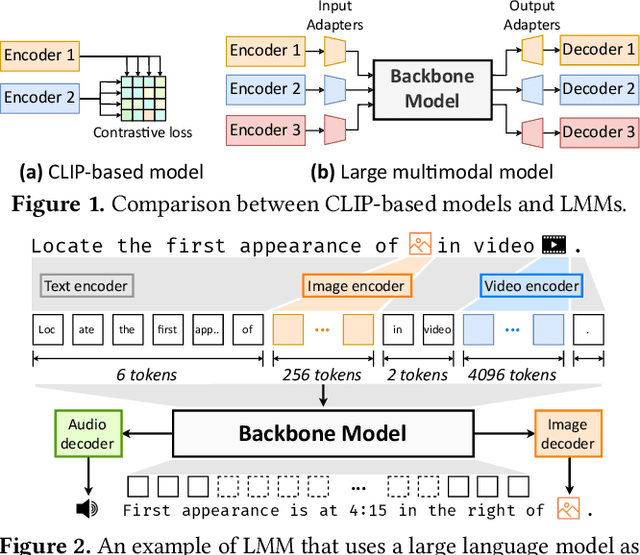
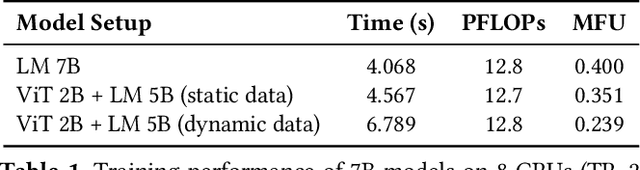
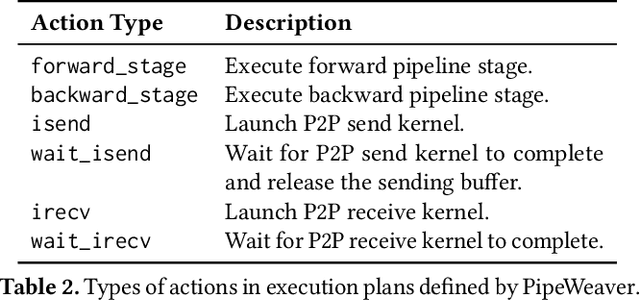

Large multimodal models (LMMs) have demonstrated excellent capabilities in both understanding and generation tasks with various modalities. While these models can accept flexible combinations of input data, their training efficiency suffers from two major issues: pipeline stage imbalance caused by heterogeneous model architectures, and training data dynamicity stemming from the diversity of multimodal data. In this paper, we present PipeWeaver, a dynamic pipeline scheduling framework designed for LMM training. The core of PipeWeaver is dynamic interleaved pipeline, which searches for pipeline schedules dynamically tailored to current training batches. PipeWeaver addresses issues of LMM training with two techniques: adaptive modality-aware partitioning and efficient pipeline schedule search within a hierarchical schedule space. Meanwhile, PipeWeaver utilizes SEMU (Step Emulator), a training simulator for multimodal models, for accurate performance estimations, accelerated by spatial-temporal subgraph reuse to improve search efficiency. Experiments show that PipeWeaver can enhance LMM training efficiency by up to 97.3% compared to state-of-the-art systems, and demonstrate excellent adaptivity to LMM training's data dynamicity.