 Add to Chrome
 Add to Firefox
 Add to Edge
SkillMemo: Expert-guided Skill Memory Framework for Compositional Embodied Manipulation
Aug 06, 2026
Embodied visuomotor models, including Diffusion Policy (DP) and Vision-Language-Action (VLA) models, have demonstrated promising performance on robotic manipulation benchmarks. However, their potential remains fundamentally constrained by the scarcity of large-scale embodied trajectory datasets, leading to insufficient compositional generalization in out-of-distribution (OOD) scenarios with limited capability to capture reusable skill structures. To address this limitation, we propose Skill-Based Memory (SkillMemo) framework that implicitly decomposes long-horizon demonstrations into latent atomic skills and integrates skill-level features into a dynamic episodic memory bank for solving compositional tasks. Specifically, we first introduce an expert-guided trajectory segmentation module built upon a Mixture-of-Experts (MoE) architecture, which implicitly partitions trajectories into distinct skill primitives represented by learned gating coefficients. We further design a skill-level episodic memory architecture that stores compact skill representations as retrievable key-value pairs. During inference, the memory bank retrieves the most relevant skill primitives which are subsequently fused with the model's current gating distribution, providing a robust contextual prior to refine action predictions. Extensive experiments on the simulation benchmark and real-world manipulation tasks demonstrate that SkillMemo consistently enhances both DP and VLA backbones, achieving state-of-the-art performance and outperforming $π_{0.5}$, while exhibiting strong compositional generalization to unseen task configurations.

CoDMD: Copula-aware Distribution Matching Distillation for Fast Video Generation
Jun 20, 2026Few-step distillation for video diffusion models has attracted significant attention, driven by the urgent demand for efficient deployment in real-world scenarios. However, Distribution Matching Distillation (DMD), a leading paradigm, tends to degrade under limited NFE budgets, manifesting in video generation as layout instability, oversaturation, and broken motion dynamics. We trace this failure to a structural limitation: standard DMD is an intra-sample distribution-matching objective with coordinate-wise gradients, and thus imposes no explicit constraint on the relational geometry across batch elements or temporal frames, leaving the underlying copula largely unregulated. Combined with the mode-seeking tendency of its reverse-KL objective, this absence of relational guidance makes DMD prone to collapsing into local optima in the few-step regime. Motivated by this insight, we propose Copula-aware DMD (CoDMD), a lightweight relational regularizer that reuses score estimates already produced by the frozen teacher and the online fake model to construct pairwise relation matrices across samples and frames. These are matched through a supplementary distributional objective that requires no additional networks, datasets, or sampling trajectories. On the Wan-2.1-T2V model series at 1.3B & 14B scales, CoDMD distills 50-step teachers into 4-step students, achieving an approximate 25$\times$ speed-up while attaining VBench scores of 84.46 & 84.87, outperforming prior trajectory-based (rCM 82.81 & 84.05) and distribution-based (DMD 83.38 & 83.81) methods.
MorphoQuant: Modality-Aware Quantization for Omni-modal Large Language Models
Jun 03, 2026Conventional Post-Training Quantization (PTQ) methods struggle with 4-bit Omni-modal Large Language Models (OLLMs) due to the extreme distribution heterogeneity and disparate outlier patterns across modalities. To address this, we propose MorphoQuant, a modality-aware PTQ framework engineered to preserve cross-modal morphology and mitigate outlier loss. Specifically, we introduce Distribution-Aware Bias Compensation (DABC), which selectively absorbs long-tailed outliers into channel-wise biases. This mechanism safeguards outlier magnitudes while maintaining high-precision discretization for dense inliers, thereby preserving accurate discretization across diverse modal distribution. Complementing this, we propose Morphology-Directed Quantization Function Optimization (MDQFO) to co-optimize the quantization grid with the bias mask, ensuring fine-grained alignment across modalities. Extensive evaluations on Qwen2.5-Omni across benchmarks like MMMU and Video-MME demonstrate our approach's superiority. Notably, our W4A4 model achieves 76.63% on ScienceQA, significantly outperforming SOTA W4A4 methods and surprisingly surpassing the W4A16 baseline, which fully demonstrates the exceptional accuracy-efficiency trade-off of our framework.
SAFE-Pruner: Semantic Attention-Guided Future-Aware Token Pruning for Efficient Vision-Language-Action Manipulation
May 28, 2026Real-time inference of vision-language-action (VLA) models is essential for robotic control. While visual token pruning has shown strong potential for accelerating inference, most existing methods mainly base pruning decisions on shallow-layer cues and risk discarding visual information required by deep layers. To address this issue, we propose SAFE-Pruner, a plug-and-play pruning framework that incorporates attention cues of future layers into pruning decisions. Specifically, we identify semantic attention consistency, the tendency that VLA models concentrate their attention probability mass on the same semantic entity across execution steps. Based on this observation, we design a forward-looking strategy to forecast the token saliency in deep layers, which prevents the premature removal of critical tokens and leads to more stable acceleration. We further introduce an adaptive subtask division strategy to detect abrupt attention shifts, thereby improving forecasting accuracy and pruning reliability. Extensive experiments in simulation and real-world settings demonstrate that our method achieves up to 1.89x speedup with a minimal degradation in success rate of less than 1.7%, while outperforming state-of-the-art methods by up to 1.9%.
MAP-VLA: Memory-Augmented Prompting for Vision-Language-Action Model in Robotic Manipulation
Nov 12, 2025Pre-trained Vision-Language-Action (VLA) models have achieved remarkable success in improving robustness and generalization for end-to-end robotic manipulation. However, these models struggle with long-horizon tasks due to their lack of memory and reliance solely on immediate sensory inputs. To address this limitation, we propose Memory-Augmented Prompting for Vision-Language-Action model (MAP-VLA), a novel framework that empowers pre-trained VLA models with demonstration-derived memory prompts to augment action generation for long-horizon robotic manipulation tasks. To achieve this, MAP-VLA first constructs a memory library from historical demonstrations, where each memory unit captures information about a specific stage of a task. These memory units are implemented as learnable soft prompts optimized through prompt tuning. Then, during real-time task execution, MAP-VLA retrieves relevant memory through trajectory similarity matching and dynamically integrates it into the VLA model for augmented action generation. Importantly, this prompt tuning and retrieval augmentation approach operates as a plug-and-play module for a frozen VLA model, offering a lightweight and flexible solution to improve task performance. Experimental results show that MAP-VLA delivers up to 7.0% absolute performance gains in the simulation benchmark and 25.0% on real robot evaluations for long-horizon tasks, surpassing the current state-of-the-art methods.
Q-VLM: Post-training Quantization for Large Vision-Language Models
Oct 10, 2024


In this paper, we propose a post-training quantization framework of large vision-language models (LVLMs) for efficient multi-modal inference. Conventional quantization methods sequentially search the layer-wise rounding functions by minimizing activation discretization errors, which fails to acquire optimal quantization strategy without considering cross-layer dependency. On the contrary, we mine the cross-layer dependency that significantly influences discretization errors of the entire vision-language model, and embed this dependency into optimal quantization strategy searching with low search cost. Specifically, we observe the strong correlation between the activation entropy and the cross-layer dependency concerning output discretization errors. Therefore, we employ the entropy as the proxy to partition blocks optimally, which aims to achieve satisfying trade-offs between discretization errors and the search cost. Moreover, we optimize the visual encoder to disentangle the cross-layer dependency for fine-grained decomposition of search space, so that the search cost is further reduced without harming the quantization accuracy. Experimental results demonstrate that our method compresses the memory by 2.78x and increase generate speed by 1.44x about 13B LLaVA model without performance degradation on diverse multi-modal reasoning tasks. Code is available at https://github.com/ChangyuanWang17/QVLM.
Towards Accurate Data-free Quantization for Diffusion Models
Jun 07, 2023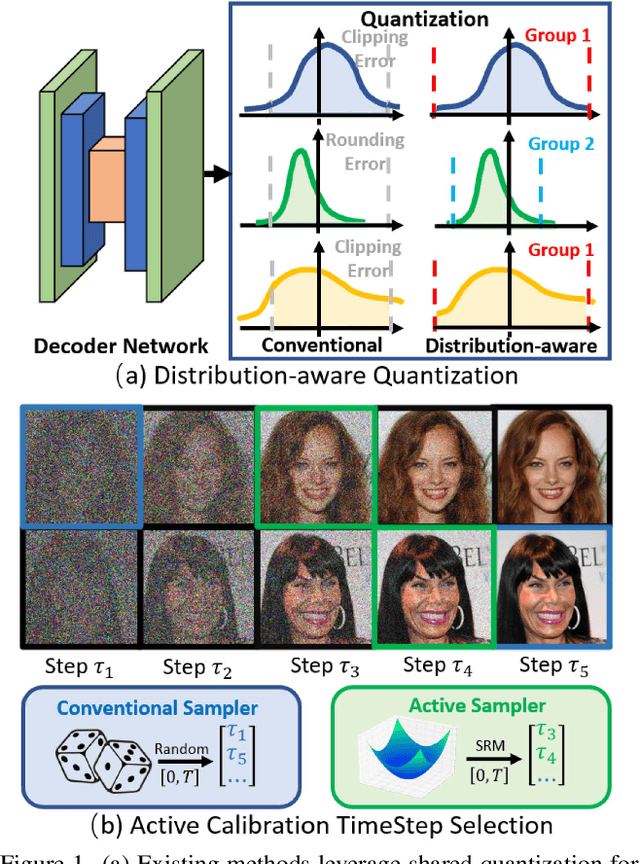
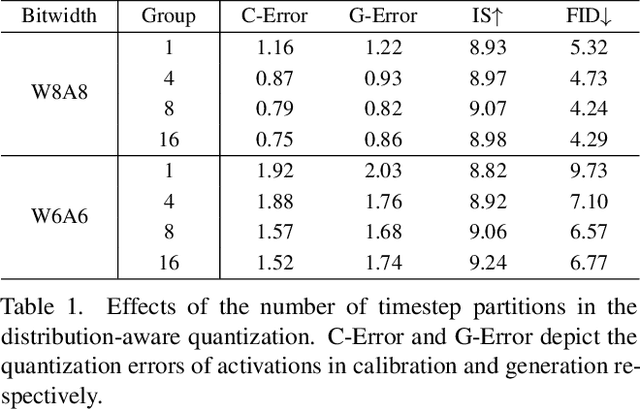
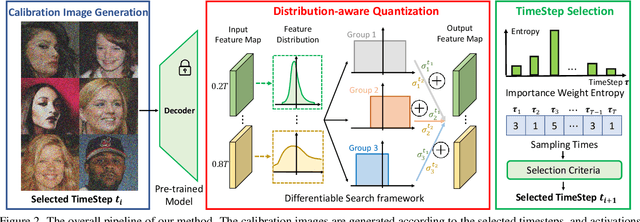
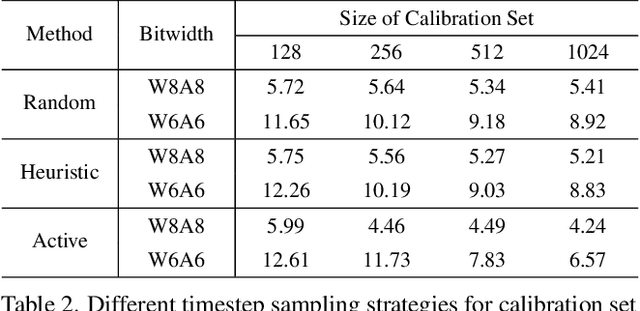
In this paper, we propose an accurate data-free post-training quantization framework of diffusion models (ADP-DM) for efficient image generation. Conventional data-free quantization methods learn shared quantization functions for tensor discretization regardless of the generation timesteps, while the activation distribution differs significantly across various timesteps. The calibration images are acquired in random timesteps which fail to provide sufficient information for generalizable quantization function learning. Both issues cause sizable quantization errors with obvious image generation performance degradation. On the contrary, we design group-wise quantization functions for activation discretization in different timesteps and sample the optimal timestep for informative calibration image generation, so that our quantized diffusion model can reduce the discretization errors with negligible computational overhead. Specifically, we partition the timesteps according to the importance weights of quantization functions in different groups, which are optimized by differentiable search algorithms. We also select the optimal timestep for calibration image generation by structural risk minimizing principle in order to enhance the generalization ability in the deployment of quantized diffusion model. Extensive experimental results show that our method outperforms the state-of-the-art post-training quantization of diffusion model by a sizable margin with similar computational cost.