 Add to Chrome
 Add to Firefox
 Add to Edge
RegisterBridgeMM: A Register-Centric Framework for RGB-Infrared Object Detection
Aug 05, 2026
RGB-infrared (RGB-IR) object detection benefits from complementary visible and thermal cues, but effective fusion remains challenging under illumination changes, weather variation, and cluttered scenes. Existing RGB-IR fusion methods often trade expressive patch-level interaction for lighter but more constrained adaptation mechanisms. We empirically observe that pretrained register tokens contain both modality-shared and modality-specific information on paired RGB-IR inputs, suggesting that they can serve as a compact substrate for cross-modal communication. Building on this observation, we propose RegisterBridgeMM, a register-mediated fusion framework organized as a three-stage register lifecycle. Aggregate preserves per-modality register summarization inherited from pretraining; Bridge performs bidirectional register-to-patch reading with consensus-residual regulation; and Project translates the resulting register summary into spatially adaptive calibration of patch features. This register pathway avoids dense patch-to-patch cross-modal interaction while preserving the pretrained patch representation. With both backbone streams frozen, RegisterBridgeMM achieves the highest mAP50-95 among the evaluated methods on all four benchmarks: LLVIP, M3FD, DroneVehicle, and FLIR-Aligned.

DRPFNet: Dual-domain Residual Progressive Fusion Network for RGB-Thermal Object Detection
Aug 04, 2026RGB-thermal (RGB-T) object detection aims to fuse complementary information from visible and thermal modalities to achieve robust detection under varying illumination and weather conditions. Current methods typically employ attention mechanisms or transformers to perform cross-modal fusion independently at each feature scale, directly combining RGB and thermal features in the spatial domain. However, they still face significant limitations: cross-level knowledge inheritance caused by independent fusion at each scale,suppressing noise continuously due to the lack of bidirectional optimization, and information degradation induced by the absence of frequency-spatial collaboration. To address these issues, we propose DRPFNet, a Dual-domain Residual Progressive Fusion Network that constructs a unified information flow optimization system from three synergistic levels:structure, feature, and enhancement. At the structural level, we establish cross-scale propagation through bottom-up knowledge accumulation and bidirectional enhancement,ensuring smooth information flow. At the feature level, we collaboratively extract RGB high-frequency edges and thermal low-frequency structures via frequency band separation and edge guidance, guaranteeing representation quality. At the enhancement level, we enhance foreground-background discrimination through edge-guided dual-domain refinement,achieving precise object localization.Extensive experiments on two public RGB-T datasets demonstrate that our method achieves competitive performance with competitive efficiency, validating the effectiveness of this hierarchical collaborative strategy.
Are Rationales Necessary and Sufficient? Tuning LLMs for Explainable Misinformation Detection
May 19, 2026The rapid spread of misinformation on social media platforms has become a formidable challenge. To mitigate its proliferation, Misinformation Detection (MD) has emerged as a critical research topic. Traditional MD approaches based on small models typically perform binary classification through a black-box process. Recently, the rise of Large Language Models (LLMs) has enabled explainable MD, where models generate rationales that explain their decisions, thereby enhancing transparency. Existing explainable MD methods primarily focus on crafting sophisticated prompts to elicit rationales from off-the-shelf LLMs. In this work, we propose a pipeline to fine-tune a dedicated LLM specifically for explainable MD. Our pipeline begins by collecting large-scale fact-checked articles, and then uses multiple strong LLMs to produce veracity predictions and rationales. To ensure high-quality training data, we leverage a filtering strategy that selects only the correct instances for fine-tuning. While this pipeline is intuitive and prevalent, our experiments reveal that naive filtering based solely on label correctness is insufficient in practice and suffers from two critical limitations: (1) Coarse-grained labels cause insufficient rationales: Rationales filtered solely based on binary labels are insufficient to adequately support their decisions; (2) Over-verification behavior causes unnecessary rationales: Stronger LLMs tend to exhibit over-verification behavior, producing excessively verbose and unnecessary rationales. To address these issues, we introduce LONSREX, a novel data synthesis pipeline to Locate Necessary and Sufficient Rationales for Explainable MD. Specifically, we propose a metric that quantifies the contribution of each verification step to the final prediction, thereby evaluating its necessity and sufficiency. Experimental results demonstrate the effectiveness of LONSREX.
Decomposing the Basic Abilities of Large Language Models: Mitigating Cross-Task Interference in Multi-Task Instruct-Tuning
May 07, 2026Recently, the prominent performance of large language models (LLMs) has been largely driven by multi-task instruct-tuning. Unfortunately, this training paradigm suffers from a key issue, named cross-task interference, due to conflicting gradients over shared parameters among different tasks. Some previous methods mitigate this issue by isolating task-specific parameters, e.g., task-specific neuron selection and mixture-of-experts. In this paper, we empirically reveal that the cross-task interference still exists for the existing solutions because of many parameters also shared by different tasks, and accordingly, we propose a novel solution, namely Basic Abilities Decomposition for multi-task Instruct-Tuning (BADIT). Specifically, we empirically find that certain parameters are consistently co-activated, and that co-activated parameters naturally organize into base groups. This motivates us to analogize that LLMs encode several orthogonal basic abilities, and that any task can be represented as a linear combination of these abilities. Accordingly, we propose BADIT that decomposes LLM parameters into orthogonal high-singular-value LoRA experts representing basic abilities, and dynamically enforces their orthogonality during training via spherical clustering of rank-1 components. We conduct extensive experiments on the SuperNI benchmark with 6 LLMs, and empirical results demonstrate that BADIT can outperform SOTA methods and mitigate the degree of cross-task interference.
Generalizing Dynamics Modeling More Easily from Representation Perspective
Mar 24, 2026Learning system dynamics from observations is a critical problem in many applications over various real-world complex systems, e.g., climate, ecology, and fluid systems. Recently, neural dynamics modeling method have become a prevalent solution that embeds the object's observations into a latent space before learning dynamics using neural methods such as neural Ordinary Differential Equations (ODE). Existing dynamics modeling methods induce a specific model for each observation of different complex systems, resulting in poor generalization across systems. Inspired by the great success of pre-trained models, we conduct a generalized Pre-trained Dynamics EncoDER (PDEDER) which can embed the original state observations into a latent space where the dynamics can be captured more easily. To conduct the generalized PDEDER, we pre-train any Pre-trained Language Model (PLM) by minimizing the Lyapunov exponent objective, which constrains the chaotic behavior of governing dynamics learned in the latent space. By penalizing the divergence of embedded observations, our PDEDER promotes locally stable and well-structured latent dynamics, thereby facilitating more effective dynamics modeling than in the original observation space. In addition, we incorporate reconstruction and forecasting objectives to mitigate the risk of obtaining an over-smoothed latent space. Specifically, we collect 152 sets of real-world and synthetic observations from 23 complex systems as pre-training corpora and employ them to pre-train PDEDER. Given any future dynamic observation, we can fine-tune PDEDER with any specific dynamics modeling method. We evaluate PDEDER on 12 dynamic systems by short/long-term forecasting under both in-domain and cross-domain settings, and the empirical results indicate the effectiveness and generalizability of PDEDER.
Semi-Supervised Learning with Balanced Deep Representation Distributions
Mar 22, 2026Semi-Supervised Text Classification (SSTC) mainly works under the spirit of self-training. They initialize the deep classifier by training over labeled texts; and then alternatively predict unlabeled texts as their pseudo-labels and train the deep classifier over the mixture of labeled and pseudo-labeled texts. Naturally, their performance is largely affected by the accuracy of pseudo-labels for unlabeled texts. Unfortunately, they often suffer from low accuracy because of the margin bias problem caused by the large difference between representation distributions of labels in SSTC. To alleviate this problem, we apply the angular margin loss, and perform several Gaussian linear transformations to achieve balanced label angle variances, i.e., the variance of label angles of texts within the same label. More accuracy of predicted pseudo-labels can be achieved by constraining all label angle variances balanced, where they are estimated over both labeled and pseudo-labeled texts during self-training loops. With this insight, we propose a novel SSTC method, namely Semi-Supervised Text Classification with Balanced Deep representation Distributions (S2TC-BDD). We implement both multi-class classification and multi-label classification versions of S2TC-BDD by introducing some pseudo-labeling tricks and regularization terms. To evaluate S2 TC-BDD, we compare it against the state-of-the-art SSTC methods. Empirical results demonstrate the effectiveness of S2 TC-BDD, especially when the labeled texts are scarce.
Learning from Label Proportions with Dual-proportion Constraints
Mar 22, 2026Learning from Label Proportions (LLP) is a weakly supervised problem in which the training data comprise bags, that is, groups of instances, each annotated only with bag-level class label proportions, and the objective is to learn a classifier that predicts instance-level labels. This setting is widely applicable when privacy constraints limit access to instance-level annotations or when fine-grained labeling is costly or impractical. In this work, we introduce a method that leverages Dual proportion Constraints (LLP-DC) during training, enforcing them at both the bag and instance levels. Specifically, the bag-level training aligns the mean prediction with the given proportion, and the instance-level training aligns hard pseudo-labels that satisfy the proportion constraint, where a minimum-cost maximum-flow algorithm is used to generate hard pseudo-labels. Extensive experimental results across various benchmark datasets empirically validate that LLP-DC consistently improves over previous LLP methods across datasets and bag sizes. The code is publicly available at https://github.com/TianhaoMa5/CV PR2026_Findings_LLP_DC.
Harmful Visual Content Manipulation Matters in Misinformation Detection Under Multimedia Scenarios
Mar 22, 2026Nowadays, the widespread dissemination of misinformation across numerous social media platforms has led to severe negative effects on society. To address this challenge, the automatic detection of misinformation, particularly under multimedia scenarios, has gained significant attention from both academic and industrial communities, leading to the emergence of a research task known as Multimodal Misinformation Detection (MMD). Typically, current MMD approaches focus on capturing the semantic relationships and inconsistency between various modalities but often overlook certain critical indicators within multimodal content. Recent research has shown that manipulated features within visual content in social media articles serve as valuable clues for MMD. Meanwhile, we argue that the potential intentions behind the manipulation, e.g., harmful and harmless, also matter in MMD. Therefore, in this study, we aim to identify such multimodal misinformation by capturing two types of features: manipulation features, which represent if visual content has been manipulated, and intention features, which assess the nature of these manipulations, distinguishing between harmful and harmless intentions. Unfortunately, the manipulation and intention labels that supervise these features to be discriminative are unknown. To address this, we introduce two weakly supervised indicators as substitutes by incorporating supplementary datasets focused on image manipulation detection and framing two different classification tasks as positive and unlabeled learning issues. With this framework, we introduce an innovative MMD approach, titled Harmful Visual Content Manipulation Matters in MMD (HAVC-M4 D). Comprehensive experiments conducted on four prevalent MMD datasets indicate that HAVC-M4 D significantly and consistently enhances the performance of existing MMD methods.
Enhancing Multimodal Misinformation Detection by Replaying the Whole Story from Image Modality Perspective
Nov 09, 2025
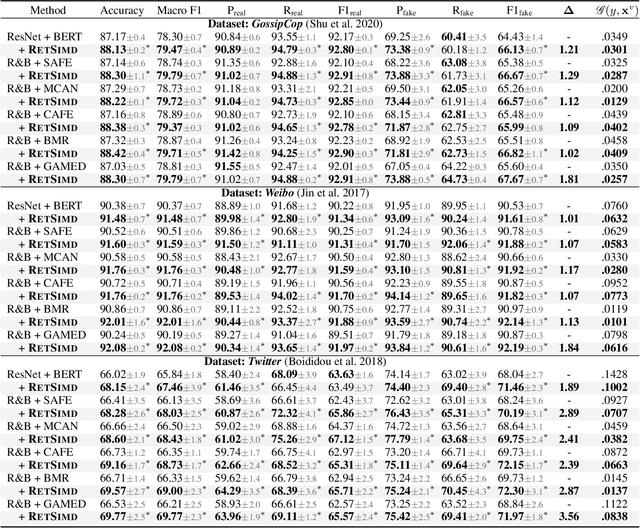
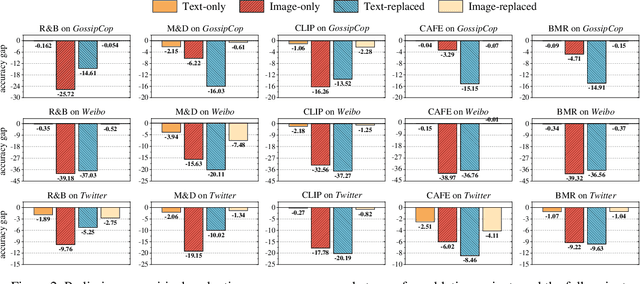
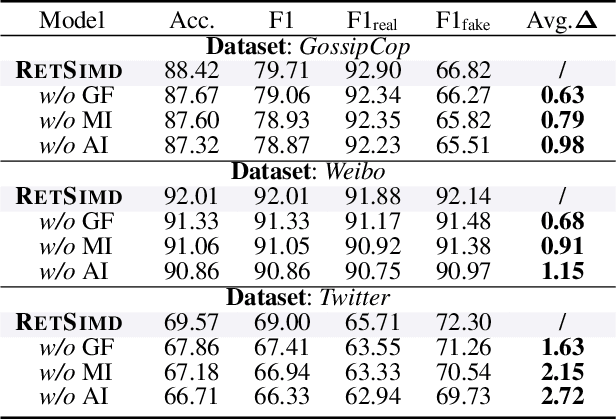
Multimodal Misinformation Detection (MMD) refers to the task of detecting social media posts involving misinformation, where the post often contains text and image modalities. However, by observing the MMD posts, we hold that the text modality may be much more informative than the image modality because the text generally describes the whole event/story of the current post but the image often presents partial scenes only. Our preliminary empirical results indicate that the image modality exactly contributes less to MMD. Upon this idea, we propose a new MMD method named RETSIMD. Specifically, we suppose that each text can be divided into several segments, and each text segment describes a partial scene that can be presented by an image. Accordingly, we split the text into a sequence of segments, and feed these segments into a pre-trained text-to-image generator to augment a sequence of images. We further incorporate two auxiliary objectives concerning text-image and image-label mutual information, and further post-train the generator over an auxiliary text-to-image generation benchmark dataset. Additionally, we propose a graph structure by defining three heuristic relationships between images, and use a graph neural network to generate the fused features. Extensive empirical results validate the effectiveness of RETSIMD.
Semi-supervised Multiscale Matching for SAR-Optical Image
Aug 11, 2025Driven by the complementary nature of optical and synthetic aperture radar (SAR) images, SAR-optical image matching has garnered significant interest. Most existing SAR-optical image matching methods aim to capture effective matching features by employing the supervision of pixel-level matched correspondences within SAR-optical image pairs, which, however, suffers from time-consuming and complex manual annotation, making it difficult to collect sufficient labeled SAR-optical image pairs. To handle this, we design a semi-supervised SAR-optical image matching pipeline that leverages both scarce labeled and abundant unlabeled image pairs and propose a semi-supervised multiscale matching for SAR-optical image matching (S2M2-SAR). Specifically, we pseudo-label those unlabeled SAR-optical image pairs with pseudo ground-truth similarity heatmaps by combining both deep and shallow level matching results, and train the matching model by employing labeled and pseudo-labeled similarity heatmaps. In addition, we introduce a cross-modal feature enhancement module trained using a cross-modality mutual independence loss, which requires no ground-truth labels. This unsupervised objective promotes the separation of modality-shared and modality-specific features by encouraging statistical independence between them, enabling effective feature disentanglement across optical and SAR modalities. To evaluate the effectiveness of S2M2-SAR, we compare it with existing competitors on benchmark datasets. Experimental results demonstrate that S2M2-SAR not only surpasses existing semi-supervised methods but also achieves performance competitive with fully supervised SOTA methods, demonstrating its efficiency and practical potential.