 Add to Chrome
 Add to Firefox
 Add to Edge
Generalizing Dynamics Modeling More Easily from Representation Perspective
Mar 24, 2026
Learning system dynamics from observations is a critical problem in many applications over various real-world complex systems, e.g., climate, ecology, and fluid systems. Recently, neural dynamics modeling method have become a prevalent solution that embeds the object's observations into a latent space before learning dynamics using neural methods such as neural Ordinary Differential Equations (ODE). Existing dynamics modeling methods induce a specific model for each observation of different complex systems, resulting in poor generalization across systems. Inspired by the great success of pre-trained models, we conduct a generalized Pre-trained Dynamics EncoDER (PDEDER) which can embed the original state observations into a latent space where the dynamics can be captured more easily. To conduct the generalized PDEDER, we pre-train any Pre-trained Language Model (PLM) by minimizing the Lyapunov exponent objective, which constrains the chaotic behavior of governing dynamics learned in the latent space. By penalizing the divergence of embedded observations, our PDEDER promotes locally stable and well-structured latent dynamics, thereby facilitating more effective dynamics modeling than in the original observation space. In addition, we incorporate reconstruction and forecasting objectives to mitigate the risk of obtaining an over-smoothed latent space. Specifically, we collect 152 sets of real-world and synthetic observations from 23 complex systems as pre-training corpora and employ them to pre-train PDEDER. Given any future dynamic observation, we can fine-tune PDEDER with any specific dynamics modeling method. We evaluate PDEDER on 12 dynamic systems by short/long-term forecasting under both in-domain and cross-domain settings, and the empirical results indicate the effectiveness and generalizability of PDEDER.

Delta1 with LLM: symbolic and neural integration for credible and explainable reasoning
Mar 13, 2026Neuro-symbolic reasoning increasingly demands frameworks that unite the formal rigor of logic with the interpretability of large language models (LLMs). We introduce an end to end explainability by construction pipeline integrating the Automated Theorem Generator Delta1 based on the full triangular standard contradiction (FTSC) with LLMs. Delta1 deterministically constructs minimal unsatisfiable clause sets and complete theorems in polynomial time, ensuring both soundness and minimality by construction. The LLM layer verbalizes each theorem and proof trace into coherent natural language explanations and actionable insights. Empirical studies across health care, compliance, and regulatory domains show that Delta1 and LLM enables interpretable, auditable, and domain aligned reasoning. This work advances the convergence of logic, language, and learning, positioning constructive theorem generation as a principled foundation for neuro-symbolic explainable AI.
Artificial Intelligence for Suicide Assessment using Audiovisual Cues: A Review
Jan 22, 2022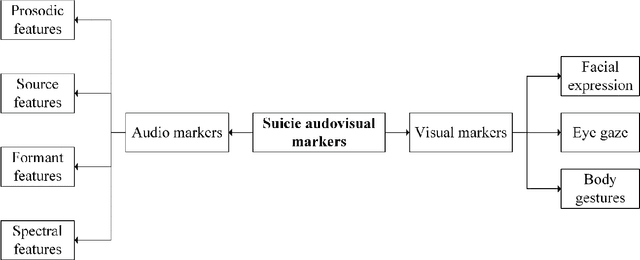
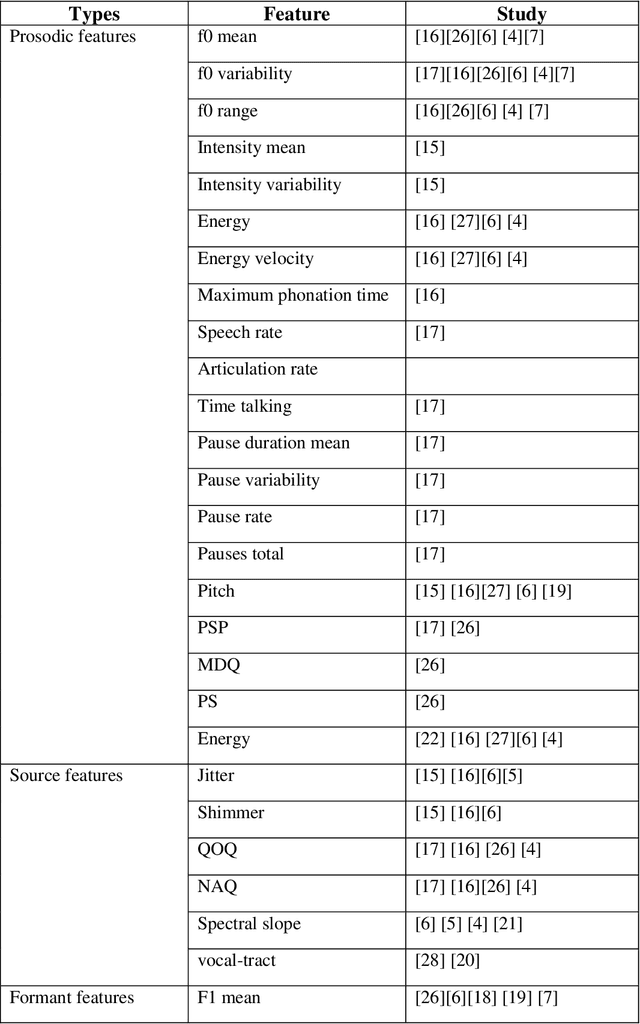
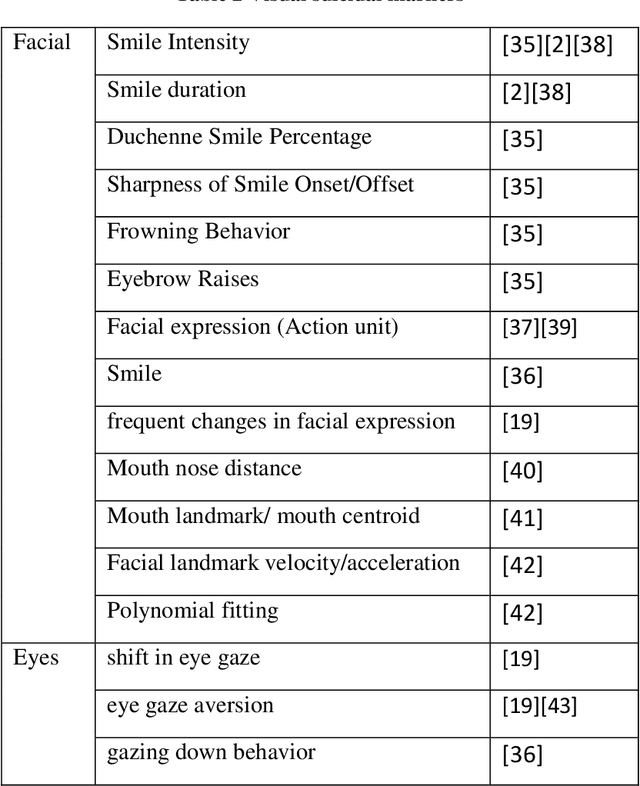
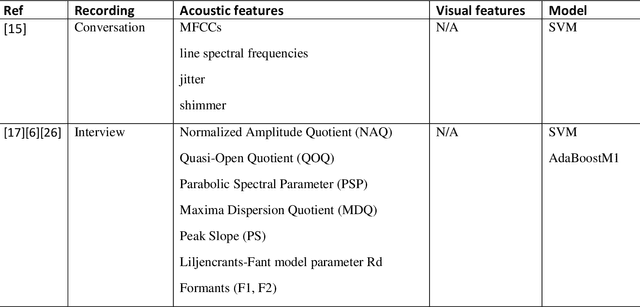
Death by suicide is the seventh of the leading death cause worldwide. The recent advancement in Artificial Intelligence (AI), specifically AI application in image and voice processing, has created a promising opportunity to revolutionize suicide risk assessment. Subsequently, we have witnessed fast-growing literature of researches that applies AI to extract audiovisual non-verbal cues for mental illness assessment. However, the majority of the recent works focus on depression, despite the evident difference between depression signs and suicidal behavior non-verbal cues. In this paper, we review the recent works that study suicide ideation and suicide behavior detection through audiovisual feature analysis, mainly suicidal voice/speech acoustic features analysis and suicidal visual cues.
Social Behavior and Mental Health: A Snapshot Survey under COVID-19 Pandemic
May 17, 2021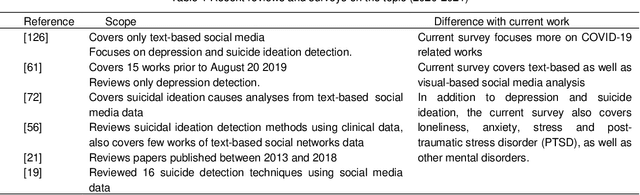
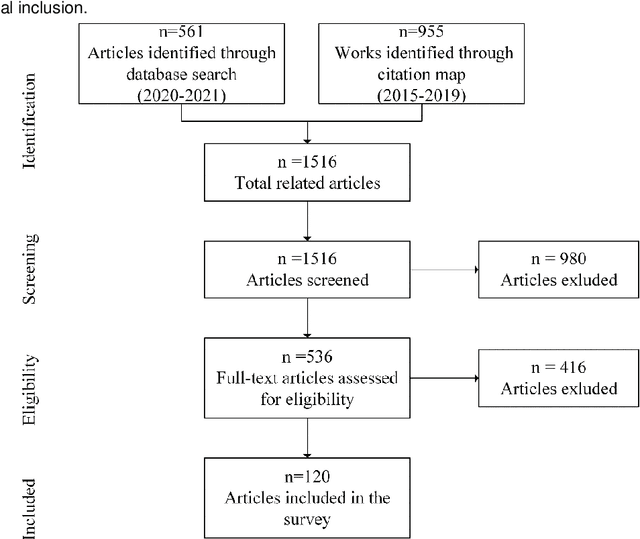


Online social media provides a channel for monitoring people's social behaviors and their mental distress. Due to the restrictions imposed by COVID-19 people are increasingly using online social networks to express their feelings. Consequently, there is a significant amount of diverse user-generated social media content. However, COVID-19 pandemic has changed the way we live, study, socialize and recreate and this has affected our well-being and mental health problems. There are growing researches that leverage online social media analysis to detect and assess user's mental status. In this paper, we survey the literature of social media analysis for mental disorders detection, with a special focus on the studies conducted in the context of COVID-19 during 2020-2021. Firstly, we classify the surveyed studies in terms of feature extraction types, varying from language usage patterns to aesthetic preferences and online behaviors. Secondly, we explore detection methods used for mental disorders detection including machine learning and deep learning detection methods. Finally, we discuss the challenges of mental disorder detection using social media data, including the privacy and ethical concerns, as well as the technical challenges of scaling and deploying such systems at large scales, and discuss the learnt lessons over the last few years.