 Add to Chrome
 Add to Firefox
 Add to Edge
Learning Adaptive Semantic Gaussian Allocation for 3D Occupancy
Jul 24, 2026
Semantic 3D Gaussians provide a compact representation for 3D semantic occupancy prediction by rendering semantic primitives into a voxel volume under voxel-wise supervision. Recent methods have improved the modeling ability and efficiency of this representation through more flexible primitive shapes, geometry-guided initialization, and progressive densification. However, these advances mainly determine how primitives are represented, initialized, or added, and do not explicitly address how to select the most useful Gaussians when their total number must be limited to control memory and computation. This imbalance creates an allocation bottleneck: redundant Gaussians remain in simple regions, while difficult regions receive insufficient semantic support. We propose the Semantic Gaussian Allocation Transformer (SAGFormer), which uses Gaussian attributes and local geometric-semantic features to score candidates and select a fixed final Gaussian set. Experiments on nuScenes-SurroundOcc and SSCBench-KITTI-360 show that SAGFormer improves occupancy prediction under the evaluated protocols and yields more semantically consistent and better-utilized Gaussian representations. Under similar final counts and raw coverage, it reduces semantic mixing, strengthens class-consistent voxel support, and produces fewer unused Gaussians. The results indicate that explicit capacity allocation is a useful complement to Gaussian refinement for semantic occupancy prediction.

Hyperbolic Distillation: Geometry-Guided Cross-Modal Transfer for Robust 3D Object Detection
May 11, 2026Cross-modal knowledge distillation has emerged as an effective strategy for integrating point cloud and image features in 3D perception tasks. However, the modality heterogeneity, spatial misalignment, and the representation crisis of multiple modalities often limit the efficient of these cross-modal distillation methods. To address these limitations in existing approaches, we propose a hyperbolic constrained cross-modal distillation method for multimodal 3D object detection (HGC-Det). The proposed HGC-Det framework includes an image branch and a point cloud branch to extract semantic features from two different modalities. The point cloud branch comprises three core components: a 2D semantic-guided voxel optimization component (SGVO), a hyperbolic geometry constrained cross-modal feature transfer component (HFT), and a feature aggregation-based geometry optimization component (FAGO). Specifically, the SGVO component adaptively refines the spatial representation of the 3D branch by leveraging semantic cues from the image branch, thereby mitigating the issue of inadequate representation fusion. The HFT component exploits the intrinsic geometric properties of hyperbolic space to alleviate semantic loss during the fusion of high-dimensional image features and low-dimensional point cloud features. Finally, the FAGO compensates for potential spatial feature degradation introduced by the 2D semantic-guided voxel optimization component. Extensive experiments on indoor datasets (SUN RGB-D, ARKitScenes) and outdoor datasets (KITTI, nuScenes) demonstrate that our method achieves a better trade-off between detection accuracy and computational cost.
EM-RBR: a reinforced framework for knowledge graph completion from reasoning perspective
Oct 11, 2020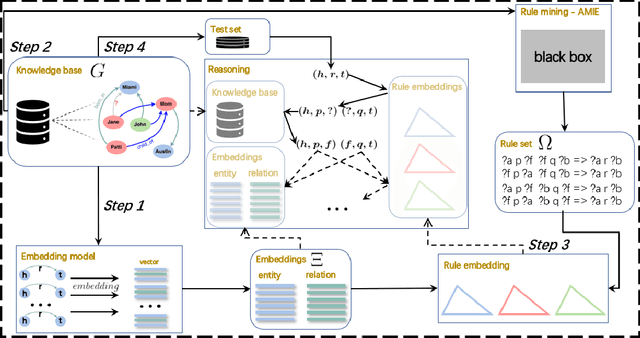
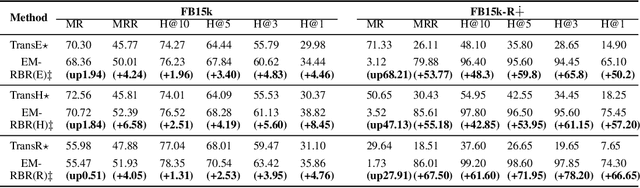
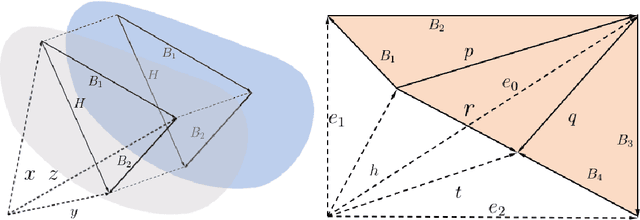
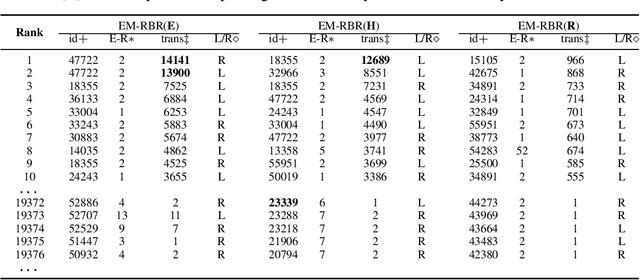
Knowledge graph completion aims to predict the new links in given entities among the knowledge graph (KG). Most mainstream embedding methods focus on fact triplets contained in the given KG, however, ignoring the rich background information provided by logic rules driven from knowledge base implicitly. To solve this problem, in this paper, we propose a general framework, named EM-RBR(embedding and rule-based reasoning), capable of combining the advantages of reasoning based on rules and the state-of-the-art models of embedding. EM-RBR aims to utilize relational background knowledge contained in rules to conduct multi-relation reasoning link prediction rather than superficial vector triangle linkage in embedding models. By this way, we can explore relation between two entities in deeper context to achieve higher accuracy. In experiments, we demonstrate that EM-RBR achieves better performance compared with previous models on FB15k, WN18 and our new dataset FB15k-R, especially the new dataset where our model perform futher better than those state-of-the-arts. We make the implementation of EM-RBR available at https://github.com/1173710224/link-prediction-with-rule-based-reasoning.