 Add to Chrome
 Add to Firefox
 Add to Edge
Temporally Grounded Compositional Camera Motion Understanding via Geometric Knowledge Distillation
Aug 11, 2026
Understanding camera motion is fundamental to video perception, with applications in spatial intelligence and controllable video generation. Multimodal large language models (MLLMs) provide a natural interface for this task, but existing work typically assigns one or more labels to an entire clip. Such clip-level recognition overlooks two defining properties of real camera motion: it can change within a shot, and multiple movements can occur simultaneously. We therefore formulate camera-motion understanding as temporally grounded, compositional recognition, which requires a model to localize motion-consistent intervals and identify every movement active within each interval. We introduce CamChoreo, a benchmark of 4,229 real single-shot clips with expert-annotated temporal segments. Its annotations use a compact vocabulary of 20 direction-aware labels, and nearly half of the segments contain compound camera motion, with multiple movement primitives active simultaneously. Recognizing such fine-grained, compositional motion is hard for current MLLMs, whose visual encoders emphasize semantic content rather than the geometric evidence on which camera motion depends. Directly injecting features from a frozen 3D foundation model addresses this gap, but requires running the expensive geometry model on every input; we refer to this baseline as CamInject. We instead propose CamDistill, which distills the same geometric knowledge into lightweight camera tokens during training and removes the 3D model at inference. CamDistill matches the accuracy of direct feature injection without running the 3D teacher at inference. Together, CamChoreo and CamDistill advance camera-motion understanding from clip-level labeling to temporally grounded, compositional recognition. Project page: https://ddz16.github.io/cammotion.github.io/.

Neural Mesh Refiner for 6-DoF Pose Estimation
Mar 26, 2020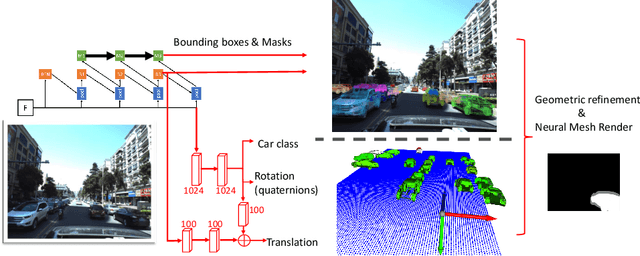
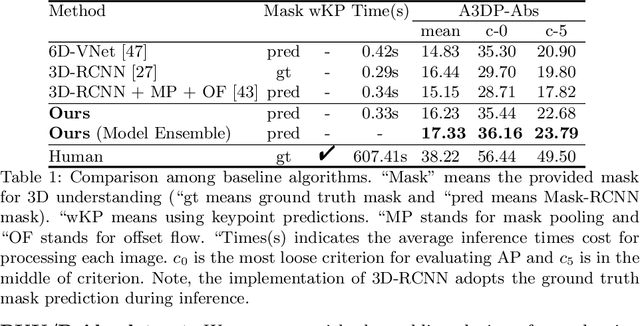
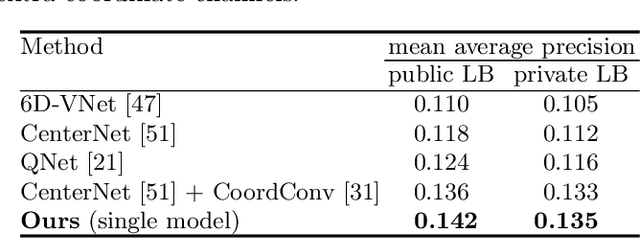
How can we effectively utilise the 2D monocular image information for recovering the 6D pose (6-DoF) of the visual objects? Deep learning has shown to be effective for robust and real-time monocular pose estimation. Oftentimes, the network learns to regress the 6-DoF pose using a naive loss function. However, due to a lack of geometrical scene understanding from the directly regressed pose estimation, there are misalignments between the rendered mesh from the 3D object and the 2D instance segmentation result, e.g., bounding boxes and masks prediction. This paper bridges the gap between 2D mask generation and 3D location prediction via a differentiable neural mesh renderer. We utilise the overlay between the accurate mask prediction and less accurate mesh prediction to iteratively optimise the direct regressed 6D pose information with a focus on translation estimation. By leveraging geometry, we demonstrate that our technique significantly improves direct regression performance on the difficult task of translation estimation and achieve the state of the art results on Peking University/Baidu - Autonomous Driving dataset and the ApolloScape 3D Car Instance dataset. The code can be found at \url{https://bit.ly/2IRihfU}.