 Add to Chrome
 Add to Firefox
 Add to Edge
SparseSpikformer: A Co-Design Framework for Token and Weight Pruning in Spiking Transformer
Nov 15, 2023
As the third-generation neural network, the Spiking Neural Network (SNN) has the advantages of low power consumption and high energy efficiency, making it suitable for implementation on edge devices. More recently, the most advanced SNN, Spikformer, combines the self-attention module from Transformer with SNN to achieve remarkable performance. However, it adopts larger channel dimensions in MLP layers, leading to an increased number of redundant model parameters. To effectively decrease the computational complexity and weight parameters of the model, we explore the Lottery Ticket Hypothesis (LTH) and discover a very sparse ($\ge$90%) subnetwork that achieves comparable performance to the original network. Furthermore, we also design a lightweight token selector module, which can remove unimportant background information from images based on the average spike firing rate of neurons, selecting only essential foreground image tokens to participate in attention calculation. Based on that, we present SparseSpikformer, a co-design framework aimed at achieving sparsity in Spikformer through token and weight pruning techniques. Experimental results demonstrate that our framework can significantly reduce 90% model parameters and cut down Giga Floating-Point Operations (GFLOPs) by 20% while maintaining the accuracy of the original model.

Geometry-Calibrated DRO: Combating Over-Pessimism with Free Energy Implications
Nov 08, 2023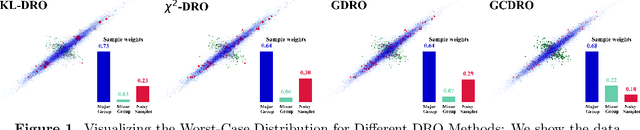
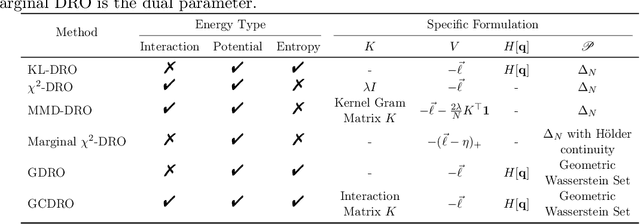
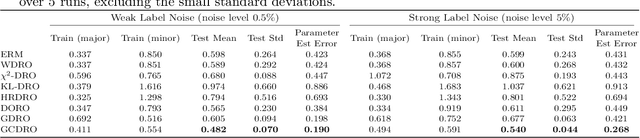
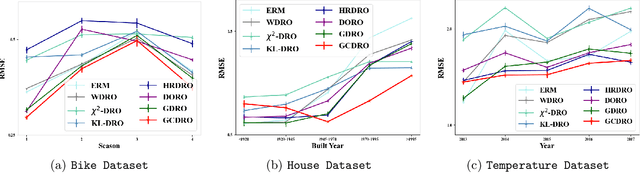
Machine learning algorithms minimizing average risk are susceptible to distributional shifts. Distributionally Robust Optimization (DRO) addresses this issue by optimizing the worst-case risk within an uncertainty set. However, DRO suffers from over-pessimism, leading to low-confidence predictions, poor parameter estimations as well as poor generalization. In this work, we conduct a theoretical analysis of a probable root cause of over-pessimism: excessive focus on noisy samples. To alleviate the impact of noise, we incorporate data geometry into calibration terms in DRO, resulting in our novel Geometry-Calibrated DRO (GCDRO) for regression. We establish the connection between our risk objective and the Helmholtz free energy in statistical physics, and this free-energy-based risk can extend to standard DRO methods. Leveraging gradient flow in Wasserstein space, we develop an approximate minimax optimization algorithm with a bounded error ratio and elucidate how our approach mitigates noisy sample effects. Comprehensive experiments confirm GCDRO's superiority over conventional DRO methods.
OtterHD: A High-Resolution Multi-modality Model
Nov 07, 2023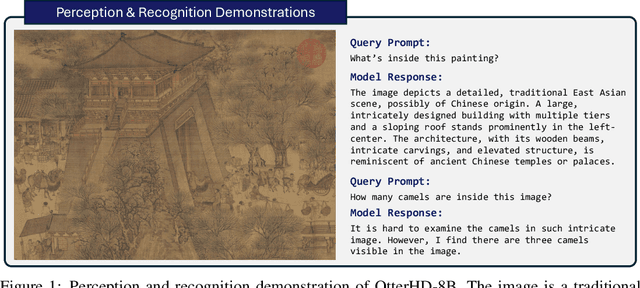
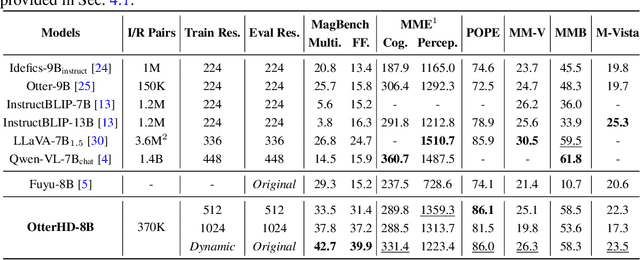
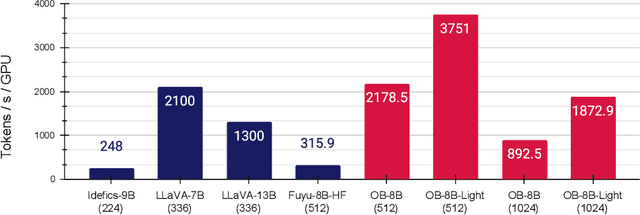
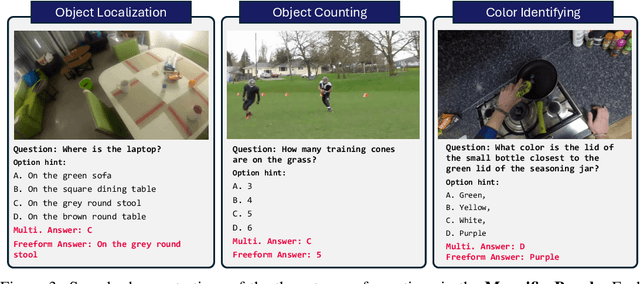
In this paper, we present OtterHD-8B, an innovative multimodal model evolved from Fuyu-8B, specifically engineered to interpret high-resolution visual inputs with granular precision. Unlike conventional models that are constrained by fixed-size vision encoders, OtterHD-8B boasts the ability to handle flexible input dimensions, ensuring its versatility across various inference requirements. Alongside this model, we introduce MagnifierBench, an evaluation framework designed to scrutinize models' ability to discern minute details and spatial relationships of small objects. Our comparative analysis reveals that while current leading models falter on this benchmark, OtterHD-8B, particularly when directly processing high-resolution inputs, outperforms its counterparts by a substantial margin. The findings illuminate the structural variances in visual information processing among different models and the influence that the vision encoders' pre-training resolution disparities have on model effectiveness within such benchmarks. Our study highlights the critical role of flexibility and high-resolution input capabilities in large multimodal models and also exemplifies the potential inherent in the Fuyu architecture's simplicity for handling complex visual data.
Invariant-Feature Subspace Recovery: A New Class of Provable Domain Generalization Algorithms
Nov 02, 2023Domain generalization asks for models trained over a set of training environments to generalize well in unseen test environments. Recently, a series of algorithms such as Invariant Risk Minimization (IRM) have been proposed for domain generalization. However, Rosenfeld et al. (2021) shows that in a simple linear data model, even if non-convexity issues are ignored, IRM and its extensions cannot generalize to unseen environments with less than $d_s+1$ training environments, where $d_s$ is the dimension of the spurious-feature subspace. In this work, we propose Invariant-feature Subspace Recovery (ISR): a new class of algorithms to achieve provable domain generalization across the settings of classification and regression problems. First, in the binary classification setup of Rosenfeld et al. (2021), we show that our first algorithm, ISR-Mean, can identify the subspace spanned by invariant features from the first-order moments of the class-conditional distributions, and achieve provable domain generalization with $d_s+1$ training environments. Our second algorithm, ISR-Cov, further reduces the required number of training environments to $O(1)$ using the information of second-order moments. Notably, unlike IRM, our algorithms bypass non-convexity issues and enjoy global convergence guarantees. Next, we extend ISR-Mean to the more general setting of multi-class classification and propose ISR-Multiclass, which leverages class information and provably recovers the invariant-feature subspace with $\lceil d_s/k\rceil+1$ training environments for $k$-class classification. Finally, for regression problems, we propose ISR-Regression that can identify the invariant-feature subspace with $d_s+1$ training environments. Empirically, we demonstrate the superior performance of our ISRs on synthetic benchmarks. Further, ISR can be used as post-processing methods for feature extractors such as neural nets.
Unraveling Fundamental Properties of Power System Resilience Curves using Unsupervised Machine Learning
Nov 01, 2023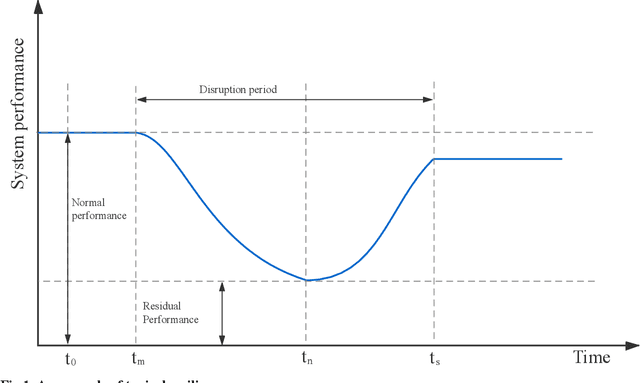
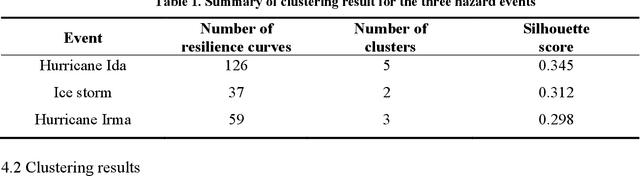
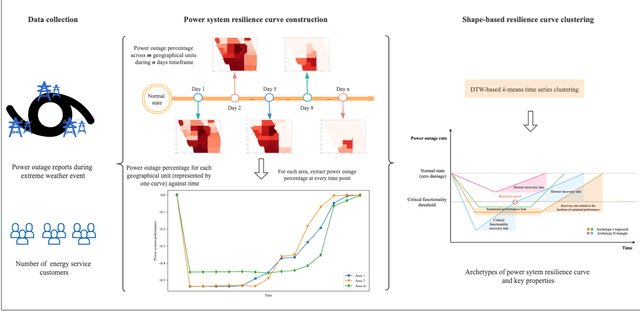
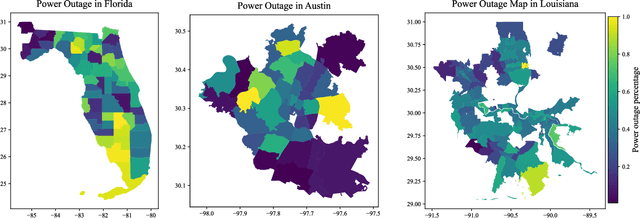
The standard model of infrastructure resilience, the resilience triangle, has been the primary way of characterizing and quantifying infrastructure resilience. However, the theoretical model merely provides a one-size-fits-all framework for all infrastructure systems. Most of the existing studies examine the characteristics of infrastructure resilience curves based on analytical models constructed upon simulated system performance. Limited empirical studies hindered our ability to fully understand and predict resilience characteristics in infrastructure systems. To address this gap, this study examined over 200 resilience curves related to power outages in three major extreme weather events. Using unsupervised machine learning, we examined different curve archetypes, as well as the fundamental properties of each resilience curve archetype. The results show two primary archetypes for power system resilience curves, triangular, and trapezoidal curves. Triangular curves characterize resilience behavior based on 1. critical functionality threshold, 2. critical functionality recovery rate, and 3. recovery pivot point. Trapezoidal archetypes explain resilience curves based on 1. duration of sustained function loss and 2. constant recovery rate. The longer the duration of sustained function loss, the slower the constant rate of recovery. The findings of this study provide novel perspectives enabling better understanding and prediction of resilience performance of power system infrastructures.
IMPRESS: Evaluating the Resilience of Imperceptible Perturbations Against Unauthorized Data Usage in Diffusion-Based Generative AI
Oct 30, 2023


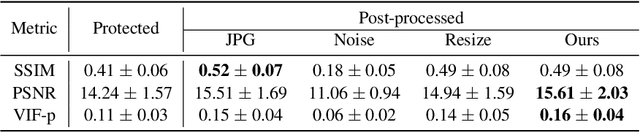
Diffusion-based image generation models, such as Stable Diffusion or DALL-E 2, are able to learn from given images and generate high-quality samples following the guidance from prompts. For instance, they can be used to create artistic images that mimic the style of an artist based on his/her original artworks or to maliciously edit the original images for fake content. However, such ability also brings serious ethical issues without proper authorization from the owner of the original images. In response, several attempts have been made to protect the original images from such unauthorized data usage by adding imperceptible perturbations, which are designed to mislead the diffusion model and make it unable to properly generate new samples. In this work, we introduce a perturbation purification platform, named IMPRESS, to evaluate the effectiveness of imperceptible perturbations as a protective measure. IMPRESS is based on the key observation that imperceptible perturbations could lead to a perceptible inconsistency between the original image and the diffusion-reconstructed image, which can be used to devise a new optimization strategy for purifying the image, which may weaken the protection of the original image from unauthorized data usage (e.g., style mimicking, malicious editing). The proposed IMPRESS platform offers a comprehensive evaluation of several contemporary protection methods, and can be used as an evaluation platform for future protection methods.
Bipartite Graph Pre-training for Unsupervised Extractive Summarization with Graph Convolutional Auto-Encoders
Oct 29, 2023Pre-trained sentence representations are crucial for identifying significant sentences in unsupervised document extractive summarization. However, the traditional two-step paradigm of pre-training and sentence-ranking, creates a gap due to differing optimization objectives. To address this issue, we argue that utilizing pre-trained embeddings derived from a process specifically designed to optimize cohensive and distinctive sentence representations helps rank significant sentences. To do so, we propose a novel graph pre-training auto-encoder to obtain sentence embeddings by explicitly modelling intra-sentential distinctive features and inter-sentential cohesive features through sentence-word bipartite graphs. These pre-trained sentence representations are then utilized in a graph-based ranking algorithm for unsupervised summarization. Our method produces predominant performance for unsupervised summarization frameworks by providing summary-worthy sentence representations. It surpasses heavy BERT- or RoBERTa-based sentence representations in downstream tasks.
CBD: A Certified Backdoor Detector Based on Local Dominant Probability
Oct 26, 2023


Backdoor attack is a common threat to deep neural networks. During testing, samples embedded with a backdoor trigger will be misclassified as an adversarial target by a backdoored model, while samples without the backdoor trigger will be correctly classified. In this paper, we present the first certified backdoor detector (CBD), which is based on a novel, adjustable conformal prediction scheme based on our proposed statistic local dominant probability. For any classifier under inspection, CBD provides 1) a detection inference, 2) the condition under which the attacks are guaranteed to be detectable for the same classification domain, and 3) a probabilistic upper bound for the false positive rate. Our theoretical results show that attacks with triggers that are more resilient to test-time noise and have smaller perturbation magnitudes are more likely to be detected with guarantees. Moreover, we conduct extensive experiments on four benchmark datasets considering various backdoor types, such as BadNet, CB, and Blend. CBD achieves comparable or even higher detection accuracy than state-of-the-art detectors, and it in addition provides detection certification. Notably, for backdoor attacks with random perturbation triggers bounded by $\ell_2\leq0.75$ which achieves more than 90\% attack success rate, CBD achieves 100\% (98\%), 100\% (84\%), 98\% (98\%), and 72\% (40\%) empirical (certified) detection true positive rates on the four benchmark datasets GTSRB, SVHN, CIFAR-10, and TinyImageNet, respectively, with low false positive rates.
Large Language Models are Visual Reasoning Coordinators
Oct 23, 2023Visual reasoning requires multimodal perception and commonsense cognition of the world. Recently, multiple vision-language models (VLMs) have been proposed with excellent commonsense reasoning ability in various domains. However, how to harness the collective power of these complementary VLMs is rarely explored. Existing methods like ensemble still struggle to aggregate these models with the desired higher-order communications. In this work, we propose Cola, a novel paradigm that coordinates multiple VLMs for visual reasoning. Our key insight is that a large language model (LLM) can efficiently coordinate multiple VLMs by facilitating natural language communication that leverages their distinct and complementary capabilities. Extensive experiments demonstrate that our instruction tuning variant, Cola-FT, achieves state-of-the-art performance on visual question answering (VQA), outside knowledge VQA, visual entailment, and visual spatial reasoning tasks. Moreover, we show that our in-context learning variant, Cola-Zero, exhibits competitive performance in zero and few-shot settings, without finetuning. Through systematic ablation studies and visualizations, we validate that a coordinator LLM indeed comprehends the instruction prompts as well as the separate functionalities of VLMs; it then coordinates them to enable impressive visual reasoning capabilities.
Gradual Domain Adaptation: Theory and Algorithms
Oct 20, 2023Unsupervised domain adaptation (UDA) adapts a model from a labeled source domain to an unlabeled target domain in a one-off way. Though widely applied, UDA faces a great challenge whenever the distribution shift between the source and the target is large. Gradual domain adaptation (GDA) mitigates this limitation by using intermediate domains to gradually adapt from the source to the target domain. In this work, we first theoretically analyze gradual self-training, a popular GDA algorithm, and provide a significantly improved generalization bound compared with Kumar et al. (2020). Our theoretical analysis leads to an interesting insight: to minimize the generalization error on the target domain, the sequence of intermediate domains should be placed uniformly along the Wasserstein geodesic between the source and target domains. The insight is particularly useful under the situation where intermediate domains are missing or scarce, which is often the case in real-world applications. Based on the insight, we propose $\textbf{G}$enerative Gradual D$\textbf{O}$main $\textbf{A}$daptation with Optimal $\textbf{T}$ransport (GOAT), an algorithmic framework that can generate intermediate domains in a data-dependent way. More concretely, we first generate intermediate domains along the Wasserstein geodesic between two given consecutive domains in a feature space, then apply gradual self-training to adapt the source-trained classifier to the target along the sequence of intermediate domains. Empirically, we demonstrate that our GOAT framework can improve the performance of standard GDA when the given intermediate domains are scarce, significantly broadening the real-world application scenarios of GDA. Our code is available at https://github.com/yifei-he/GOAT.