 Add to Chrome
 Add to Firefox
 Add to Edge
ChLogic: Evaluating Robustness of Logical Reasoning in Chinese Expressions
Jun 16, 2026
Large language models perform increasingly well on standardized logical reasoning benchmarks, but whether this ability remains robust beyond English is unclear. We introduce ChLogic, an English--Chinese aligned benchmark that tests whether models preserve logical reasoning performance when the same latent logical structure is expressed in English and diverse Chinese surface realizations. Built from formal logical templates, the benchmark contains three data sets: (i) the General aligned set, derived from 60 General Propositions across nine template families; (ii) the Difficult aligned set, derived from 40 Difficult Problems; and (iii) the Chinese-only set, covering 15 language-specific phenomenon types. Each aligned item pairs one English reference expression with five Chinese realizations. Experiments on Qwen3, Ministral, and GLM models reveal a persistent English--Chinese performance gap. Back-translation from standard Chinese into English often improves performance on the General aligned set, but produces mixed effects on the Difficult aligned set, where Qwen3-32B and GLM-5.1 perform worse after translation. These results indicate that Chinese surface realization, translation artifacts, and model-specific behavior jointly affect multilingual logical reasoning. Overall, ChLogic provides a useful stress test for the robustness of multilingual reasoning.

Memo-SQL: Structured Decomposition and Experience-Driven Self-Correction for Training-Free NL2SQL
Jan 15, 2026Existing NL2SQL systems face two critical limitations: (1) they rely on in-context learning with only correct examples, overlooking the rich signal in historical error-fix pairs that could guide more robust self-correction; and (2) test-time scaling approaches often decompose questions arbitrarily, producing near-identical SQL candidates across runs and diminishing ensemble gains. Moreover, these methods suffer from a stark accuracy-efficiency trade-off: high performance demands excessive computation, while fast variants compromise quality. We present Memo-SQL, a training-free framework that addresses these issues through two simple ideas: structured decomposition and experience-aware self-correction. Instead of leaving decomposition to chance, we apply three clear strategies, entity-wise, hierarchical, and atomic sequential, to encourage diverse reasoning. For correction, we build a dynamic memory of both successful queries and historical error-fix pairs, and use retrieval-augmented prompting to bring relevant examples into context at inference time, no fine-tuning or external APIs required. On BIRD, Memo-SQL achieves 68.5% execution accuracy, setting a new state of the art among open, zero-fine-tuning methods, while using over 10 times fewer resources than prior TTS approaches.
On the Non-decoupling of Supervised Fine-tuning and Reinforcement Learning in Post-training
Jan 12, 2026Post-training of large language models routinely interleaves supervised fine-tuning (SFT) with reinforcement learning (RL). These two methods have different objectives: SFT minimizes the cross-entropy loss between model outputs and expert responses, while RL maximizes reward signals derived from human preferences or rule-based verifiers. Modern reasoning models have widely adopted the practice of alternating SFT and RL training. However, there is no theoretical account of whether they can be decoupled. We prove that decoupling is impossible in either order: (1) SFT-then-RL coupling: RL increases SFT loss under SFT optimality and (2) RL-then-SFT coupling: SFT lowers the reward achieved by RL. Experiments on Qwen3-0.6B confirm the predicted degradation, verifying that SFT and RL cannot be separated without loss of prior performance in the post-training
NeuralDB: Scaling Knowledge Editing in LLMs to 100,000 Facts with Neural KV Database
Jul 24, 2025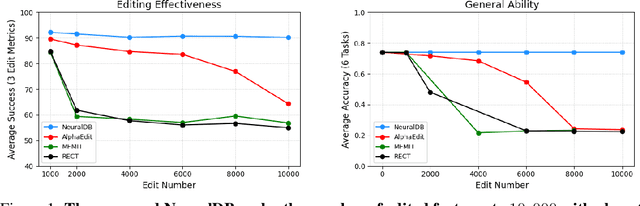
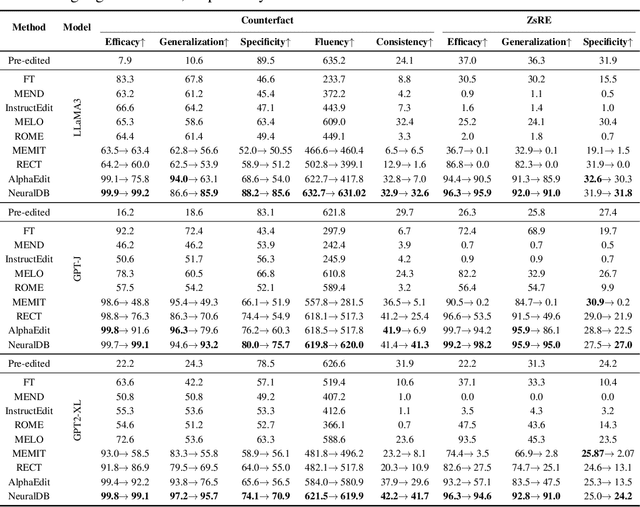
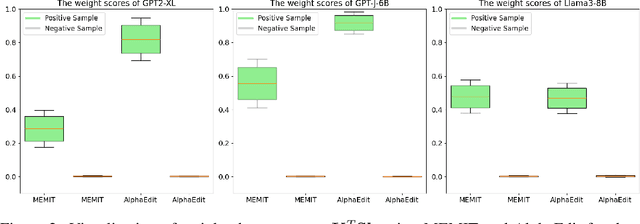

Efficiently editing knowledge stored in large language models (LLMs) enables model updates without large-scale training. One possible solution is Locate-and-Edit (L\&E), allowing simultaneous modifications of a massive number of facts. However, such editing may compromise the general abilities of LLMs and even result in forgetting edited facts when scaling up to thousands of edits. In this paper, we model existing linear L\&E methods as querying a Key-Value (KV) database. From this perspective, we then propose NeuralDB, an editing framework that explicitly represents the edited facts as a neural KV database equipped with a non-linear gated retrieval module, % In particular, our gated module only operates when inference involves the edited facts, effectively preserving the general abilities of LLMs. Comprehensive experiments involving the editing of 10,000 facts were conducted on the ZsRE and CounterFacts datasets, using GPT2-XL, GPT-J (6B) and Llama-3 (8B). The results demonstrate that NeuralDB not only excels in editing efficacy, generalization, specificity, fluency, and consistency, but also preserves overall performance across six representative text understanding and generation tasks. Further experiments indicate that NeuralDB maintains its effectiveness even when scaled to 100,000 facts (\textbf{50x} more than in prior work).
Towards Faster Graph Partitioning via Pre-training and Inductive Inference
Sep 01, 2024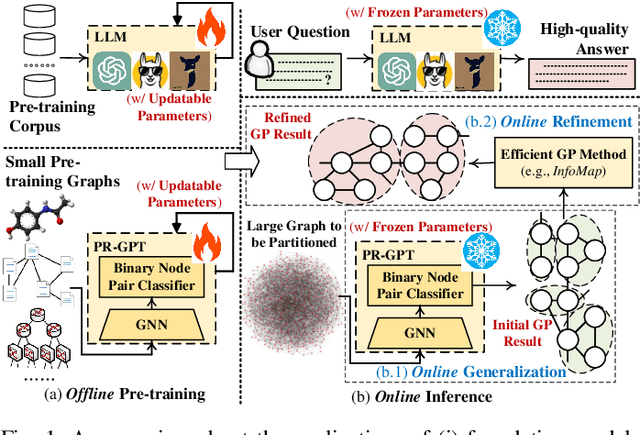
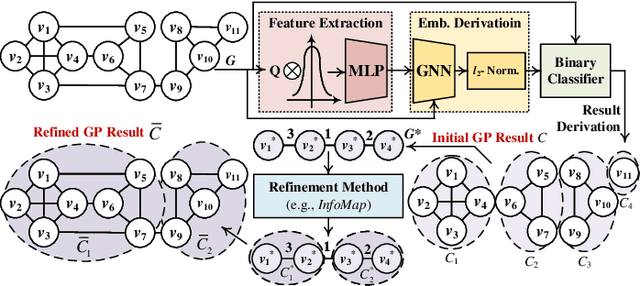
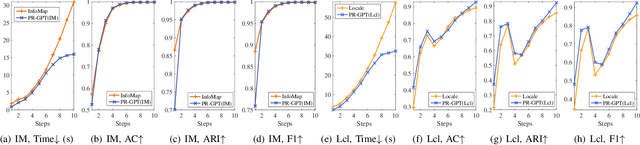
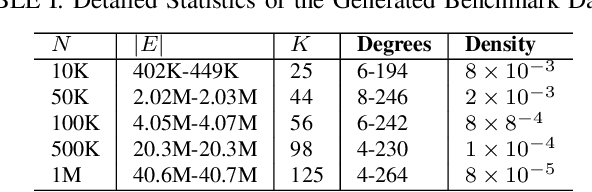
Graph partitioning (GP) is a classic problem that divides the node set of a graph into densely-connected blocks. Following the IEEE HPEC Graph Challenge and recent advances in pre-training techniques (e.g., large-language models), we propose PR-GPT (Pre-trained & Refined Graph ParTitioning) based on a novel pre-training & refinement paradigm. We first conduct the offline pre-training of a deep graph learning (DGL) model on small synthetic graphs with various topology properties. By using the inductive inference of DGL, one can directly generalize the pre-trained model (with frozen model parameters) to large graphs and derive feasible GP results. We also use the derived partition as a good initialization of an efficient GP method (e.g., InfoMap) to further refine the quality of partitioning. In this setting, the online generalization and refinement of PR-GPT can not only benefit from the transfer ability regarding quality but also ensure high inference efficiency without re-training. Based on a mechanism of reducing the scale of a graph to be processed by the refinement method, PR-GPT also has the potential to support streaming GP. Experiments on the Graph Challenge benchmark demonstrate that PR-GPT can ensure faster GP on large-scale graphs without significant quality degradation, compared with running a refinement method from scratch. We will make our code public at https://github.com/KuroginQin/PRGPT.
A Mean Field Ansatz for Zero-Shot Weight Transfer
Aug 16, 2024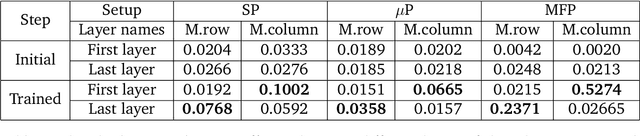
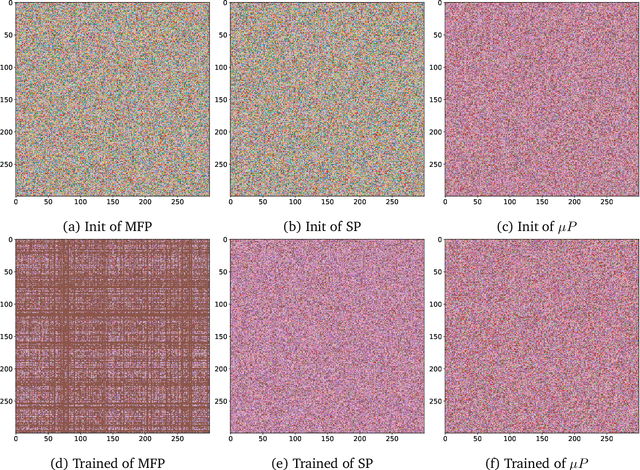


The pre-training cost of large language models (LLMs) is prohibitive. One cutting-edge approach to reduce the cost is zero-shot weight transfer, also known as model growth for some cases, which magically transfers the weights trained in a small model to a large model. However, there are still some theoretical mysteries behind the weight transfer. In this paper, inspired by prior applications of mean field theory to neural network dynamics, we introduce a mean field ansatz to provide a theoretical explanation for weight transfer. Specifically, we propose the row-column (RC) ansatz under the mean field point of view, which describes the measure structure of the weights in the neural network (NN) and admits a close measure dynamic. Thus, the weights of different sizes NN admit a common distribution under proper assumptions, and weight transfer methods can be viewed as sampling methods. We empirically validate the RC ansatz by exploring simple MLP examples and LLMs such as GPT-3 and Llama-3.1. We show the mean-field point of view is adequate under suitable assumptions which can provide theoretical support for zero-shot weight transfer.
Retrieval Meets Reasoning: Dynamic In-Context Editing for Long-Text Understanding
Jun 18, 2024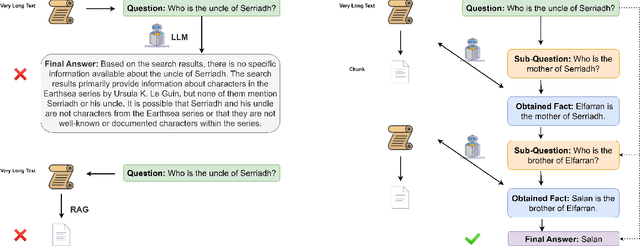
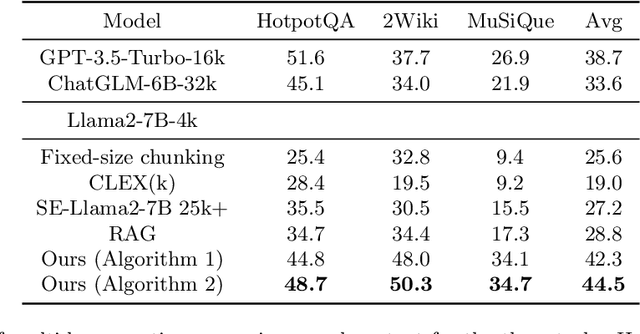
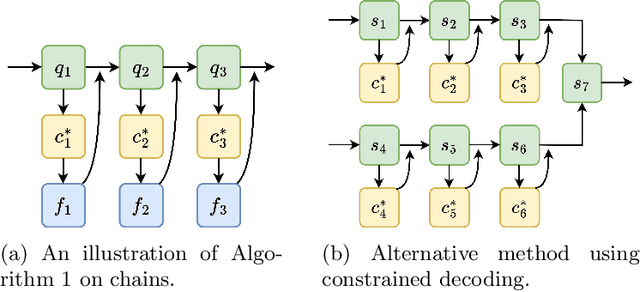
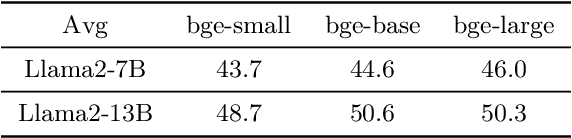
Current Large Language Models (LLMs) face inherent limitations due to their pre-defined context lengths, which impede their capacity for multi-hop reasoning within extensive textual contexts. While existing techniques like Retrieval-Augmented Generation (RAG) have attempted to bridge this gap by sourcing external information, they fall short when direct answers are not readily available. We introduce a novel approach that re-imagines information retrieval through dynamic in-context editing, inspired by recent breakthroughs in knowledge editing. By treating lengthy contexts as malleable external knowledge, our method interactively gathers and integrates relevant information, thereby enabling LLMs to perform sophisticated reasoning steps. Experimental results demonstrate that our method effectively empowers context-limited LLMs, such as Llama2, to engage in multi-hop reasoning with improved performance, which outperforms state-of-the-art context window extrapolation methods and even compares favorably to more advanced commercial long-context models. Our interactive method not only enhances reasoning capabilities but also mitigates the associated training and computational costs, making it a pragmatic solution for enhancing LLMs' reasoning within expansive contexts.
Beyond Scaling Laws: Understanding Transformer Performance with Associative Memory
May 14, 2024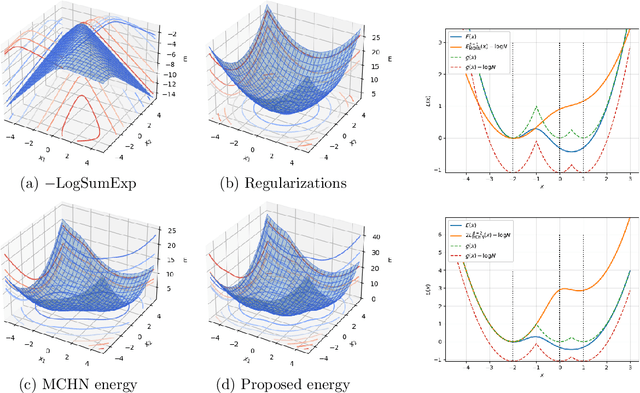
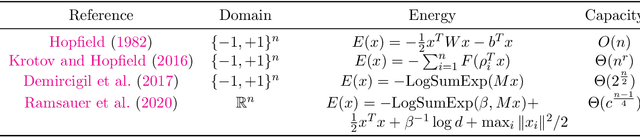
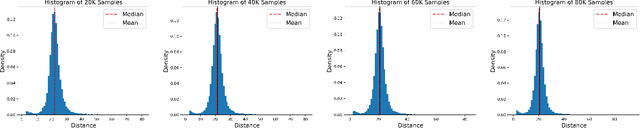
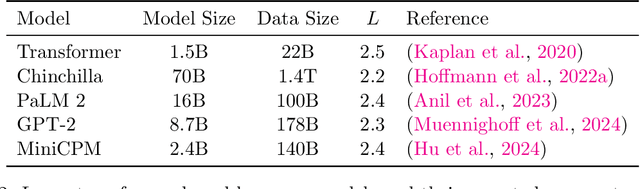
Increasing the size of a Transformer model does not always lead to enhanced performance. This phenomenon cannot be explained by the empirical scaling laws. Furthermore, improved generalization ability occurs as the model memorizes the training samples. We present a theoretical framework that sheds light on the memorization process and performance dynamics of transformer-based language models. We model the behavior of Transformers with associative memories using Hopfield networks, such that each transformer block effectively conducts an approximate nearest-neighbor search. Based on this, we design an energy function analogous to that in the modern continuous Hopfield network which provides an insightful explanation for the attention mechanism. Using the majorization-minimization technique, we construct a global energy function that captures the layered architecture of the Transformer. Under specific conditions, we show that the minimum achievable cross-entropy loss is bounded from below by a constant approximately equal to 1. We substantiate our theoretical results by conducting experiments with GPT-2 on various data sizes, as well as training vanilla Transformers on a dataset of 2M tokens.
Extreme Video Compression with Pre-trained Diffusion Models
Feb 14, 2024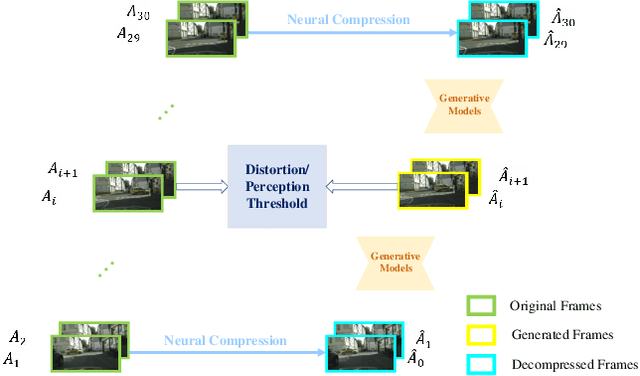
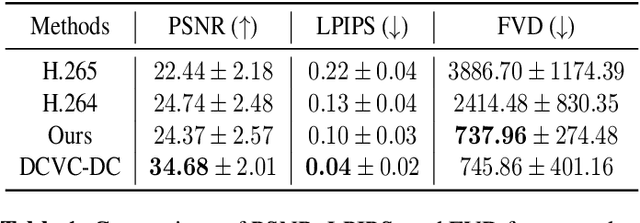
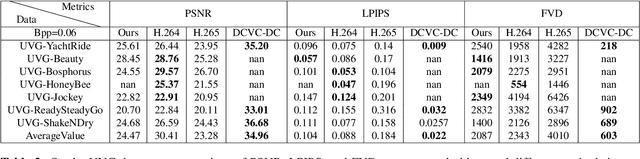
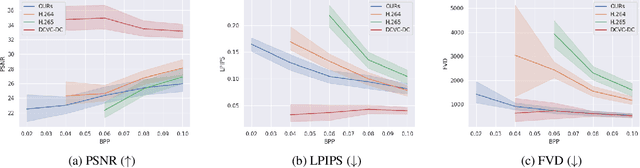
Diffusion models have achieved remarkable success in generating high quality image and video data. More recently, they have also been used for image compression with high perceptual quality. In this paper, we present a novel approach to extreme video compression leveraging the predictive power of diffusion-based generative models at the decoder. The conditional diffusion model takes several neural compressed frames and generates subsequent frames. When the reconstruction quality drops below the desired level, new frames are encoded to restart prediction. The entire video is sequentially encoded to achieve a visually pleasing reconstruction, considering perceptual quality metrics such as the learned perceptual image patch similarity (LPIPS) and the Frechet video distance (FVD), at bit rates as low as 0.02 bits per pixel (bpp). Experimental results demonstrate the effectiveness of the proposed scheme compared to standard codecs such as H.264 and H.265 in the low bpp regime. The results showcase the potential of exploiting the temporal relations in video data using generative models. Code is available at: https://github.com/ElesionKyrie/Extreme-Video-Compression-With-Prediction-Using-Pre-trainded-Diffusion-Models-
Localization and Discrete Beamforming with a Large Reconfigurable Intelligent Surface
Dec 19, 2023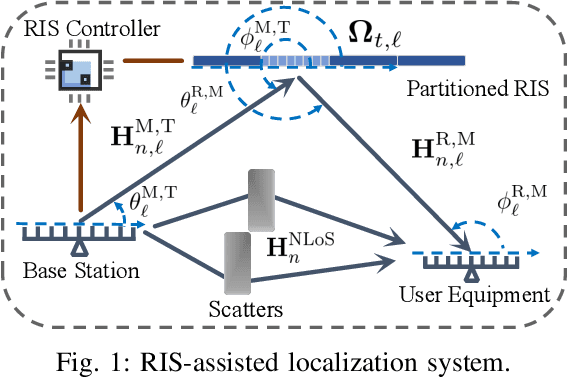


In millimeter-wave (mmWave) cellular systems, reconfigurable intelligent surfaces (RISs) are foreseeably deployed with a large number of reflecting elements to achieve high beamforming gains. The large-sized RIS will make radio links fall in the near-field localization regime with spatial non-stationarity issues. Moreover, the discrete phase restriction on the RIS reflection coefficient incurs exponential complexity for discrete beamforming. It remains an open problem to find the optimal RIS reflection coefficient design in polynomial time. To address these issues, we propose a scalable partitioned-far-field protocol that considers both the near-filed non-stationarity and discrete beamforming. The protocol approximates near-field signal propagation using a partitioned-far-field representation to inherit the sparsity from the sophisticated far-field and facilitate the near-field localization scheme. To improve the theoretical localization performance, we propose a fast passive beamforming (FPB) algorithm that optimally solves the discrete RIS beamforming problem, reducing the search complexity from exponential order to linear order. Furthermore, by exploiting the partitioned structure of RIS, we introduce a two-stage coarse-to-fine localization algorithm that leverages both the time delay and angle information. Numerical results demonstrate that centimeter-level localization precision is achieved under medium and high signal-to-noise ratios (SNR), revealing that RISs can provide support for low-cost and high-precision localization in future cellular systems.