 Add to Chrome
 Add to Firefox
 Add to Edge
Memo-SQL: Structured Decomposition and Experience-Driven Self-Correction for Training-Free NL2SQL
Jan 15, 2026
Existing NL2SQL systems face two critical limitations: (1) they rely on in-context learning with only correct examples, overlooking the rich signal in historical error-fix pairs that could guide more robust self-correction; and (2) test-time scaling approaches often decompose questions arbitrarily, producing near-identical SQL candidates across runs and diminishing ensemble gains. Moreover, these methods suffer from a stark accuracy-efficiency trade-off: high performance demands excessive computation, while fast variants compromise quality. We present Memo-SQL, a training-free framework that addresses these issues through two simple ideas: structured decomposition and experience-aware self-correction. Instead of leaving decomposition to chance, we apply three clear strategies, entity-wise, hierarchical, and atomic sequential, to encourage diverse reasoning. For correction, we build a dynamic memory of both successful queries and historical error-fix pairs, and use retrieval-augmented prompting to bring relevant examples into context at inference time, no fine-tuning or external APIs required. On BIRD, Memo-SQL achieves 68.5% execution accuracy, setting a new state of the art among open, zero-fine-tuning methods, while using over 10 times fewer resources than prior TTS approaches.

DrugMCTS: a drug repurposing framework combining multi-agent, RAG and Monte Carlo Tree Search
Jul 10, 2025
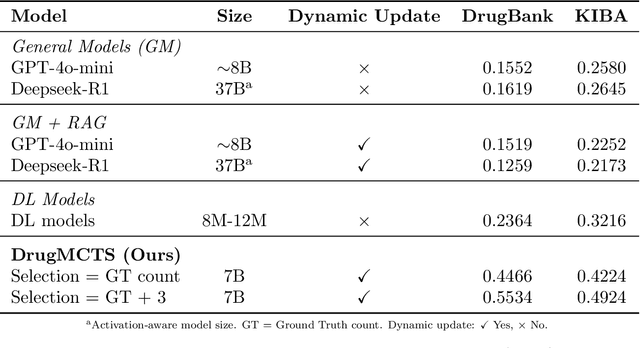

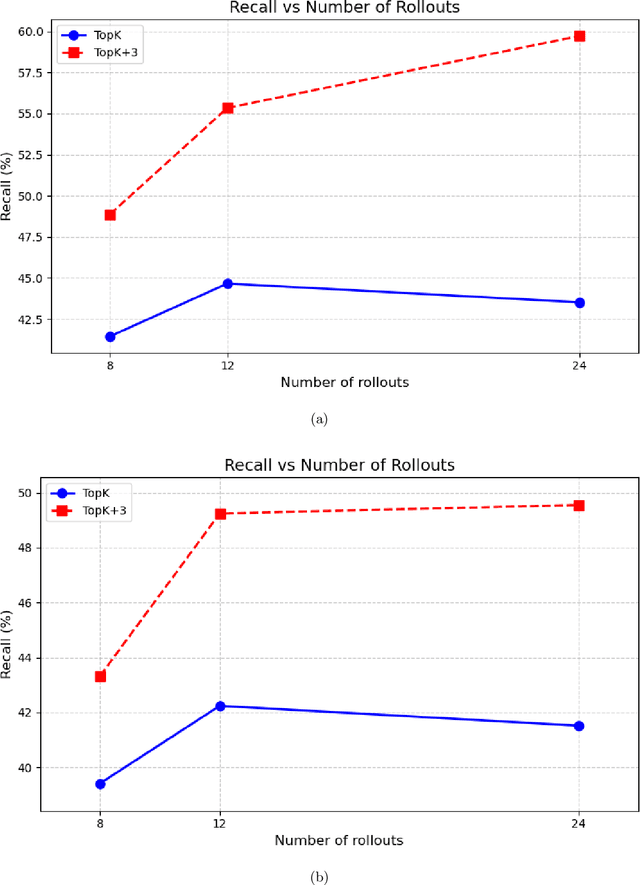
Recent advances in large language models have demonstrated considerable potential in scientific domains such as drug discovery. However, their effectiveness remains constrained when reasoning extends beyond the knowledge acquired during pretraining. Conventional approaches, such as fine-tuning or retrieval-augmented generation, face limitations in either imposing high computational overhead or failing to fully exploit structured scientific data. To overcome these challenges, we propose DrugMCTS, a novel framework that synergistically integrates RAG, multi-agent collaboration, and Monte Carlo Tree Search for drug repurposing. The framework employs five specialized agents tasked with retrieving and analyzing molecular and protein information, thereby enabling structured and iterative reasoning. Without requiring domain-specific fine-tuning, DrugMCTS empowers Qwen2.5-7B-Instruct to outperform Deepseek-R1 by over 20\%. Extensive experiments on the DrugBank and KIBA datasets demonstrate that DrugMCTS achieves substantially higher recall and robustness compared to both general-purpose LLMs and deep learning baselines. Our results highlight the importance of structured reasoning, agent-based collaboration, and feedback-driven search mechanisms in advancing LLM applications for drug discovery.